
Two Plates, Twenty-Eight Lines: The Jewish Copper Plates of Cochin and the Rights of Anjuvannam
Around 1000 CE, the Chera king Bhaskara Ravi engraved on copper a grant to the merchant Joseph Rabban: the headship of a guild of West Asian traders, tolls, exemptions and seventy-two marks of noble rank. What the plates say, how they were dated, and what they reveal about Kerala and the Indian Ocean.
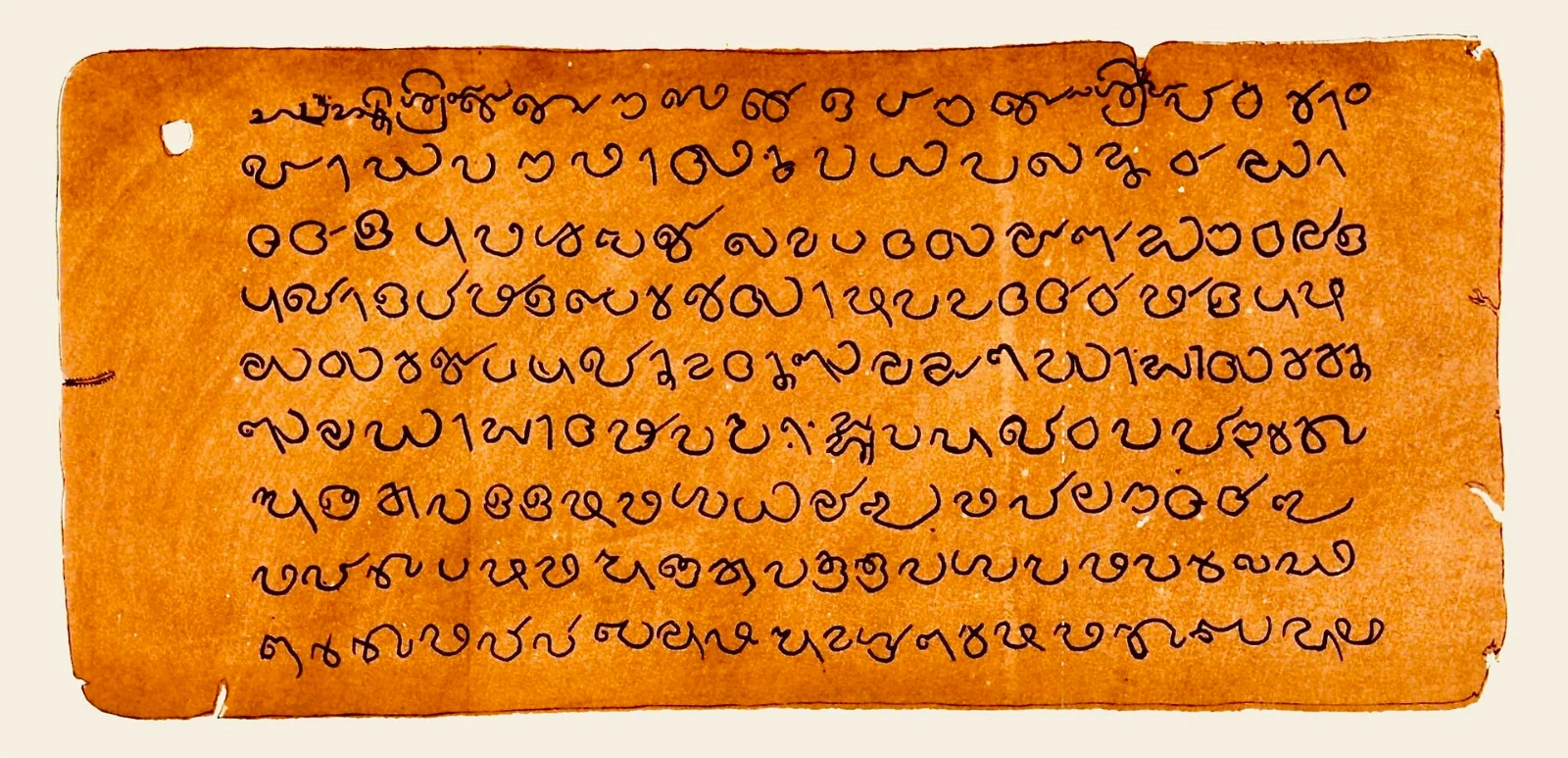
For centuries, in Jew Town at Mattancherry, the Cochin Jewish community kept its most important document in an iron box at the Paradesi Synagogue: two sheets of copper, small enough to hold in two hands. They treated them as the deed of their settlement and showed them to every important visitor. Replicas have been given to two Israeli prime ministers, Ariel Sharon in 2003 and Benjamin Netanyahu in 2017, and since 2026 the originals have been on show in the new museum beside the synagogue.
The plates deserve the attention, though they do not say what the legends made them say. They do not found a Jewish kingdom, and they grant no land and no synagogue. They are a precise administrative grant from a Chera king to one merchant. Read closely, they show something rarer than a founding myth: how a medieval Kerala state brought a foreign merchant into its own hierarchy of rank.
This article follows four questions. What is the physical object? When was it made, and why has that been so hard to settle? What did Anjuvannam and the privileges actually mean? And what does the charter tell us about Kerala’s place in Indian Ocean trade around the year 1000? For the wider story of the community, see our long read on the Jews of Kerala. As always, our own assessments are clearly marked.
At a glance
- What: a royal charter on two copper plates, with writing on three sides in 28 lines, in Old Malayalam in Vattezhuthu script with Grantha letters.
- Issued by: the Chera Perumal king Bhaskara Ravi (Parkaran Iravi), at Muyirikkode near Kodungallur.
- Granted to: Joseph Rabban (Issuppu Irappan).
- What it grants: the rights of Anjuvannam, with tolls, dues, exemptions and “seventy-two privileges”, hereditary “as long as the world, sun and moon endure”.
- Date: c. 1000–1001 CE, the modern epigraphic consensus. Community traditions give 379 CE or 490 CE.
- Where now: the Paradesi Synagogue, Mattancherry, where they are displayed in the museum that opened beside the synagogue in 2026.
The object: two plates, three faces, one missing ring
The charter is engraved on two copper plates, inscribed on three sides in 28 lines. The script is Vattezhuthu, with Grantha characters for Sanskrit sounds, and the language is the vernacular of medieval Kerala, usually called Old Malayalam (some scholars prefer “Middle Tamil”). When E. Hultzsch edited the text for Epigraphia Indica in the 1890s, he noted that the second side of the second plate is blank. He also noted that the impression of each plate shows a hole for the ring on which the plates must once have been strung. The ring, and any royal seal on it, no longer survives.
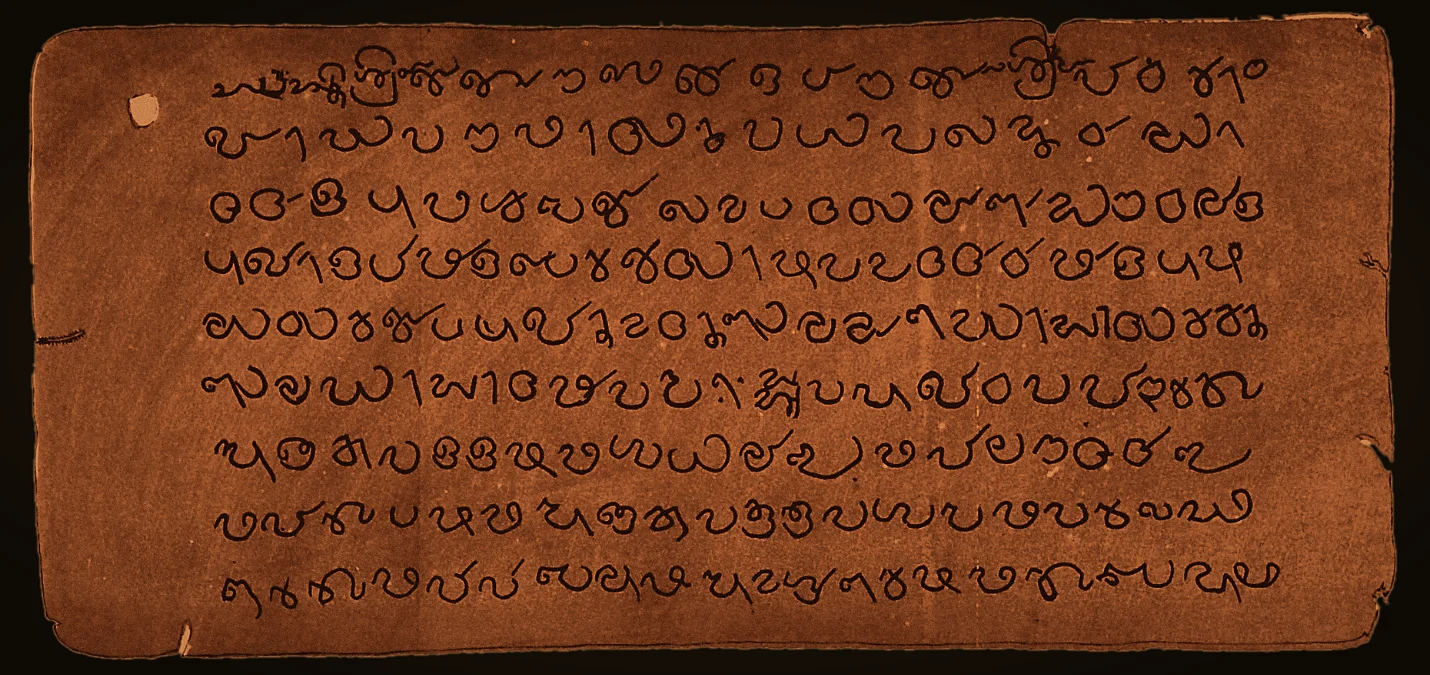
For the script itself, see our guide to Tamil-Brahmi, Vattezhuthu and Kolezhuthu. Two details matter here. First, the script and language belong to the same family as the 849 CE Tharisapalli plates of Kollam and the Tirunelli plates of the same king; comparing the three has been central to the dating arguments. Second, Hultzsch remarked on spellings such as añju in Añjuvaṇṇam, where older Tamil would have aindu. Small changes of this kind mark the drift from Tamil towards Malayalam.
The plates were long kept in an iron box, which community sources call the Pandeal, inside the Paradesi Synagogue. In January 2026 the Cochin Synagogue Trust opened a small Jewish heritage museum next to the synagogue, and the original plates are now displayed there.
What the plates say
In summary (not a full translation): the king of kings, Bhaskara Ravi, in “the thirty-sixth year opposite to the second year” of his reign, residing at Muyirikkode, grants to Issuppu Irappan:
- the Anjuvannam, the rights of a merchant body;
- revenues and remissions: tolls on boats and carts, the dues of the Anjuvannam, and remission of customs duty and weighing fees;
- marks of rank: the day lamp, decorative cloth, palanquin, umbrella, the Vaduka (northern) kettledrum, the trumpet, gateway, arch, arched roof, weapons “and the rest of the seventy-two privileges”;
- exemption: he need not make the payments that other settlers of the town make to the royal palace, but he keeps the rights they enjoy;
- inheritance: all this passes to his male and female issue, his nephews and his sons-in-law, “as long as the world, sun and moon endure”.
The grant is witnessed by five regional governors and one military commander:
| Witness | Office |
|---|---|
| Govardhana Marttandan | Governor of Venad |
| Kota Sri Kantan | Governor of Venapalinad |
| Manavepala Manaviyan | Governor of Eralanad |
| Irayiran Chattan | Governor of Valluvanad |
| Kota Iravi | Governor of Nedumpurayurnad |
| Murkkan Chattan | Commander of the Eastern Forces |
The text was written down by Vanralaceri Kantan Kunrappolan, the secretary who recorded the king’s oral orders.
The list of witnesses is itself evidence. It amounts to a map of the Chera state as the court saw it in that year: Venad in the far south (around Kollam), Valluvanad and Eralanad in the north, Nedumpurayurnad around Palakkad, and a commander for the eastern front. Kesavan Veluthat’s The Political Structure of Early Medieval South India (1993) uses records of this kind to argue that the Perumal kingdom was a federation of nadu chiefs bound to a ritual centre at Mahodayapuram (Kodungallur), not a centralised monarchy. A grant of this weight needed the chiefs’ signatures as well as the king’s word.
The plates in English: the full 1894 translation
Here is the complete English translation published by E. Hultzsch in Epigraphia Indica III (1894–95), p. 69, now in the public domain. We have corrected obvious scanning errors in the digitised copy and modernised some spellings of names. The line numbers refer to the 28 lines of the original. Notes below the translation show where later scholars read the text differently.
Cochin plates of Bhaskara Ravi: translation (Hultzsch, 1894–95)
(Line 1.) Hail! Prosperity! (The following) gift (prasada) was graciously made by him who had assumed the title “King of Kings” (Kogon), His Majesty (tiruvadi) the king (ko), the glorious Bhaskara Ravivarman, in the time during which (he) was wielding the sceptre and ruling over many hundred-thousands of places, in the thirty-sixth year after the second year, on the day on which (he) was pleased to stay at Muyirikkodu:
(L. 6.) “We have given to Issuppu Irappan (the village of) Anjuvannam, together with the seventy-two proprietary rights, (viz.) the tolls on female elephants and (other) riding animals, the revenue of Anjuvannam, a lamp in day-time, a cloth spread (in front to walk on), a palanquin, a parasol, a Vaduga (i.e. Telugu?) drum, a large trumpet, a gateway, an arch, a canopy (in the shape of an arch), a garland, and so forth.
(L. 12.) “We have remitted tolls and the tax on balances.
(L. 13.) “Moreover, we have granted, with these copper-leaves, that he need not pay (the dues) which the (other) inhabitants of the city pay to the royal palace (koyil), and that (he) may enjoy (the benefits) which (they) enjoy.
(L. 15.) “To Issuppu Irappan of Anjuvannam, to the male children and to the female children born of him, to his nephews, and to the sons-in-law who have married (his daughters), (we have given) Anjuvannam (as) an hereditary estate for as long as the world and the moon shall exist. Hail!”
(L. 20.) Thus do I know, Govardhana Martandan of Venadu. Thus do I know, Kodai Srikandan of Venapalinadu. Thus do I know, Manavepala Manaviyan of Eralanadu. Thus do I know, Irayiran Sattan of Valluvanadu. Thus do I know, Kodai Iravi of Nedumpuraiyurnadu. Thus do I know, Murkkan Sattan, who holds the office of sub-commander of the forces.
(L. 27.) The writing of the under-secretary (kilvay-kelppan), Van-Ralaiseri Kandan Kunrappolan.
- “The village of Anjuvannam”: the words in brackets are Hultzsch’s addition. Most historians now read Anjuvannam as a merchant body (see below), so the grant is of its headship and revenues, not a village.
- “Tolls on female elephants and riding animals”: later readings, including Narayanan’s, understand this phrase as tolls on boats and carts, which fits a river port better.
- “The tax on balances”: the weighing fee charged on goods sold by weight.
- “The thirty-sixth year after the second year”: Hultzsch’s rendering of the double regnal year, now usually read as the 38th year of the reign (see below).
- “As long as the world and the moon shall exist”: other translations give “as long as the world, sun and moon endure”.
A date in search of a calendar
The plates give no era date, only a regnal year written in an odd form: “the thirty-sixth year opposite to the second year.” Most of the controversy about their age comes from that phrase.
The community’s dates. Cochin Jewish tradition dated the plates to 379 CE. A seventeenth-century letter from the community gives the year 4520 after Creation, which Walter Fischel converts to 490 CE. These dates matter as history of memory: they show how strongly the community wanted the charter to be ancient. They cannot be squared with the script, the language or the political setting the text describes.
The nineteenth-century editors. The first scholarly editions appeared in 1844 in the Madras Journal of Literature and Science (vol. XIII): Hermann Gundert’s translation and Walter Elliot’s tracing of the plates. A. C. Burnell discussed the text in the Indian Antiquary (vol. III, 1874), and Hultzsch re-edited it in Epigraphia Indica III (1894–95). Hultzsch suggested that the double year meant the king’s 36th year counted from an earlier event in his second year. But without a fixed Chera chronology, the editors could only place the plates relative to other undated records, chiefly by the shapes of the letters.
Long chronologies. In the 1920s the debate moved into the Indian Antiquary. Writers placed Bhaskara Ravi as early as the sixth century or as late as the eleventh. T. K. Joseph argued in 1929 that the grant belonged to 1085 CE, combining a chronogram in a Jewish song, Jewish genealogical tradition and astronomical readings of Bhaskara Ravi’s other inscriptions. His reasoning shows the method of the time: oral tradition and astronomy used to fill the gaps in the epigraphy.
The modern solution. M. G. S. Narayanan’s doctoral work (1972, later published as Perumals of Kerala) rebuilt Chera chronology from the full body of Perumal inscriptions. He showed that Bhaskara Ravi’s records use two styles of regnal year. In one, an “opposite” year counts from a second starting point. So “36 opposite 2” means the king’s 38th year (2 + 36). Fixing the start of the reign at about 962 CE from other astronomically datable records, Narayanan dated the Jewish plates to c. 1000–1001 CE. He returned to the problem in “Further Studies in the Jewish Copper Plates of Cochin” (Indian Historical Review, 2002).
That date is now the working consensus. Noboru Karashima, Kesavan Veluthat, Y. Subbarayalu, Ranabir Chakravarti, Pius Malekandathil, Elizabeth Lambourn, Ophira Gamliel and Manu V. Devadevan all work with it. It is not completely closed: Devadevan (2020) places the king’s investiture slightly earlier, around 959/60 CE, which would move the plates by a year or two, and Nathan Katz (2005) prefers to say only “tenth or eleventh century”.
Our assessment: how to date the plates
The honest formulation is c. 1000 CE, on Narayanan’s chronology. It rests on a careful reconstruction of the whole Chera record and is accepted by nearly every specialist, but it is a calculation, not a date written on the plates.
What Anjuvannam meant
The word has changed meaning more than once in modern scholarship. The early editors read it as Dravidian: añju (five) and vaṇṇam (colour or caste), “the five castes”. Some took it as the name of a quarter of the town or a group of artisans. Their difficulty was that the 849 CE Kollam plates name the Anjuvannam alongside the Manigramam as bodies entrusted with customs collection and the protection of a church: a strange role for “five castes”.
The current reading takes the word from Persian anjuman, an assembly or association. Kannada and Telugu inscriptions have hanjamana, which fits the derivation. Y. Subbarayalu’s definition has become standard: Anjuvannam was a body of West Asian traders, to which Jews, Christians, Muslims and probably Zoroastrians could belong. Its known activity is limited to coastal towns, unlike the Manigramam, which also worked inland. From the twelfth century both were drawn under the umbrella of the great itinerant guild, the Ainurruvar (“Five Hundred”).
So when Bhaskara Ravi grants “the Anjuvannam” to Joseph Rabban, he is not giving a village to the Jews. He is giving one merchant headship of a corporate body of foreign traders, with the revenues attached to it. Ophira Gamliel (2018) stresses the point: Rabban appears as a representative of the trade guild, not as the ruler of a distinct Jewish settlement. The text grants no land, mentions no place of worship and does not even call Rabban a Jew. We assume he was one because Jews preserved the plates and because his name is Semitic, as Hultzsch already observed.
The inheritance clause adds a further point. The rights descend to sons and daughters, nephews and sons-in-law. Gamliel reads the mention of nephews as a sign that Rabban’s household followed, or at least had to allow for, local matrilineal conventions of succession. A foreign-born merchant’s family was being written into Kerala’s ways of passing on property and rank.
Seventy-two privileges: a grammar of rank
The privileges sound decorative to a modern reader: lamps, cloths, umbrellas, palanquins, drums. In medieval Kerala they marked social position. The right to be carried in a palanquin, to walk under an umbrella, to have a lamp carried before you by day, or to have drums and trumpets announce your arrival was carefully graded, and a visible breach could be read as a claim to rank one did not hold.
The “seventy-two privileges” were a formula for the full set of honours of the high nobility. Granting them to Rabban placed him socially among the chiefs, not merely among traders. The exemption clause works the same way: he keeps the rights of the town’s settlers but not their payments. The charter therefore records more than the purchase of a commercial monopoly. It is a ruler fitting a foreign merchant into the hierarchy of a caste society, at a level that let him deal with nadu governors as an equal. The status symbols lasted longest: Gamliel notes that the Paradesi community later displayed privileges named in the grant at its weddings, as proof of a noble past.
Why around the year 1000?
The plates do not say why the grant was made. Narayanan read it as a reward for financial or military support rather than an ordinary endowment, and the timing fits. From the late 980s the Chola emperor Rajaraja I was campaigning on Kerala’s southern coast: his inscriptions celebrate destroying ships at Kandalur Salai from about 988 CE. A Perumal king under pressure from the Cholas had good reason to bind wealthy merchant groups to his court with honours, exemptions and hereditary office.
This remains an inference. The charter’s own vocabulary is commercial and social, not military. Still, the witnesses include a commander of the Eastern Forces, and Kerala’s eastern frontier was where the Chola threat came from.
What the charter reveals about Indian Ocean trade
- Revenue farming at a river port. Tolls on boats and carts, and the remission of customs and weighing fees, mean Rabban was both exempt from charges and entitled to collect some of them. The Chera state ran its port economy through merchant intermediaries rather than salaried officials, as it did at Kollam in 849, where the guilds keep the daily customs collection under seal.
- Continuity with Kollam. The 849 plates already show West Asian merchants, signing in Arabic, Pahlavi and Hebrew script, working alongside the Anjuvannam and Manigramam. The Cochin grant shows that by about 1000 the Anjuvannam could be handed to one individual as a hereditary office. A loose association had become a position the state could confer.
- A wider Jewish trading world. In the eleventh and twelfth centuries, letters preserved in the Cairo Geniza show Jewish merchants from Egypt, Aden and North Africa trading on the Malabar coast in pepper, iron, textiles and bronze. Rabban predates most of these letters, but the grant fits a coast where Jewish merchants were already established; its wording shows that Jews were not newcomers when it was issued.
An afterlife: from charter to legend
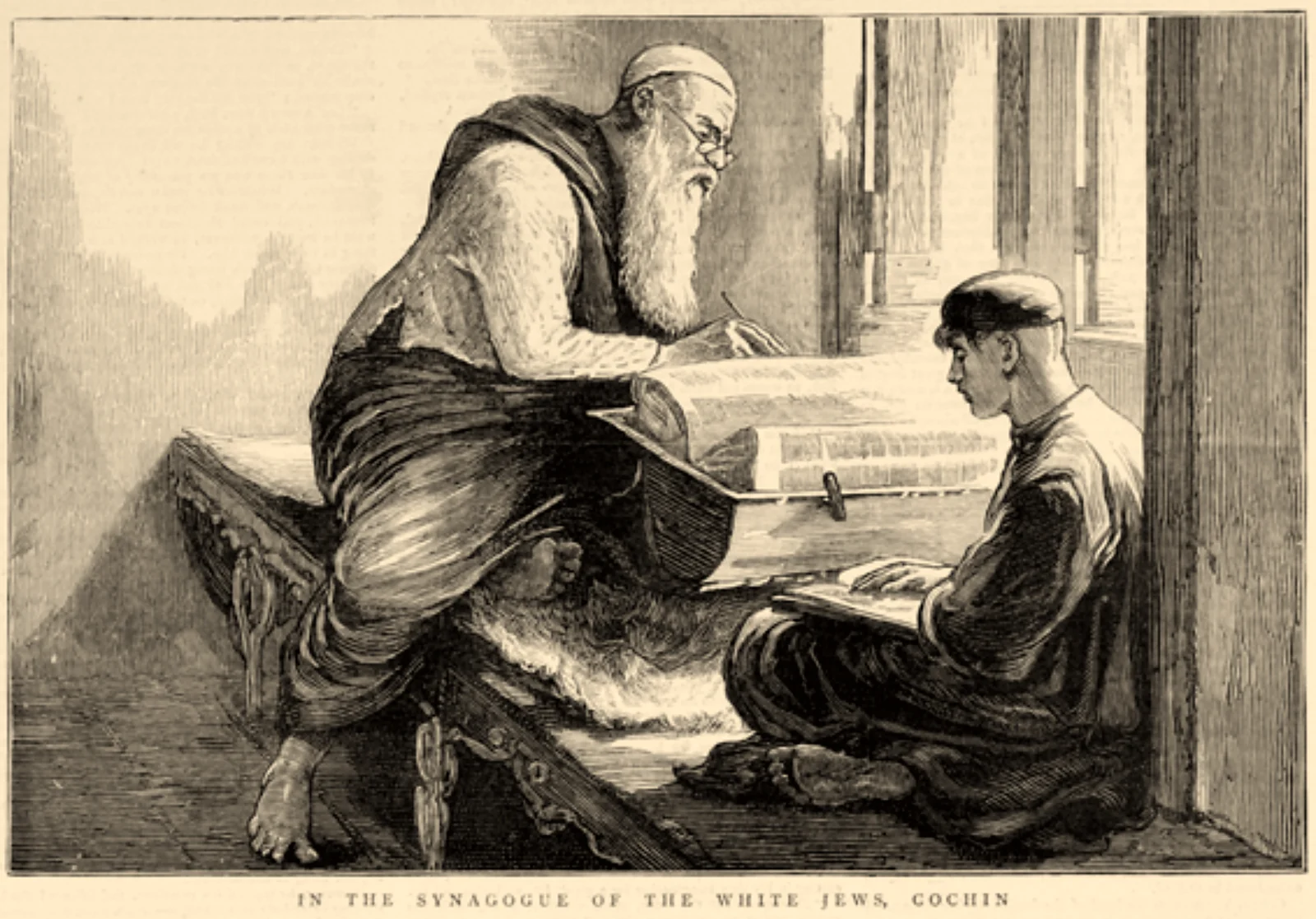
For centuries the plates were a community heirloom, and that history matters too. In November 1686 the leaders of the Paradesi community showed them to Mosseh Pereyra de Paiva, a visitor from Amsterdam, as evidence of a lost Jewish principality at Kodungallur, which early modern Hebrew sources call Shingly. Gamliel points out that the Paradesi community itself dates from the sixteenth century; how it came to hold an eleventh-century charter is a question the sources do not answer.
Over time both the “White” (Paradesi) and the “Black” (Malabari) Jews of Kochi treasured the plates, and argument over them was also argument over who descended from Rabban. Visitors to the Kadavumbhagam and Thekkumbhagam synagogues, to Chendamangalam and to the Paravur synagogue museum meet the other side of that history. The Kodungallur setting connects to our pieces on Muziris, Pattanam and Kottappuram and the Jew ponds of Joothakulam.
What is proven, and what is not
Fact, inference and legend
- Documented: a Chera king named Bhaskara Ravi granted Issuppu Irappan the Anjuvannam, specified revenues and exemptions, and the seventy-two privileges, hereditarily, at Muyirikkode in the Kodungallur region.
- Documented: five nadu governors and an eastern commander witnessed it; a named secretary wrote it.
- Calculated: the date c. 1000–1001 CE, on Narayanan’s regnal reconstruction.
- Well supported: Anjuvannam as a body of West Asian merchants, from Persian anjuman; Rabban as Jewish (his name, and the custody of the plates).
- Plausible but not stated: a military or financial reason for the grant, amid Chola pressure.
- Not supported by the plates: a Jewish “kingdom” at Kodungallur or Shingly; a grant of land, a synagogue or territory; the dates 379 CE or 490 CE.
Visiting notes
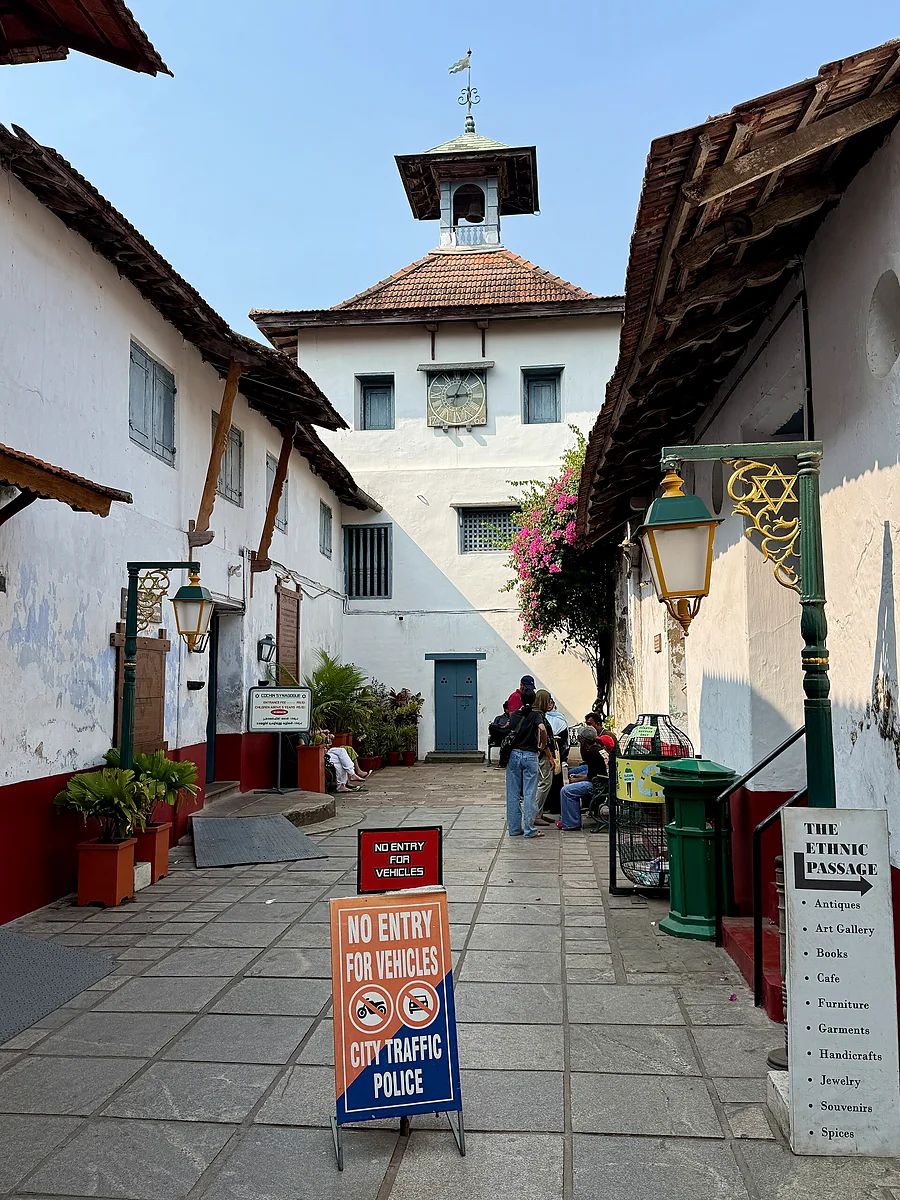
- Paradesi Synagogue and the new museum: at the end of Synagogue Lane in Jew Town, Mattancherry, a short walk from Mattancherry Palace. The original plates are displayed in the Jewish heritage museum beside the synagogue, opened in 2026 by the Cochin Synagogue Trust.
- Hours: the synagogue is usually open 10 am to 1 pm and 3 to 5 pm, and closed on Fridays, Saturdays and Jewish holidays. Check before you go.
- Nearby: our Fort Kochi long read and the story of Sarah Cohen of Jew Town.
- From Munnar: Mattancherry is about four hours by road.
Planning a heritage route through Jewish Kerala, from Mattancherry to Paravur, Chendamangalam and Kodungallur? Write to us at info@geekayglobal.com or through our contact page.
Read also: The Jews of Kerala · The Paradesi Synagogue · The Tharisapalli Plates · Bound to the Grant · Kerala’s ancient scripts
See it for yourself, with a local driver who knows these roads.
Book a Munnar Jeep SafariSources & further reading
- E. Hultzsch, 'Cochin Plates of Bhaskara Ravivarman', Epigraphia Indica III (1894-95), No. 11, pp. 66-69 (translation on p. 69)
- A. C. Burnell, on the Cochin plates, Indian Antiquary III (1874), p. 334 ff.
- T. K. Joseph, 'The Date of Bhaskara Ravi Varman', Indian Antiquary 58 (1929)
- M. G. S. Narayanan, Perumals of Kerala (1972; CosmoBooks, 2013), pp. 451-452; and Cultural Symbiosis in Kerala (Kerala Historical Society, 1972)
- M. G. S. Narayanan, 'Further Studies in the Jewish Copper Plates of Cochin', Indian Historical Review 29 (2002), pp. 66-76
- Kesavan Veluthat, The Political Structure of Early Medieval South India (Orient Longman, 1993), pp. 118-120
- Y. Subbarayalu, 'Trade guilds of south India up to the tenth century', Studies in People's History 2:1 (2015)
- Ophira Gamliel, 'Back from Shingly: Revisiting the Premodern History of Jews in Kerala', Indian Economic and Social History Review 55:1 (2018), pp. 53-76
- Walter J. Fischel, 'The Exploration of the Jewish Antiquities of Cochin on the Malabar Coast', Journal of the American Oriental Society 87:3 (1967)
- Nathan Katz, 'The Historical Traditions of the Jews of Kochi', Studies in History 21:2 (2005)
- S. D. Goitein and M. A. Friedman, India Traders of the Middle Ages (Brill, 2008)
- Onmanorama (January 2026): Museum showcasing Kochi's Jewish heritage opens at Mattancherry
- AP (2026): After centuries in India, the last Cochin Jews try to keep their history alive
- Wikipedia: Jewish copper plates of Cochin
- Wikipedia: Anjuvannam
Figures are from the sources listed and were checked in November 2026. Park timings and road conditions change, so please confirm before you travel.