
Bound to the Grant: Labour, Slaves and the Fine Print of the Tharisapalli Plates (849 CE)
Kerala's oldest royal charter handed families of Ezhavas, washermen, carpenters and cultivators to a church at Kollam, and waived a tax on slaves its merchants bought. What the plates prove about bonded labour, what 'adimakasu' really means, and the full grant in plain English.
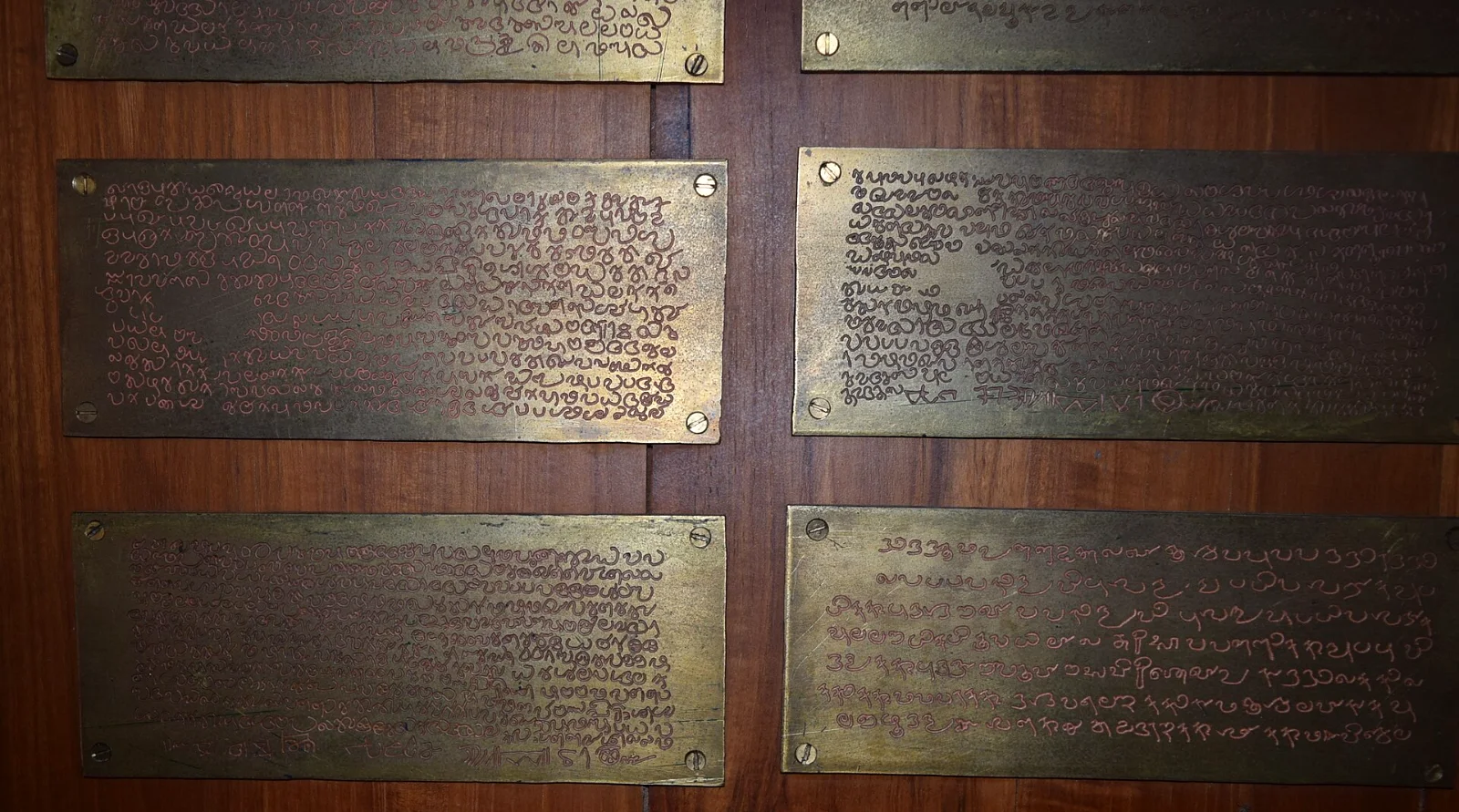
Our earlier long read on the Tharisapalli plates told the story most visitors want: a Persian Christian merchant, Maruvan Sapir Iso, a church at Kollam, and witnesses who signed in Arabic, Pahlavi and Hebrew script. That story is true. But the plates are also a deed of transfer, and a deed of transfer is mostly fine print. It says who pays what, who judges whom, and who goes with the land.
Read that way, the oldest surviving Chera-period royal charter is also one of the earliest documents of unfree and bonded labour in Kerala. This piece looks at that side of the record. What does the epigraphy prove? Where have modern writers gone beyond it? How does the grant fit with the later history of agrestic slavery on the Malabar coast? As always, our own assessments are clearly marked.
At a glance
- The record: the Tharisapalli (Tarisappalli, Kollam or Quilon Syrian) copper plates, issued by Ayyan Adikal Tiruvadikal of Venad in the fifth regnal year of the Chera Perumal Sthanu Ravi, usually calculated as 849/50 CE.
- This piece asks: what the plates say about the people handed over with the land, the guilds that policed the town, and the taxes on slaves.
- What is proven: named groups of households (Ilavar, Vannar, Tachar, Vellalar and others) were transferred to the church with the land; a levy on purchased slaves existed and was waived for the grantees.
- What needs care: the term adimakasu is a later and modern label, not a word we could confirm in the plate text. Slave prices quoted online (“100 fanams for a man, 70 for a woman”) are not in the standard translations.
- Companion piece: The Tharisapalli Plates tells the story of the grant, its merchant Sapir Iso and its three-script signatures.
The grant in brief
The plates were drafted at Kurakkeni Kollam in the presence of the Chera prince Vijayaraga, the Venad ruler Ayyan Adikal Tiruvadikal, the junior chief Rama Tiruvadikal, officers of Venad (the adhikarar, the prakriti, the punnathala padi and the pulakkudi padi) and representatives of the merchant bodies Anjuvannam and Manigramam. The beneficiary is the Tarisappalli, the church of the Tarsa (Christians), founded by Sapir Iso.
The set comprises six plates. Four are at the Devalokam Aramana of the Malankara Orthodox Syrian Church, Kottayam, and two are at the Poolatheen Aramana of the Mar Thoma Syrian Church, Thiruvalla. They were long read as two separate grants. In 2013 M. R. Raghava Varier and Kesavan Veluthat (Tharissappally Pattayam, in Malayalam) reordered them and argued for a single charter. The text breaks off, and early transcripts (a 1601 Garshuni Malayalam copy and Anquetil-Duperron’s 1758 French version) suggest that part of it is lost.
The plates in English
What follows is a clause-by-clause English rendering in our own words, not a word-for-word translation. It is based on the published scholarly translation in M. G. S. Narayanan, Cultural Symbiosis in Kerala (1972), pp. 91–93, and follows the plate numbering of his 1972 arrangement. A few technical terms are left in the original because scholars still disagree about what they mean; the sections below discuss them.
Part one: plates 1 and 4
- Invocation and date. “Hail, prosperity!” This is the fifth year of the reign of King Sthanu Ravi, a reign wished to last countless years.
- Who is present. Ayyan Adikal Tiruvadikal, ruler of Venad, sits in council with the Adhikarar (officials), the Prakriti (state council), the Manigramam and Anjuvannam merchant guilds, and the chief of Punnaittalai.
- People given to the church. To the church of the Tarsa (Christians) at Kurakkeni Kollam, Ayyan gives four Ilavar families, together with eight Ilava men from those families (twelve people in all), and one family of Vannar (washermen).
- Taxes. These households are freed from the state levies named in the text, including talaikkanam and enikkanam. The dues called varakkol, kappan and paincakkanti, which they had been paying, go to the church instead, and the church authorities collect all their taxes.
- Right to trade. The Ilavar may take their carts into the bazaar and the fort to do business, and the washerman may trade there too.
- Legal protection. Royal officers, named as the Tiyamalvan and Matinayakan, may not interfere with these people over any offence. Only the church authorities (palliyar) may look into it.
- Duration. This holds for as long as the world, the moon and the sun endure.
- Closing. It was Maruvan Sapir Iso who had Ayyan grant these privileges to the church. May those who protect this grant be blessed. “This is the writing of Ayyan” (signature). Agreed to by Velkulasundaran (signature). The text then breaks off at “Vijaya…”, where plate 4 ends.
Part two: plates 2 and 3
- The land. Maruvan Sapir Iso, who received the town (the nagaram) by the ceremony of pouring water, gives land to the church. On it he settles two families of a group the text leaves unnamed, one family of Tachar (carpenters) and four families of Vellalar (cultivators) as tenants, so that the church lacks nothing, such as oil for its lamps.
- The ceremony. Ayyan, the crown prince Rama Tiruvadi and others meet with Vijayaragadeva, the royal officer in charge. They perform the elephant-walk and water-pouring rites to fix the boundaries.
- Boundaries. East: Vayalkkatu. Southeast: the wall of Ciruvatilkkal, with the palace. West: the sea. North: Toranattottam. Northeast: Punnattalai Antilantottam.
- Duration. The land inside these limits is granted by copper plate for as long as the world, the moon and the sun endure.
- Justice. Only the church authorities may fine the settlers for offences and receive the “head price” and “breast price”. The king’s servants may not enter the land over any offence.
- Protection. The Six Hundred (the Venad militia), the Anjuvannam and the Manigramam are to protect the church and its land, and to look after the settlers as the plates set out.
- Trade privileges for the guilds: no one-sixtieth duty when goods come in or are sold; no slave-tax on slaves they buy; a charge of eight kasu per cart and four per boat, on arrival and on departure; taxable goods are valued, and prices fixed, together with the guilds; and the Anjuvannam and Manigramam keep each day’s customs takings under seal.
- Rent from land inside the fort. On land within the fort’s four gates that is let to tenants, one-tenth goes to the king (through the prince) and one-tenth to the lord. The lord’s share is assigned to the two guilds.
- Seventy-two privileges. These are given “on elephant back”, for use at weddings, beginning with the rights over earth and water.
- Self-government. The two guilds may press their complaints, even by holding back the duty and weighing fees. They judge offences among their own people, and decisions made jointly by these two heads alone are valid.
- Measuring fees. For the varakkol and paincakkanti dues, Sapir Iso keeps the measuring rights and passes the fee to the church.
- Closing. The whole grant is given with full rights, for as long as the moon and the sun endure.
The upright plate (plate 5)
This plate holds no text to translate, only the witnesses’ signatures: eleven names in Arabic (Kufic script), such as Maymun son of Ibrahim; ten in Middle Persian (cursive Pahlavi), such as Farrokh son of Narseh; and five in Persian written in Hebrew letters, such as Hasan Ali. Our earlier long read covers the witnesses in detail.
A note on editions. The 1920 edition by T. A. Gopinatha Rao in the Travancore Archaeological Series (vol. II) is out of copyright and has an English translation, but the freely available online scan breaks off before it. The 2013 Malayalam study by Varier and Veluthat, which reorders the plates as a single charter, gives no English translation.
Who was handed over
Put the clauses about people side by side and the pattern is clear. In part one, four households of Ilavar (Ezhavas) and one household of Vannar (washermen) are given to the church, which receives their dues in place of the state. Only the church authorities may inquire into their offences. In part two, Sapir Iso settles two households of an unnamed group, one of Tachar (carpenters) and four of Vellalar (cultivators) on the gifted land, so that the church lacks nothing, such as oil for its lamps. Only the palliyar may fine them or receive “head price” and “breast price” (talaivilai and mulaivilai).
The grant also mentions Eruviyar (salt-makers) among the dependants of the town. Its land clauses describe a donation by attipperu, a conveyance “with water poured” (dhara-purvaka). Some historians see in it an early form of the later janmam tenure, the permanent proprietary right that structured Kerala’s land relations for the next thousand years.
These clauses have a clear meaning. The church did not just receive land. It received jurisdiction over the people on that land: the right to their dues, the right to judge their offences, and the fines that came with that right. The households did not choose the church. They came with the grant.
Tenants, serfs or slaves? The vocabulary problem
Historians disagree about what to call these households, and the disagreement goes to the heart of the matter.
- “Tenants.” Our earlier article followed the cautious reading. The Ilavar, Vannar, Tachar and Vellalar appear as households attached to the church, paying dues and protected from outside officials. The Ilavar and Vannar are explicitly allowed to trade in the bazaar, which is hard to square with chattel slavery.
- “Bonded serfs.” Most recent summaries describe the land as a large settlement with its bonded occupants: people tied to the land and transferred with it, but not bought and sold as individuals. That is closer to serfdom than to slavery.
- “Slaves.” A 2024 study by Keerthi Reghunath and J. Muthukumar reads the grant as evidence for slavery as an institution. It glosses a group term, aladimaikal, as slaves transferred to the church for cultivation, and reads talaivilai and mulaivilai as fees for owning male and female slaves.
The careful position is that the plates record more than one form of dependence at once. Craft and service households (Vannar, Tachar), cultivators (Vellalar) and Ilavar, who later records associate with toddy-tapping, are transferred as groups with obligations attached. Separately, the plates refer to slaves who are bought, as individuals. The text does not let us assume that the named households were slaves in that sense.
The “head price” and “breast price” deserve caution too. In later Kerala, taxes on the head (talakkaram) and the breast (mulakkaram) became notorious caste levies on lower-caste men and women. It is tempting to read the 849 terms through that later history. In the plates themselves they appear as dues or fines whose collection passes to the church. Calling them “slave-ownership fees” is an interpretation, not a translation.
The clause on purchased slaves
The one place where the plates speak plainly of slaves is a short clause among the trade privileges. In the 1924 translation quoted by K. N. Daniel in the Indian Antiquary (vol. 53):
“No poll-tax shall be levied upon the slaves bought by these people.”
The modern reference translation gives the same sense: no slave tax is charged on slaves they buy. Reghunath and Muthukumar identify the underlying levy as alkasu (āḷ-kāśu), a per-head charge on the purchase of a person, waived for people associated with the church. The clause proves three things:
- People were bought and sold in ninth-century Kollam. The market in persons was normal enough to be taxed.
- The state taxed that market with a per-head charge on purchases.
- Merchant grantees were exempted. For the trading community round the church, the exemption was a commercial privilege of the same kind as remission from the one-sixtieth customs duty on entry and sale.
It does not tell us who the slaves were, where they came from (local captives, debtors, imports by sea), what work they did, or how many there were.
What “adimakasu” really is
Many popular and some academic writers say the Tharisapalli plates record adimakasu, “the slave levy”. Some go further and call this the only ancient Kerala document to do so. The idea deserves a closer look.
- In the plate translations consulted for this article (the 1924 translation quoted by Daniel and the modern reference translation), the relevant clause is rendered as a poll tax or slave tax on purchased slaves. The term adimakasu does not appear in them. The 2024 study that uses “adimakasu” most prominently also gives the plate’s own term as alkasu.
- The term adimakasu (also adimappanam, “slave money”) is well documented elsewhere: in nineteenth-century palm-leaf records of Syrian Christian churches. There it refers to money given to a church as a “slave offering”, a custom of symbolically dedicating oneself or a child to a saint (Artha Journal of Social Sciences, 2012). That paper calls the 849 clause one of the earliest inscriptions related to such a levy.
- The word adima (slave) and its derivatives are the standard vocabulary of Kerala’s early modern and colonial slave deeds, the Malayalam title deeds that recorded the purchase, sale or gift of a person.
Our assessment: a later word for an older levy
“Adimakasu” is best treated as a later and modern label applied to the 849 clause, not as a word we can show was engraved in 849. The underlying fact still holds: a ninth-century levy on purchased persons existed. Calling it by a nineteenth-century name, though, makes Kerala’s slave system sound more continuous and more uniform than the evidence can show.
The same caution applies to a figure repeated in several articles: that the plates fix a male slave’s price at 100 fanams and a female’s at 70. It appears in neither of the translations reviewed here, and the writers who repeat it cite no line of the plates. Panam coinage in that form also belongs to later Kerala. Until someone points to the line, we treat the figure as unverified.
The guilds as policemen and tax-farmers
The labour clauses make full sense only next to the clauses on the guilds. In Daniel’s 1924 rendering:
“The Arunurruvar, the Añchuvannam and the Manigramam shall protect the church and the land belonging to it.”
Together with the customs, rent and justice clauses translated above, these describe a town run by a partnership:
- the state (Venad and, above it, the Perumal) keeps sovereignty and a share of revenue;
- the merchant bodies, Anjuvannam (West Asian traders) and Manigramam (an Indian merchant body), collect customs, hold funds and act as trustees of the town;
- the church holds land and jurisdiction over the households settled on it;
- the militia, the Six Hundred, enforces the arrangement;
- the labouring households produce oil, cloth-washing, carpentry and crops, and pay dues to whichever of these authorities the charter names.
The historiography has its own lesson about Anjuvannam here. T. A. Gopinatha Rao, who edited the plates for the Travancore Archaeological Series, read añju-vaṇṇam literally as “five colours”, and so “five castes”. K. N. Daniel complained in 1924 that Rao had even tried to identify the Anjuvannam with the slaves and dependent castes in the grant. Daniel himself identified the Anjuvannam with the Jews. Both readings have since been abandoned. The derivation from Persian anjuman (association), and Y. Subbarayalu’s definition of Anjuvannam as a body of West Asian traders, now stand. The episode shows how easily a word in the plates could be moved from one end of the social order to the other.
How this fits with later records
The 849 plates are an early point in a long and uneven record.
- c. 1000 CE: the Jewish copper plates of Cochin. Bhaskara Ravi’s grant to Joseph Rabban gives tolls, exemptions and the “seventy-two privileges” of aristocratic rank. It transfers no dependent households. A century and a half after Kollam, the charter for a merchant grantee is about status and revenue, not labour. (See The Jewish Copper Plates of Cochin.)
- Temple records, 9th–12th centuries. Temple committee resolutions such as the Thiruvalla (Huzur Treasury) plates list tenants and dependants with temple lands. They show the Brahmin-controlled temple, more than the church, becoming the main manager of land and labour. M. G. S. Narayanan’s Perumals of Kerala and Manu V. Devadevan’s work on changing land relations follow this shift.
- Early modern and colonial slave deeds. By the seventeenth to nineteenth centuries, Malayalam title deeds record the sale, mortgage and gift of individuals described as adima. These were overwhelmingly members of agrestic labouring castes such as the Pulayas and Parayas, bought, sold and inherited with land. Dutch and English Company records add an overseas slave trade through Kochi, which our article on the Kappiris of Kochi touches on.
- Abolition. Slavery in British India was delegalised by the Indian Slavery Act of 1843. Travancore and Kochi followed in the 1850s by royal proclamation. The social order built on that labour lasted far longer: see Pulayanarkotta and the Vaikom Satyagraha.
The line from 849 to the 1850s is not straight. The ninth-century record shows dependent households transferred with land and a taxed market in purchased persons. It does not show the hereditary, caste-defined agrestic slavery of the colonial period fully formed. Writing that later system back into the plates, through words like adimakasu, flattens a thousand years of change.
What is proven, and what is not
Fact, interpretation and debate
- Documented: named groups of households (four Ilavar, one Vannar; and in the second part two of an unnamed group, one Tachar, four Vellalar) were transferred to the church with the land, with their dues and with jurisdiction over their offences.
- Documented: a per-head levy on purchased slaves existed and was waived for the grantees.
- Documented: “head price” and “breast price” were dues or fines whose collection passed to the church.
- Documented: Anjuvannam and Manigramam collected and held customs revenue and, with the Six Hundred, protected the church and its land.
- Debated: whether the transferred households were bonded or serf-like rather than free tenants; whether attipperu foreshadows later janmam tenure; whether “head” and “breast” prices were tied to owning male and female dependants.
- Not supported by the texts we reviewed: that the word adimakasu appears on the plates; fixed slave prices of 100 and 70 fanams; that the named households were chattel slaves; that the Anjuvannam were slaves, or simply “the Jews”.
Visiting notes
- The originals: four plates at the Devalokam Aramana, Kottayam, and two at the Poolatheen Aramana, Thiruvalla. Both are working church headquarters and the plates are not normally on view; write well in advance.
- The replica: on display at the Kerala Jews History Museum, Paravur synagogue.
- The port: start at Kollam and Thangasseri, where the Tarisappalli is believed to have stood.
- From Munnar: Kottayam is about four hours by road; Kollam about six.
Researching Kerala’s inscriptions, or planning a route through Kollam, Kottayam and Thiruvalla? Write to us at info@geekayglobal.com or through our contact page.
Read also: The Tharisapalli Plates · The Jews of Kerala · Kollam: the port of Quilon · Kerala’s ancient scripts · Pulayanarkotta
See it for yourself, with a local driver who knows these roads.
Book a Munnar Jeep SafariSources & further reading
- T. A. Gopinatha Rao, Travancore Archaeological Series, vol. II (Government Press, Trivandrum, 1920), inscriptions of Sthanu Ravi
- M. G. S. Narayanan, 'Kottayam Syrian copper-plates of Sthanu Ravi', Cultural Symbiosis in Kerala (Kerala Historical Society, 1972), pp. 91-93; and Perumals of Kerala (CosmoBooks, 2013)
- M. R. Raghava Varier and Kesavan Veluthat, Tharissappally Pattayam (National Book Stall, 2013)
- K. N. Daniel, 'The Anchuvannam and the Manigramam of the Kottayam Plates of Tanu Iravi', Indian Antiquary vol. 53 (December 1924), p. 257 ff.
- Keerthi Reghunath and J. Muthukumar, 'Slavery as a Social Institution Gleaned from Tarisappalli Copper Plates', SEEJPH vol. XXV S1 (2024)
- 'Man Slaving to Divine: A Socio-religious Custom Gleaned from the Nineteenth Century Palm Leaves', Artha Journal of Social Sciences 11:4 (2012), pp. 1-23
- 'Local Networks of the Slave Trade in Colonial Kerala' (2022)
- Malarvizhi Jayanth, Abolishing Agrarian Slavery in Southern Colonial India (PhD dissertation, University of Chicago, 2020)
- Y. Subbarayalu, 'Trade guilds of south India up to the tenth century', Studies in People's History 2:1 (2015)
- Kesavan Veluthat, The Early Medieval in South India (Oxford, 2009)
- Manu V. Devadevan, The 'Early Medieval' Origins of India (Cambridge University Press, 2020)
- Wikipedia: Quilon Syrian copper plates
- Wikipedia: Anjuvannam
Figures are from the sources listed and were checked in November 2026. Park timings and road conditions change, so please confirm before you travel.