
The Synagogues of Kerala: A Guide to a Unique Architecture
Tiled roofs like a Kerala temple, gatehouses like a Nair tharavad, and inside, a Torah ark facing Jerusalem and a second reading platform in the women's gallery found almost nowhere else on earth. A guide to the eight synagogues of Kerala, what survives of them and where their treasures went.
Kerala's Jewish heritage: The synagogues of Kerala · Paradesi · Kadavumbhagam & Thekkumbhagam · Paravur · Chendamangalam · Mala · The Jew ponds · The Jews of Kerala
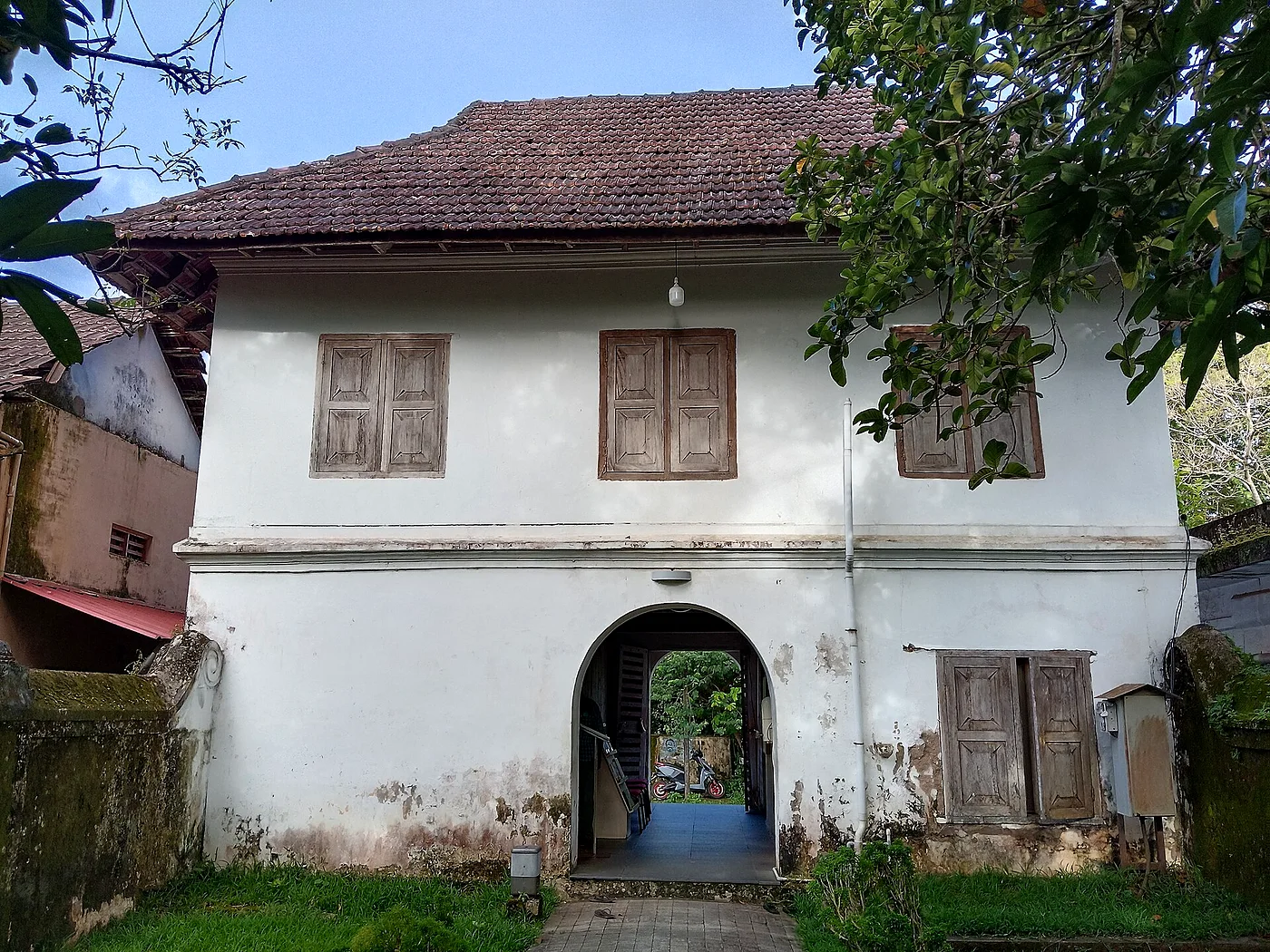
For perhaps a thousand years, Jews lived in the towns along Kerala's backwaters, trading in pepper and spices, farming, and serving the local rajas. They are among the oldest Jewish communities in Asia. (Read their full story in The Jews of Kerala.) By the eighteenth century they worshipped in eight synagogues in five towns: Mattancherry (three), Ernakulam (two), Paravur, Chendamangalam and Mala. Almost all the community emigrated to Israel in the 1950s and after, but most of the buildings survive, and several have been beautifully restored. Together they form one of the most unusual groups of religious buildings in India.
Two communities, one style
Seven of the eight synagogues belonged to the Malabari Jews, the old Malayalam-speaking community. The eighth, the Paradesi synagogue in Mattancherry, was built in 1568 for the Paradesi ("foreign") Jews, newcomers from Spain, Portugal, the Middle East and Europe. Despite the divisions between the communities, their synagogues share a common architecture, created by local carpenters and masons who also built Kerala's temples, churches and mosques.
What makes a Kerala synagogue
The American architect and scholar Jay Waronker, who has documented these buildings in detail, and the Kerala Department of Archaeology describe a shared plan:
- A gatehouse (padippura) on the street, often with a room above it, leading into a courtyard, exactly like the gateway of a traditional Kerala house or temple.
- An anteroom (azara) between the courtyard and the prayer hall.
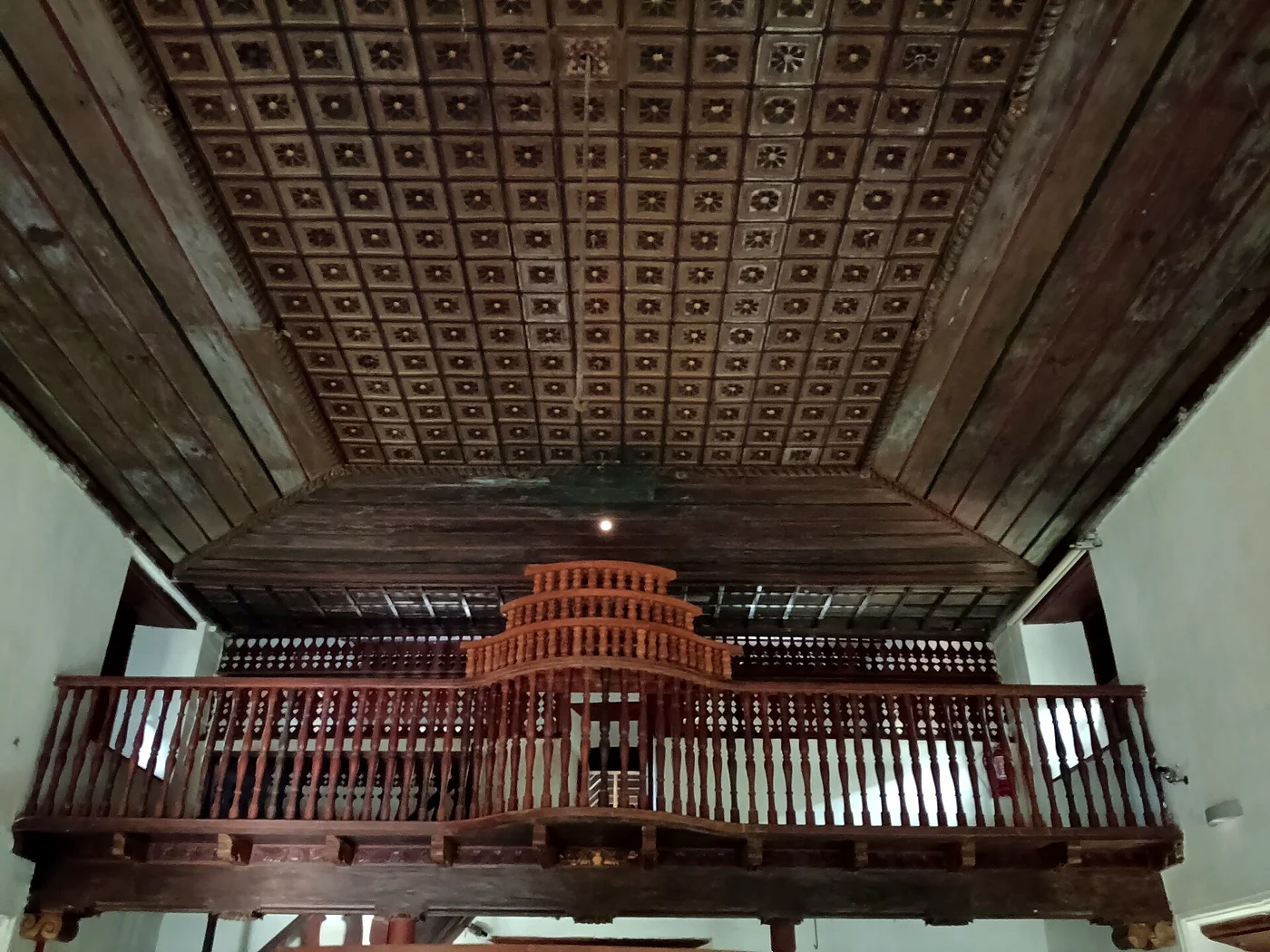
- The sanctuary: a tall hall with whitewashed laterite walls, a carved and painted wooden ceiling (often with lotus patterns), and many hanging oil lamps and glass chandeliers.
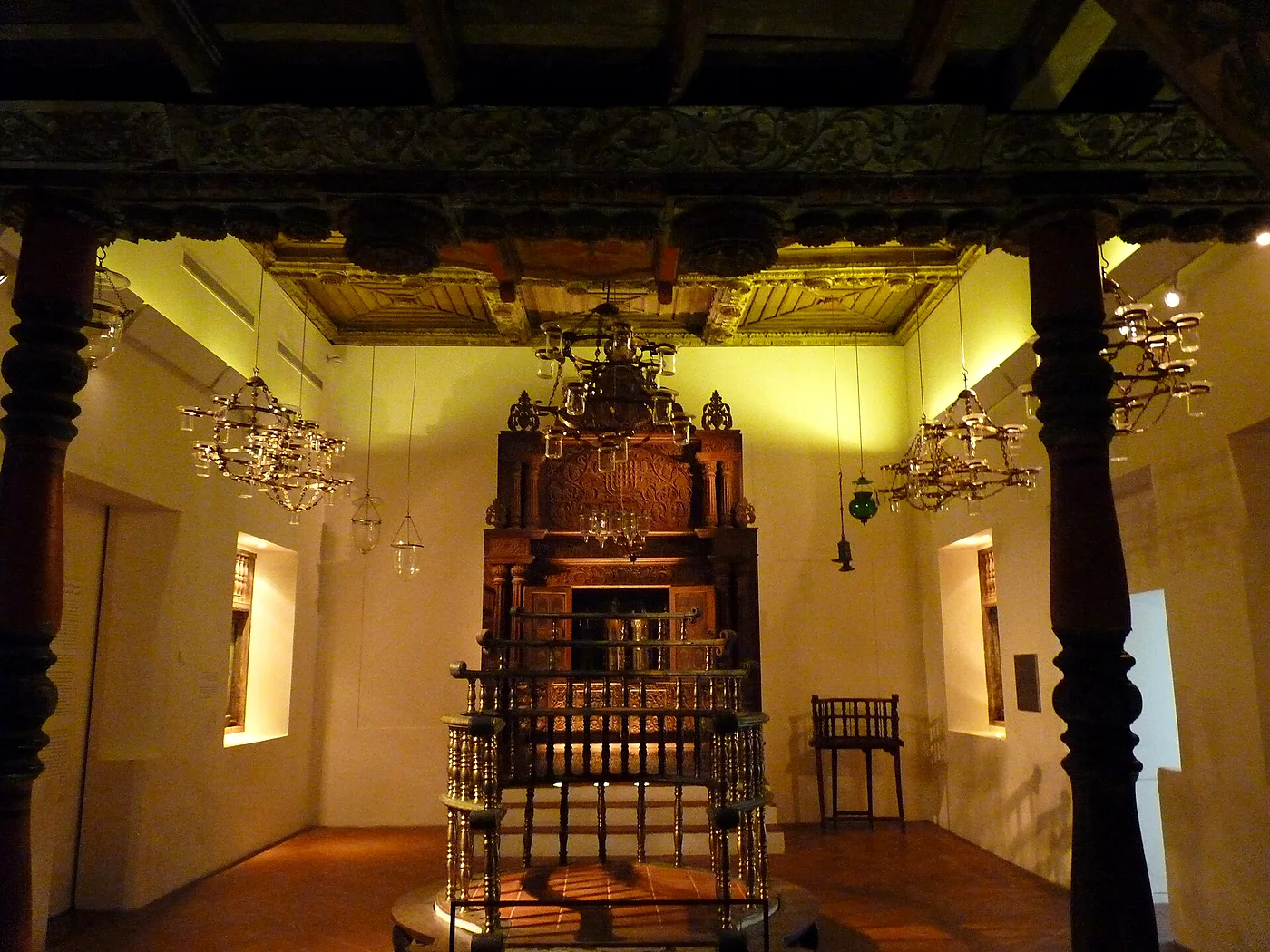
- The tevah (also bimah): a raised platform with a curved wooden or brass railing in the centre of the hall, from which the Torah is read.
- The heikhal: the Torah ark, a richly carved, painted and gilded wooden cabinet on the western wall, facing Jerusalem, where the Torah scrolls are kept behind a curtain.
- The women's gallery upstairs, behind a wooden screen, usually reached by an outside staircase.
- The second tevah: in the Malabari synagogues, a second, smaller reading platform projects from the front of the women's gallery, used on Sabbaths and festivals. This upper tevah is almost unknown in synagogues outside Kerala, and its origin is still debated.
Worshippers entered barefoot, as in a Hindu temple, and many customs (oil lamps, a coconut-oil lamp lit before the ark, songs in Jewish Malayalam) show how deeply the community had become part of Kerala life.
The eight synagogues and their fate
| Synagogue | Founded (traditional / documented) | Today |
|---|---|---|
| Paradesi, Mattancherry | 1568 | The only one still in regular use; open to visitors. |
| Kadavumbhagam, Mattancherry | 1544 | Ruined; front collapsed in 2019; interior reconstructed in the Israel Museum, Jerusalem; under restoration by the state. |
| Thekkumbhagam, Mattancherry | 16th century | Demolished after 1955; ark at the Magnes Collection, Berkeley. |
| Kadavumbhagam, Ernakulam | c. 1200 (tradition) | Restored in 2018; occasional services. |
| Thekkumbhagam, Ernakulam | c. 1580; rebuilt 1939–40 | Closed 1954; used for community events by arrangement. |
| Paravur | 1616 (on an older site) | Kerala Jews History Museum (Muziris Heritage Project). |
| Chendamangalam | 1420 (tradition), rebuilt 1614 | Kerala Jews Lifestyle Museum (Muziris Heritage Project). |
| Mala | disputed; rebuilt 1909 | Handed to the panchayat in 1954–55; museum; roof collapsed June 2025. |
Older synagogues are known only from records and tradition: at Kochangadi in Kochi (1344, whose foundation stone is now set in the wall of the Paradesi synagogue), at Kodungallur, Palayur, Muttam and elsewhere. Some Jewish sites are remembered only by place names, such as the Joothakulam, the "Jew ponds" of Kodungallur and Madayi.
Where the treasures went
When the congregations emigrated, they took their Torah scrolls, and often the arks and reading platforms too, to new synagogues in Israel, at moshavim such as Nevatim and Nehalim. Other furnishings reached museums: the Israel Museum in Jerusalem, and the Magnes Collection at the University of California, Berkeley. The empty buildings passed to local bodies, and for decades several decayed. Since the 2010s the Muziris Heritage Project and the Kerala Department of Archaeology have restored the synagogues at Paravur, Chendamangalam and Mala as museums, with replica furnishings, so that visitors can again see what a Kerala synagogue looked like.
Visiting tips
- The Paradesi synagogue is closed on Fridays, Saturdays and Jewish holidays; dress modestly and remove your shoes.
- The museums at Paravur, Chendamangalam and Mala are part of the Muziris Heritage Project; one ticket can cover several sites. Check current hours locally (usually about 10 am to 5 pm, closed on Mondays).
- Combine Paravur and Chendamangalam with the Keezhthali temple and the other Muziris sites.
See it for yourself, with a local driver who knows these roads.
Book a Munnar Jeep SafariSources & further reading
- Wikipedia: List of synagogues in Kerala
- Kerala Tourism, Judaism in Kerala
- Sahapedia: Cochin Jews and the seven synagogues of Kerala, history and architecture
- Jewish Monuments of Kerala (Dr. Laju Paul K.)
- Hadassah Magazine: Kochi, an ancient Jewish treasure in South India (2017)
Figures are from the sources listed and were checked in October 2026. Park timings and road conditions change, so please confirm before you travel.