
Mahabalipuram: The Pallava Workshop by the Sea and the Legend of the Seven Pagodas
Temples carved from single rocks, a cliff face turned into one great story in stone, a temple at the edge of the waves and a legend of drowned pagodas. The story of Mamallapuram from its Sangam-age port to the 2004 tsunami, through the first European accounts and photographs, with our own assessments.
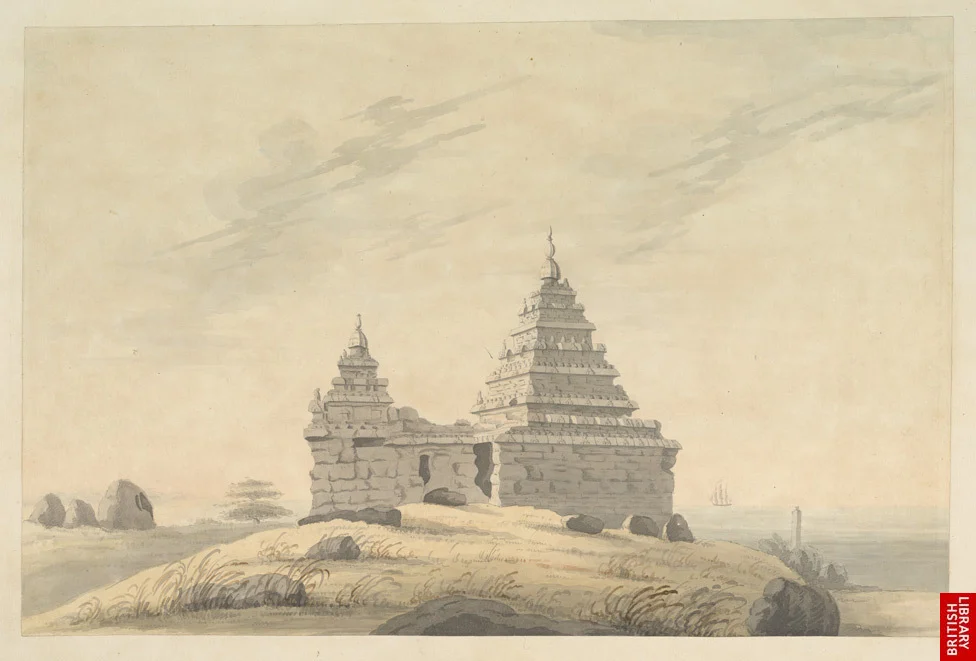
On a flat stretch of the Coromandel coast in Tamil Nadu, about 55 km south of Chennai, a low ridge of pink-grey granite rises out of the sand. For about a hundred years in the seventh and eighth centuries, sculptors working for the Pallava kings of Kanchipuram turned this ridge, its boulders and the beach beside it into a vast open-air workshop. They cut temples out of the living rock, carved caves with some of the finest reliefs in India, sculpted a whole cliff face into a single story in stone, and finally built one of the earliest free-standing stone temples in the south, right at the edge of the sea. The place is Mamallapuram, better known to travellers as Mahabalipuram, and to generations of sailors simply as the Seven Pagodas.
This article sets out what is firmly known about the site, from the Pallava kings and their inscriptions to the first European accounts of the 1770s and 1780s, the lighthouse on the temple roof and the discoveries made after the 2004 tsunami. Where the evidence runs out and opinion begins, we say so, and our own reading of the evidence is kept in clearly marked boxes.
At a glance
- Where: Chengalpattu district, Tamil Nadu, on the East Coast Road, about 55 km south of central Chennai.
- Names: Mamallapuram (official, from the royal title Mamalla), Mahabalipuram ("city of the great Bali"), the Seven Pagodas (the old sailors' name).
- Builders: the Pallava dynasty of Kanchipuram, mainly in the 7th and early 8th centuries CE.
- Best known for: the Shore Temple, the Pancha Rathas (five monolithic temples), the great relief called Arjuna's Penance or the Descent of the Ganges, and a series of cave temples.
- Status: inscribed on the UNESCO World Heritage List in 1984 as the Group of Monuments at Mahabalipuram; protected and maintained by the Archaeological Survey of India (ASI).
Three names for one town
The official name, Mamallapuram, means "the town of Mamalla", "the great wrestler". This was a title of the Pallava king Narasimhavarman I (reigned about 630–668), the ruler most closely linked with the site. The older and more popular Mahabalipuram connects the town with Mahabali, the generous demon-king of Hindu legend who was humbled by Vishnu in his dwarf incarnation, Vamana. When William Chambers wrote the first English account of the place in 1788, the local Tamil name he recorded was Mavalipuram, which he explained as the city of the great Bali.
The third name, the Seven Pagodas, came from the sea. For European sailors working the Coromandel coast, the cluster of temple towers on the shore and on the hill was a landmark visible from far out, and "pagoda" was the usual European word for an Indian temple. Nobody has ever been able to count seven of them on land. That gap between the name and what can actually be seen is where the town's most famous legend begins, and we return to it below.
Before the Pallavas: a Sangam-age port
Mamallapuram was not a new town when the Pallava sculptors arrived. Megalithic burial urns dating to around the beginning of the Common Era have been found in the area, and some scholars identify the town with a port named Nirppeyarru in the Sangam-age Tamil poem Perumpanarruppadai, which describes a busy harbour with ships and warehouses. The identification is not certain, but the coast here had clearly been settled and used for trade long before the seventh century.
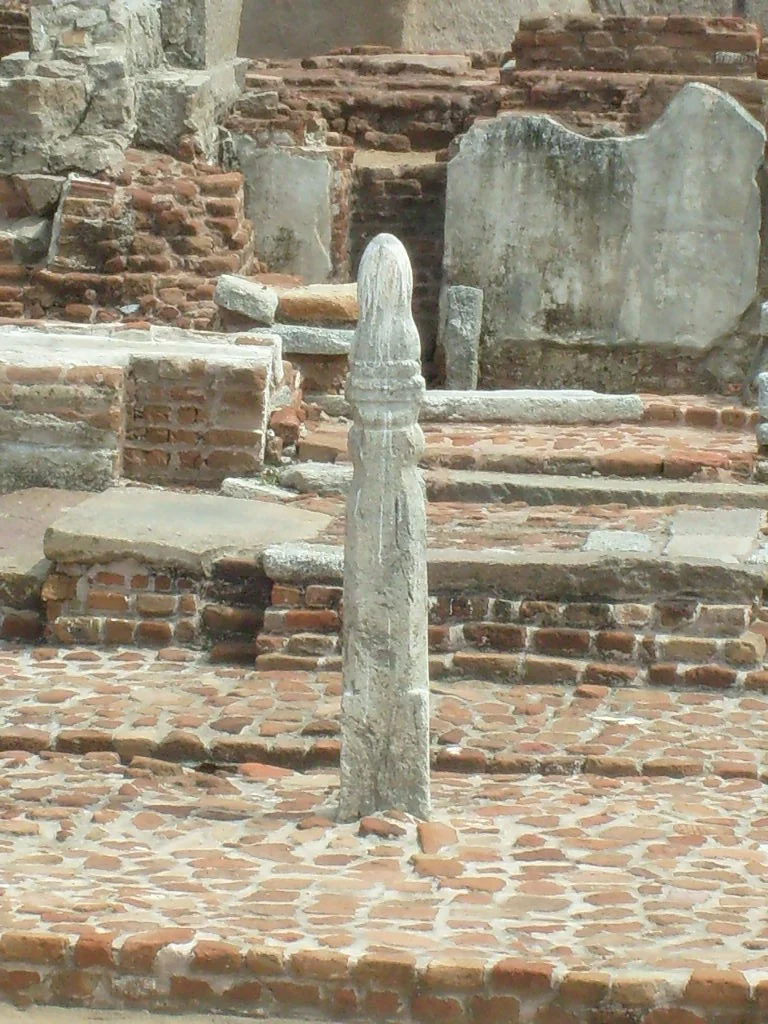
The strongest physical evidence came after the Indian Ocean tsunami of 26 December 2004. At Saluvankuppam, a fishing hamlet about 4 km north of the main monuments, the waves and the later clearing of sand exposed a rock bearing inscriptions of the Chola and Rashtrakuta periods that referred to a temple of Subrahmanya (Murugan). ASI archaeologists dug into a nearby mound in 2005 and found a granite shrine of the Pallava period, built on top of a much older brick temple. The brick shrine faces north, unlike later temples built to the rules of the agamas, and from its bricks, pottery and layout the excavators dated it to the late Sangam period, perhaps around two thousand years ago. Layers of sea sand and shell inside the excavation suggested that the shrine had been damaged by waves, possibly more than once.
The Pallavas and the stone revolution
The Pallavas ruled much of northern Tamil country from their capital at Kanchipuram, about 65 km inland, from roughly the fourth to the ninth century. Before the late sixth century, temples in the Tamil region were built of brick, timber and plaster, and almost none survive. The change came with Mahendravarman I (about 600–630), a king who was also a playwright. At Mandagapattu, in today's Villupuram district, an inscription of his proudly describes a shrine made without brick, timber, metal or mortar: a cave cut straight into the granite. It is one of the first rock-cut temples in the Tamil country.
His son Narasimhavarman I Mamalla carried the idea much further. He is remembered in history for defeating the Chalukya king Pulakeshin II and capturing the Chalukya capital, Vatapi (Badami), in about 642. Mamallapuram, the port of the Pallava kingdom, bears his title. Later kings, especially Narasimhavarman II, better known by his title Rajasimha (about 700–728), moved on from carving rock to building with cut stone: the Shore Temple here and the great Kailasanatha temple at Kanchipuram are his. Rajasimha's reign is also linked with an embassy from the Pallava court to Tang China recorded in Chinese sources, a reminder that this was a seafaring kingdom.
Our assessment: who made Mamallapuram?
Few questions about the site have been argued over as long as this one. Some scholars give almost everything to Narasimhavarman I, whose title the town bears; others see the hand of Mahendravarman I in the simpler caves, and of Paramesvaravarman I or Rajasimha in the later and more ornate work. The inscriptions do not settle it, because the same royal titles (birudas) were reused by several kings. Our view: Mamallapuram is best understood not as one king's project but as a royal workshop that ran for three or four generations, roughly from 630 to 730. The styles change from the plain to the richly carved, the techniques move from cutting caves to carving free-standing monoliths and finally to building in dressed stone, and many works were left unfinished when the patrons' attention moved on. That sequence fits a long-running school of sculptors far better than a single burst of building.
Arjuna's Penance, or the Descent of the Ganges
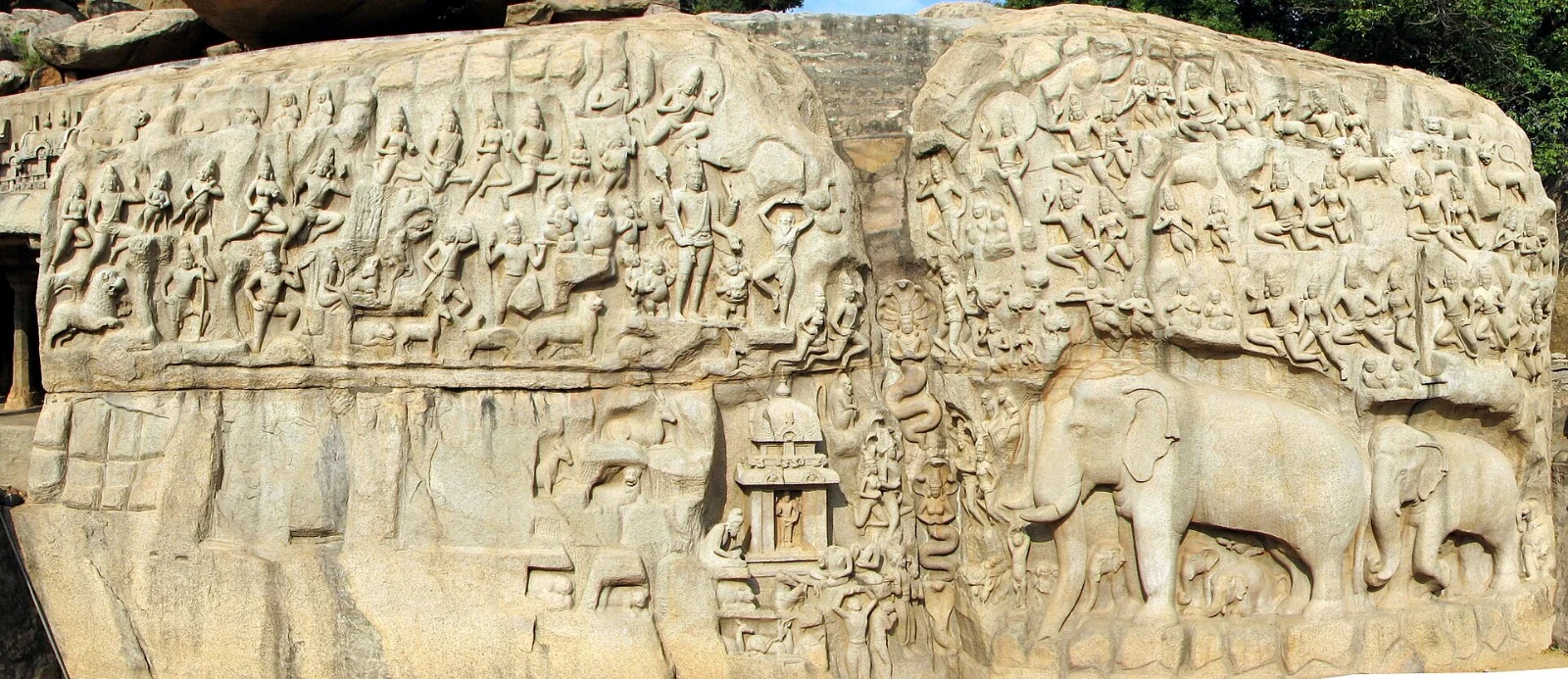
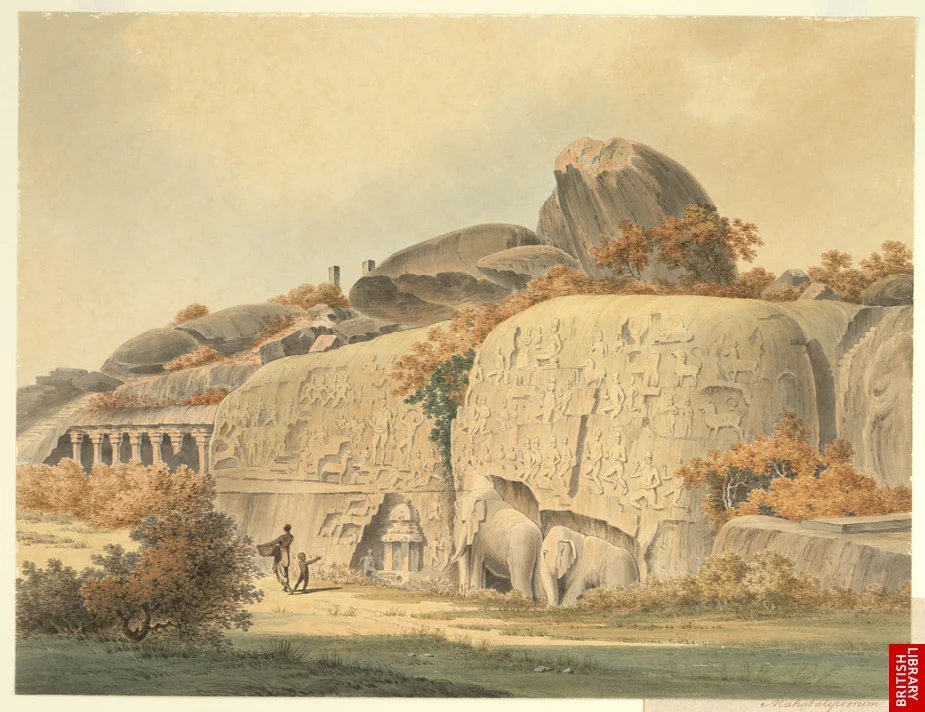
The most famous single work at Mamallapuram is a granite cliff face, nearly 30 metres long and some 13 metres high, carved from end to end into one crowded scene. Gods, celestial beings, sages, hunters, monkeys, deer, lions and a herd of life-size elephants all turn towards a natural cleft in the middle of the rock. In the cleft swim nagas, serpent deities with human upper bodies. Traces of a cistern on top of the rock suggest that water could be released to run down the cleft on festival days, turning the carving into a living picture.
What the scene shows has been debated since the nineteenth century. One reading follows the old local name, Arjuna's Penance: the hero of the Mahabharata standing on one leg in severe austerity to win a divine weapon from Shiva. The other reading sees the sage Bhagiratha, whose penance brought the heavenly river Ganga down to earth, and the cleft as the river itself. A beloved detail beside the elephants shows a cat standing on its hind legs in mock penance while mice play around it, a sculptor's joke about false piety that appears in Indian fable literature.
Our assessment: Arjuna or Bhagiratha?
The arguments on both sides are serious. The ascetic standing on one leg near a small shrine, with a figure of Shiva granting a boon, fits Arjuna's story well. The central cleft full of water serpents, and the many creatures streaming towards it, fit the descent of the Ganga better. Our view: the Pallava designers probably meant both at once. Pallava art is full of deliberate double meanings, and the king's own poets praised him in verses that play on two senses at the same time. A single carving that celebrates penance, divine grace and the coming of water would have spoken to a dynasty that ruled a river-fed farming country and a busy port. We cannot prove that intention, but it explains why neither single reading has ever quite defeated the other.
The cave temples
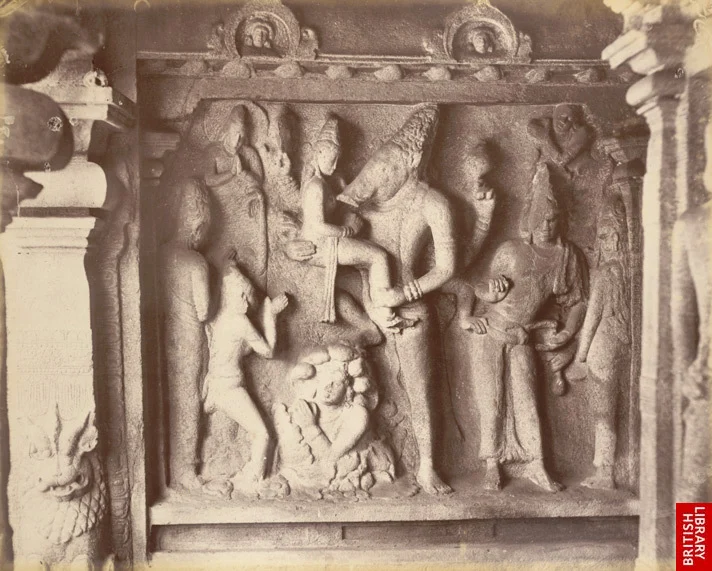
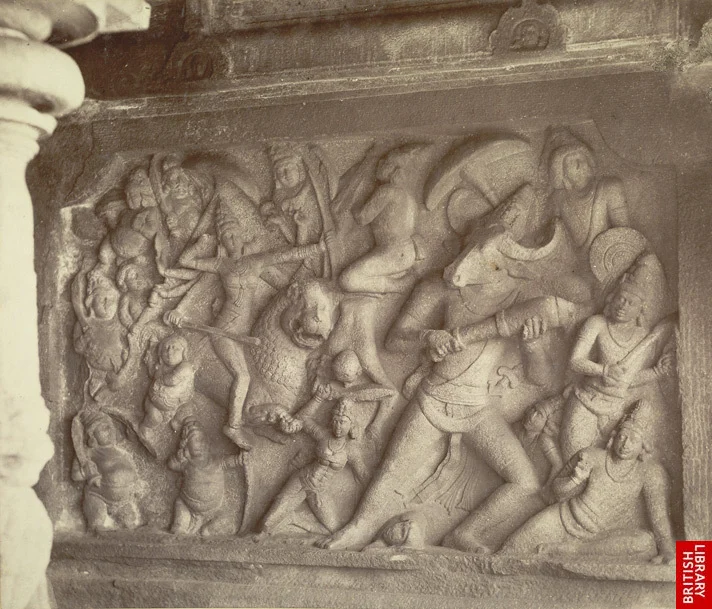
Around the hill are about a dozen mandapas, pillared halls cut into the granite. Their columns often rest on seated lions, a Pallava signature. Inside are some of the finest reliefs in Indian art. In the Varaha cave, Vishnu as a boar lifts the earth goddess Bhudevi from the ocean, and nearby panels show Gajalakshmi bathed by elephants and Durga standing above a severed head. In the Mahishasuramardini cave, one long panel shows the goddess Durga, riding her lion and drawing her bow, driving back the buffalo-headed demon Mahisha and his army; the opposite wall shows Vishnu asleep on the cosmic serpent. The Krishna mandapa holds a broad relief of Krishna lifting Mount Govardhana to shelter herders and their cattle, full of everyday detail such as a man milking a cow.
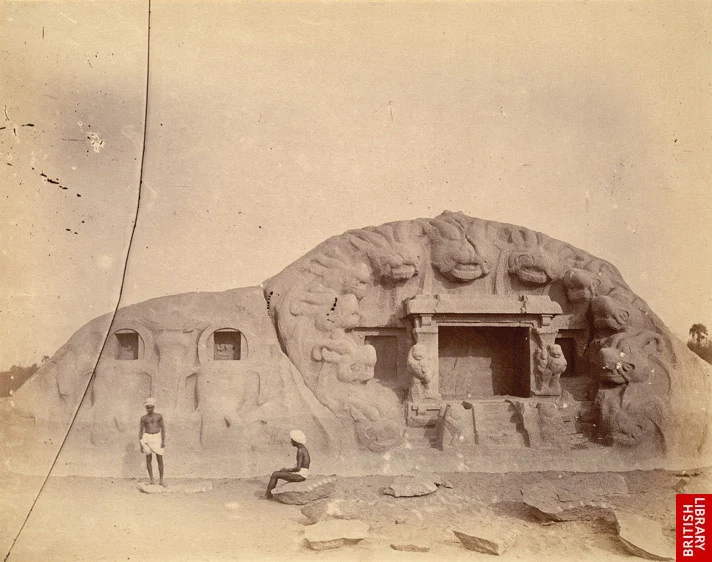
About 4 km north, at Saluvankuppam, is the Tiger Cave, a small shrine framed by a ring of carved yali heads, lion-like monsters that early visitors took for tigers. It carries an inscription with the title Atiranachanda, usually linked with Rajasimha.
The Pancha Rathas: temples carved from a single rock
At the southern end of the town, five temples stand in a row on the sand. They were not built: each was carved, top to bottom, out of one long granite outcrop that sloped from north to south. The local names, Dharmaraja, Bhima, Arjuna, Nakula–Sahadeva and Draupadi rathas, after the five Pandava brothers and their wife in the Mahabharata, are later popular names with no basis in the Pallava inscriptions. The word ratha means chariot, but these were never meant to move; they are full-size models of different temple forms. Draupadi's ratha copies a thatched hut-shrine, Bhima's a long barrel-roofed hall, and the Dharmaraja ratha, the tallest, a pyramidal tower of the kind that would become the standard southern vimana. A life-size elephant, a lion and a Nandi bull were carved from boulders alongside them.
None of the rathas was completed or consecrated. The inscriptions on the Dharmaraja ratha, written in the elegant Pallava-Grantha script, list royal titles that link it with Narasimhavarman I, though some scholars attribute the inscriptions to a later king.
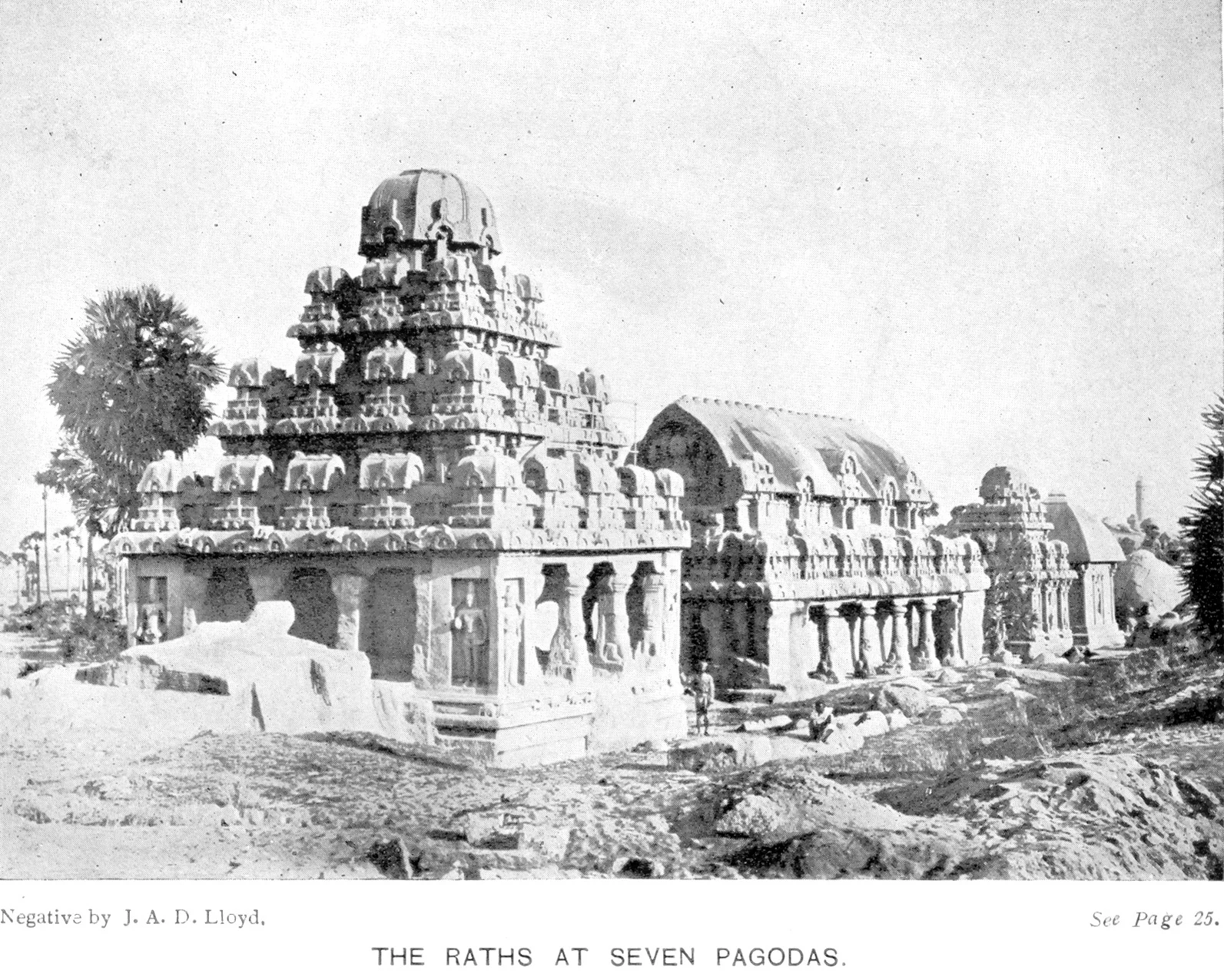
The Shore Temple
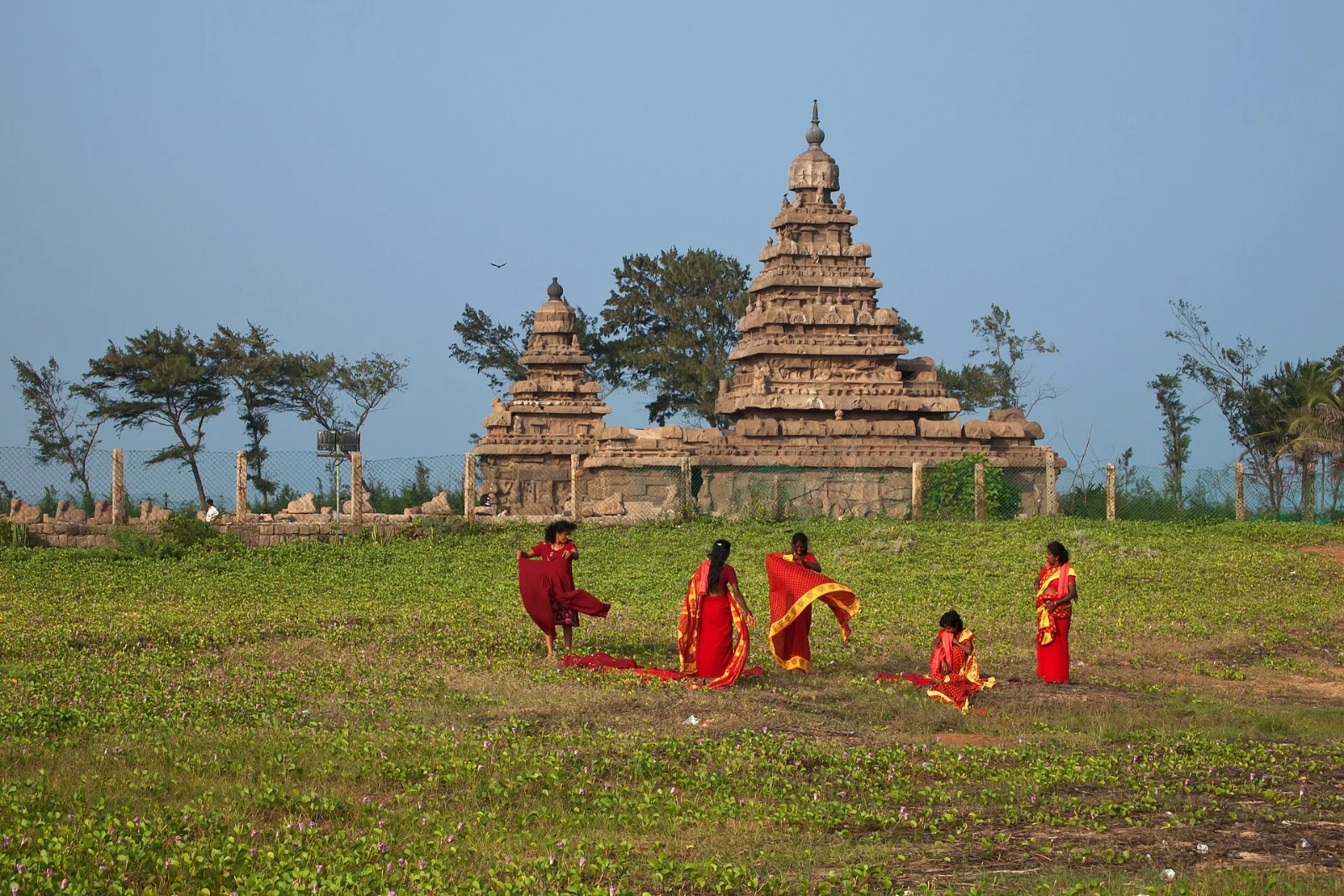
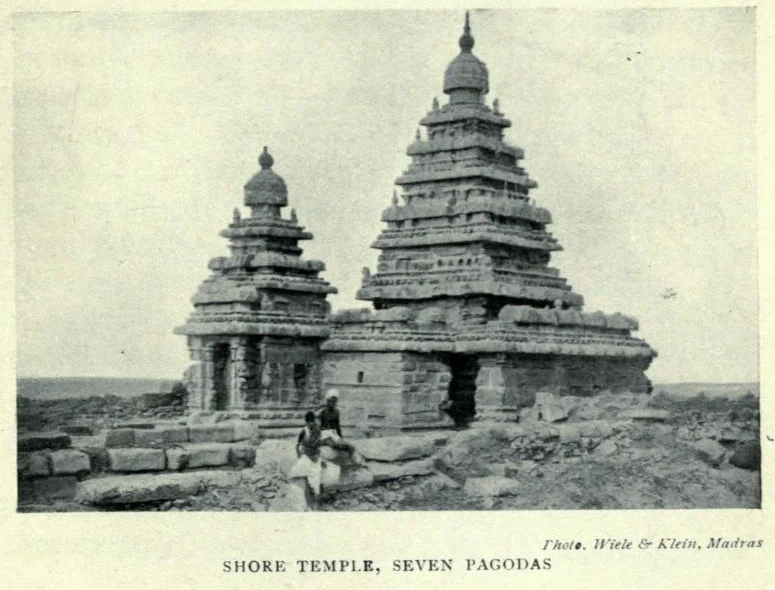
The Shore Temple, built in the reign of Rajasimha in the early eighth century, is one of the oldest structural stone temples in South India. Instead of carving into the rock, the builders cut granite blocks and assembled them. The plan is unusual: two shrines to Shiva, one facing east towards the sea and one facing west towards the town, with a third, smaller shrine between them containing a reclining Vishnu carved from the bedrock. Many scholars think the Vishnu shrine is the oldest part, and that the Shiva shrines were built around it. Rows of seated Nandi bulls line the enclosure wall.
For centuries the temple stood exposed to salt wind and sand, and its carvings are softened and worn. When Chambers and his contemporaries saw it in the late eighteenth century, the surf broke against its foundations. Its survival through the 2004 tsunami, when the waves rolled over the beach and into the enclosure but did not bring the towers down, impressed engineers and pilgrims alike.
The Seven Pagodas legend
The story told to every early visitor was that the town had once been far larger and richer, with seven great temples, and that the sea had swallowed all but one. William Chambers, who first visited in 1772 and published his account in the first volume of Asiatick Researches in 1788, recorded that older people among the local population remembered seeing the tops of several pagodas far out in the sea. John Goldingham, writing in the same journal in 1798, heard a similar story: a man's father had seen gilded temple tops above the waves. In the Hindu version, the gods themselves were jealous of the city's splendour and sent a flood to destroy it. The English poet Robert Southey took up the tale in The Curse of Kehama (1810), and through him the Seven Pagodas entered European Romantic literature.
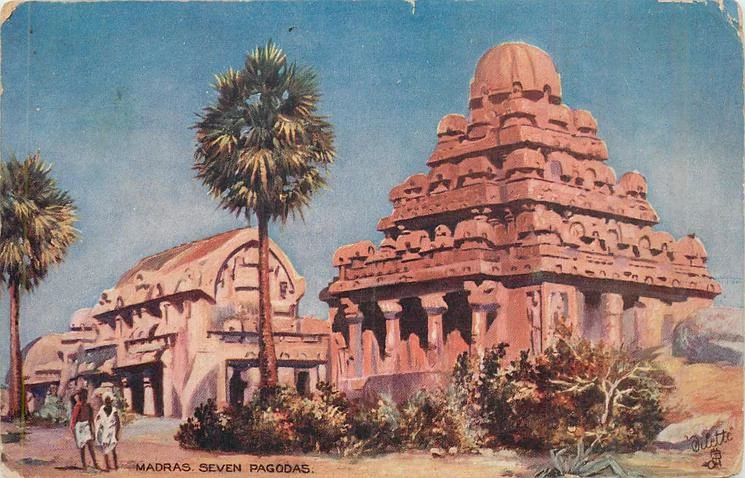
For two centuries the submerged temples remained a matter of hearsay. Then evidence began to appear. Underwater surveys in 2002 by India's National Institute of Oceanography, together with the Scientific Exploration Society of Britain, recorded structures of cut stone on the sea floor off the Shore Temple, including what appeared to be walls and scattered blocks, published in Current Science in 2004. When the tsunami of December 2004 pulled the sea back for some minutes, people on the beach reported seeing rows of rocks and structures far out; afterwards the shifted sand exposed a number of sculptures near the shore, including a large stone lion and an elephant head.
Our assessment: were there seven pagodas?
The established facts are these: the coastline has moved, there are man-made stone remains under the sea off the Shore Temple, and the Saluvankuppam shrine shows that waves damaged temples on this shore in the past. What is not established is a lost city of seven great temples. No Pallava or later inscription describes such a complex, and the eighteenth-century witnesses were reporting what their parents and grandparents had said. Our view: "Seven Pagodas" is most likely a sailors' landmark name for the group of temple towers they could see from offshore, and the local memory of drowned temples grew from real but smaller losses to the sea. The legend is not pure fiction, but it has magnified a genuine history of coastal erosion into something grander. We expect future underwater work to find more remains of harbour structures and shrines, not seven towering temples.
Krishna's Butter Ball
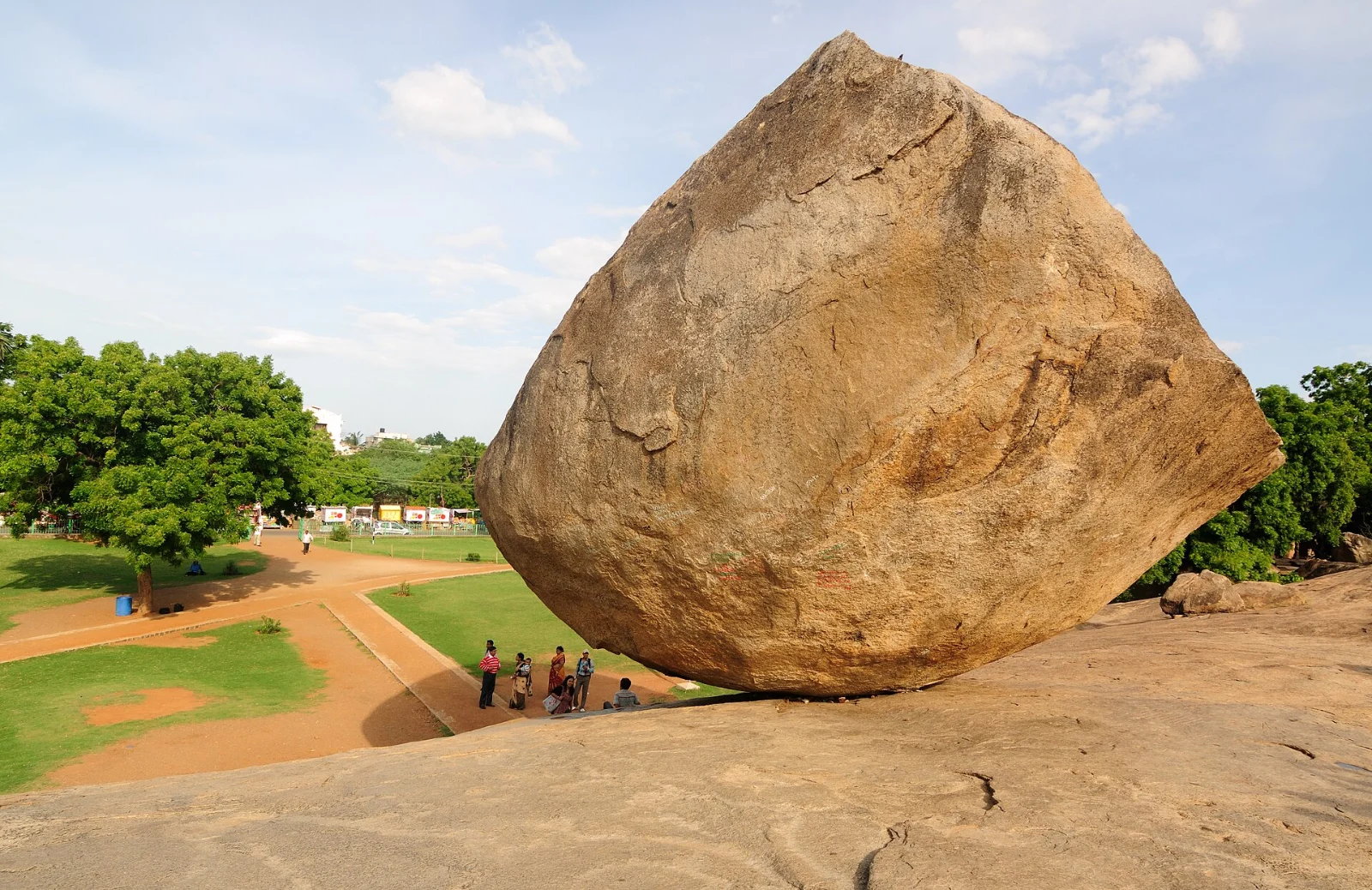
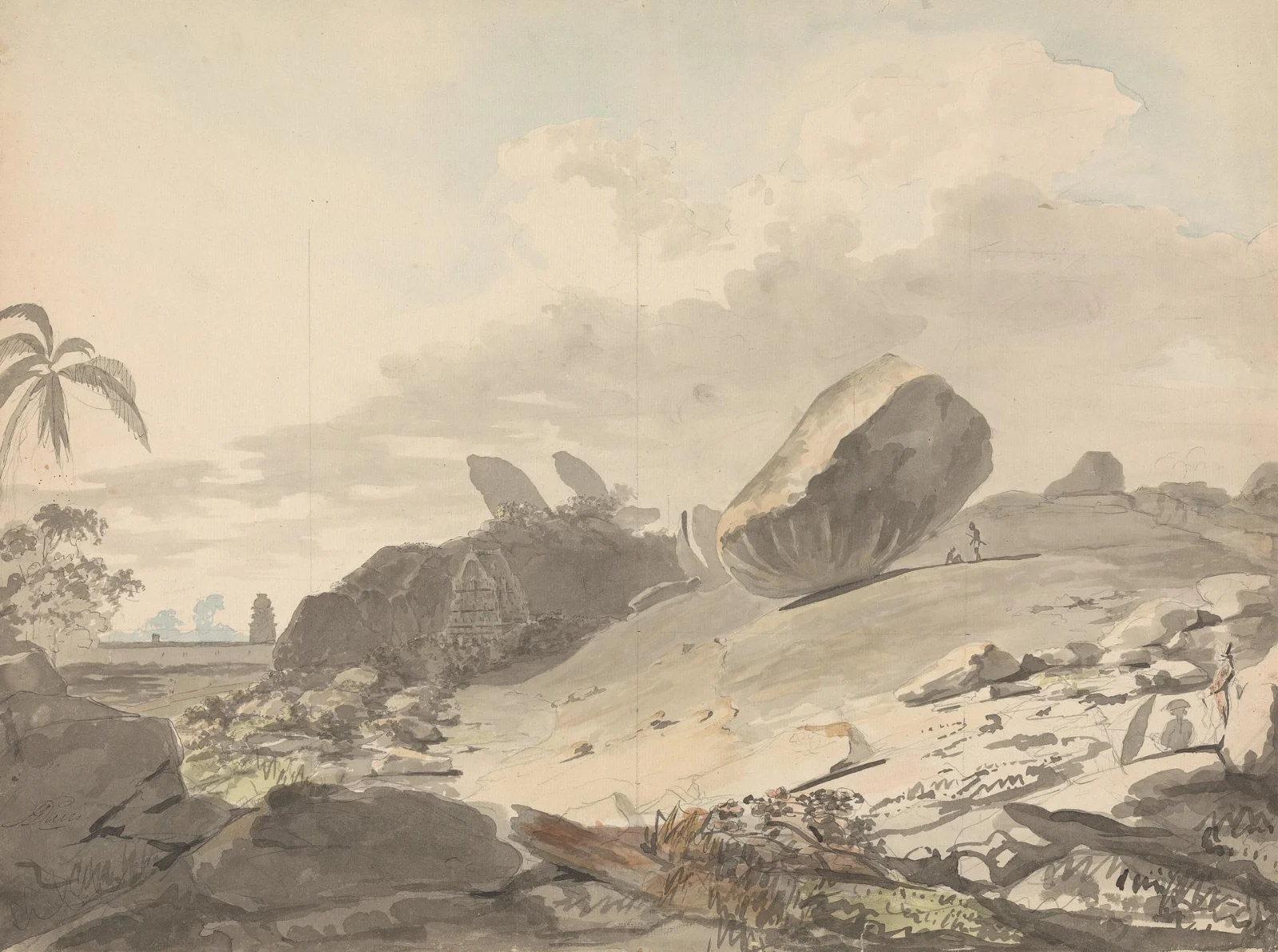
On the slope of the hill near the Ganesha ratha sits a granite boulder about 6 metres high, resting on a tiny base on a steep incline. Its popular name, Krishna's Butter Ball, compares it to the butter that the child Krishna loved to steal. It is entirely natural, the product of the slow weathering of granite along its joints. A widely repeated story says that a Governor of Madras in the early twentieth century tried to have it moved with a team of elephants and failed.
Our assessment: the elephant story
The elephants appear in almost every modern guide, often with the name of Governor Arthur Havelock and the year 1908. We have not been able to find a contemporary record of the attempt, such as a government order or a newspaper report, and it is absent from the nineteenth- and early twentieth-century accounts we have read. Our view: the story should be treated as modern folklore unless such a record turns up. What is real, and more interesting, is the geology: a rounded corestone left behind when the surrounding rock weathered away, balanced on a contact area small enough to look impossible.
A temple, a beacon and a lighthouse
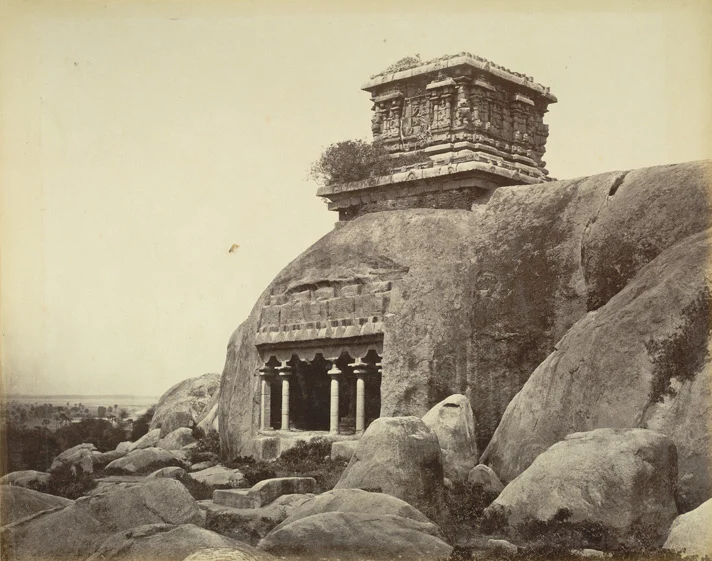
On the summit of the hill, above the Mahishasuramardini cave, stands the small Pallava temple called Olakkannesvara, often explained as "the lord of the flame-eye". In May 1887 the British authorities placed a wick lamp inside a fourth-order optic and lantern on its roof, and for some years the temple served as the Seven Pagodas light for ships on the coast. A new lighthouse, a circular tower of natural stone, was built beside it and became fully functional in 1904. It is still operated by the Directorate General of Lighthouses and Lightships and has been open to visitors since 2011.
Our assessment: "India's oldest lighthouse"?
Many websites now call the Olakkannesvara temple a Pallava lighthouse, built around 640 to guide ships with a fire on its roof. The record supports something more modest. The building is a Shiva temple in the style of the late seventh or early eighth century, with sculptures of Shiva on its walls. The light on its roof is documented from 1887, and the earlier tradition of fires on the high rocks to guide sailors is a reasonable but undocumented belief. Our view: a Pallava port would certainly have needed night beacons, and the hilltop is the obvious place for one, so it is possible that fires were lit near the temple. But there is no evidence that the temple was designed as a lighthouse, and "India's oldest lighthouse" is a modern label rather than an established fact.
Rediscovery: from Chambers to the World Heritage List
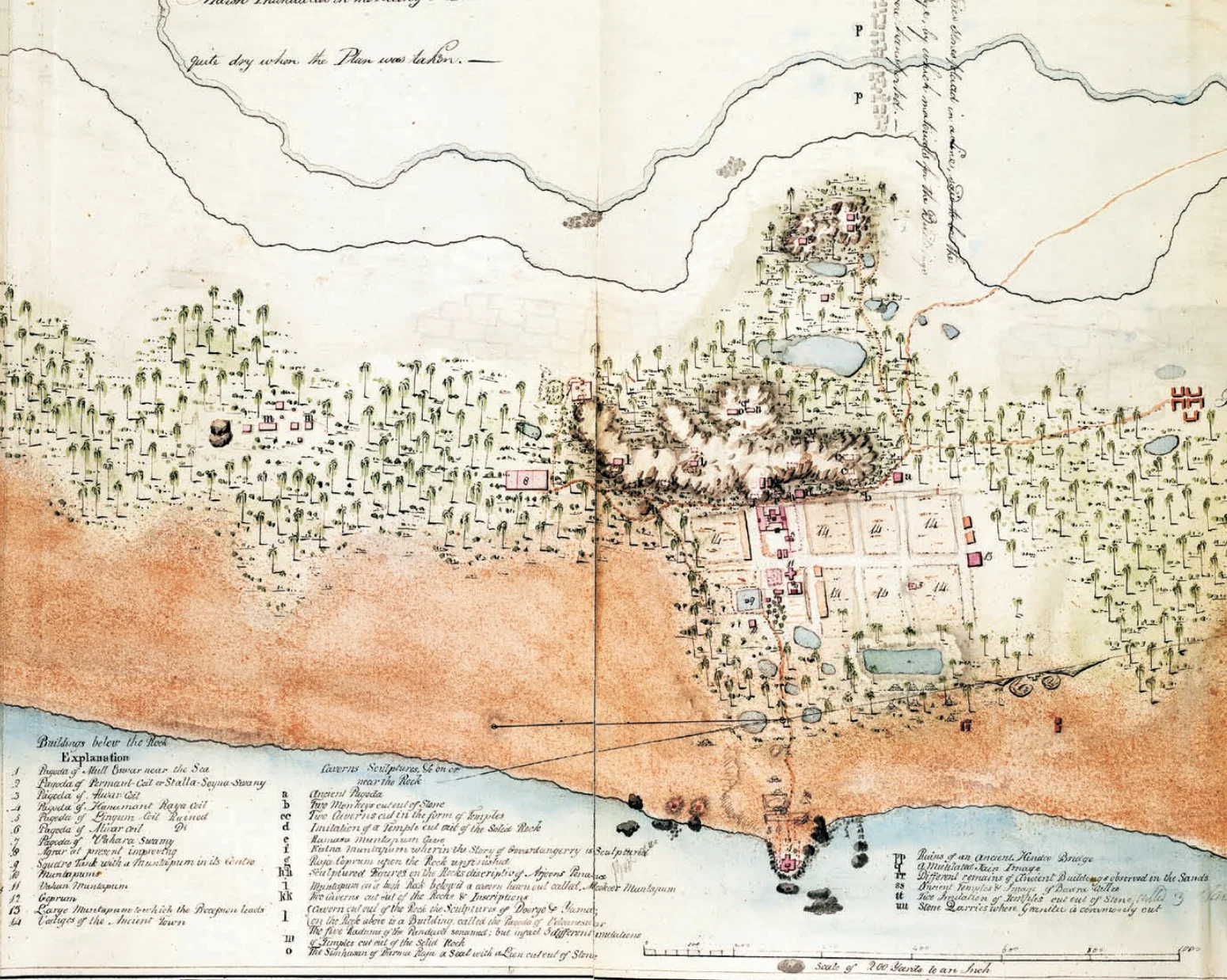
Mamallapuram was never abandoned. Later dynasties, including the Cholas and the Vijayanagara rulers, endowed its temples, and the Sthalasayana Perumal temple in the town, rebuilt in the Vijayanagara period, is one of the 108 sacred shrines of Vishnu praised by the Alvar poet-saints. But its Pallava monuments gradually lost their meaning as their inscriptions became unreadable to later generations.
European scholarship began with William Chambers (1788) and John Goldingham (1798), whose copies of the inscriptions he could not read helped later scholars decipher them. Benjamin Guy Babington published a fuller account with plates in 1830 in the Transactions of the Royal Asiatic Society, and in 1869 M. W. Carr collected these and other papers in Descriptive and Historical Papers relating to the Seven Pagodas on the Coromandel Coast. Artists such as Thomas and William Daniell, John Gantz and Henry Salt drew the monuments; from the 1850s photographers followed, and in the 1880s the newly organised Archaeological Survey in Madras, under Alexander Rea, documented the caves. The Pallava inscriptions were systematically published by E. Hultzsch in South Indian Inscriptions from 1890 onwards.
In 1984 UNESCO inscribed the Group of Monuments at Mahabalipuram on the World Heritage List. Today the town is also a living centre of stone carving: the Government College of Architecture and Sculpture, founded in 1957, trains sculptors in traditional methods, and workshops along the main roads still turn out deities in granite for temples across India and abroad. Every winter the Mamallapuram Dance Festival is held with the Arjuna's Penance relief as a backdrop, and in October 2019 the town hosted the informal summit between India's Prime Minister and China's President, chosen partly for its ancient links with China.
Visiting Mamallapuram
- Getting there: by road along the East Coast Road from Chennai (about 1.5 hours) or from Puducherry (about 2.5 hours); the nearest railway station is Chengalpattu, about 30 km away.
- Tickets: the ASI ticket for the Shore Temple also covers the Pancha Rathas; Arjuna's Penance, Krishna's Butter Ball and most of the hill monuments are open-air. The lighthouse has its own ticket.
- Best time: November to February, early morning or late afternoon; the granite gets very hot at midday, and the light on the reliefs is best when the sun is low.
- Allow: at least a full day to walk the hill, the rathas and the Shore Temple without hurrying; add Saluvankuppam and the Tiger Cave for a second half-day.
- Respect: the monuments are protected; do not climb on sculptures or touch the carved surfaces.
Read also: Hampi: the rise and fall of Vijayanagara · Madurai: the city of Meenakshi · Rameswaram and Dhanushkodi · French India: Pondicherry and Mahe · Muziris and Pattanam: the lost port of Kerala · Edakkal Caves of Wayanad · Kuthirayala cave temple
See it for yourself, with a local driver who knows these roads.
Book a Munnar Jeep SafariSources & further reading
- UNESCO World Heritage Centre: Group of Monuments at Mahabalipuram
- Encyclopaedia Britannica: Mamallapuram
- William Chambers, "Some Account of the Sculptures and Ruins at Mavalipuram" (Asiatic Researches, 1788), Tamil Nadu Archaeology reprint, Tamil Digital Library
- M. W. Carr (ed.), Descriptive and Historical Papers relating to the Seven Pagodas on the Coromandel Coast (1869), HathiTrust
- Directorate General of Lighthouses and Lightships: Mahabalipuram Lighthouse
- Wikipedia: Murugan Temple, Saluvankuppam (with references to ASI reports in The Hindu and Current Science)
- Puratattva: Mamallapuram, the mystery of the Seven Pagodas
- Wikipedia: Seven Pagodas of Mahabalipuram
Figures are from the sources listed and were checked in October 2026. Park timings and road conditions change, so please confirm before you travel.