
Madurai: The City of Meenakshi, from the Sangam Poets to the Nayaks
A capital of the Pandya kings more than two thousand years ago, a city that Kannagi's curse set ablaze, and a temple that has held the city together through raids and conquests. The story of Madurai through ancient poems, the Daniells' aquatints and Linnaeus Tripe's photographs of 1858.
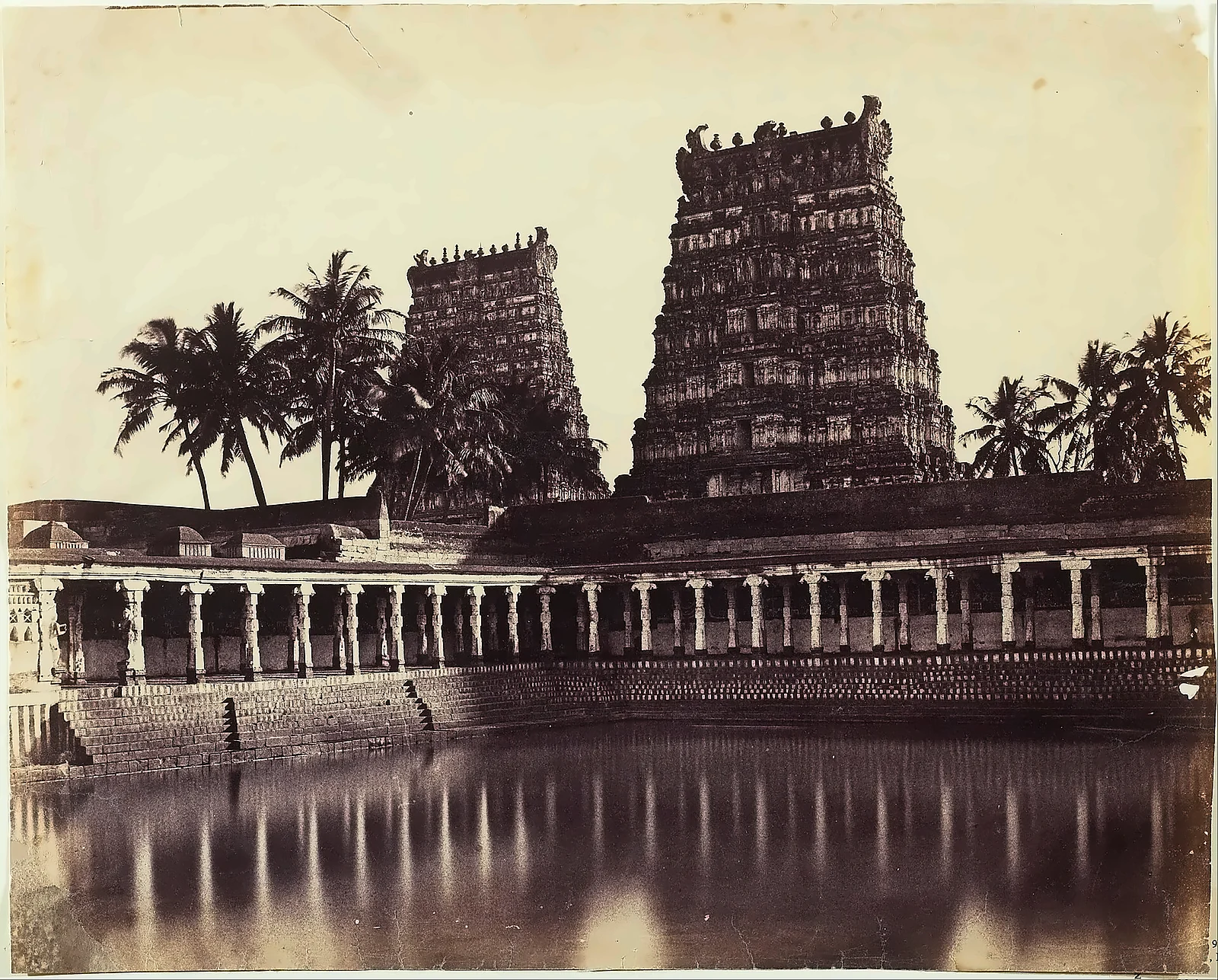
Madurai is one of the oldest continuously inhabited cities in India. It was the capital of the Pandya kings in the age of the Tamil Sangam poets more than two thousand years ago, and it is still, as it has been for centuries, a city that revolves around a temple: the great shrine of the goddess Meenakshi and her consort Sundareswarar (Shiva). Its streets are laid out in squares around the temple, like the petals of a lotus, and named after the Tamil months in which the festival processions pass along them.
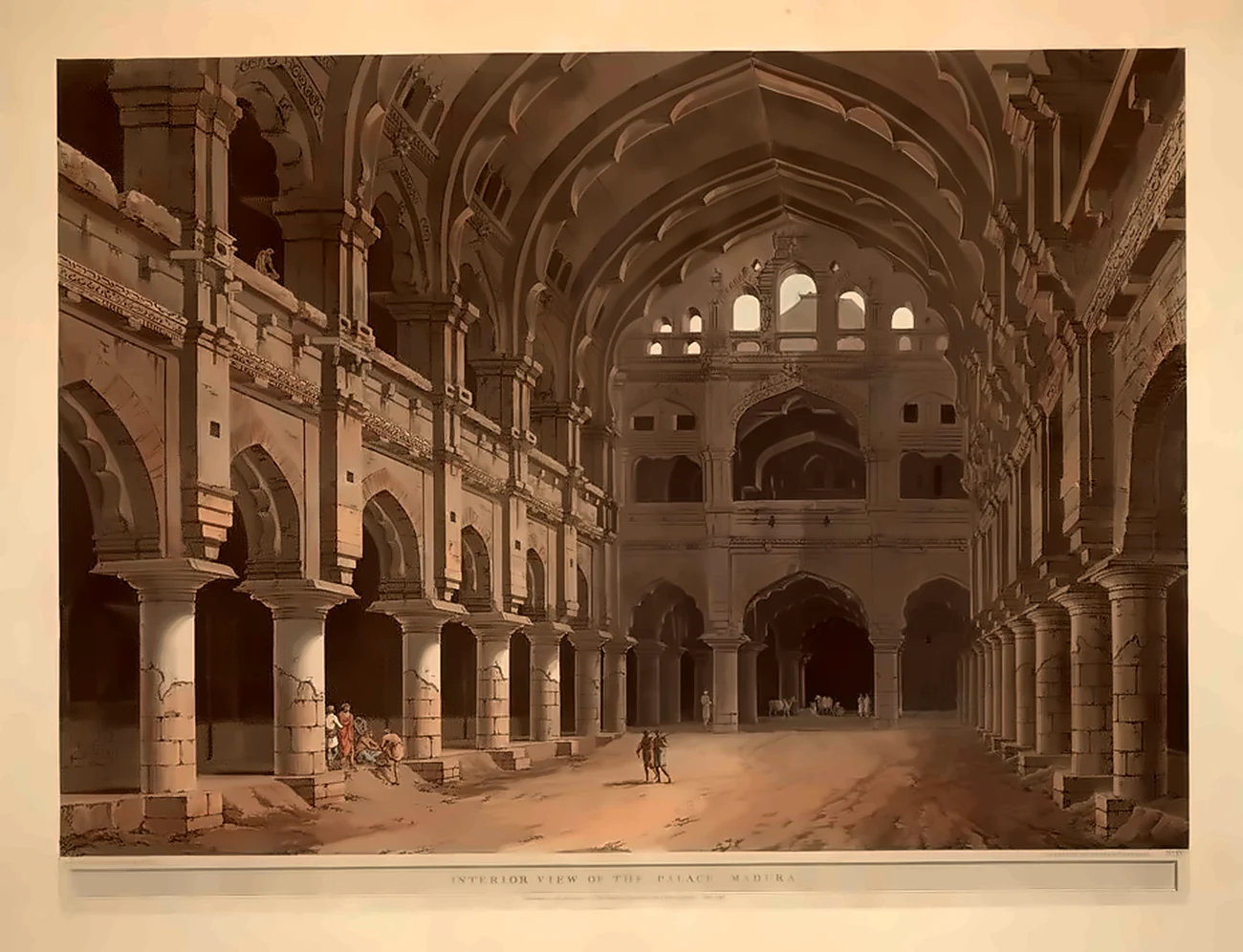
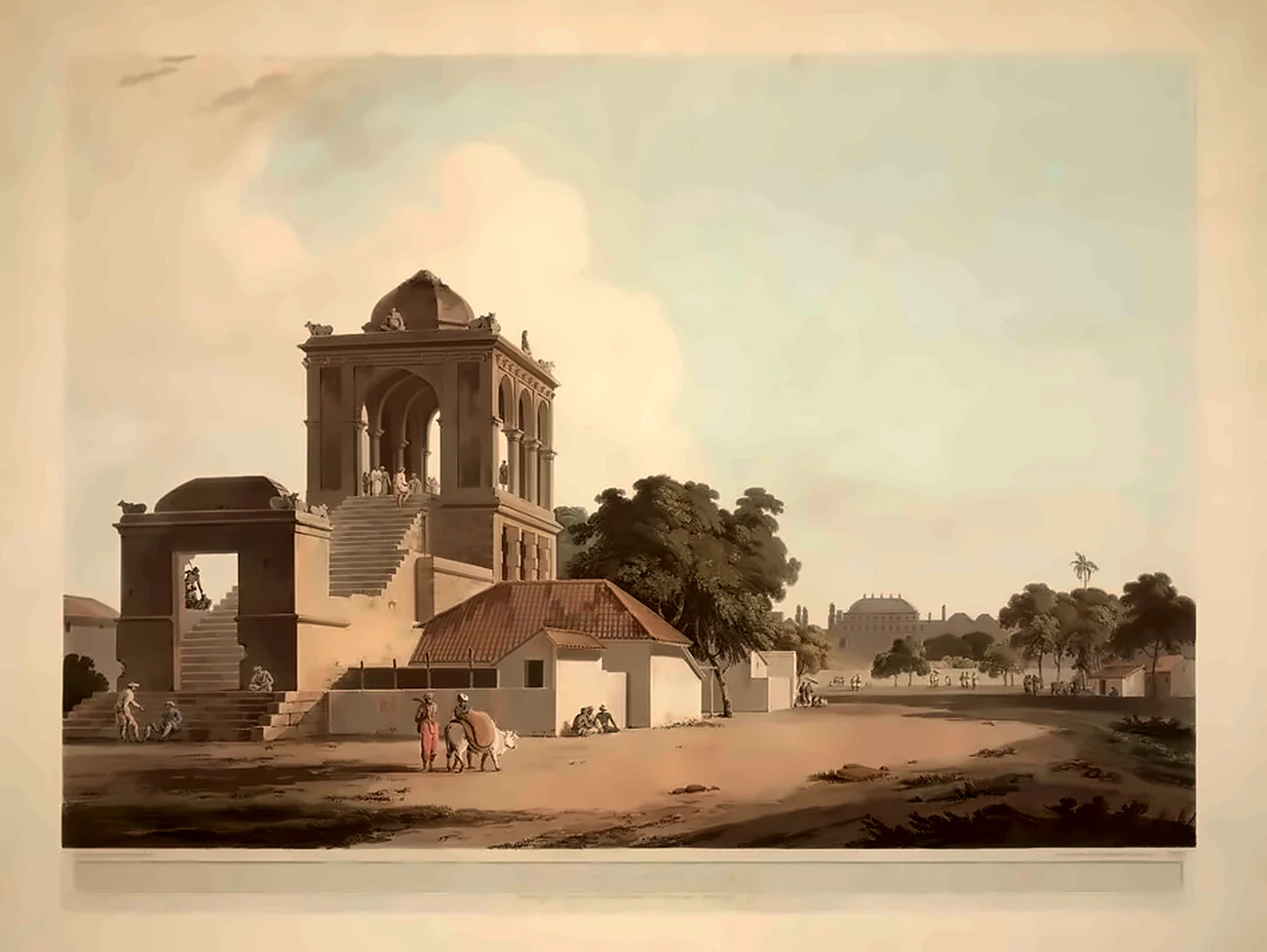
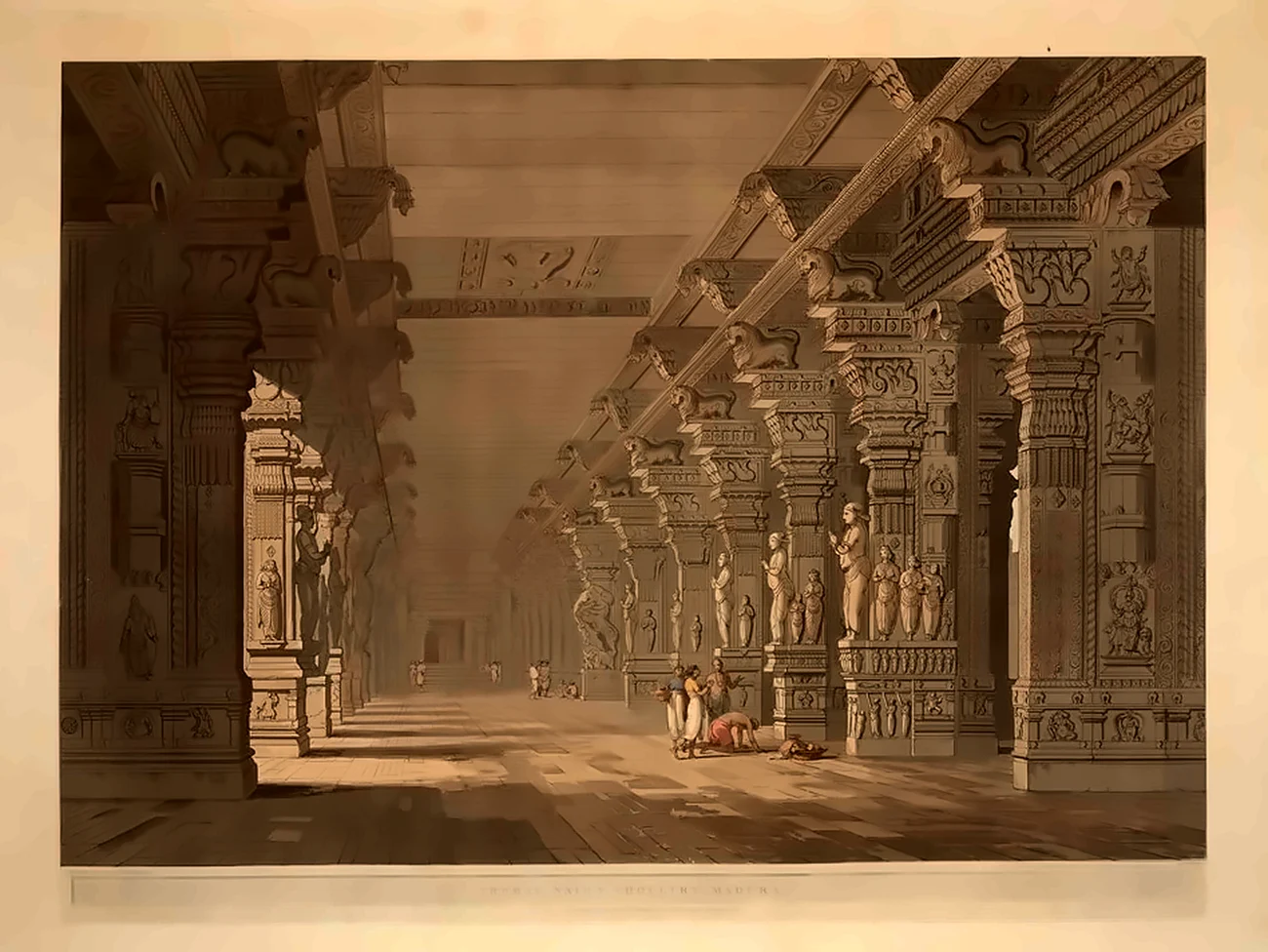
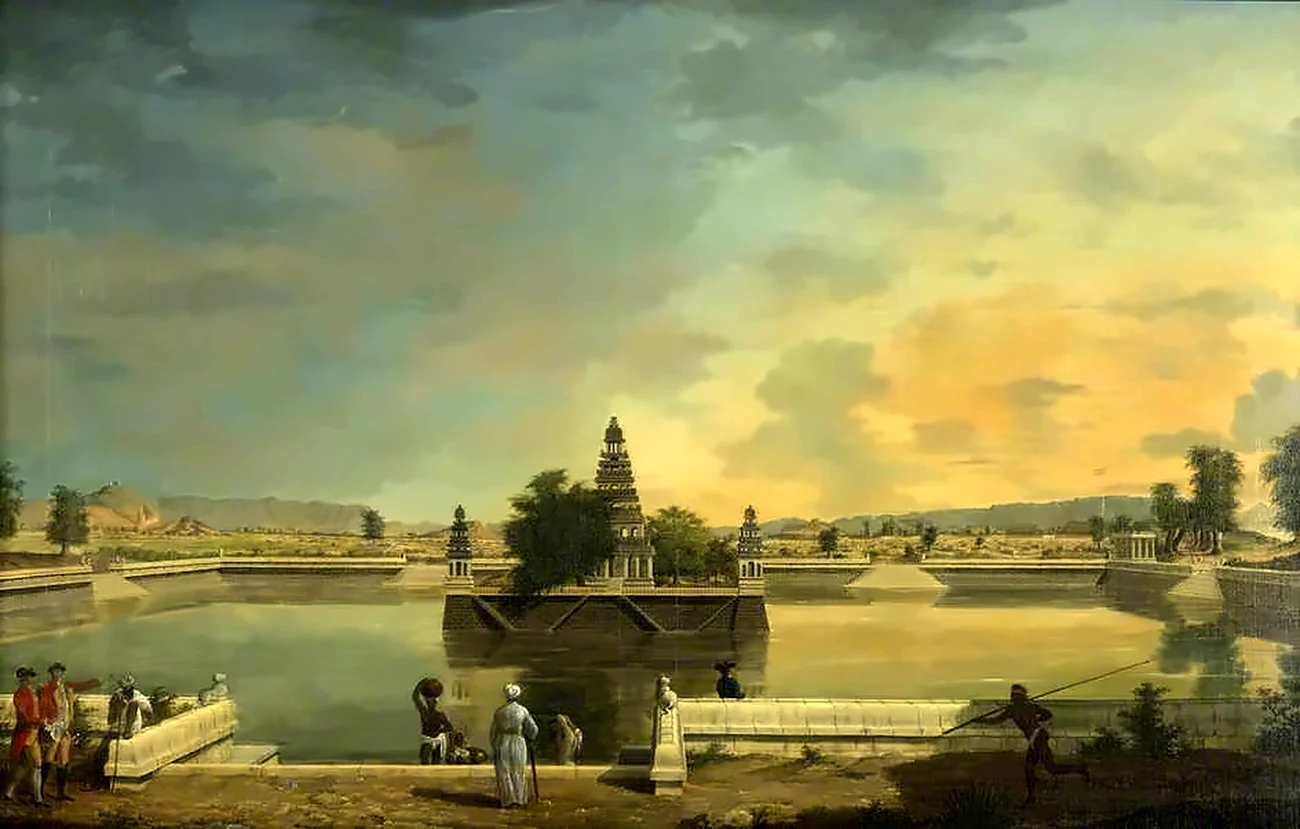
This article traces Madurai's long history through ancient poetry, the accounts of travellers, the aquatints of the Daniells (1790s) and the photographs of Linnaeus Tripe (1858). As always, our own assessments are clearly marked.
At a glance
- Where: on the Vaigai river, southern Tamil Nadu, about 200 km east of Kochi as the crow flies.
- Ancient capital of: the Pandyas; later the Madurai Sultanate (1335–1378), Vijayanagara, and the Madurai Nayaks (1529–1736).
- The temple: about 14 gopurams (gateway towers), the tallest, the southern, about 52 m high; the present buildings are mostly of the 16th and 17th centuries.
- Festival: Chithirai (April–May), celebrating the marriage of Meenakshi and Sundareswarar.
- Nearby: the Keezhadi excavations, about 12 km south-east, which have revealed a Sangam-age town.
The city of the Sangam
Tamil tradition speaks of three great literary academies, the Sangams, held under the patronage of the Pandya kings, the last of them at Madurai. Whatever the truth of the legend, the poems of the Sangam anthologies, composed roughly between the 3rd century BCE and the 3rd century CE, describe Madurai as a rich capital with broad streets, markets, palaces and foreign traders. The Greek ambassador Megasthenes (around 300 BCE) had heard of a southern kingdom called Pandaia, ruled by a queen, and the Roman writers knew the Pandyan ports.
The Tamil epic Silappatikaram tells the story of Kannagi, whose husband Kovalan was wrongly executed in Madurai for stealing the queen's anklet. Kannagi proved his innocence before the king by breaking open her own anklet, which held rubies, not the queen's pearls, and in her grief and fury she cursed the city to burn. Kannagi is worshipped as a goddess across Tamil Nadu and Kerala, where she is identified with the Bhagavathi of Kodungallur.
Our assessment: what does Keezhadi tell us?
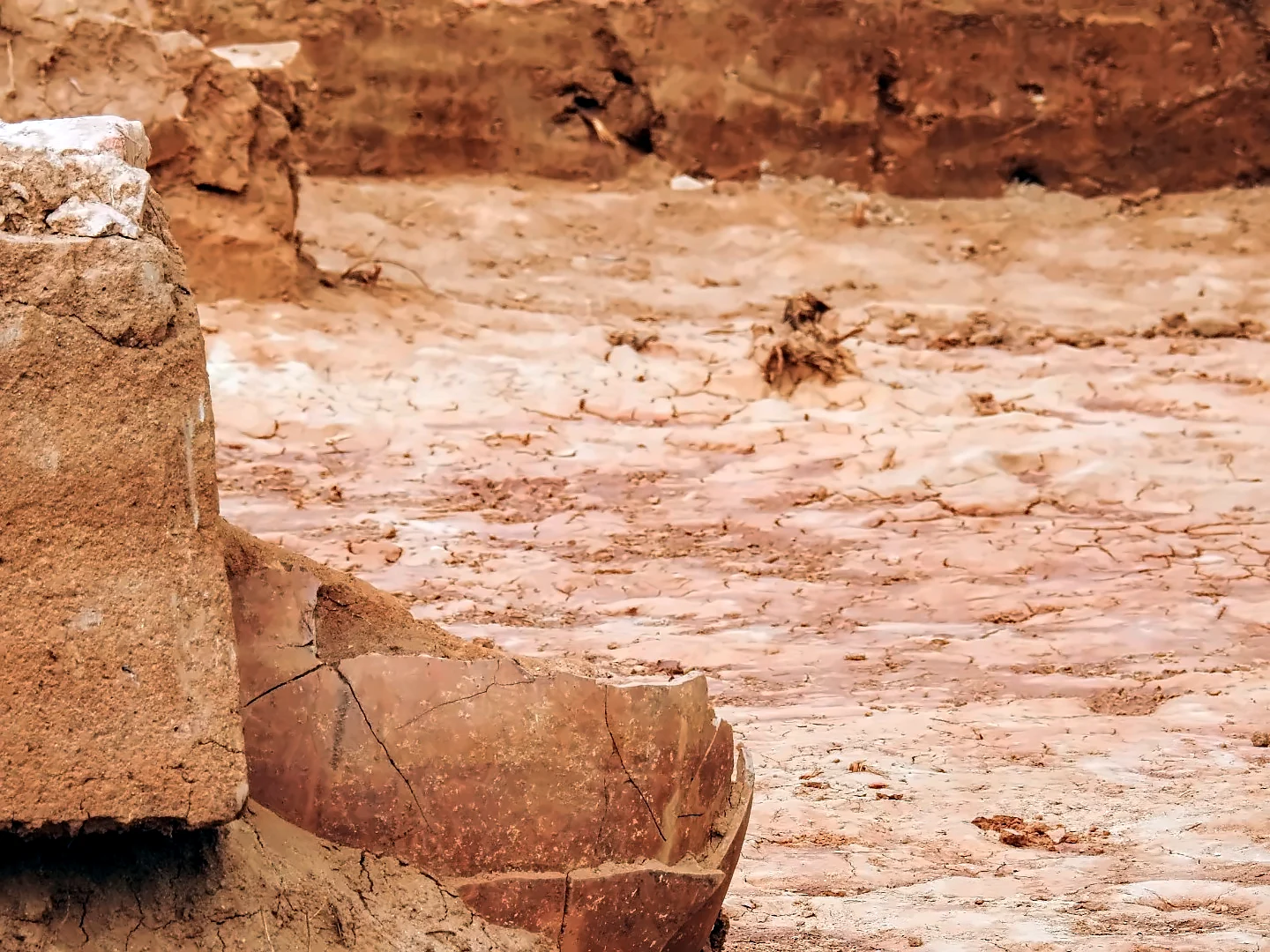
Excavations at Keezhadi, on the Vaigai about 12 km from Madurai, begun by the Archaeological Survey of India in 2014–15 and continued by the Tamil Nadu archaeology department from 2018, have uncovered brick buildings, drains, wells, furnaces, ornaments, dice and thousands of potsherds, some inscribed in Tamil-Brahmi script. Radiocarbon dates from the state's excavations have been reported as early as the 6th century BCE.
The results have become politically charged, with arguments between the state and central governments over dates and reports. Our view: the evidence shows that an urban, literate settlement existed near Madurai several centuries BCE, which supports the picture in Sangam literature of a developed early Tamil urban culture. Claims based on single dates, or direct links to the Indus civilisation, still need more evidence and independent peer review before they can be accepted as settled.
Pandyas, sultans and Vijayanagara
The Pandyas rose and fell several times. In the 13th century, under kings such as Jatavarman Sundara Pandya, they dominated the whole of the Tamil country, and the Venetian traveller Marco Polo, who visited their coast around 1292, described the wealth of their pearl fisheries. But in 1311 the general Malik Kafur, sent by Alauddin Khalji of Delhi, raided Madurai and carried off enormous plunder. In 1335 a governor declared independence and founded the short-lived Madurai Sultanate. The Moroccan traveller Ibn Battuta, whose wife was a sister of the sultan's wife, visited it in 1344 and described a capital ravaged by plague and cruelty.
Around 1378 the Vijayanagara prince Kumara Kampana conquered Madurai. His wife, Gangadevi, wrote a Sanskrit poem about the campaign, the Madhura Vijayam (Conquest of Madurai), in which the goddess of Madurai appears in a dream and asks him to restore her city. Temples were reopened and rebuilt.
The Nayaks and the temple we see today
In 1529 Vijayanagara appointed Viswanatha Nayak as governor of Madurai. His family, the Madurai Nayaks, became effectively independent after Vijayanagara's defeat in 1565 and ruled until 1736. They rebuilt the city on the old plan of concentric streets around the temple, divided the country into military districts (the palayams of the later Poligars), and poured wealth into the temples.
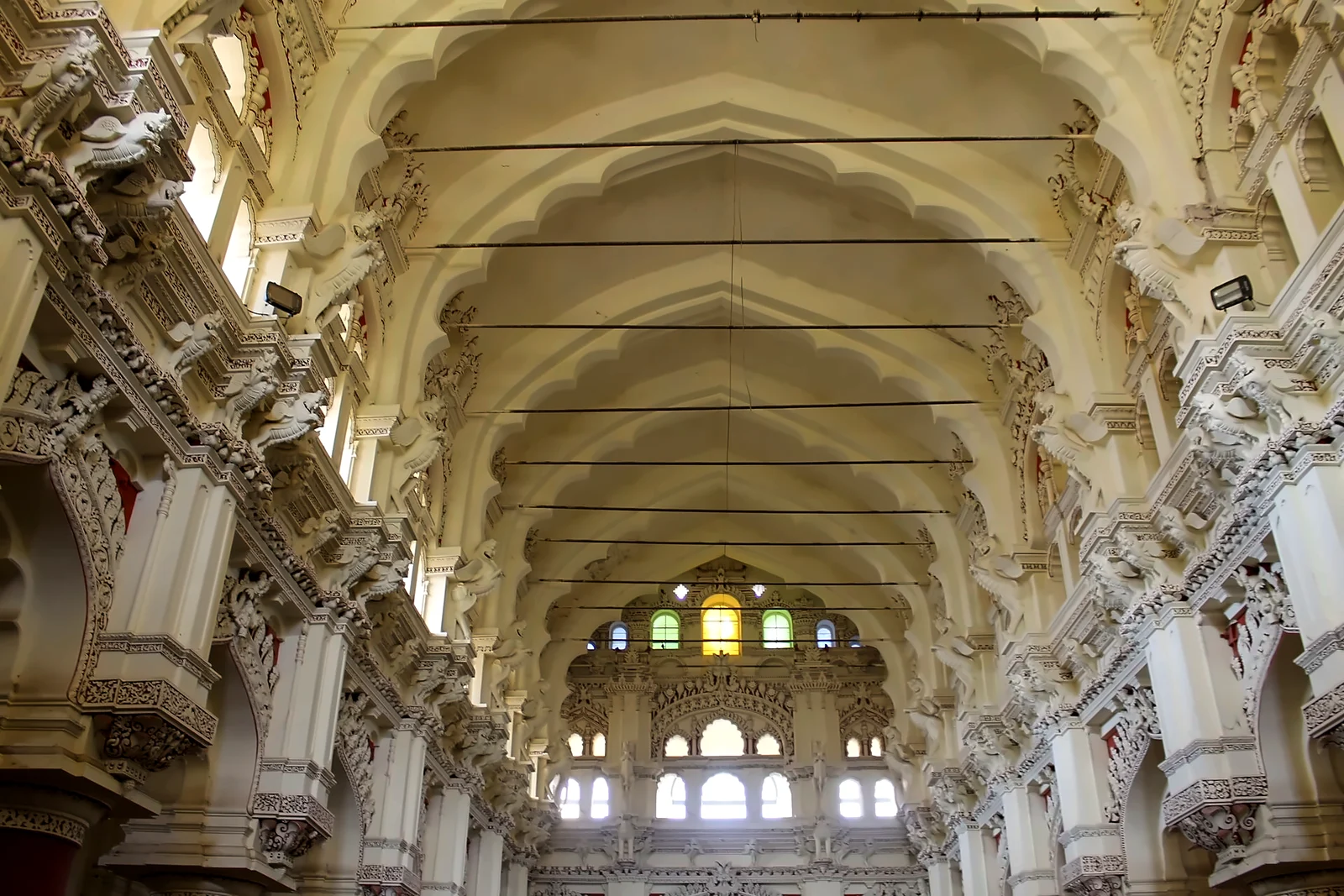
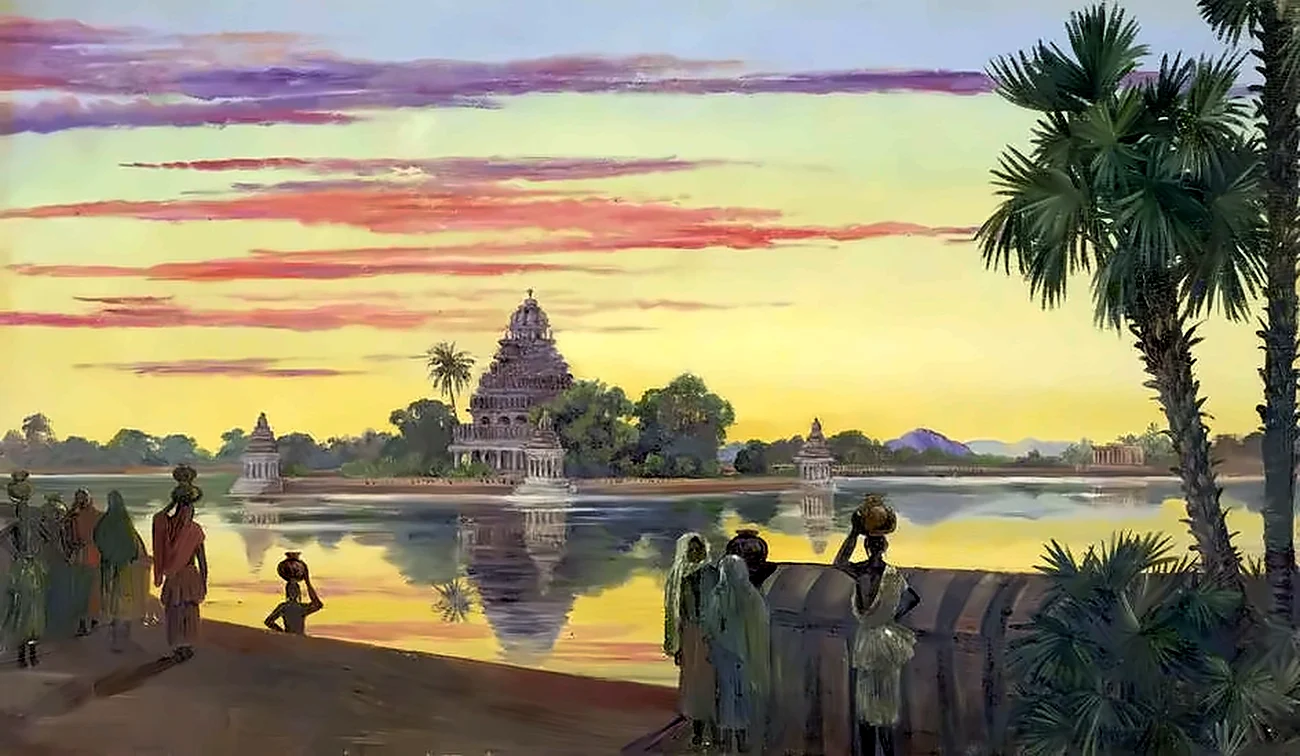
The greatest of them, Thirumalai Nayak (reigned 1623–1659), built the Pudu Mandapam, a great pillared hall facing the temple; the huge Mariamman Teppakulam tank with its island pavilion; and his palace, the Thirumalai Nayak Mahal (completed around 1636). Its vast arcaded halls, blending Dravidian and Islamic forms, are sometimes said to have been designed with the help of an Italian architect, though there is no firm evidence for this. His grandson Chokkanatha moved the capital to Tiruchirappalli and is said to have dismantled much of the palace for materials; only about a quarter survives. Queen Mangammal, who ruled as regent from 1689 to about 1706, is remembered for her roads, rest-houses and wells.
The temple of Meenakshi
According to legend, Meenakshi ("fish-eyed") was born to the Pandya king Malayadhwaja with three breasts, and it was foretold that the third would vanish when she met her husband. She grew up a warrior queen and conquered the world, until she met Shiva on Mount Kailash. They returned to Madurai, where Shiva, as Sundareswarar ("the beautiful lord"), married her and ruled as a Pandya king. Uniquely among great Shiva temples, worship here begins with the goddess, and Madurai is considered her city.
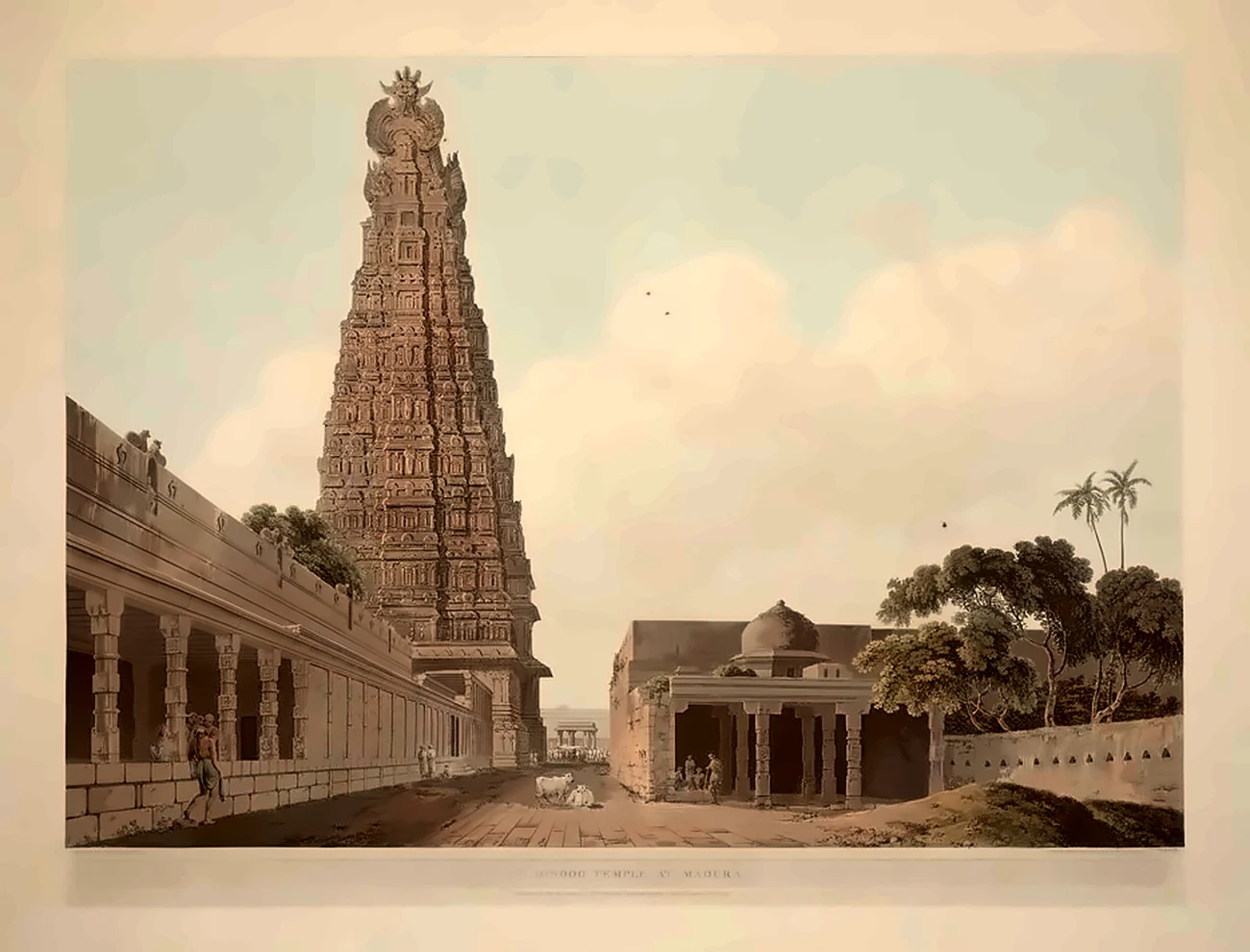
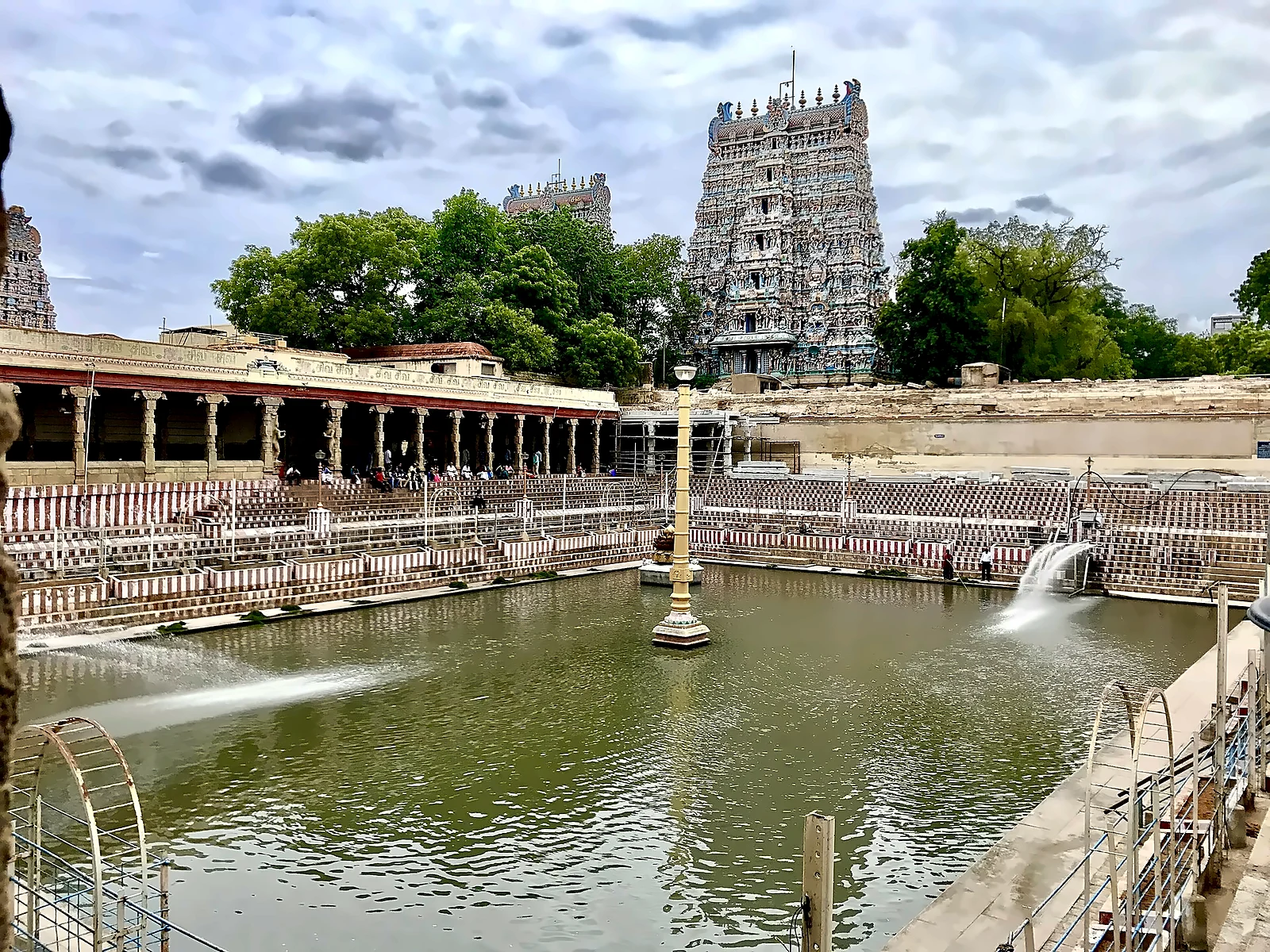
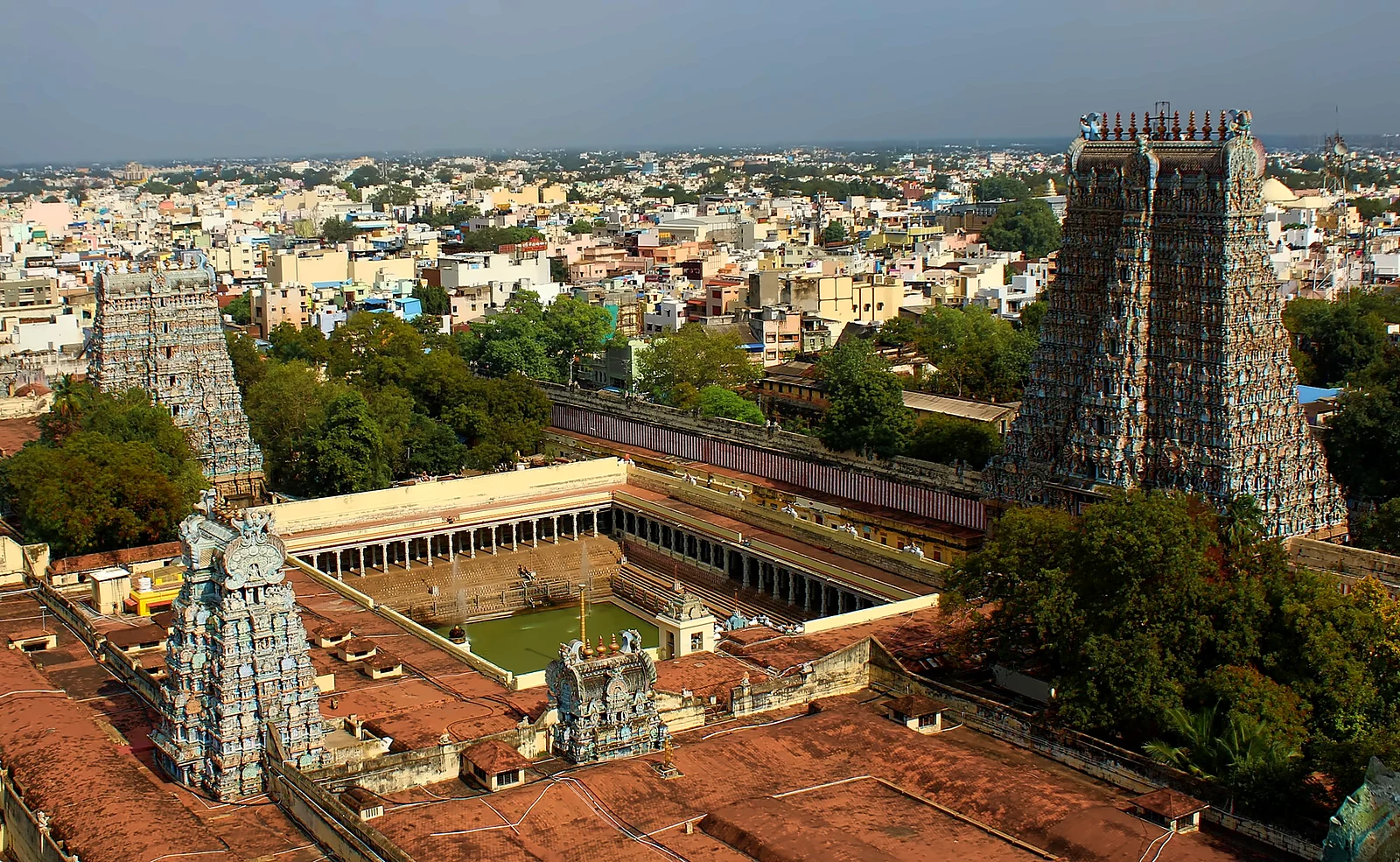
The temple complex covers about 14 acres. Its four outer gopurams, the tallest about 52 m high, are covered with thousands of painted stucco figures of gods, demons and animals, repainted at each kumbhabhishekam (consecration). Inside are the Potramaraikulam (Golden Lotus tank), where tradition says the Sangam poets' works were tested by floating them on the water; the Hall of a Thousand Pillars (in fact 985), built in 1569 by the minister Ariyanatha Mudaliar and now a museum; and corridors lined with sculpted pillars. Although the shrines are ancient, most of the buildings we see were built or rebuilt by the Nayaks in the 16th and 17th centuries.
Chithirai: the divine wedding
Every April–May, during the Chithirai festival, Madurai re-enacts the wedding of Meenakshi and Sundareswarar. The festival also includes the arrival of Kallazhagar (Vishnu, Meenakshi's brother) from the Alagar Kovil hills, who, arriving too late for the wedding, enters the Vaigai river riding a golden horse before hundreds of thousands of devotees. Historians believe that Thirumalai Nayak merged two separate festivals, one Shaiva and one Vaishnava, into a single celebration, which helps explain its unusual story.
Under the British and after
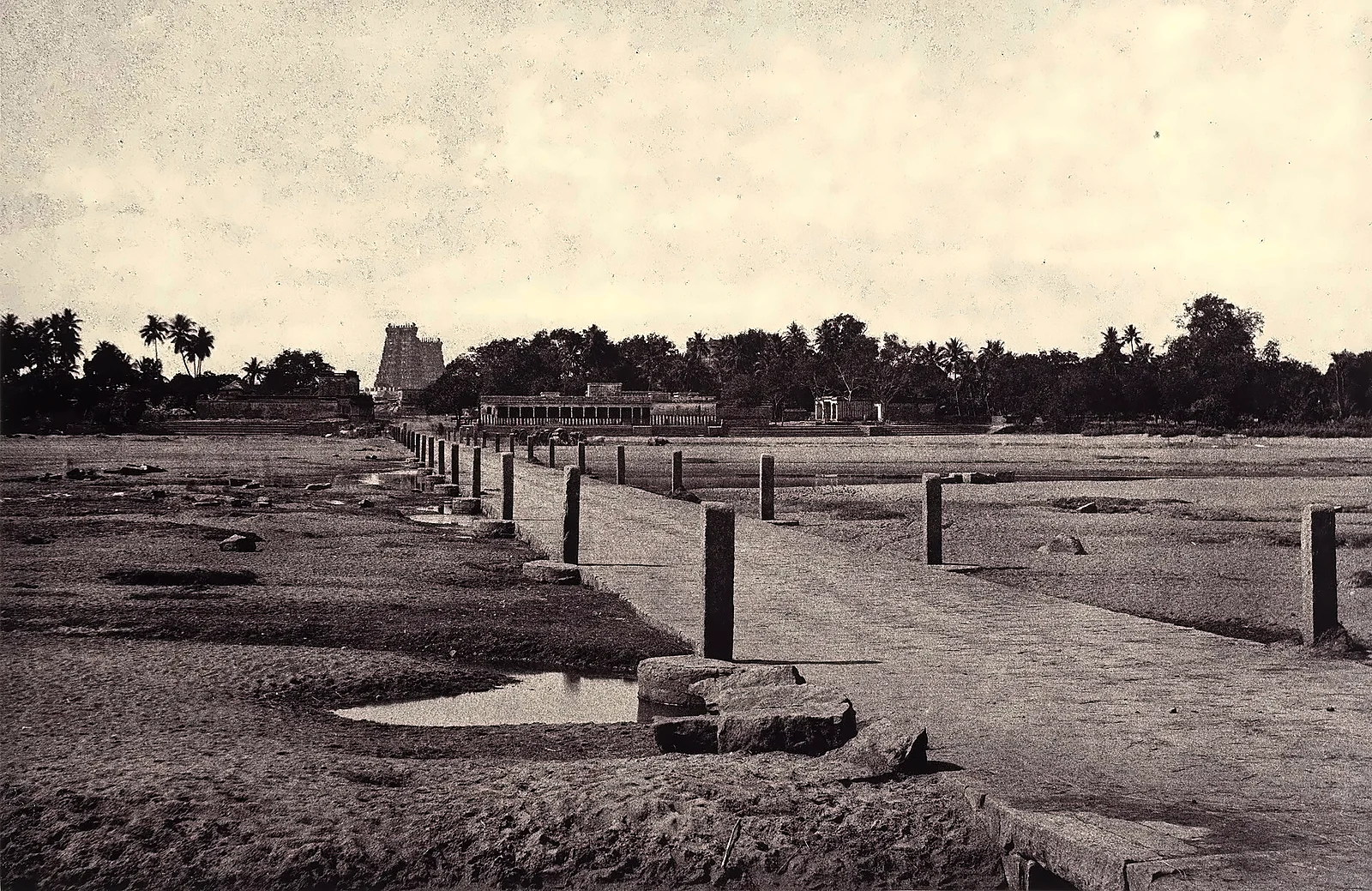
After the Nayaks fell, Madurai passed through the hands of the Nawab of Arcot, the soldier-adventurer Yusuf Khan (Marudhanayagam), who held it in the 1760s, and finally the British East India Company. In the 1840s the British collector demolished the old fort walls and laid out the outer streets on their line, giving the city its present shape. Linnaeus Tripe, the official photographer of the Madras Presidency, photographed the temple and the city in 1858.
Madurai played a notable part in the national movement. It was here, on 22 September 1921, that Mahatma Gandhi decided to give up his shirt and wear only a loincloth, to identify himself with India's poor. And on 8 July 1939, the reformer A. Vaidyanatha Iyer led a group of Dalit and Nadar devotees, among them P. Kakkan, later a Tamil Nadu minister, into the Meenakshi temple, an event that helped open the temples of the Madras Presidency to all Hindus.
Our assessment: why has Madurai survived when so many ancient capitals vanished?
Hampi was abandoned after one battle; Muziris disappeared under the silt. Madurai has been raided, conquered and rebuilt many times, yet it has never been deserted. We think the reason is the temple. Because the city's identity was built around a living shrine and its festivals, every new ruler, whether Pandya, Vijayanagara governor or Nayak, gained legitimacy by restoring the temple and its rituals rather than founding a new centre. The temple anchored the people, the streets and the economy. It is a striking example of how a sacred centre can keep a city alive for more than two thousand years.
Visiting
- Getting there: Madurai has an airport and is a major railway junction. By road it is about 4–5 hours from Munnar via Bodinayakanur, or via Theni.
- The temple: open from early morning to late evening with an afternoon break. Mobile phones and cameras are not allowed inside; there are counters to deposit them. Modest dress is required.
- Don't miss: the Thousand Pillar Hall museum, the evening ceremony when Sundareswarar is carried to Meenakshi's bedchamber, the Thirumalai Nayak Mahal (sound-and-light show in the evening) and the Gandhi Memorial Museum, housed in Rani Mangammal's palace.
- Best time: October to March; Chithirai festival in April–May if you can handle the crowds and heat.
Read also: Hampi and Vijayanagara · Padmanabhaswamy and Thiruvananthapuram · Muziris · Keezhthali and Kodungallur
Read also: Rameswaram and Dhanushkodi
See it for yourself, with a local driver who knows these roads.
Book a Munnar Jeep SafariSources & further reading
- Live History India: Madurai Palace, a royal survivor
- The Wire Science: Keezhadi excavations
- Wikipedia: A. Vaidyanatha Iyer
- DT Next: Facilitating entry of Dalits into Meenakshi Amman temple
- Wikipedia: Thirumalai Nayakkar Mahal
Figures are from the sources listed and were checked in October 2026. Park timings and road conditions change, so please confirm before you travel.