
Where the Goddess Rested: The Kuthirayala Cave Temple and the Memory of Madurai in the High Ranges
In a rock shelter above Adimali, a small cave shrine to Kali keeps alive a story that the goddess of Madurai once rested here on her way to the Kerala coast. What the legend tells us, and how it fits the old traditions that link Madurai to these hills.
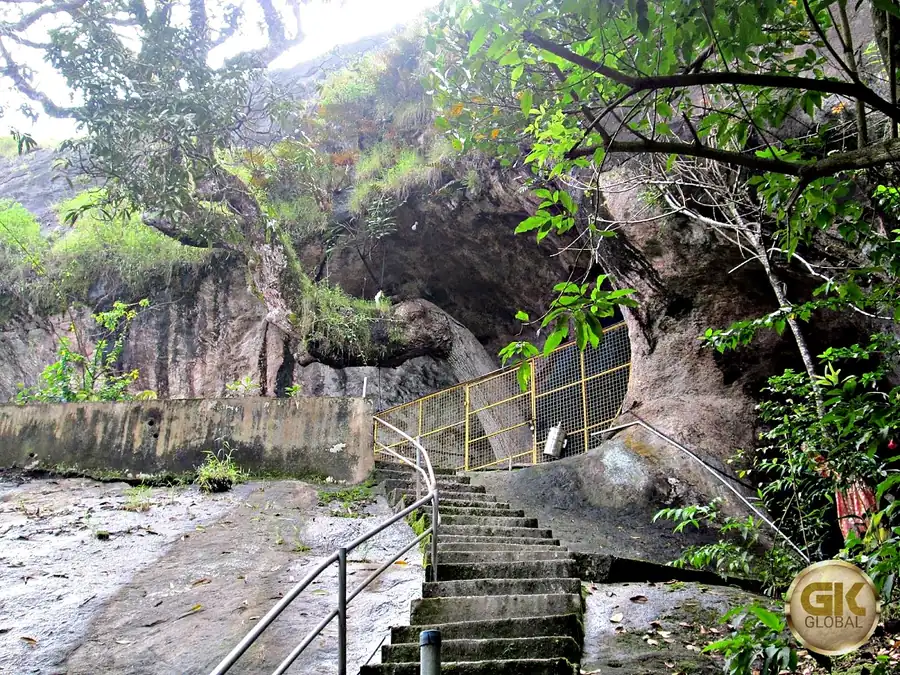
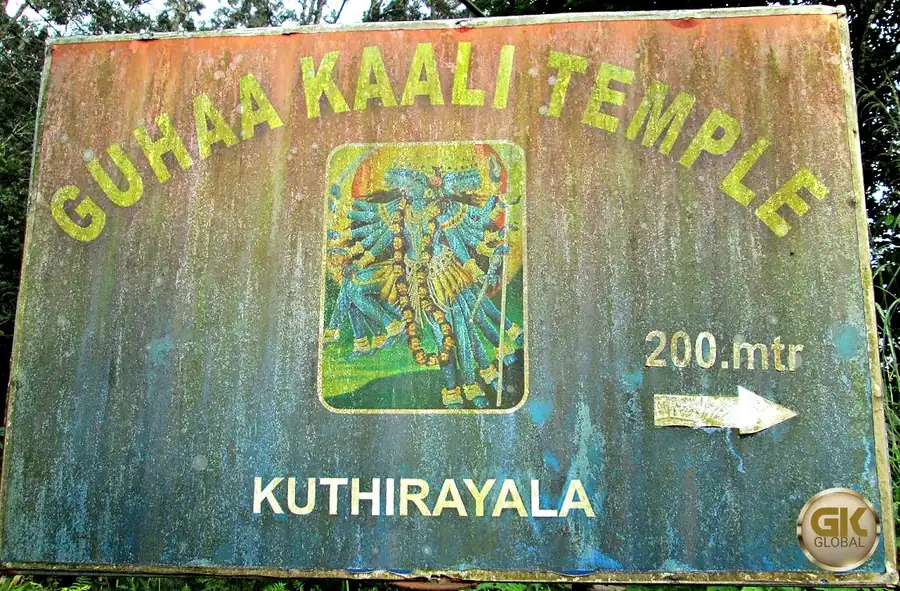
A faded signboard by the roadside points the way: Guhaa Kaali Temple, Kuthirayala, 200 m. A short climb leads to a great overhang of granite, its roof streaked by monsoon rain and fringed with grass and shola trees. Concrete steps and steel railings rise to a yellow grille that closes off the mouth of the shelter. Inside, in the half-dark, is a shrine to the goddess Kali. Red and yellow cloths tied to the nearby trees mark the offerings of devotees.
Local people speak of this shrine with a particular reverence. The goddess worshipped here, they say, is Kodungallur Amma, the great goddess of the Kodungallur Bhagavathy temple on the Kerala coast. Long ago, on her journey from Madurai to Kodungallur, she is said to have rested in this cave.
This article looks at that story the way a historian and anthropologist would: by placing it beside the written epic it echoes, the other traditions of these hills that remember a journey from Madurai, and the long history of cave shrines in Kerala. The aim is not to prove or disprove the legend, which belongs to the faith of those who keep it, but to understand where it comes from and why it has taken root here.
At a glance
- Where: Kuthirayala, in the hills near Adimali, Idukki district, in the area of the tribal settlements of Korangatty and Mannamkandam (the old name of Adimali), close to the old Neriamangalam–Munnar road.
- What: a natural granite rock shelter housing a shrine to Kali, worshipped locally as Kodungallur Amma.
- The legend: the goddess of Madurai rested in the cave on her journey west to Kodungallur.
- Behind it: the Tamil epic Silappatikaram, in which Kannagi walks from Madurai into the Chera hills, and several traditions of migration from Madurai into these mountains.
- Evidence: no inscriptions or archaeological study of the cave are known. Its age as a place of worship is unrecorded, and the legend survives in oral tradition.
The place and its name
Kuthirayala lies in the rolling, forested country between Adimali and the higher tea hills of Munnar. Before the large settlements of the mid-twentieth century, this was the land of the Mannan and Muthuvan peoples. Adimali itself was long known as Mannamkandam, "the land of the Mannans". Settlers from the lowlands arrived in numbers only from the 1930s and 1940s, under the land auctions of Travancore and later the Grow More Food programme.
The name Kuthirayala is usually understood as kuthira-alayam, a "horse stable" or "place of horses". Local explanations vary, and no written record explains it. Rock shelters of this kind, dry under their overhangs even in the monsoon, have sheltered travellers, herders and hunters for as long as people have crossed these hills.
Geography: a road between two kingdoms?
The legend places the cave on a journey from Madurai, capital of the Pandya kings, to Kodungallur, the ancient Chera port often identified with Muziris. It is natural to ask whether the road past Kuthirayala was an ancient route between the two.
The evidence calls for caution. The road through Neriamangalam and Adimali that visitors use today is modern. After the Great Flood of 1924 destroyed the older route through Pooyamkutty and Karinthiri, Maharani Sethu Lakshmi Bayi ordered a new road from Aluva to Munnar, which opened in 1931; the Neriamangalam bridge over the Periyar followed in 1935. The older "Royal Road" (see our article on Karinthiri) was itself rebuilt by the British in the 1890s, although popular accounts claim that it followed far older paths.
The best-documented ancient links between the Tamil country and the Kerala coast lay elsewhere: chiefly the Palakkad Gap, where the ancient highway known as the Rajakesari Peruvazhi ran, and, further south, the passes near Kambam and Kumily. Trade in pepper, cardamom, sandalwood and other forest produce certainly crossed the High Ranges by footpaths and bullock tracks, and the passes at Bodimettu and Top Station connected the hills to Bodinayakanur and the Madurai country. But no archaeological survey has yet traced an ancient road through Adimali itself. The safest statement is that the cave lies in country that has long been crossed between the Tamil plains and the coast, not that it sat on a mapped royal highway.
The Silappatikaram and Kannagi's journey
The story the cave remembers has its roots in the Silappatikaram, "The Tale of the Anklet", the earliest of the great Tamil epics. It is attributed to Ilango Adigal, remembered as a Chera prince who became an ascetic, and is usually dated to around the fifth or sixth century CE, though it draws on older traditions.
Its heroine, Kannagi, comes to Madurai with her husband Kovalan, who is wrongly accused of stealing the queen's anklet and executed on the Pandya king's order. Kannagi proves his innocence before the king, and in her grief and fury Madurai burns. She then leaves the city and walks west into the hills of the Chera country. According to the epic, she reaches a hill of the god Murugan, waits there, and on the fourteenth day rises to heaven with Kovalan in a celestial chariot.
The first witnesses are not kings but the hill people, the kuravar, who see the goddess rise and worship her with song and dance. Their report reaches the Chera king Chenguttuvan, who brings a stone from the Himalayas, carves her image and consecrates it as Pattini, the goddess of chastity, at his capital, Vanji. The epic thus describes the birth of a cult that began among mountain folk and was then taken up by a king.
Exactly where Kannagi went is not settled by the text, and many places claim her. The Mangala Devi Kannagi temple, high on the Kerala–Tamil Nadu border near Kumily, is traditionally held to be where she stayed for fourteen days; it opens only once a year, at Chitra Pournami, and is worshipped by priests from both states. In Kerala tradition, Attukal in Thiruvananthapuram is one of the places she passed, and at Kodungallur she is believed to have found her final rest and union with the goddess Bhadrakali. The Kodungallur temple's own tradition says that a shrine to Kannagi was first established there by Chenguttuvan.
The Kuthirayala legend belongs to this wider landscape of memory. A goddess who walked from Madurai into the Chera hills could have passed through many valleys, and communities along the way have made her journey their own. Kuthirayala adds a resting place on a northern line of travel, through the High Ranges towards the Periyar and the coast.
Kannagi, Meenakshi and the goddess of Madurai
In the local telling, the goddess who rested at Kuthirayala is sometimes called Madurai Meenakshi rather than Kannagi. To a literary historian, these are different figures. Meenakshi is the presiding goddess of Madurai's great temple, the divine queen of the city and consort of Shiva as Sundareswarar. Kannagi is a mortal woman of the epic who becomes a goddess through her suffering and righteous anger. In some versions of the Kannagi story, it is Meenakshi, the guardian goddess of Madurai, who calms her and sends her on her way.
Oral tradition often merges such figures. Both are powerful goddesses tied to Madurai, and in popular memory "the goddess who came from Madurai" can easily become one. In the hills of Idukki, this merging has a special resonance, because several communities here hold traditions of their own journeys from Madurai:
- The Poonjar royal family, whose lands once included the Kannan Devan Hills where Munnar now stands, trace their descent from a Pandya king of Madurai. Family tradition says that he fled the city in the twelfth century after a war, carrying the images of Meenakshi and Sundareswarar, and that the family later enshrined them in a Meenakshi temple at Poonjar on the Meenachil river. The Kannan Devan Hills were leased from the Poonjar chief to John Daniel Munro in 1877, opening the High Range to planting.
- The Muthuvan people say that they too came from Madurai, and their name is often linked to muthuku, "back". In one version, recorded among Muthuvan families near Adimali, they left Madurai when the city fell under the wrath of the goddess Meenakshi, carrying her image on their backs and shoulders up into the hills. In another, they carried their children, their belongings and a dethroned king. Meenakshi of Madurai remains their goddess.
- The Mannan people, who gave Mannamkandam its name, keep a hereditary king of their own. Their tradition links them to a Pandya king, and they too look to Meenakshi of Madurai as their tutelary goddess.
Whatever the historical basis of each story, together they show how deeply the idea of a migration from Madurai into these mountains is rooted in the High Ranges. A legend that Madurai's goddess rested in a cave near Adimali fits naturally into that shared memory. Indeed, for the Muthuvan and Mannan families of the Adimali hills, a goddess who came up from Madurai and made her home in the mountains is not a borrowed idea but part of their own story of origin. The cave legend may be the form in which Kannagi's epic journey, the Poonjar family's carrying of Meenakshi, and the hill peoples' own memories have come together in one place.
From rock shelter to Shakti shrine
The Kuthirayala cave is today a temple of Kali, worshipped as Kodungallur Amma, in an area long inhabited by tribal communities. That combination has deep roots in Kerala's religious history.
The worship of fierce mother goddesses, known in Kerala as Bhagavathy or Bhadrakali, is among the oldest and most widespread forms of religion in the region. It has absorbed many older layers: the worship of forest and mountain spirits, of local guardian deities, and of heroic women such as Kannagi, whose cult the Silappatikaram traces to the hill people. Kodungallur itself, with its famous Bharani festival, its oracles (velichappad) and its long history of non-Brahmin rites, preserves many of these older elements.
Caves and rock shelters have often been at the centre of this layering. At Kallil, near Perumbavoor, a shrine cut into a great boulder was originally Jain, with carvings of the Tirthankaras Parshvanatha and Mahavira and of the goddess Padmavati; from about the ninth century it became a Bhagavathy temple, and Padmavati is still worshipped there as Bhagavathy. At Chitharal, in the old Travancore country, a Jain rock shelter with carved Tirthankaras was likewise turned into a Bhagavathy shrine in the medieval period. Across South India, natural caves first used by ascetics, hunters and herders were later taken over by new forms of worship.
There is, however, no evidence that Kuthirayala was ever a Jain site. No carvings or inscriptions have been reported from the cave, and no archaeological study has been made of it. It is more likely, though unproven, that it was first a shelter and a sacred place for the forest peoples of the area, and that its present form as a Kali temple, with its gate, steps and railings, is recent. Like many shrines in the hills, it is probably a place where older local reverence has been given the name and form of a great regional goddess.
A legend worth recording
The Kuthirayala cave temple is a small place with a large story. Its legend links a rock shelter in the Idukki hills to Madurai, to the Kerala coast, and to one of the great works of Tamil literature. Read critically, the story does not tell us that a particular goddess slept in this particular cave. It tells us how the people of these hills have understood their place in a wider world: on the path of goddesses, kings and peoples who came from Madurai to the land of the Cheras.
Such traditions live mainly in memory and are easily lost as generations change. Recording them, with the voices of the people who keep them, is an important task for local history. We would be glad to hear from anyone who knows more about the Kuthirayala cave, its festivals and its stories.
Visiting
- The cave temple is a place of worship. Remove footwear where asked, dress modestly, and ask before taking photographs of the shrine.
- The steps can be wet and slippery in the monsoon; take care with children and elderly visitors.
- Kuthirayala lies in an area of tribal settlements. Please respect people's privacy and homes.
- For more on the High Ranges and their peoples, see our articles on the history of Munnar and the tribal communities of the Munnar hills.
See it for yourself, with a local driver who knows these roads.
Book a Munnar Jeep SafariSources & further reading
- Wikipedia: Silappatikaram (Cilappatikaram)
- Wikipedia: Kannagi
- Wikipedia: Mangala Devi Kannagi Temple
- Wikipedia: Kodungallur Sree Kurumba Bhagavathy Temple
- Wikipedia: Kallil Temple
- Wikipedia: Poonjar dynasty
- Poonjar Online: The Pandyan king of Madurai who became king of Poonjar
- Wikipedia: Muthuvan
- Cherian, Korulla & Sheena: Changes in tribal culture: a study among the Muthuvan tribe in Idukki district (2018)
- Wikipedia: Mannan people
- Adimali Grama Panchayat: History
- Wikipedia: Adimali
- Wikipedia: Neriamangalam Bridge
- Wikipedia: Palakkad Gap
- Aanavandi: History of the old Munnar–Aluva pathway
Figures are from the sources listed and were checked in October 2026. Park timings and road conditions change, so please confirm before you travel.