
Theyyam, Part 2: The Gods. Types, Names, Stories and Shrines
Muchilottu Bhagavathi, Kathivanoor Veeran, Pottan, Muthappan, Vishnumoorthi, Kadangot Makkam, the Mappila theyyams and more: the families of theyyam, the stories behind them, how they differ and where to see them.
This is the second of two parts. Part 1: the ritual explains the ritual: its origins, the performers, their preparation, the make-up, the costume and the night. Here we turn to the gods themselves: the families of theyyam, the stories behind the most important ones, how they differ, and where they are performed.
Ask a devotee in Kannur how many theyyams there are and you may be told 'more than four hundred'. Some scholars count fewer; a few writers count many more, because the same deity often appears under different local names, and many small family shrines have theyyams known only in their own village. There is no official list. But the gods fall into recognisable families, and once you know the families, any theyyam you meet will begin to make sense.
The stories below are told as the shrines and the sacred songs tell them. Where a story differs between villages, we say so. Where history can be seen behind the legend, we give our own reading, always clearly marked.
The families of theyyam
- Mother goddesses (Bhagavathi, Amma): the largest family, from the gentle Muchilottu Bhagavathi to fierce Kali forms.
- Chamundis: fierce goddesses who destroy demons, such as Raktha Chamundi and Kundora Chamundi.
- Heroes and deified people (veeran, daivakkaru): men and women who lived, died, often unjustly, and became gods: Kathivanoor Veeran, Kandanar Kelan, Kadangot Makkam, Palanthayi Kannan.
- Forms of Shiva: Pottan, Gulikan, Bhairavan, the hunter god Vettakkorumakan.
- Forms of Vishnu: Vishnumoorthi (Narasimha), Daivathar, and the fire rite Ottakolam.
- Forest, hunter and ancestor gods: Muthappan, Vayanattu Kulavan.
- Spirits and serpents: Kuttichathan, the Naga (serpent) theyyams such as Nagakkali.
- Muslim and other characters: the Mappila theyyams, such as Bappiriyan, Aali and Ummachi.
The goddesses
Muchilottu Bhagavathi: the scholar who was not believed
Muchilottu Bhagavathi is the family deity of the Vaniya community, traditionally oil-pressers, and is worshipped in more than a hundred Muchilottu kaavus across north Kerala. Her story, as the oral tradition tells it, begins with a young Brahmin woman of Peringellur (Perinchellur, today's Taliparamba area) who was so learned that she defeated the scholars in debate on the Vedas. Humiliated, they turned on her and questioned her purity; she was driven out. In despair she went to the shrine at Karivellur and threw herself into a fire. A Vaniya man carrying oil to the temple came by and poured his oil on the flames; with the blessing of Shiva, she rose as a goddess. She then came to the house of Muchilottu Padanayar, a Vaniya soldier of the Kolathiri, and his family made her their deity. A palm-leaf text of the shrines adds a Puranic frame, calling her an incarnation of Sita, Maya and Gayatri.
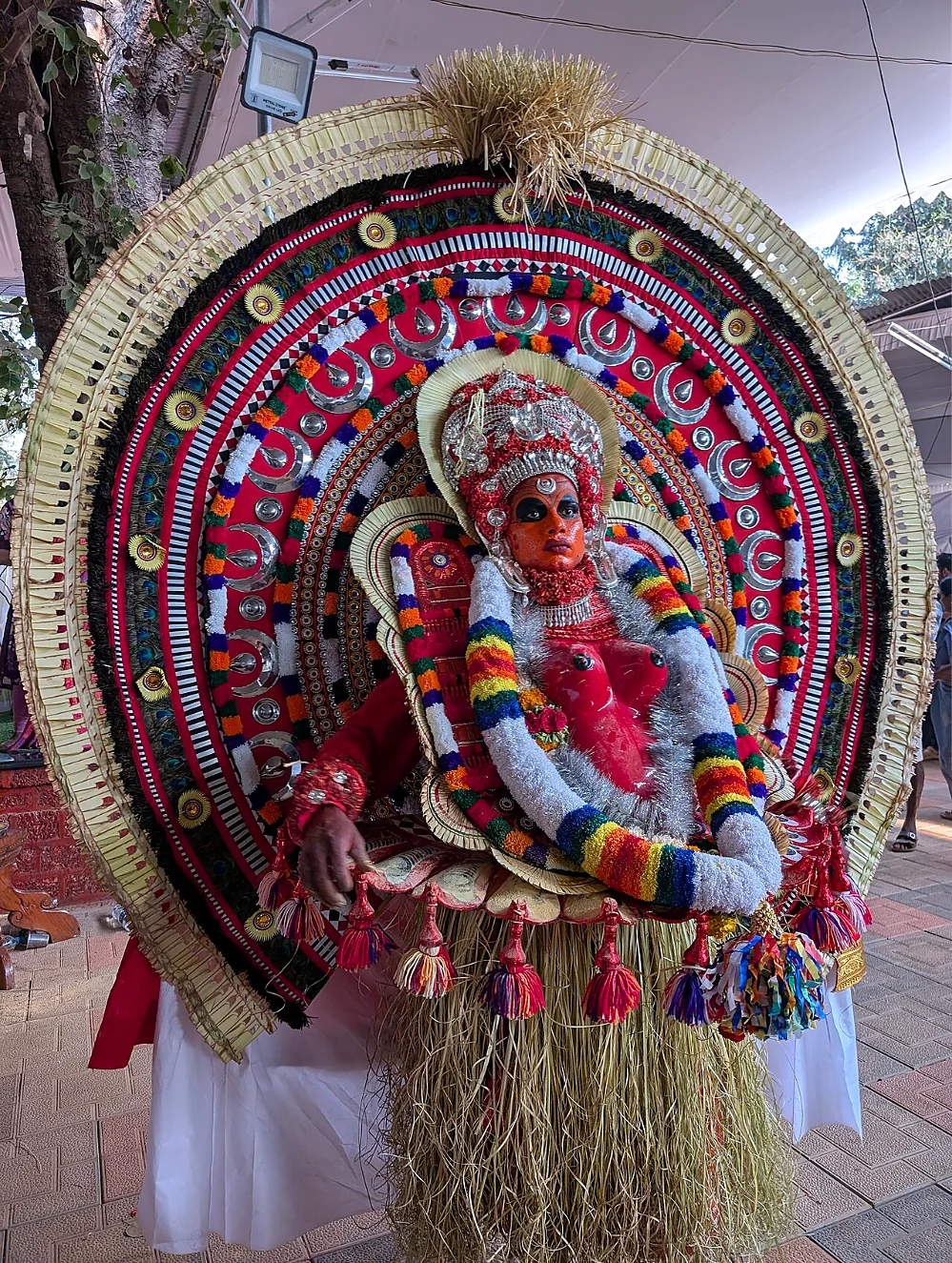
Her theyyam is known for its grace: she is a gentle, sattvic goddess, and her movements are slow and dignified, with a great round crown. Her perumkaliyattams, held at long intervals at one or another of her shrines, are among the largest festivals of north Malabar, with free meals for tens of thousands.
Our assessment: a learned woman punished
We cannot know whether a particular Brahmin woman of Peringellur ever lived. But the story is very specific: a woman whose learning shamed men of her own caste, who was accused of impurity because she could not be answered, and who was saved, as a goddess, by an oil-presser of a 'lower' community. Stories with such precise social detail rarely arise from nothing. We read it as the memory of a real kind of injustice, the silencing of women's learning, preserved and reversed by the community that adopted her. It is striking that a goddess born of a Brahmin story should be worshipped by Vaniyas and embodied by a performer from one of the most marginalised castes of north Kerala.
Thiruvarkattu Bhagavathi and Madayi Kavu
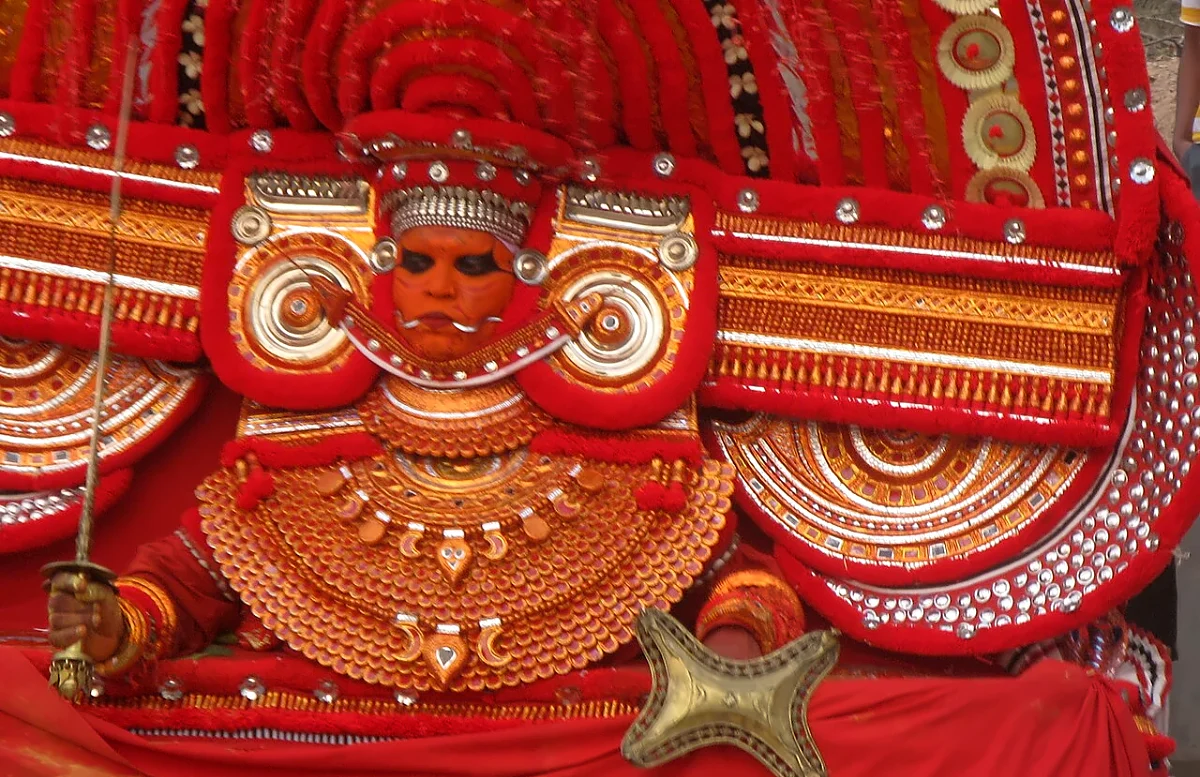
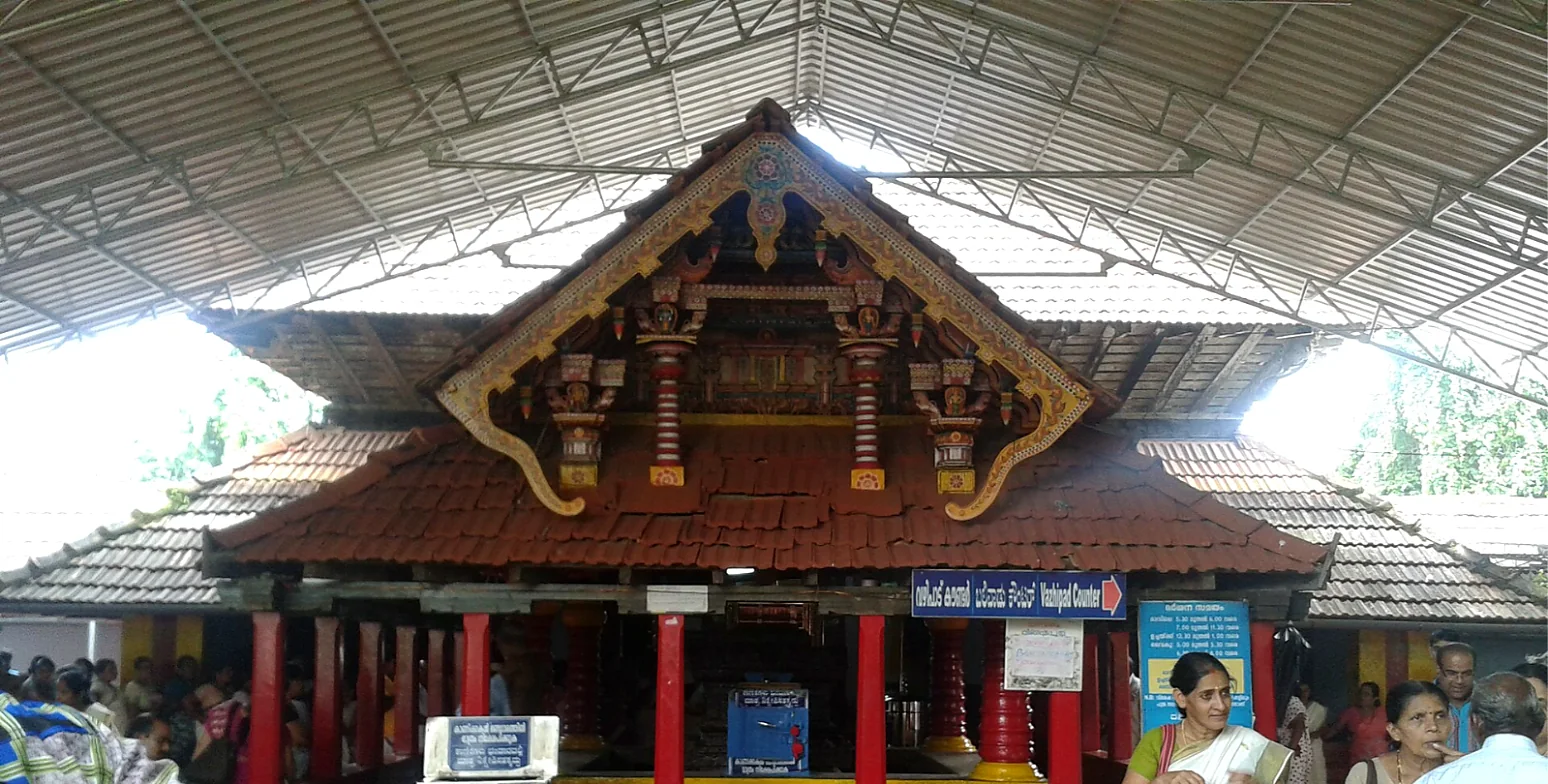
The grove-temple of Madayi Kavu, near Payangadi in Kannur district, is the great shrine of the Kolathiri rajas, dedicated to the goddess as Thiruvarkattu Bhagavathi, a form of Bhadrakali. Its kaliyattam, with that of Kalarivathukkal, closes the theyyam season each year.
Puthiya Bhagavathi: the fire goddess
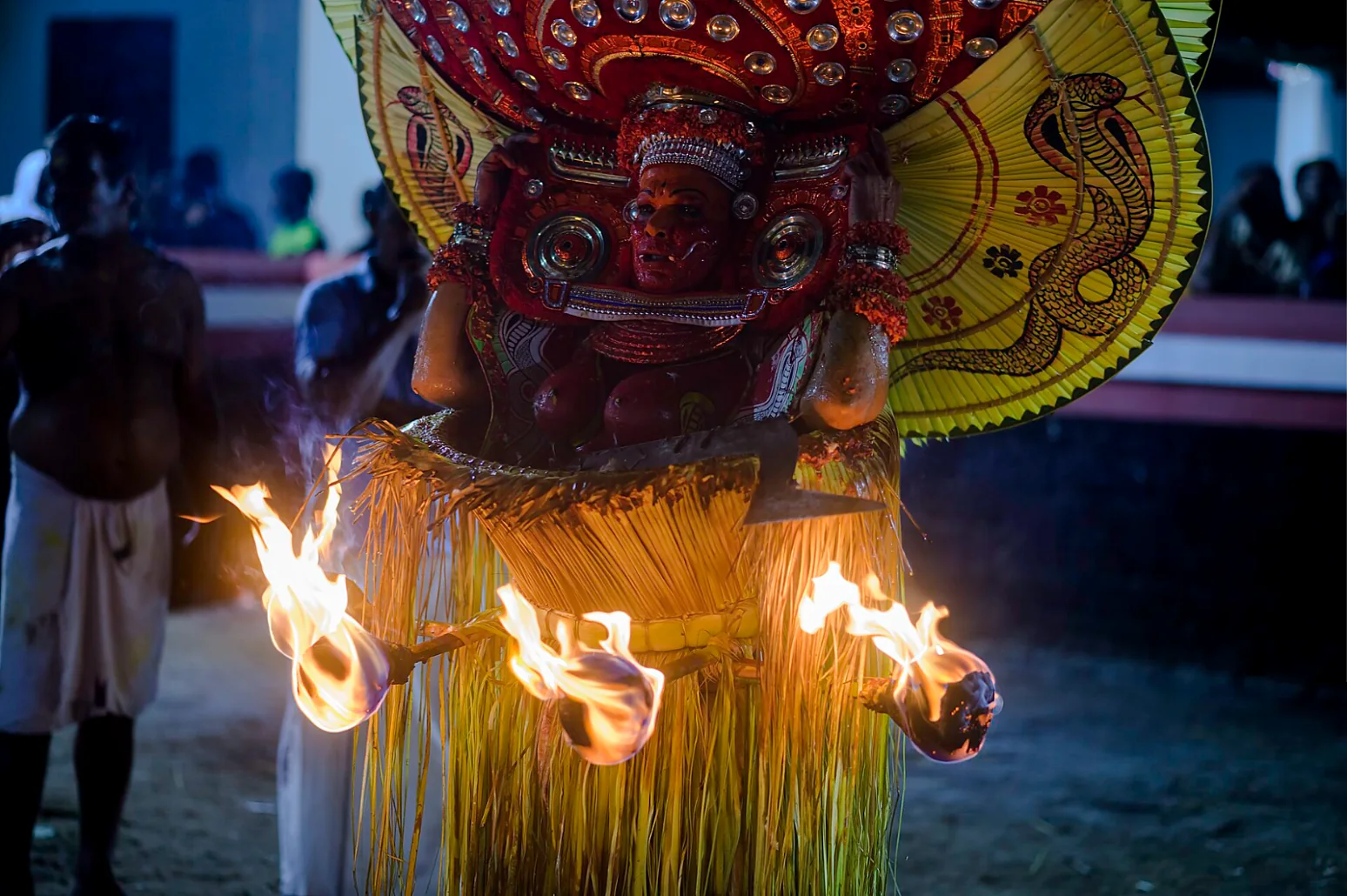
Puthiya Bhagavathi ('the new goddess') is a fierce mother goddess, often identified with Bhadrakali, recognised by the burning torches fixed around her waist and the cobras painted on the side wings of her headdress. In one version of her story, she was born from a sacrifice performed to end an epidemic of smallpox that had followed another goddess's anger, and agreed to cure the disease; later she fought a demon, lost her children and destroyed his city in her rage before settling in the shrines of north Malabar. The Kolathiri raja, says the tradition, commanded her theyyam after she appeared to him in a dream. Cheerumba Bhagavathi is regarded as her younger sister.
Raktha Chamundi and the Chamundis
The Chamundis are the warrior forms of the goddess who destroyed the demons Chanda and Munda. Raktha Chamundi ('blood Chamundi') is one of the most widespread; a famous shrine is the Chamundi Kottam at Chirakkal. Kundora Chamundi, performed by the Velan community, is said to have fought the demon Darika for seven days, riding a vetala; the song of Madayil Chamundi follows the demon into the underworld. Some Chamundis absorbed local spirits: at Kamballur in Kasaragod the spirit of a Muslim mukri is said to have merged with Karinchamundi (see the Mappila theyyams below).
Kadangot Makkam: the sister who was murdered
This is one of the most moving theyyam stories, and one of the best documented. Makkam was the only daughter of the Kadangot Nambiar family of Kunhimangalam, near Payyannur, born after twelve brothers, all warriors of the Kolathiri. While her brothers were away at war, her jealous sisters-in-law spread the slander that she had a lover, the Vaniya who brought oil to the house: she had only asked him to carry the pot inside because she was menstruating and could not touch it, and they had refused to help. The brothers believed their wives. They invited Makkam to a festival and, on the way, at a well, killed her and her two children, Chathu and Chiru, and a Mavilan man who saw it. Only the youngest brother refused to take part. The family house burned; the guilty died; Makkam appeared in a dream and asked for a shrine. She is worshipped with her children and the Mavilan as Makkavum Makkalum, 'Makkam and her children', and families pray to her for children. Her story was set down in Malayalam verse in the kilippattu style in 1918.
Our assessment: a crime remembered
The Makkam story names a real family house, real villages, a real well and the exact relations of everyone involved; it remembers the one brother who refused; and it even includes the outsider, a Mavilan, who was killed as a witness and is worshipped with her. This is exactly how communities remember a real crime. We think it very likely that behind Makkam lies a historical killing in a Nambiar family, an 'honour' murder in the language of today, and that the theyyam was the community's way of declaring her innocence and keeping the guilt of the killers in public memory.
The heroes
Kathivanoor Veeran: the warrior and his wife
Kathivanoor Veeran is the deified Mandappan Chekavar, a Thiyya warrior. Born to a wealthy family, he preferred hunting and martial arts to work, quarrelled with his father, and left home; abandoned by his friends in the Kudagu (Coorg) hills, he found his way to his uncle's house at Kathivanoor, started an oil business, and married Chemmarathi. When an army from Kudagu attacked the village, he fought and won, but on the way home realised he had lost his ring and his little finger in the fight. He went back alone to find them and was killed by the defeated enemy. In the story, Chemmarathi saw the ring and the finger fall onto a banana leaf at home, and threw herself onto his funeral pyre. Both became deities.
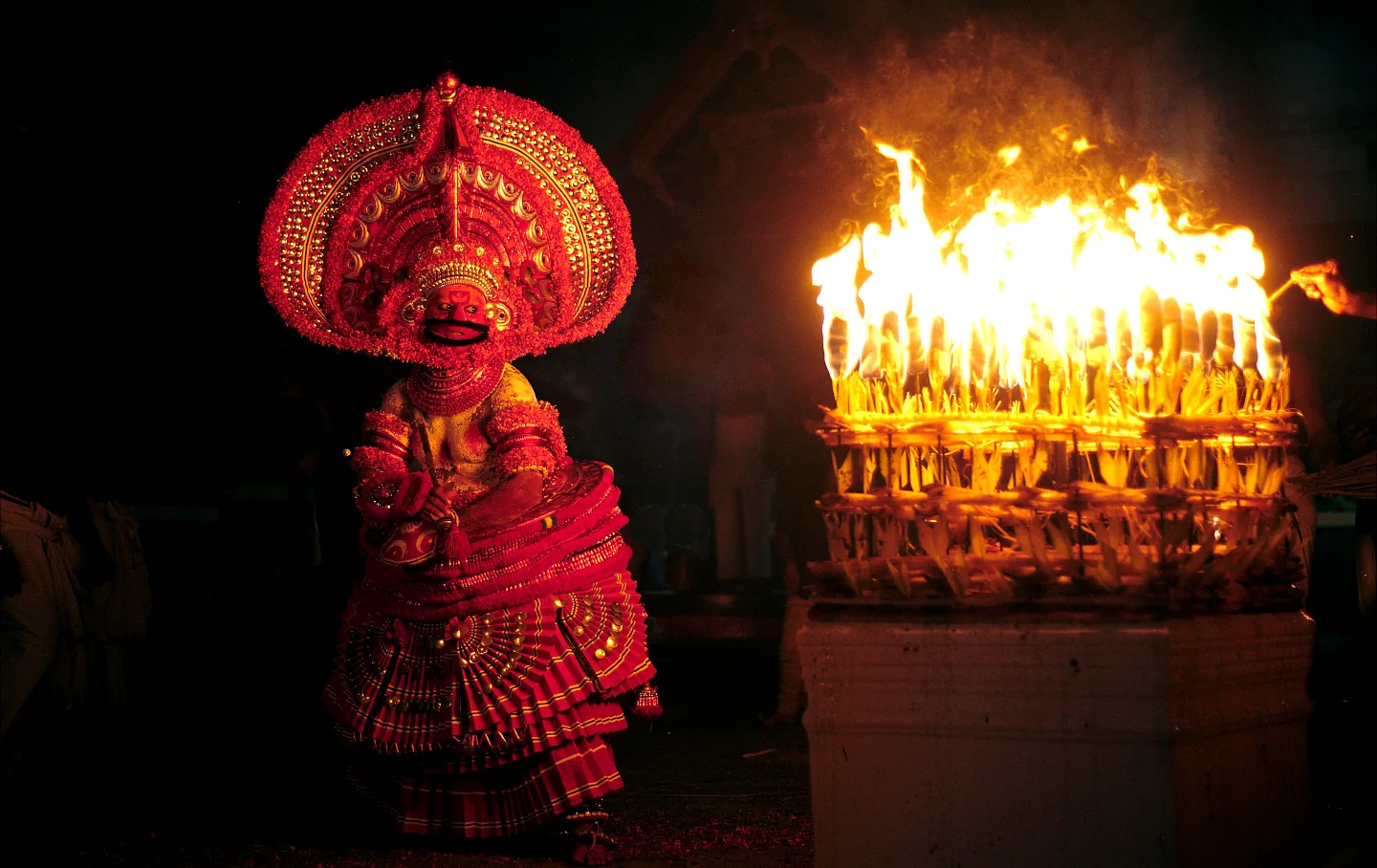
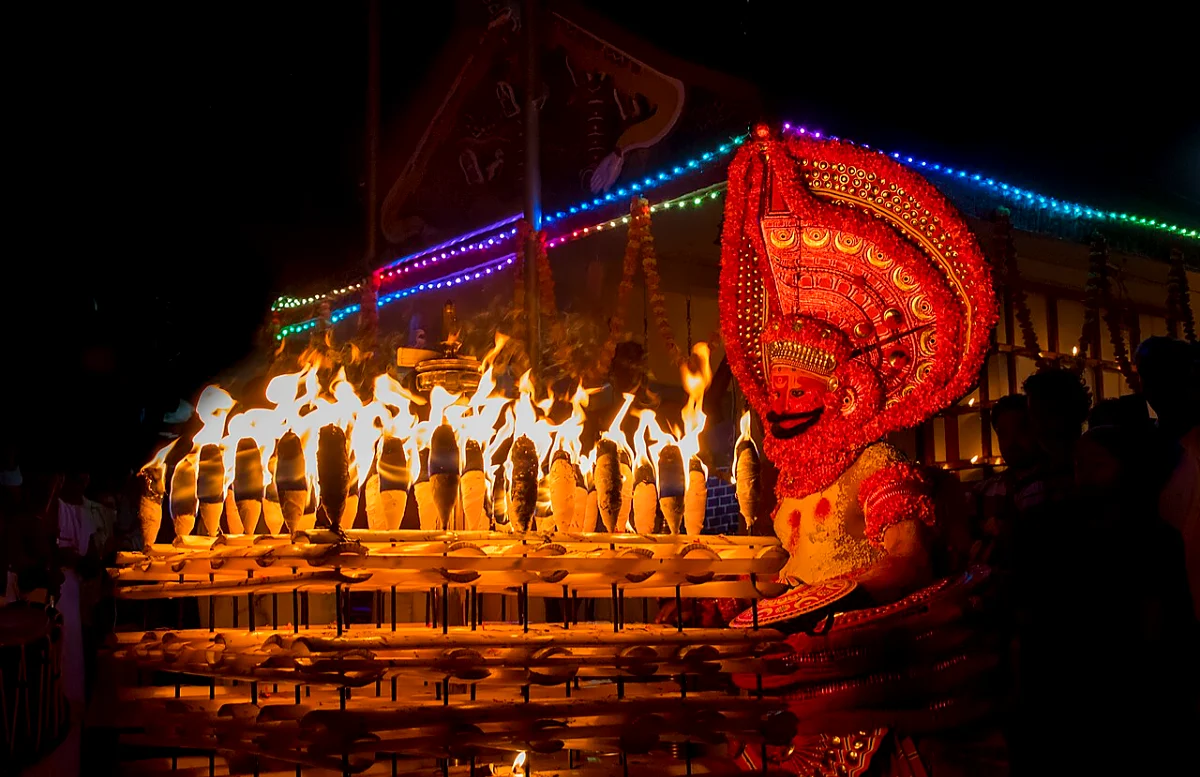
His theyyam is one of the most athletic of all, full of sword and shield work, with the bearded face painting called nagam thazhthi ezhuthu. The climax is the Chemmarathi thara: a platform of banana stems and coloured paste, divided into 64 sections for the 64 pieces into which, the song says, his body was cut, and lit with lamps. It represents his wife.
Our assessment: Thiyya warriors and the Kudagu frontier
The Kathivanoor story fits real history closely. The Thiyyas of north Malabar included families of trained fighters (chekavar) who served in the militias of local chiefs, and the hill passes to Kodagu were a contested frontier for centuries, with raids and trade in both directions. The detail of the oil business and of the 64 cuts is the kind of detail oral memory keeps. We think Mandappan was very probably a historical warrior killed in a border fight, whose death in the village's defence, and his young wife's death after him, made him a protector of the community.
Kandanar Kelan: the man who rose from the fire
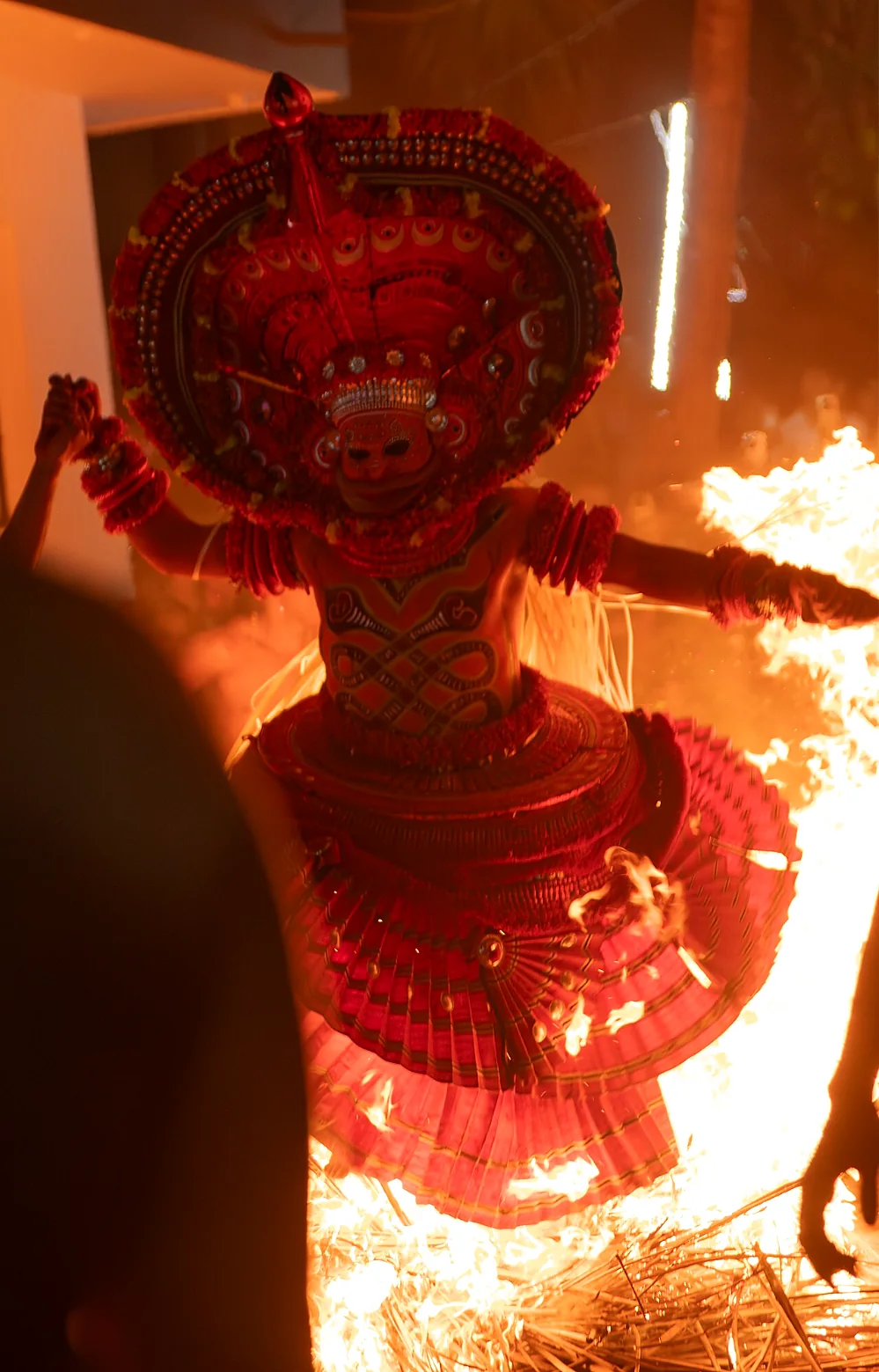
Kelan was a hard-working Thiyya youth who cleared his mother's barren land for farming. Clearing her forest land in Wayanad, he spared a gooseberry tree where two snakes were sheltering, and then set fire to the cut scrub. The fire ran out of control. Kelan climbed the tree, the flames engulfed it, the snakes bit him, and all three burned. When the fire died, the god Vayanattu Kulavan passed by, touched the charred body with his foot, and Kelan rose alive, with the snakes. He became a deity at Kulavan's side. His theyyam reproduces the story: Kelan leaps through, and out of, a great fire.
Palanthayi Kannan and Vishnumoorthi
The most widespread Vaishnava theyyam, Vishnumoorthi, is Vishnu as Narasimha, the man-lion who destroyed the demon king Hiranyakashipu. In north Malabar his story is joined to a human one. Kannan, a Thiyya boy in the household of Kuruvat Kurup, a commander of the Nileshwaram raja, climbed a mango tree in his master's grounds; a mango seed he threw fell on the Kurup's niece. The furious Kurup came at him with a sword, and Kannan fled north to the Tulu country near Mangalore, where he served at a Narasimha shrine for twelve years. When he returned home, the deity came with him. The Kurup killed him at a pond at Nileshwaram; the god's anger fell on the Kurup's house, and the raja's astrologers ordered a temple to be built. This is the Sree Vaikunta temple at Kottappuram, Nileshwaram, where Vishnumoorthi and Palanthayi Kannan are worshipped together, and from where the cult spread through the Vishnumoorthi shrines from Kozhikode to Mangalore.
Ottakolam: the fire rite
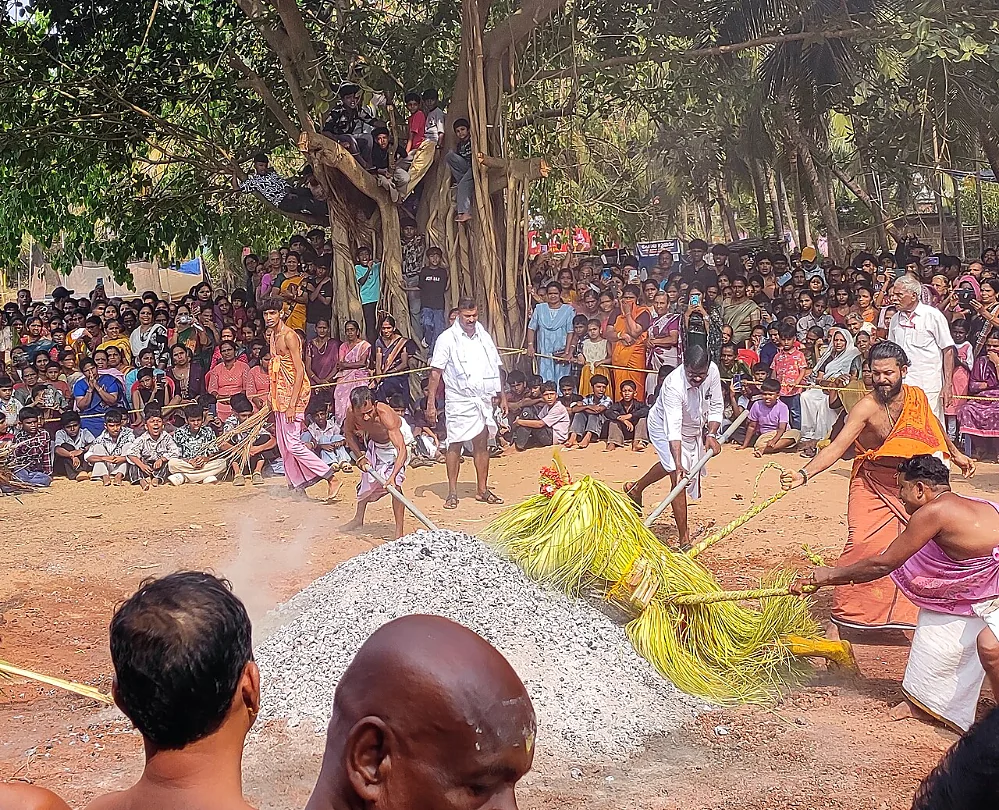
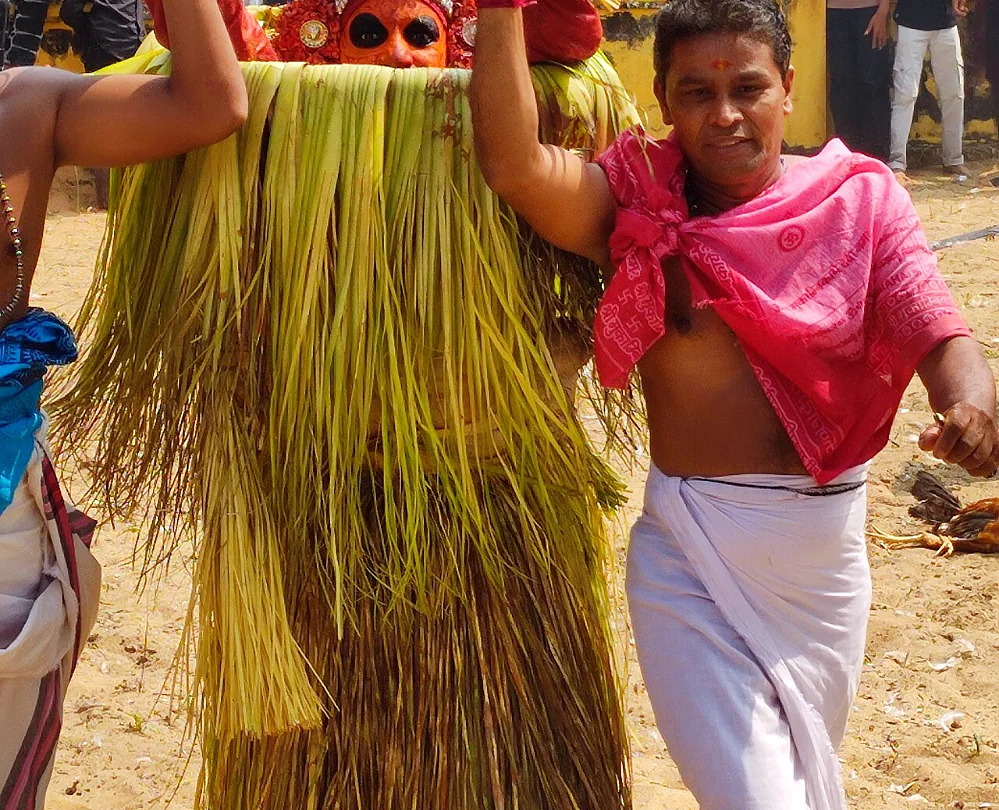
In the Ottakolam, also called Thee Chamundi ('fire Chamundi'), a performer in a costume of tender coconut leaves throws himself again and again onto a great heap of glowing embers prepared through the night, while attendants hold him by ropes tied to his costume and pull him out. Its story, too, is told as a Narasimha story: in one version the god, angered that Agni, the fire, belittled his victory over Hiranyakashipu, leaps into the sacrificial fire and overcomes it. It is one of the most dangerous rites in theyyam, and accidents still happen.
The forms of Shiva
Pottan: the outcaste who argued with Shankara
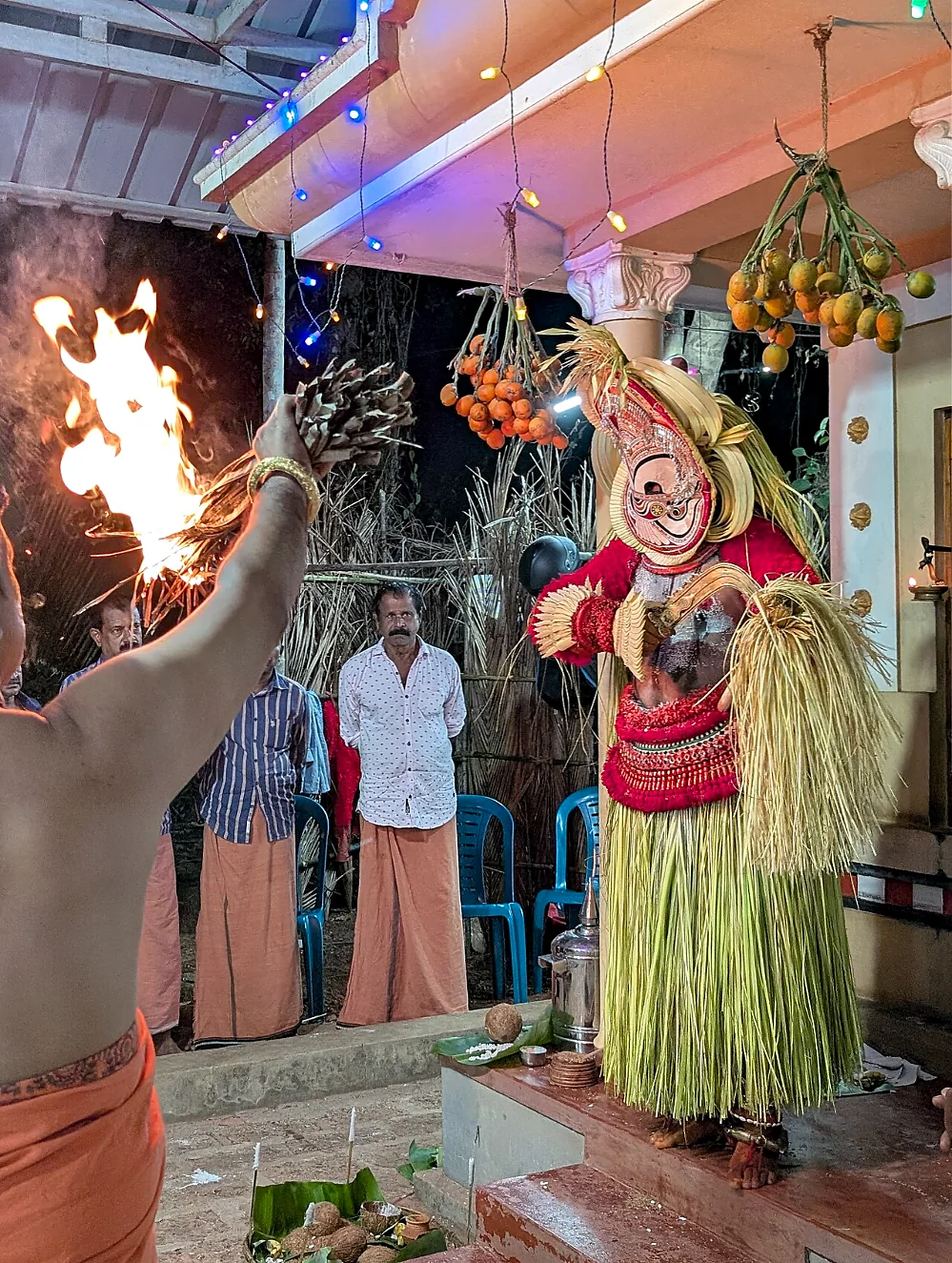
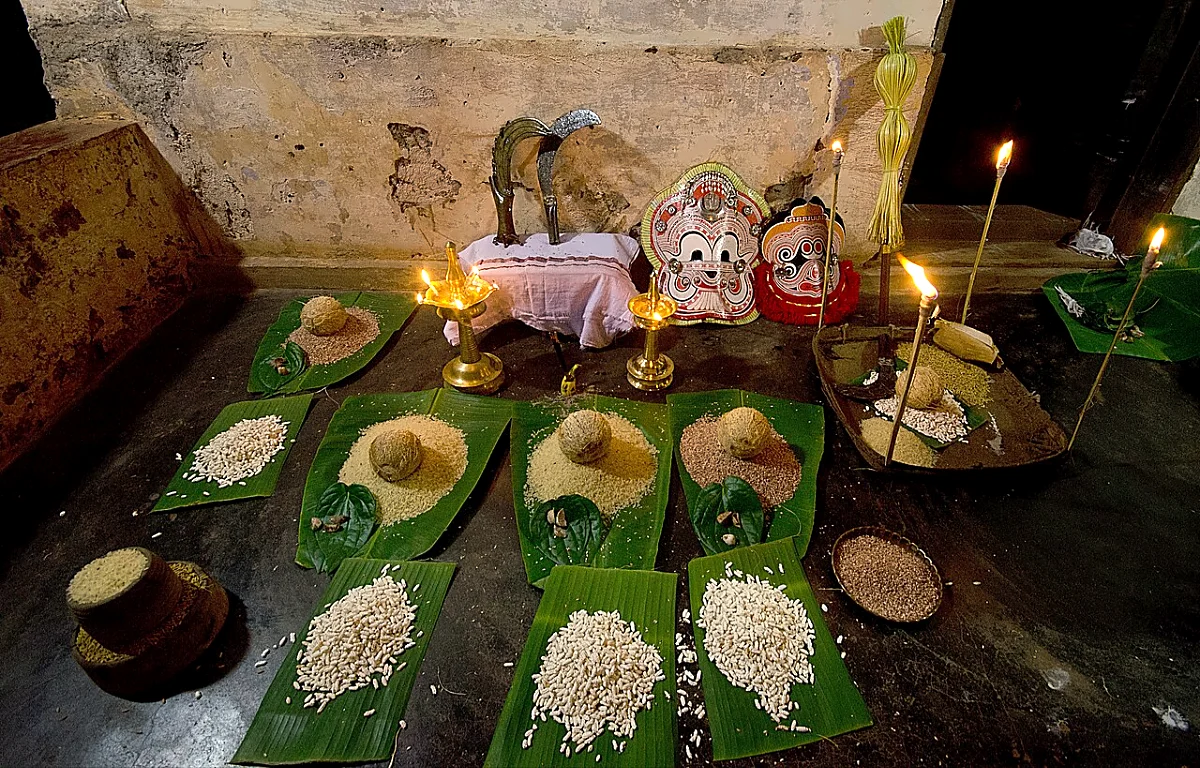
In the story of Pottan theyyam, the great philosopher Shankaracharya meets on a narrow road a Pulaya (or Chandala) labourer, carrying a child on his hip and a pot of toddy on his head, with his wife. Shankara orders him to step aside to avoid polluting him. The man refuses and answers him: does not the same red blood flow from the wound of a Brahmin and of a Pulaya? If all is one, as Shankara teaches, who is polluting whom? Shankara realises that the man is Shiva himself, with Parvati, come to test him, and bows to him. The song of Pottan is the most direct attack on caste in the whole theyyam tradition, and audiences know its lines. The theyyam wears a mask, often several in turn, and lies on a bed of embers while the people beg him to rise.
Our assessment: did it happen?
A very similar episode is told in Sanskrit tradition, in the hagiographies of Shankara, where Shiva appears to him as an outcaste with dogs at Kashi, and Shankara responds with the verses known as the Manisha Panchakam. The Pottan song takes that story and moves it to Malabar, gives the outcaste a voice of his own, and makes his argument, not his divine identity, the heart of the matter. We do not think it records a historical meeting. We think it records something just as real: the confident voice of north Malabar's labouring castes, who knew the philosophers' own doctrine of oneness and turned it against untouchability, long before the reform movements of the 20th century.
Gulikan: the guardian of death
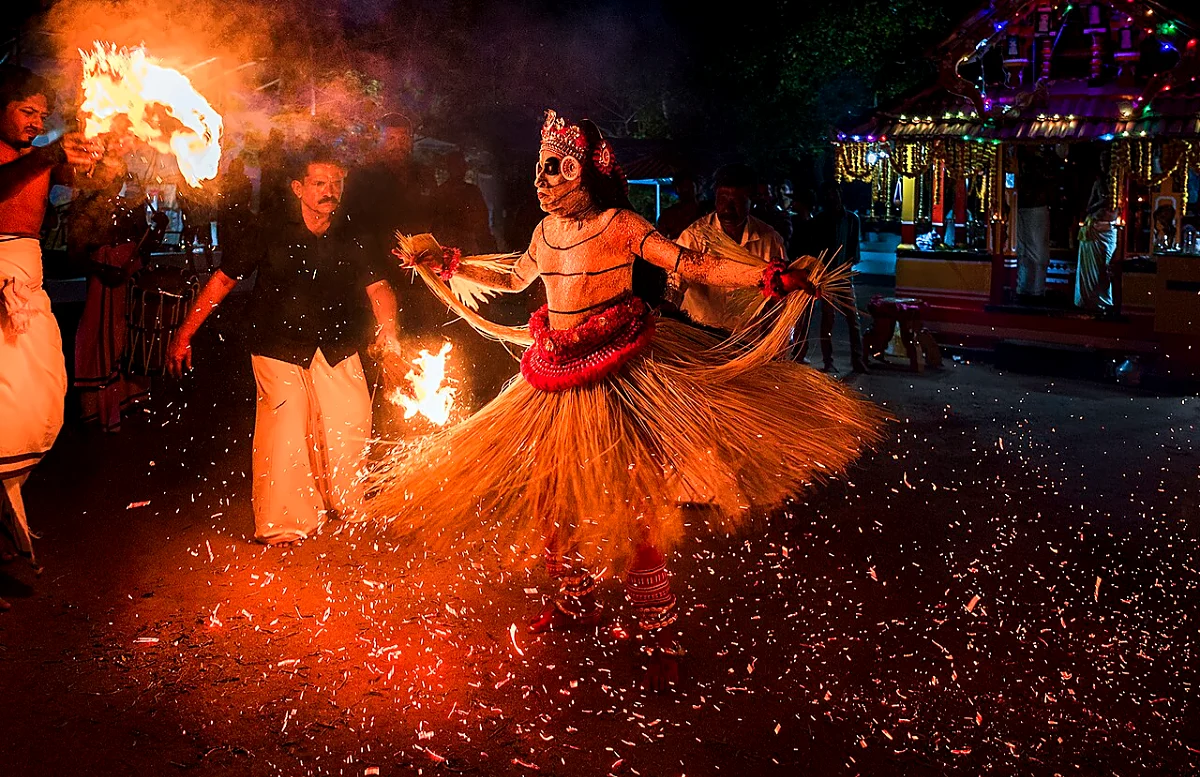
Gulikan is the god of death in theyyam, in effect Yama's successor. In one version, when Shiva burned Yama to save the boy-sage Markandeya, nothing in the world could die, and the universe fell into disorder; Shiva then created Gulikan from his left thumb (or toe) pressed into the earth, and gave him a trident and the noose of death. His shrine stands in or beside many kaavus as their guardian, and he is especially associated with the Malayan community. A famous shrine is Benkanakavu at Nileshwaram. His forms vary: some Gulikans walk on stilts, others wear a face plate and a costume of tender coconut leaves, carry a trident and a bell, and play tricks on the crowd.
Vettakkorumakan and Bhairavan
Vettakkorumakan, 'the son of the hunter', is the son of Shiva and Parvati born when they took the forms of hunters (the story of Shiva's meeting with Arjuna in the forest). He is a warrior and hunting god, armed with bow and sword, with important shrines in north Kerala. Bhairavan is a fierce guardian form of Shiva.
The forest and the ancestors
Muthappan: the god of all
Muthappan is the most popular theyyam deity of all, and the most open. He is understood as two gods in one: Thiruvappana (the elder, Valiya Muthappan) and Vellattam (the younger, Cheriya Muthappan), linked with Vishnu and Shiva respectively. His story: a childless Brahmin couple of Ayyankara, Ayyankara Vazhunavar and Padikutti Amma, found a baby boy by a river. He grew into a hunter who ate meat, drank toddy and mixed with the hill people, scandalising his family; when he revealed his divine form, his gaze set things on fire, and at his mother's plea he covered his eyes, which is why Thiruvappana is shown with blind, covered eyes. He came to Kunnathoor in the hills, drawn by the toddy palms; a toddy-tapper named Chandan tried to shoot the old man stealing his toddy and collapsed, and Chandan's wife called the stranger Muthappan, 'grandfather', and offered him boiled gram, coconut, roasted fish and toddy, still his offerings today. He later settled at Parassinikadavu on the Valapattanam river.
Muthappan is performed by the Thiyya community; his theyyam is performed almost every day at Parassinikadavu, where all are fed, whatever their caste or religion. Dogs are sacred to him; the first offering is given to a dog. His shrines (madappura) have no idol and no flagstaff.
Vayanattu Kulavan: the blind god of toddy
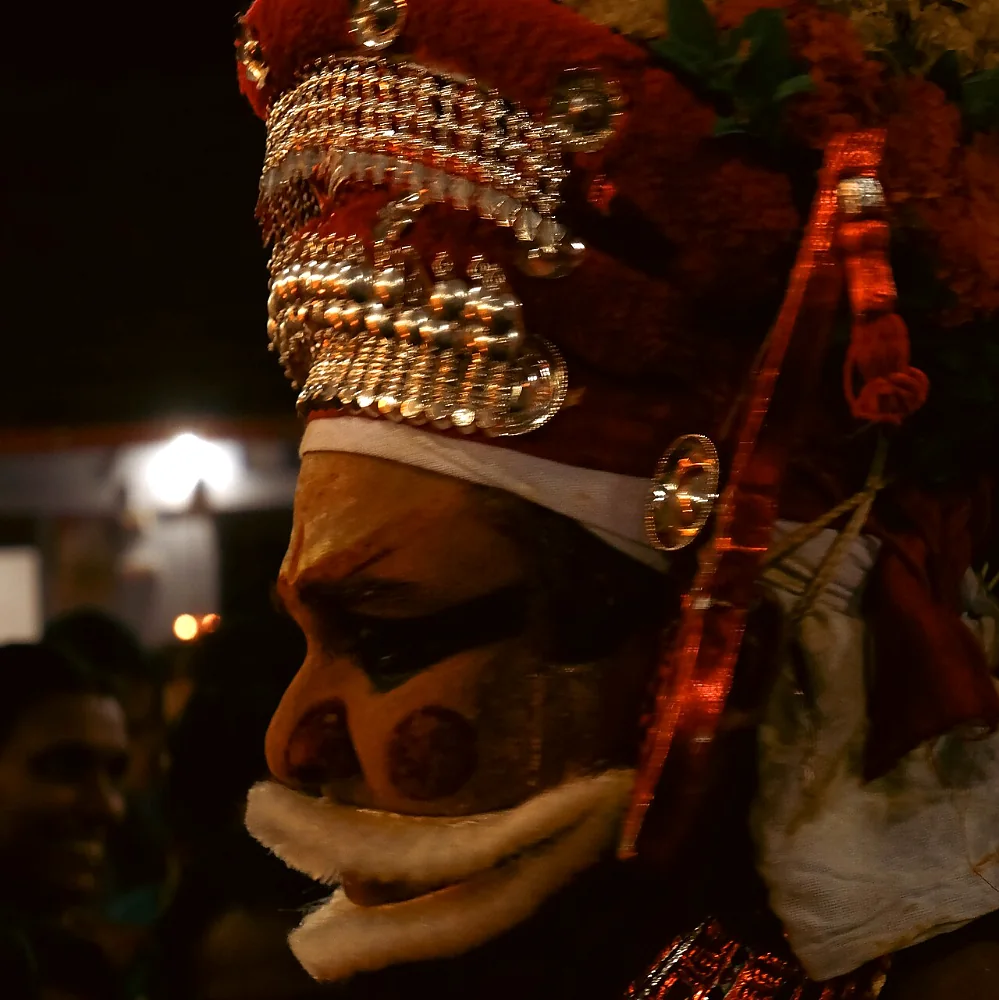
Vayanattu Kulavan, called Thondachan ('the elder') by the Thiyyas, whose principal deity he is, has a story full of humour. Shiva came home drunk every day; Parvati found the three coconut palms on Kailasa that gave him toddy and made the toddy flow back up into the trees. In anger Shiva struck his thigh, and from it a son was born, whose task was to fetch the toddy. The son drank it himself, was forbidden, opened the pot anyway, and lost his sight. Shiva gave him false eyes, a bamboo torch and a bamboo bow and sent him to the earth, where he appeared in Wayanad, hence his name. His theyyam is a blind old man with false eyes (poikkann) and a torch, slow-moving and humorous, delivering serious messages with jokes. Its great festival is the theyyamkettu, held at Thiyya family shrines at intervals of years. In the rite of bonam kodukkal a Thiyya elder, his head covered, offers him toddy; the gesture remembers Kunjali, a Muslim man who, the story says, was saved from execution by the god and then served him toddy with his head covered.
Spirits, serpents and the Ramayana
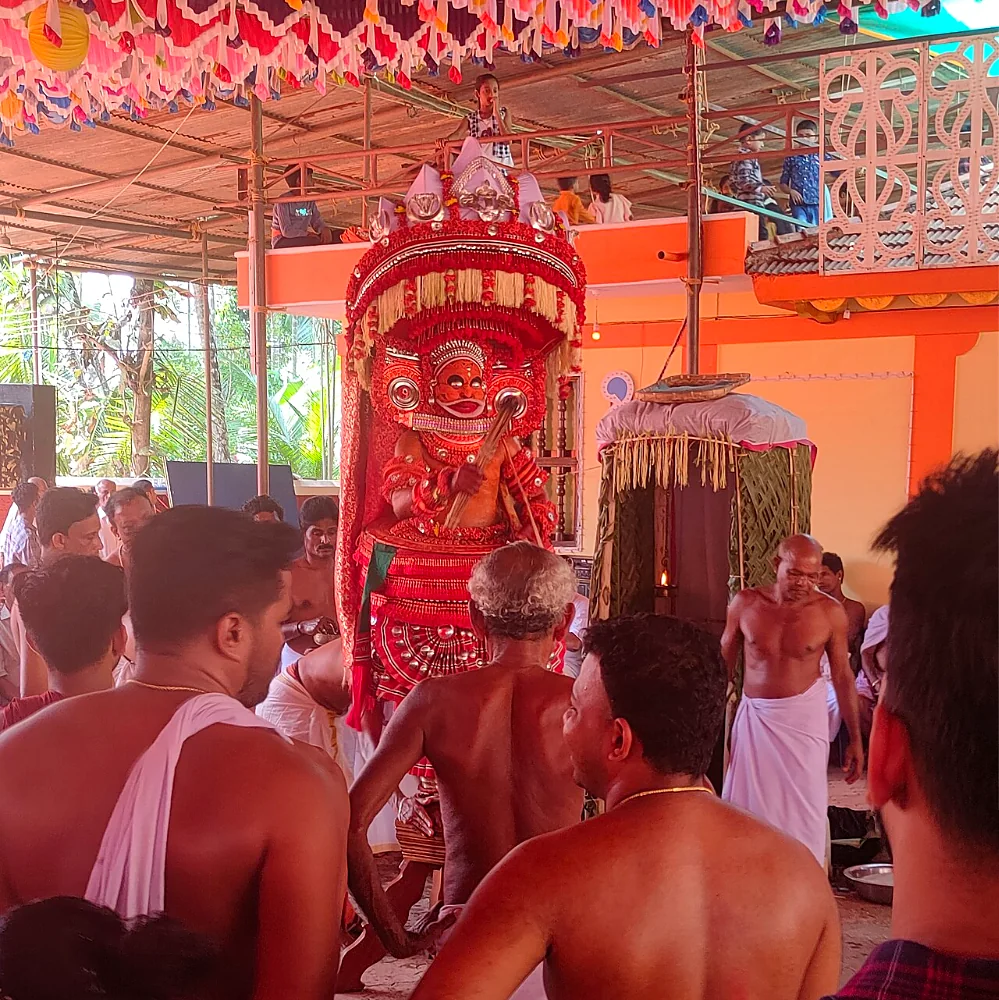
Kuttichathan is a young trickster spirit, associated with the Kalakattu Illam of Payyannur. The story says the head of that Brahmin house tore him into pieces, 396 of them, and from each piece a new Chathan was born, who set fire to the houses of the Brahmins; he is remembered as a granter of wishes and a restorer of justice. Serpent theyyams such as Nagakkali belong to the old worship of the snake groves (sarpakkavu) of Kerala. At Andalur Kavu, near Thalassery, the theyyams take the forms of the Ramayana: Daivathar is Rama, Angakkaran is Lakshmana and Bappooran is Hanuman, and the festival, in the month of Kumbham (February), also shows the battle of Bali and Sugriva. Elsewhere, Bali theyyam is Vali, the monkey king of the epic, who in the local legend came to Kannur with Vishwakarma, the divine craftsman, and became the family deity of the carpenters; it is performed by the Vannan community, mainly at the shrines of carpenter families.
The Mappila theyyams
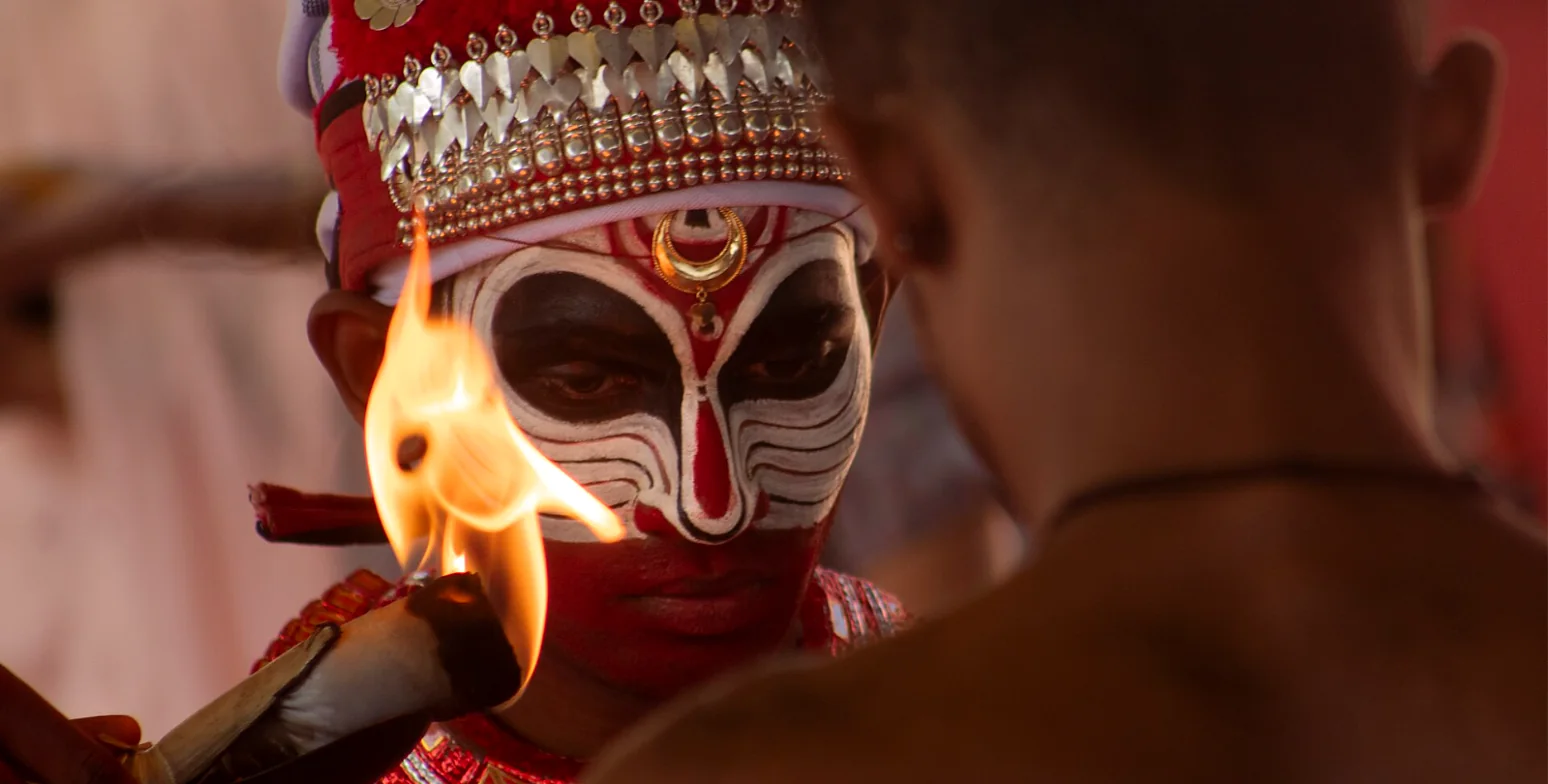
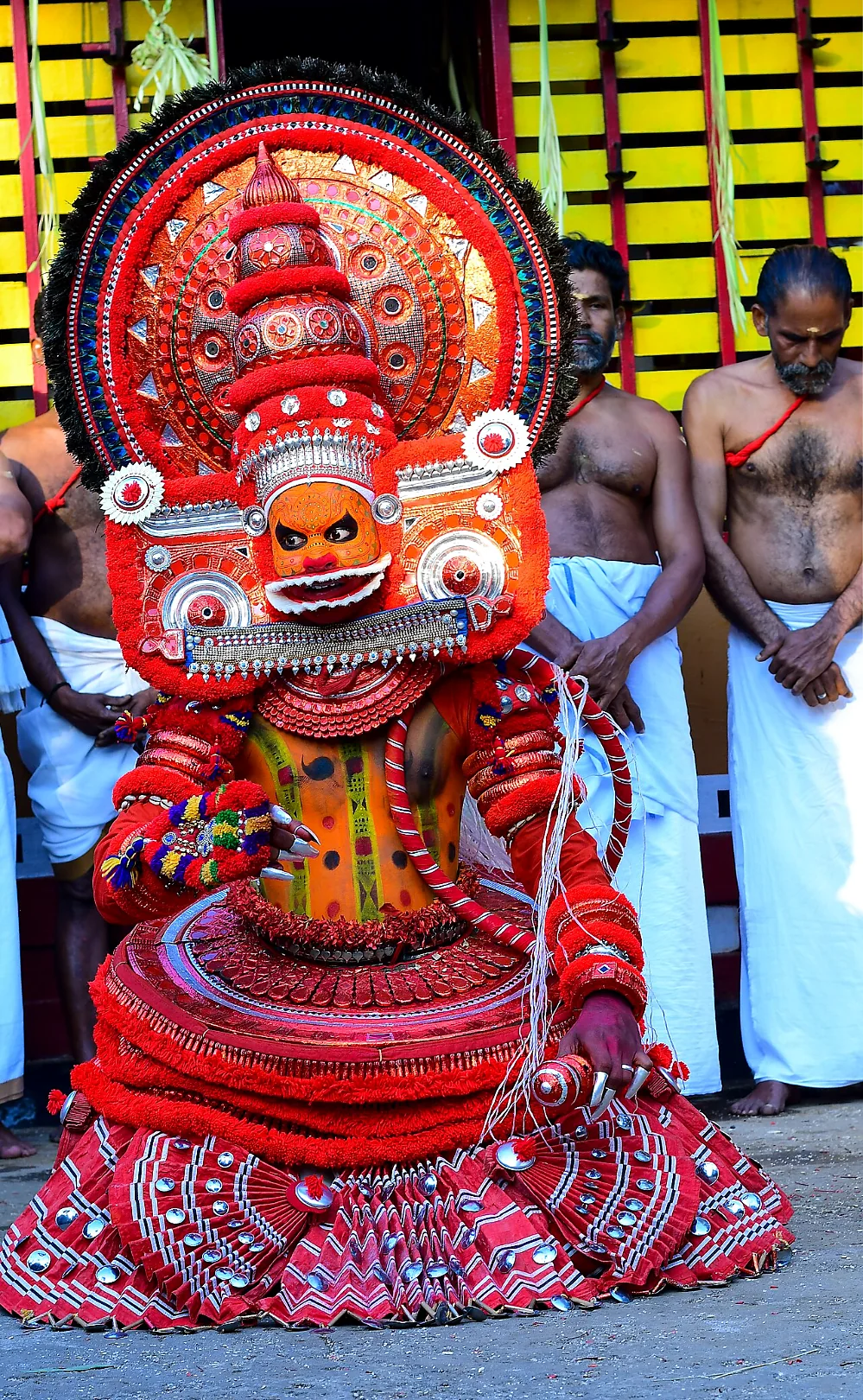
Some of the most remarkable theyyams are Muslim characters. Scholars count about fifteen Mappila theyyams in the old Kolathunadu country, mostly in Kasaragod and the northern parts of Kannur. Their names include Aali, Mukri Pokker, Bappiriyan, Kunhali, Mammad, and the women Ummachi, Naithiyar and Beevi. They are performed by Hindu communities, the Mavilan, Koppalan and Vannan, often with the cooperation of local Muslims. A Mappila theyyam typically begins by acting out the call to prayer and the namaz; its costume is simpler than that of the goddesses, with less face painting and a smaller headdress.
- At Kamballur Kottayil in Kasaragod, the spirit of Kalanthan, a mukri of the nearby Pulingome mosque who died mysteriously in the river, is said to have merged with the goddess Karinchamundi, and he appears as a Mappila theyyam beside her; the mosque's own festival opens with the cooperation of the same Hindu family.
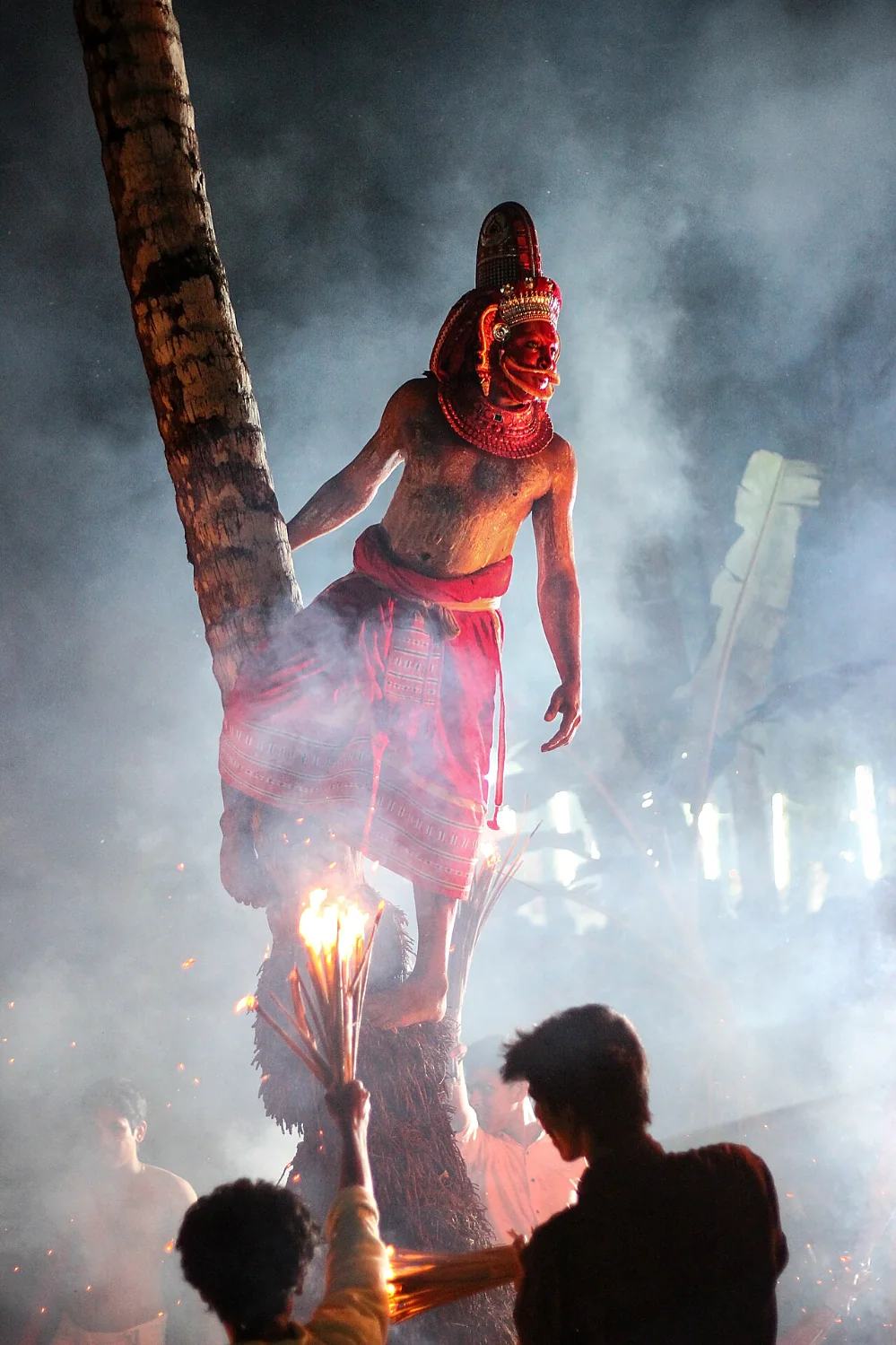
- Bappiriyan belongs to the story of the goddess Aryapoonkanni. He was a Muslim merchant, the captain of the ship in which she and her brothers sailed in search of pearls; after a shipwreck she found him again in a small boat and, at first unwilling, he ferried her along the coast until they reached the hills near Taliparamba, where they are enshrined together. His theyyam, performed by the Vannan community, has a decorated headdress, and its most famous moment is when the performer climbs coconut palms and kicks them to shake down the nuts, a feat in which performers have been badly hurt.
Our assessment: the gods of a shared coast
The Mappila theyyams are not an oddity. North Malabar had a large Muslim community from early times, sailors, traders and farmers, living in the same villages as the Hindu castes, and, as we saw in the story of the Arakkal family, sharing their customs of matrilineal inheritance. A god that absorbs a drowned mukri, a goddess whose ship is steered by a Muslim sailor, a Muslim man saved by the god of toddy: these are the memories of daily life on a shared coast. They show that, in this region, the boundaries between communities were long more porous than modern politics sometimes suggests.
How theyyams differ
- Gentle and fierce. Sattvic deities such as Muchilottu Bhagavathi move slowly and gracefully; fierce ones such as the Chamundis and Gulikan dance wildly, and some accept blood offerings, always made outside the inner precinct.
- Painted and masked. Most theyyams have painted faces; Pottan, Gulikan and Kuttichathan, among others, wear masks or face plates.
- Cloth and leaf. The great goddesses and heroes wear red cloth skirts and heavy ornaments; many fire theyyams wear skirts of tender coconut leaf.
- Fire theyyams. Kandanar Kelan leaps through fire, Pottan lies on embers, Puthiya Bhagavathi wears torches, and in the Ottakolam the performer plunges into embers.
- Who performs. Each theyyam belongs to particular communities; Muthappan is performed by Thiyyas, Gulikan above all by Malayans, Kundora Chamundi by the Velan, and so on.
- Where. Some theyyams belong to a single shrine; others, such as Vishnumoorthi, Gulikan, Pottan or Raktha Chamundi, are performed in hundreds.
- Theyyam and its neighbours. In the Kozhikode area the closely related form is called thira (hence 'Theyyam Thira'); in the Tulu country it is bhuta kola; in southern Kerala, padayani and mudiyettu share some features. Unlike Kathakali or Koodiyattam, theyyam does not represent the god on a stage; it makes the god present.
Where to see them
- Muthappan: Parassinikadavu Madappura, near Taliparamba, almost every day; the forest shrine of Kunnathoor Padi during its festival season.
- Vishnumoorthi and Palanthayi Kannan: Sree Vaikunta temple, Kottappuram, Nileshwaram, and many Vishnumoorthi shrines in Kasaragod and Kannur.
- Gulikan: Benkanakavu, Nileshwaram, and most kaavus.
- Muchilottu Bhagavathi: the Muchilottu kaavus, including Karivellur; watch for perumkaliyattam announcements.
- Raktha Chamundi: the Chamundi Kottam at Chirakkal, and many shrines.
- Kathivanoor Veeran, Kandanar Kelan, Vayanattu Kulavan, Pottan: Thiyya family shrines and kaavus throughout Kannur and Kasaragod.
- Ramayana theyyams: Andalur Kavu, Dharmadam, near Thalassery (Kumbham, February).
- Devakkoothu: Thekkumbad Koolom Thayakavu, near Cherukunnu, once in two years in Dhanu (December).
- The season's close: Madayi Kavu and Kalarivathukkal.
- Dates: each shrine keeps its own fixed days; check the Kerala Tourism theyyam calendar and local announcements.
Our assessment: why the wronged become gods
Look at the stories together and a pattern appears. A learned woman driven out and burned; a sister murdered by her brothers; a servant boy chased for a fallen mango and killed at a pond; a warrior killed by treachery; a man burned in a forest fire; an outcaste ordered off the road. Again and again, the theyyam deity is someone who suffered injustice at the hands of the powerful, and whose death was followed by misfortune for the guilty until the community gave them a shrine. We think this is the moral heart of theyyam. In a society where the weak had few courts to appeal to, theyyam gave the wronged dead a voice, made their killers' families pay for their shrines, and put the story of the injustice into a song that is sung every year. The gods of theyyam are, very often, the conscience of north Malabar.
Read the first part: Part 1: the ritual, on the origins, the performers, their preparation, the make-up, costume and music.
Read also: Kannur, the Arakkal kingdom and theyyam · Bekal Fort and Kasaragod · Thalassery · French India and Mahé
See it for yourself, with a local driver who knows these roads.
Book a Munnar Jeep SafariSources & further reading
- Wikipedia: Theyyam
- Wikipedia: Muchilot Bhagavathi
- Wikipedia: Kathivanoor Veeran
- Wikipedia: Kadangot Makkam
- Wikipedia: Pottan Theyyam
- Wikipedia: Muthappan
- Wikipedia: Mappila Theyyam
- Hindu Blog: Vayanattu Kulavan theyyam story
- Hindu Blog: Kandanar Kelan theyyam story
- Hindu Blog: Paalanthayi Kannan theyyam story
- Hindu Blog: Gulikan theyyam
- Kerala Folklore: Theyyam
- Theyyam calendar: history
Figures are from the sources listed and were checked in October 2026. Park timings and road conditions change, so please confirm before you travel.