
Theyyam, Part 1: The Night a Man Becomes a God. Origins, Artists, Make-up and Costume
Where theyyam came from, who performs it, the vows before the night, the painted face, the great headdress and the drums, with an 1872 dictionary, the first photographs of 1909 and our own assessments.
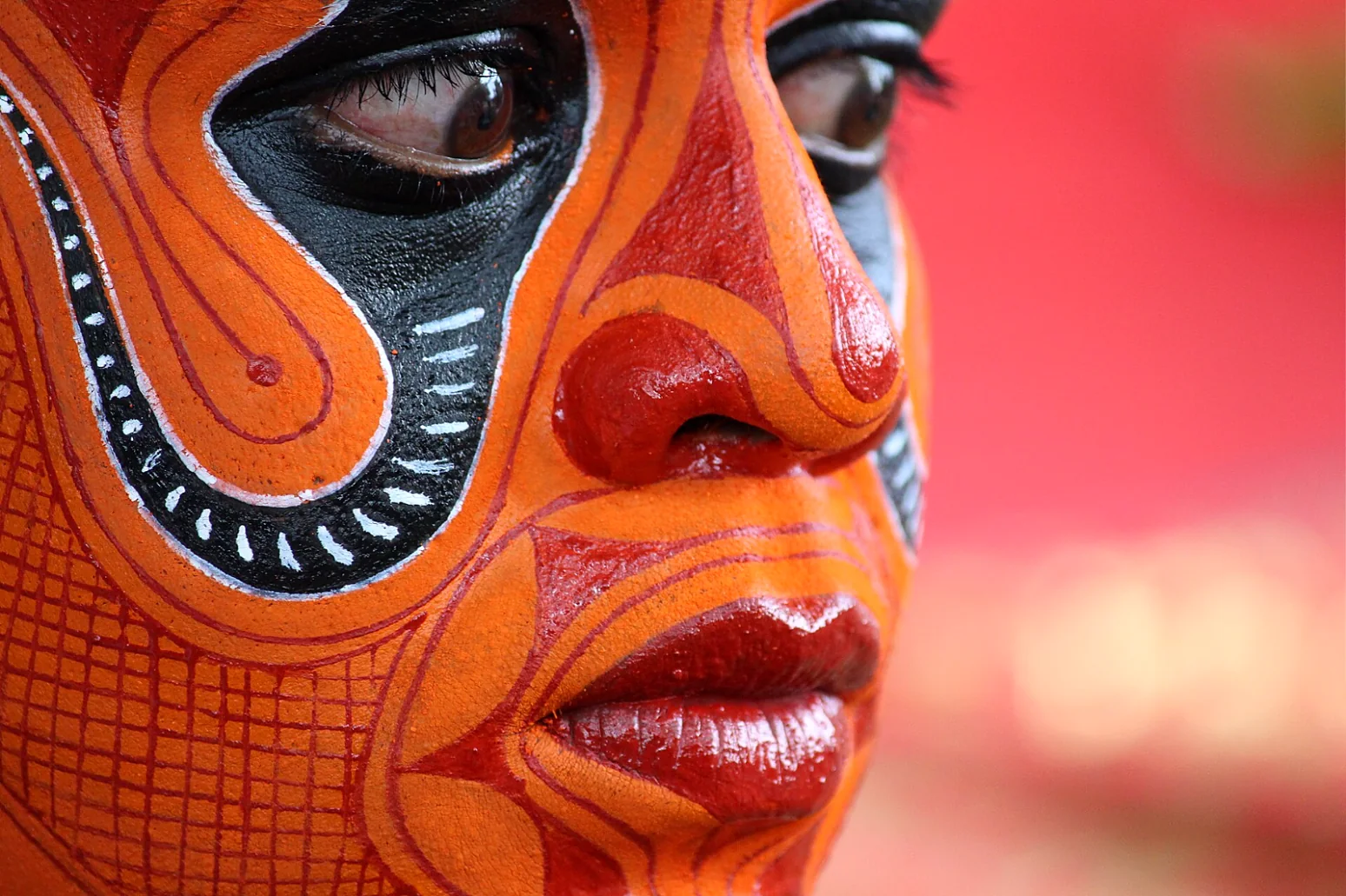
This is a two-part study. Part 1, below, is about the ritual itself: where theyyam came from, who performs it, how the performers prepare, how the face is painted and the costume made, and what happens on the night. Part 2: the gods is about the deities: the types of theyyam, their names, their stories, how they differ and where each is performed.
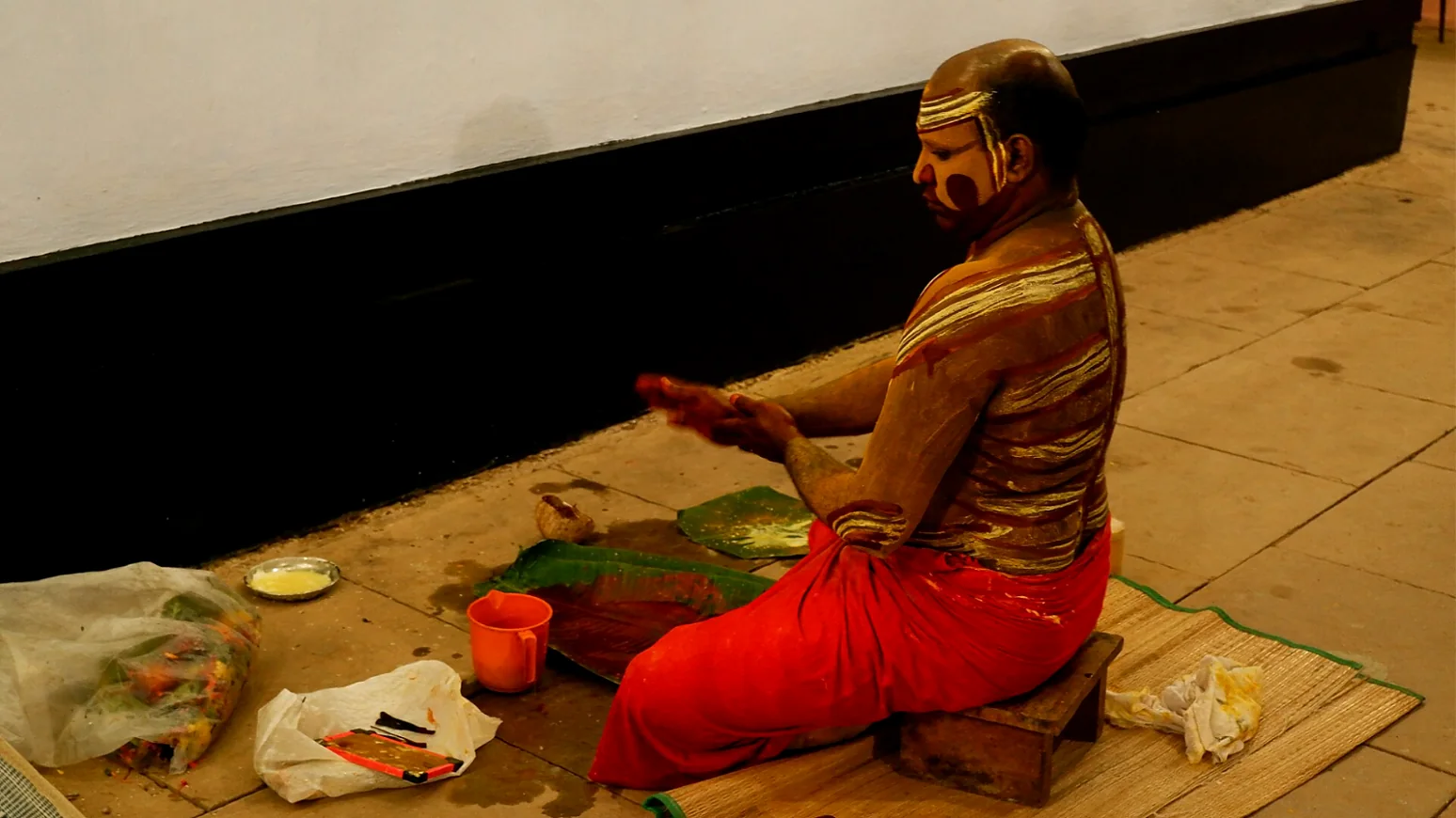
On a winter night in a village of north Kerala, a man sits on a mat while another paints his face with rice paste, turmeric and red mineral powder. He has fasted, slept apart and kept himself pure for days. By midnight he will have sung the god's story, put on a towering headdress, looked at his painted face in a small mirror and, in the belief of everyone gathered around the sacred grove, stopped being himself. Until dawn he is the deity. People of every caste, including families who once would not have let him walk on the same road, bow before him, place coins in his hand and ask him about their illnesses, their quarrels and their children's futures. He answers them in the god's voice.
This is theyyam, also called kaliyattam or theyyattam, the great ritual of the old Kolathunadu country, today's Kannur and Kasaragod districts with parts of Kozhikode and Wayanad. It is often described as a dance or an art form, and it is both. But to those who keep it, it is neither theatre nor a show. Kathakali tells stories about gods; in theyyam, the god is believed to be present.
At a glance
- The word: theyyam is the north Malabar form of daivam, 'god'.
- Where: Kannur and Kasaragod districts, with parts of Kozhikode and Wayanad. The neighbouring Tulu country of coastal Karnataka has the related bhuta kola.
- When: from the tenth day of the Malayalam month of Thulam (late October) to the middle of Edavam (late May or June). The Muthappan theyyam at Parassinikadavu is performed almost every day of the year.
- How many: sources count 'more than 400' forms; estimates range from about 400 to over 450, and a few writers go higher.
- Who performs: men of hereditary communities, chiefly the Vannan, Malayan, Velan, Mavilan, Koppalan, Pulayan and others. The one theyyam performed by a woman is Devakkoothu.
The word, in a dictionary of 1872
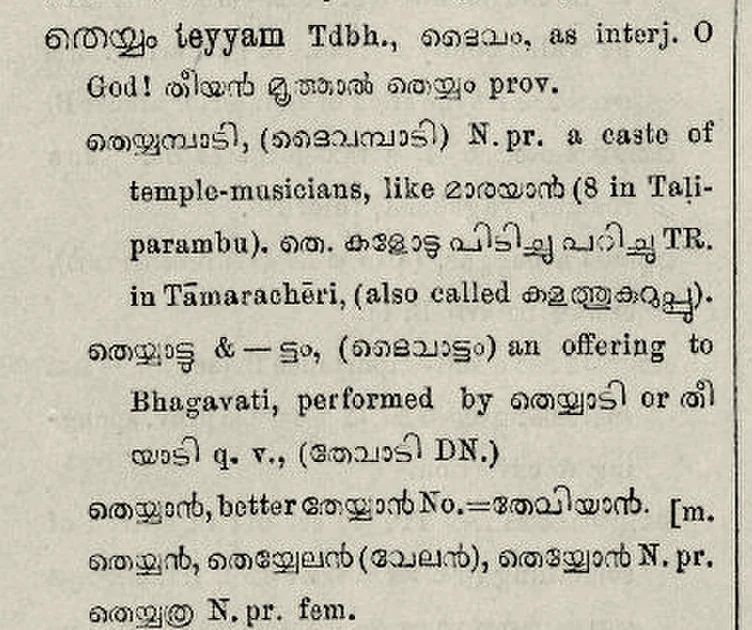
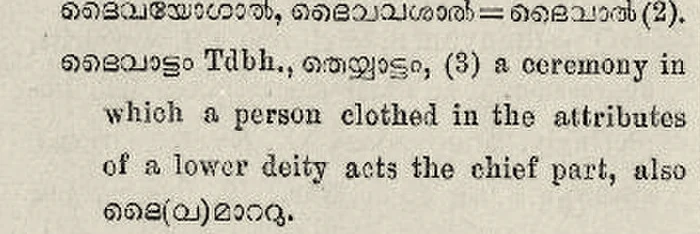
One of the earliest careful definitions of theyyam in English was written in Thalassery, by the German missionary and scholar Hermann Gundert, who lived there in the mid-19th century and compiled the first great Malayalam–English dictionary, printed at Mangalore in 1872. (We tell his story in our Thalassery article.) Gundert marks teyyam as a tadbhava, a word reshaped from daivam, records the exclamation 'O God!', and gives teyyāṭṭam ('god-dance') as 'an offering to Bhagavati'. Under daivāṭṭam he gives the clearest description: 'a ceremony in which a person clothed in the attributes of a lower deity acts the chief part'.
Our assessment: what Gundert's words tell us
Two things stand out. First, the definition is accurate and respectful in its core: a person 'clothed in the attributes' of a deity who 'acts the chief part' is exactly the theyyam idea of the performer becoming the god's vehicle. Second, the phrase 'lower deity' shows the lens of the time. To a missionary trained in Sanskrit learning, as to many upper-caste Hindus of the day, the gods of theyyam were village spirits below the great gods of the temples. Theyyam's own devotees never saw them that way: to them Muchilottu Bhagavathi or Muthappan is simply God. A few decades later, colonial census writers went further and called theyyam 'devil-dancing'. The dictionary is valuable precisely because it predates that hardening of the language.
The beginnings: what is known, and what is legend
No document records the birth of theyyam, and anyone who gives a precise date is guessing. What scholars broadly agree on is this:
- Ancestor and hero worship. Many theyyams are deified human beings: warriors who died fighting, women wronged and killed, men who defied caste. The historian K. K. N. Kurup, in his study The Cult of Theyyam and Hero Worship in Kerala (1973), placed theyyam firmly in the old South Indian tradition of honouring the heroic dead. The Sangam poems of ancient Tamilakam, to which Kerala belonged, describe memorial 'hero stones' (nadukal) raised and worshipped for fallen warriors.
- Possession dances. The same Sangam poems describe the velan, a priest-dancer possessed by the god Murukan (Murugan), dancing with a spear and pronouncing oracles. A community called Velan still performs theyyam today. We do not claim a direct line, but the family resemblance is striking.
- Gods of the land. Theyyam also carries the worship of serpents, trees, forest and hunting gods, disease goddesses and village guardians, the religion of farmers and forest people before temple Hinduism spread across Kerala.
- Later layers. Over centuries the cult absorbed the goddess worship of Shaktism and the great gods Shiva and Vishnu. Today many theyyams are understood as forms of Shiva, Vishnu or the Goddess, while keeping very local stories.
- Royal patronage. The Kolathiri rajas of Kolathunadu, whose story we tell in our Kannur article, became the great patrons. The season still closes with the last kaliyattams at Madayi Kavu and the Kalarivathukkal shrine, both shrines of the Kolathiri family.
The legend of Manakkadan Gurukkal
The performers' own tradition tells a story of origin. A Kolathiri raja, it is said, wished to test a master performer named Manakkadan Gurukkal and commanded him to create a set of theyyams, their costumes and their songs, between dusk and dawn. The number varies in the telling: 39 forms, of which, some say, the king chose 35 to be the first consecrated theyyams. Manakkadan succeeded, and the title of Gurukkal, 'master', was his reward. The Vannan community remembers him as the master of their art.
Our assessment: a codification, not a creation
Theyyam cannot have been invented in one night, and older writers and performers themselves say so: the art grew over a very long period. But legends of this kind usually remember something real. We read the Manakkadan story as the memory of a codification: a moment, under Kolathiri patronage, when the costumes, songs and rights of many existing local cults were fixed, and the right to perform each form in each shrine was assigned to particular families. Three pieces of circumstantial evidence point that way. The story is about a king testing and rewarding a performer, which is the language of royal recognition; titles given by rulers are still part of the theyyam world; and the season's closing rites are still tied to the Kolathiri shrines. In other words, the raw material of theyyam is ancient and popular, but its present shape bears the stamp of a royal court.
What the colonial ethnographers saw
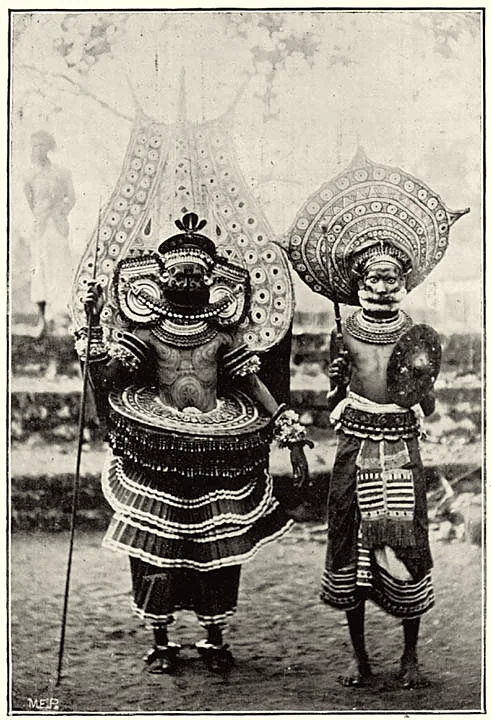
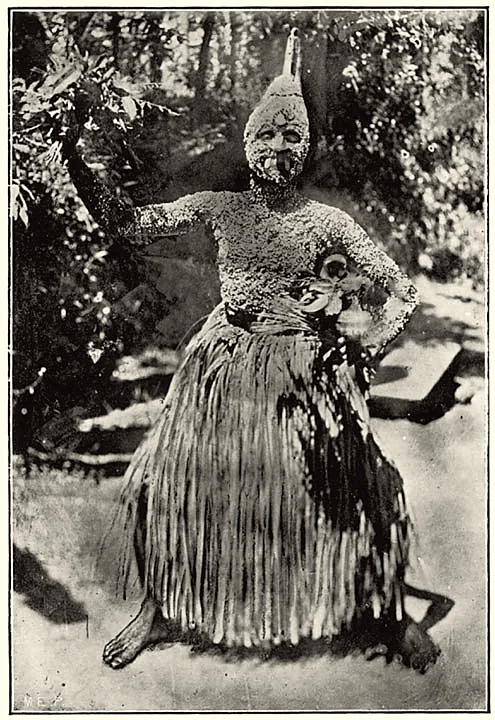
The earliest photographs of theyyam performers that we know of were published in 1909 by Edgar Thurston, superintendent of the Madras Government Museum, in his seven-volume Castes and Tribes of Southern India. In the entry on the Malayan community he quotes a Malabar official, A. R. Loftus-Tottenham, who describes a ceremony 'known as tīyattam, in which they wear masks, and, so disguised, sing, dance, tom-tom, and play on a rude and strident pipe'. The same official notes that Malayans 'take part with Peruvannāns' in ceremonies 'in which the performer impersonates, in suitable costume, some of the minor deities', with an oracle pronouncing at the end.
Thurston himself watched a Malayan performance at Tellicherry (Thalassery) and recorded the costume with care: a paste of rice flour reddened with turmeric and lime on the body, 'strips of young cocoanut leaves, strung together so as to form a petticoat', and strips of palm leaf in the mouth for fangs. All of these are still recognisable in theyyam today.
Our assessment: reading colonial sources with care
Thurston's volumes are a precious record, and we use them gladly; without them we would have no photographs of theyyam from that time. But they must be read critically. The label 'devil-dancer' was a colonial and missionary category that put theyyam in the same box as exorcism; it ignored what devotees believed and gave the art a stigma that took decades to shake off. The sources also make small errors that reveal how little the writers knew from the inside: the passage glosses Peruvannan as 'big barbers', when the Vannans were a washer community and Peruvannan is in fact a title of honour given to master performers. Read with this in mind, the colonial texts still confirm something important: by 1900 the costume, the masks, the coconut-leaf skirts, the music and the oracle were all in place, much as we see them today.
When and where theyyam is performed
The season
The season opens on Thulam 10, the day called pathamudayam, in late October, as the paddy harvest is gathered, and runs into Edavam (May–June), when the monsoon closes the year. The busiest months are December to March. Each shrine has its own fixed dates in the Malayalam calendar, so performances are held on the same days every year. A single kaliyattam at a shrine can last from one night to several days and include many theyyams one after another.
- Kaliyattam: the regular festival of a shrine, usually yearly.
- Perumkaliyattam: the 'great kaliyattam', held at long and irregular intervals, often many years apart, with enormous crowds and the feeding of thousands. The perumkaliyattams of the Muchilottu Bhagavathi shrines are among the most famous.
- Household performances: a family may sponsor a theyyam at its ancestral house (tharavadu) as a vow, for a new house, for the birth of a child or to end a misfortune.
- The Muthappan exception: at the Parassinikadavu Madappura, on the Valapattanam river, Muthappan is performed almost every day of the year.
The sacred places
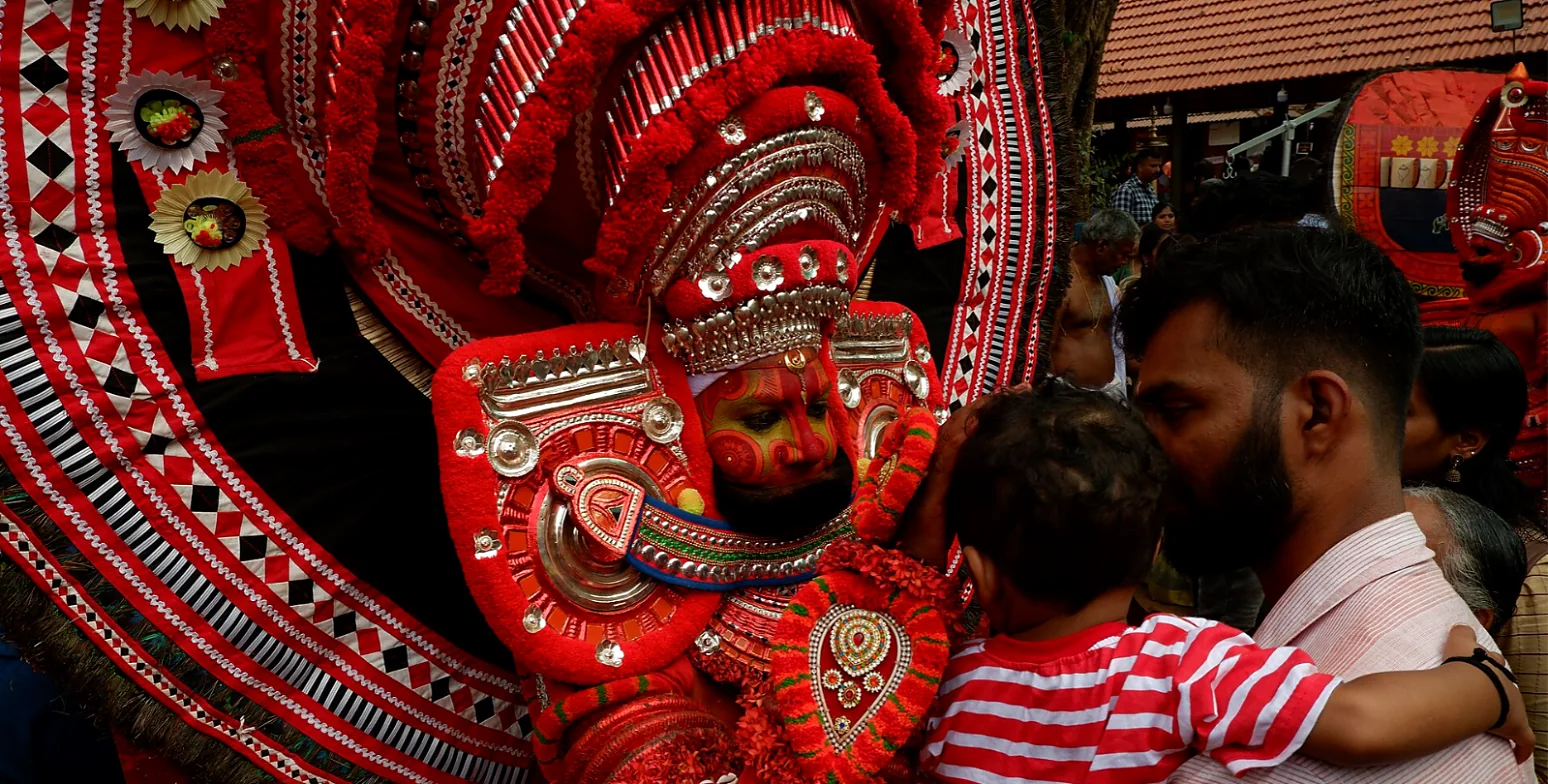
Theyyam is not a temple art in the ordinary sense. It belongs to a family of shrines with their own names: the kaavu (sacred grove), kottam, sthanam or thanam, mundya, ara and palliyara, the madappura of Muthappan, and the courtyards of the ancestral houses (tharavadu). Many shrines have no idol; the deity may be represented by a sword, a stool, a stone, a lamp or a mask. There is no stage and no curtain. The theyyam comes out of the shrine into the open courtyard, the people stand or sit around, children climb the trees, and the drums and torches make the theatre.
The performers
Theyyam belongs to particular communities, and the right to perform a given theyyam at a given shrine passes down within families, from father to son or from uncle to nephew. Most of these communities are listed today as Scheduled Castes or Scheduled Tribes. The main performing groups are:
- Vannan: the largest group of performers; responsible for many of the great goddess and hero theyyams. One study cited by The Caravan estimated that about 30 per cent of all performers were Vannans.
- Malayan: performers, and also the most celebrated drummers and singers; Gulikan is closely associated with them.
- Velan, including the Anjuttan and Munnuttan groups: performers of several Chamundi forms, among others.
- Mavilan, Koppalan, Pulayan, Chingathan and others; in Wayanad the Kalanadi; north of Kerala, in the Tulu country, the Parava, Pambada and Nalike perform the related bhuta kola.
- For a few deities the performer must come from another community: the Muthappan theyyam, for instance, is performed by members of the Thiyya family that founded each shrine.
Boys begin by watching, drumming, singing in the chorus and helping with costumes, and may perform minor theyyams in their teens. A full performer must know the songs (thottam pattu) of his deities by heart, the steps, the make-up, the making of the costume, and the ritual words with which the deity speaks to the people. Masters are honoured with titles, among which Peruvannan (for Vannans) and Panicker are the best known; such titles were traditionally conferred by the ruling houses and the great shrines. In 2024 a theyyam artist of Kannur, E. P. Narayanan (Narayanan Peruvannan), received the Padma Shri, one of India's highest civilian honours.
Most performers are not professional artists. Outside the season they work as farmers, labourers, drivers or in small jobs; reporting in The Caravan (2021) found most owned very little land and were paid irregularly, with a costly silver ornament sometimes worth more than a season's earnings. The physical price is real too: burns from fire rituals, bruises from heavy headdresses tied tight for hours, and nights of dancing without proper food or rest.
Devakkoothu: the one theyyam of a woman
Theyyam is performed by men, who also take the parts of the goddesses. The single exception is Devakkoothu, performed by a woman at the Thekkumbad Koolom Thayakavu, a sacred grove near Cherukunnu in Kannur district. It tells of a celestial maiden, Valliyamma, who comes down to earth to pick flowers, gets lost among the creepers and is rescued, and who returns every other year to bless the people. It is held once in two years, in the month of Dhanu (December). The performer keeps a 41-day vow of purity beforehand. The rite lapsed for many years and was revived in the mid-1980s; M. V. Ambujakshi has performed it since 2012, after Lakshmi Amma.
Preparation: the vow before the god
The performer's preparation begins long before the night. For days or weeks, depending on the deity and the shrine (Devakkoothu requires 41 days, for example), he keeps a vow of purity (vratham): vegetarian food, abstinence from alcohol and from sexual relations, ritual baths, and in many places sleeping apart, sometimes in a hut of palm fronds at the shrine. On the day of the performance the chief performer fasts. These rules are not only discipline: they mark the separation of the man from his ordinary life, so that the god can come.
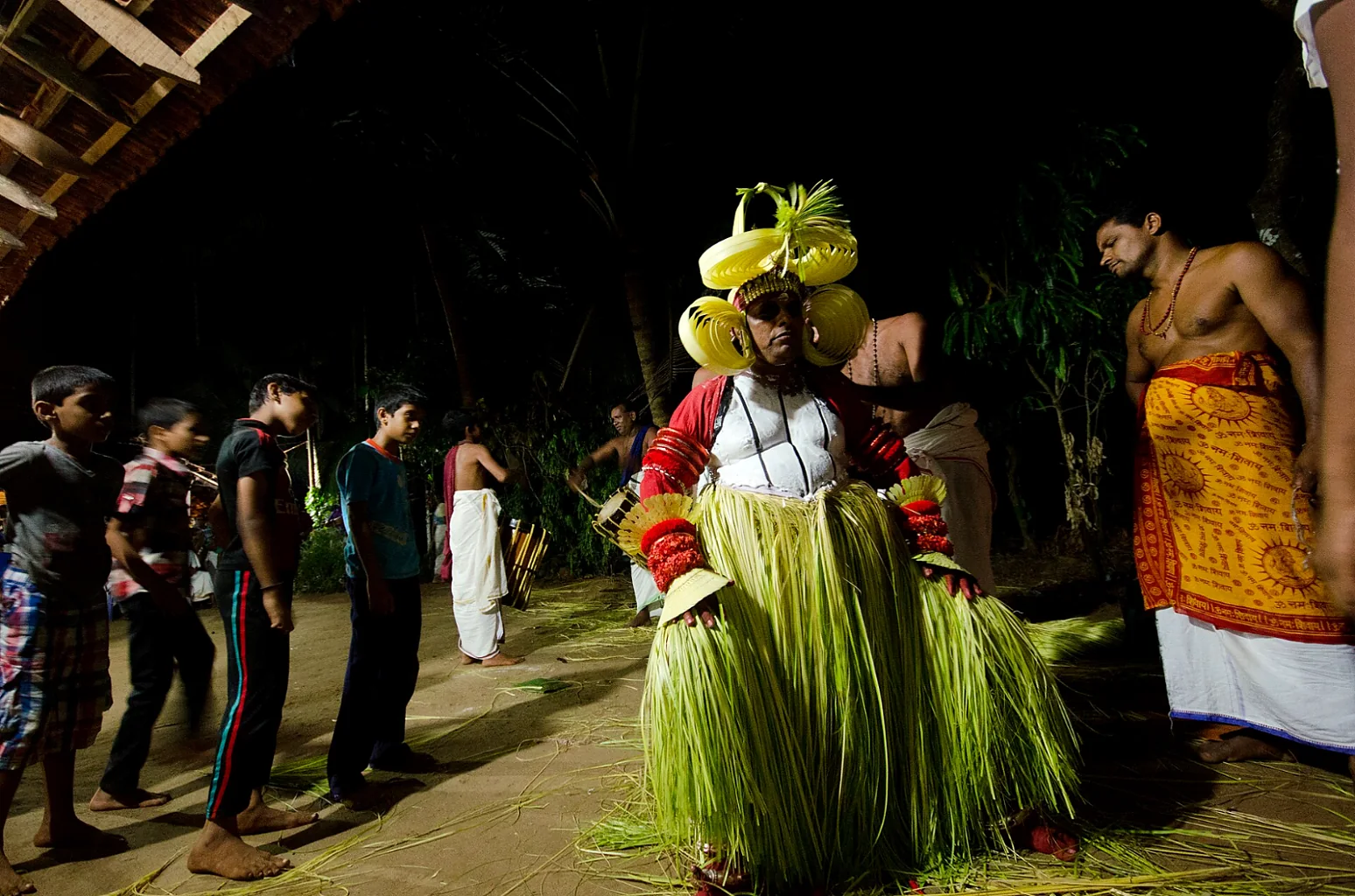
Much of the costume is made fresh by the performer, his family and his helpers. Strips of tender coconut leaf (kuruthola) are cut, split and plaited on the same day so that they stay green; the frames of the headdress are built from bamboo or areca palm and covered with red cloth, silvered foil, coloured paper and mirrors; ornaments of wood, metal and silver are cleaned and tied on. A large theyyam needs a whole team.
The night: from song to god
Every shrine has its own order, but the sequence of a theyyam generally follows these stages:
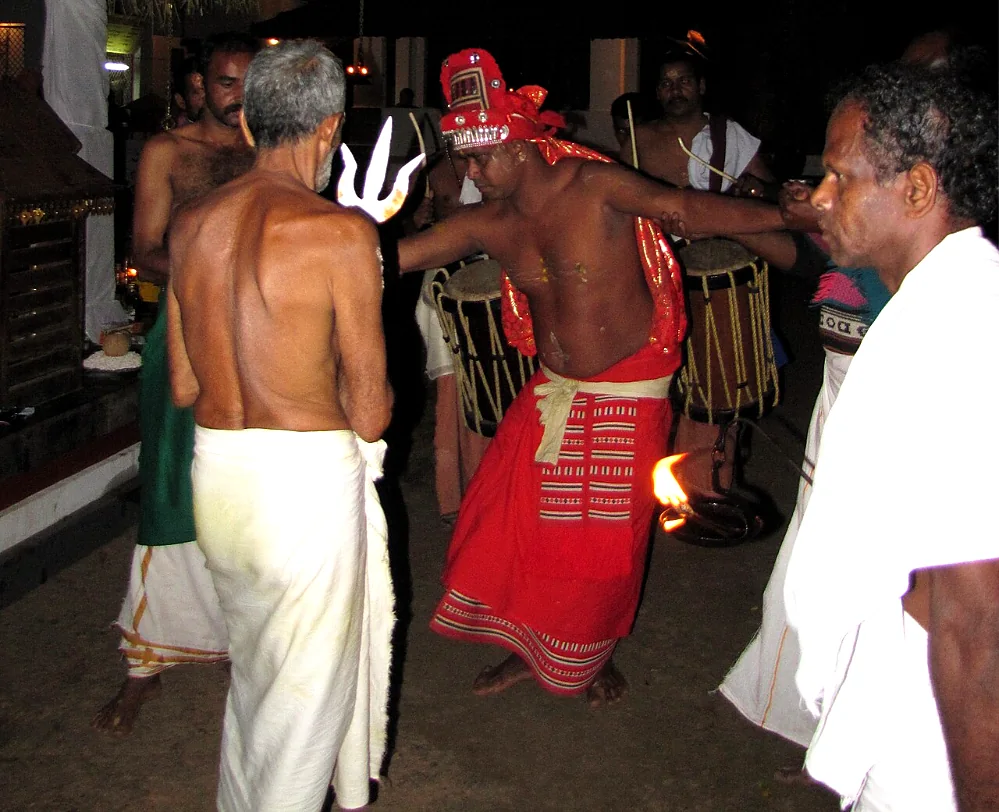
- Thottam. The performer, wearing a small red headdress and simple make-up, stands before the shrine with the drummers and sings the thottam pattu, the sacred song that tells the deity's origin and story and invites the deity to come. The tempo rises; the performer begins to tremble.
- Vellattam. For some deities a lighter preliminary form, called vellattam, follows, in simpler costume and make-up, with its own dance.
- Make-up and dressing. The performer goes to the dressing place (often a shed of palm fronds) where the face painting and costume are completed, a process of two to six hours or more.
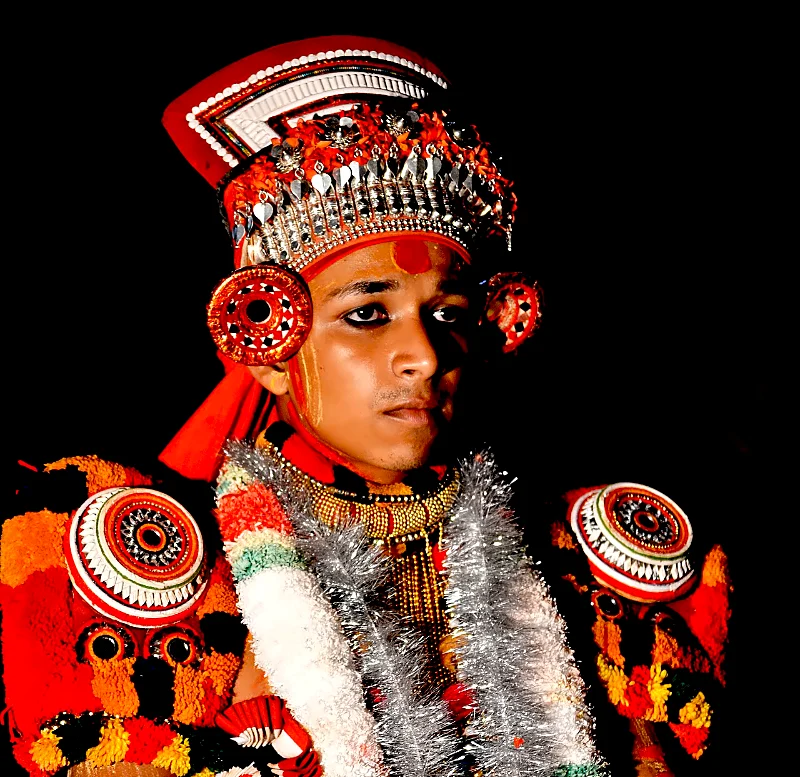
- The mirror and the headdress. Before the shrine he is given a small mirror. Looking at the god's face painted on his own, he is believed to cross over. The sacred headdress, the mudi, is placed on his head or raised onto it: this is the moment the deity is believed to enter him. In many shrines the performer also takes a ritual draught of toddy.
- The dance. The theyyam dances in the courtyard, circles the shrine, shows his weapons, and enacts episodes of his story, sometimes for hours. Fire theyyams leap through or lie on embers.
- The blessing and the word. The theyyam then receives the people one by one. He gives them turmeric powder or rice as a blessing and speaks the god's words: advice, comfort, warnings, judgments in disputes. In many shrines the Thiyya community brings the kalasam, a ritual offering of toddy, and has the traditional right to stop a performance.
- The end. When the mudi is taken off, the god leaves. The exhausted man returns.
Our assessment: is the performer possessed?
For the devotees the answer is simply yes: for those hours the man is the god, and that is why a landlord will bow to a man he would not otherwise have touched. Anthropologists describe the same thing in other words, as a learned and disciplined trance: weeks of vows and fasting, hours of make-up, the rising drums, the song of the god's story, the mirror and the weight of the headdress together carry the performer into another state. Performers themselves usually speak of it with great humility, as something that comes over them rather than something they do. We do not think these views need to be set against each other. What can be said with certainty is that the transformation is taken with total seriousness by everyone present, and that a good performer is judged not only by his dancing but by whether the god is felt to have come.
Mukhathezhuthu: writing the god's face
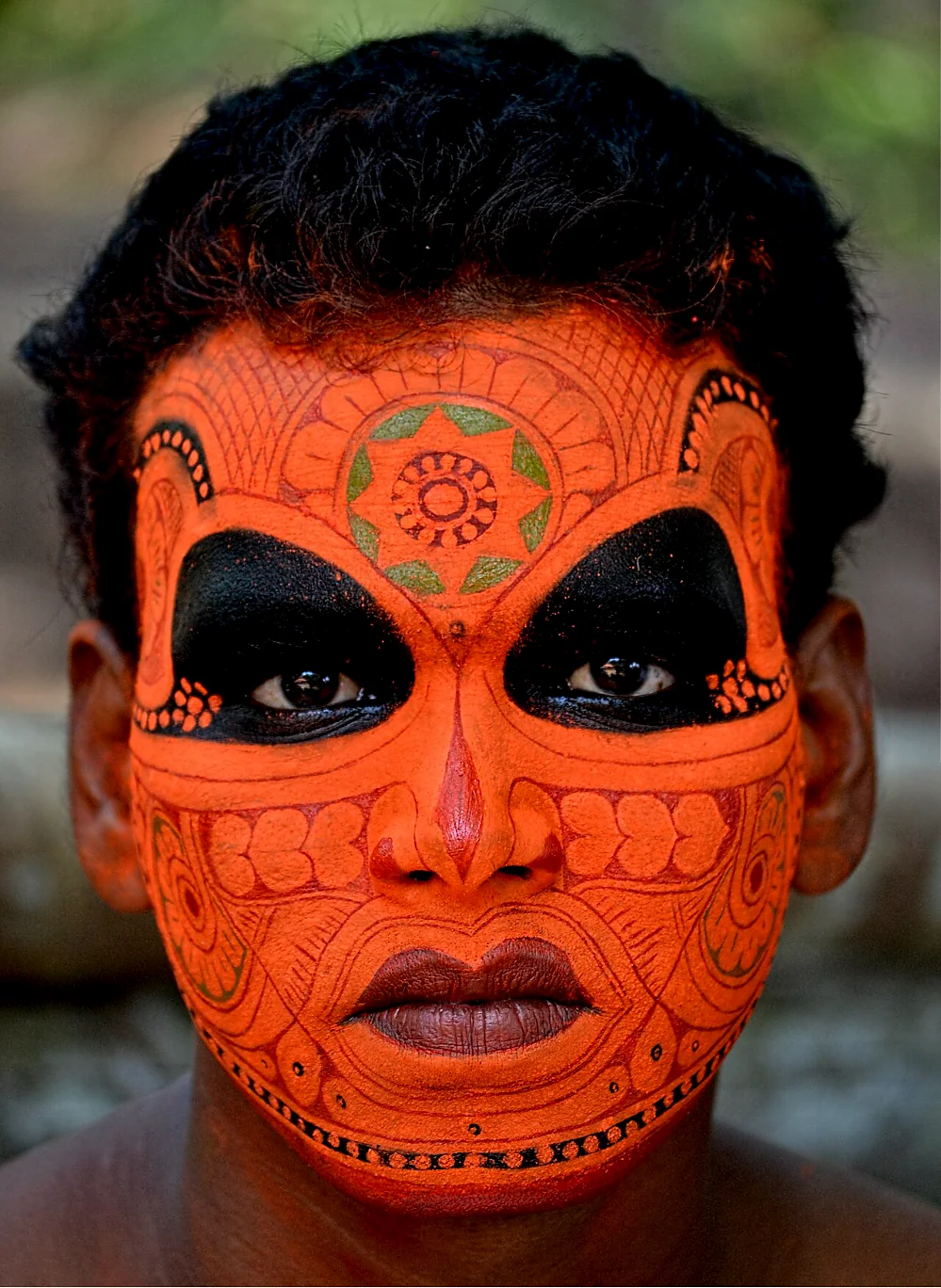
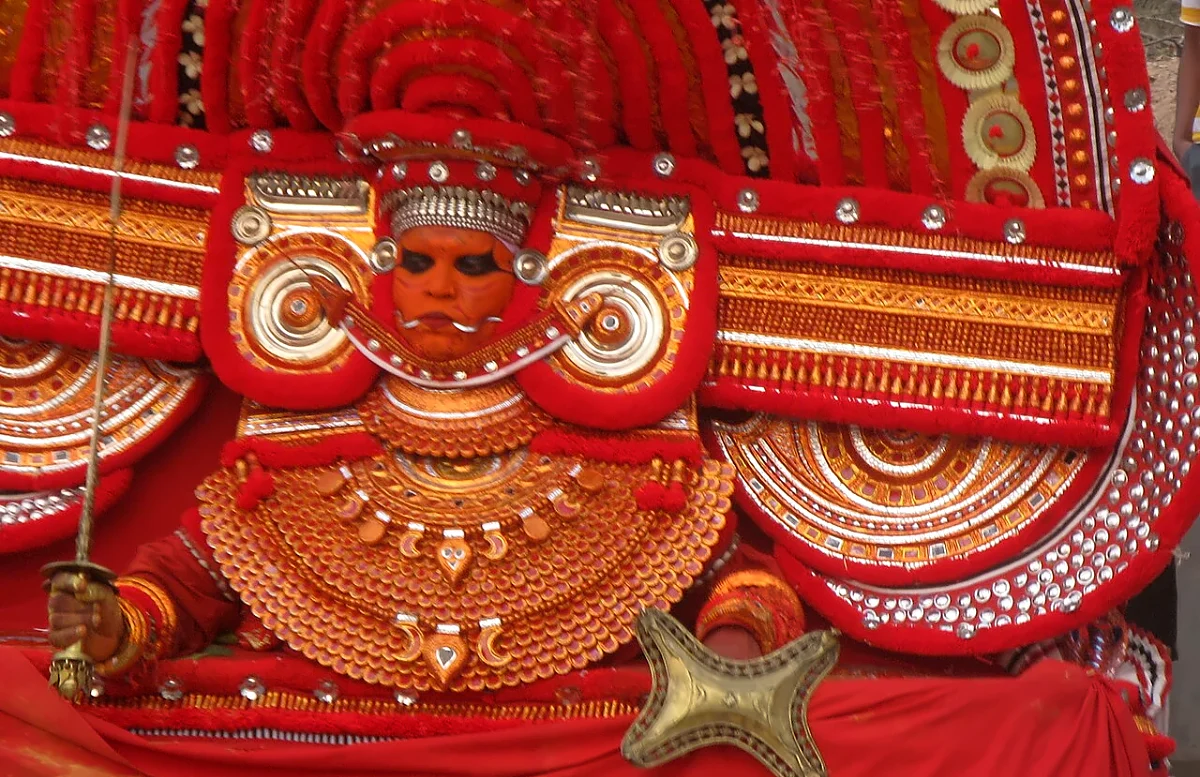
The face painting is called mukhathezhuthu, 'face writing', and it is a specialist art. The performer lies on his back or sits still while a senior artist, often another performer, paints with a thin stick or a coconut-leaf rib. The traditional colours are natural:
- White from rice paste (arichantu);
- Yellow from turmeric and from manayola, a mineral yellow;
- Red from chayilyam, a mineral vermilion, and from turmeric mixed with lime;
- Black from lamp soot or charcoal; mixed with coconut oil.
Red, orange and black dominate, and each theyyam has its own pattern, reflecting its nature, fierce or gentle. Painters and writers name a number of styles, among them prakkezhuthu, sankhezhuthu, vairadelam, kattaram, kozhipuspam, kottumpurikam and the nagam thazhthi ezhuthu of Kathivanoor Veeran, with its painted beard and moustache. The body, too, may be painted, with styles such as parunthuvaal ezhuthu and anchupulli ezhuthu. Some theyyams wear a face mask instead of, or as well as, painting: Pottan, Gulikan and Kuttichathan are examples. Vayanattu Kulavan wears false eyes over his own, because in his story he lost his sight.
Costume: the mudi and the dress
The costume is the god's body, and every element is prescribed for each deity.
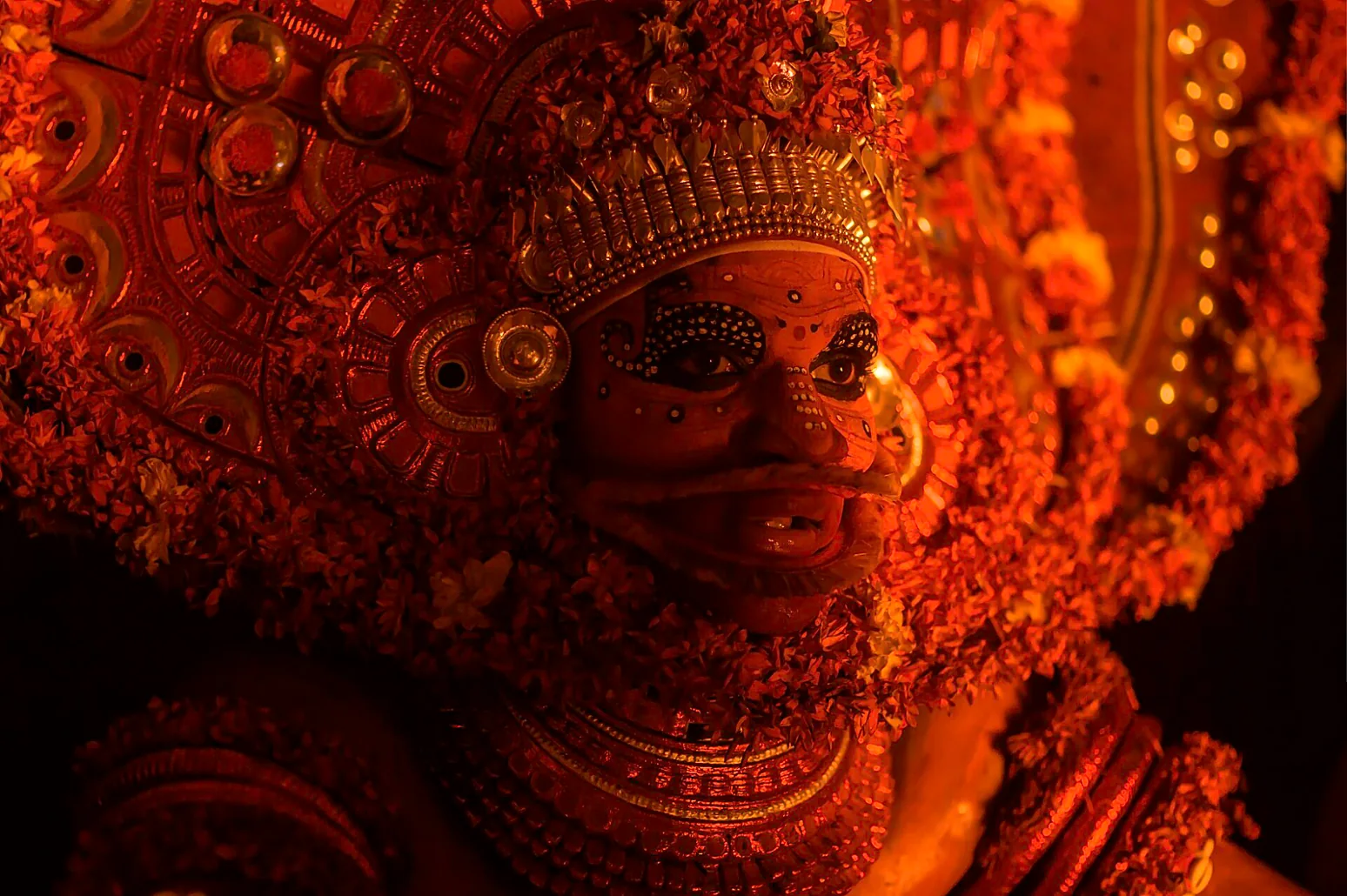
- The mudi (headdress) is the most sacred part. It ranges from small caps to enormous structures several metres high that must be supported by helpers; there are round halo-like crowns, tall pillar-like crowns, fan shapes and crowns of flowers. They are built on frames of bamboo, areca palm or wood, covered with red cloth, silver foil, coloured paper, mirrors and tender coconut leaf, and decorated with flowers, especially red chethi (ixora) and marigold.
- The skirt is either a broad, many-layered wrap of red cloth tied around a frame (uduthukettu), or a skirt of tender coconut leaves, which many fire theyyams wear.
- The ornaments include breastplates, armlets, bangles, anklets with bells (chilambu), and false breasts for goddess forms, in wood, metal or silver.
- The weapons are the god's: swords, shields, bows and arrows, the trident, the bamboo torch of Vayanattu Kulavan, the staff of Gulikan.
Music
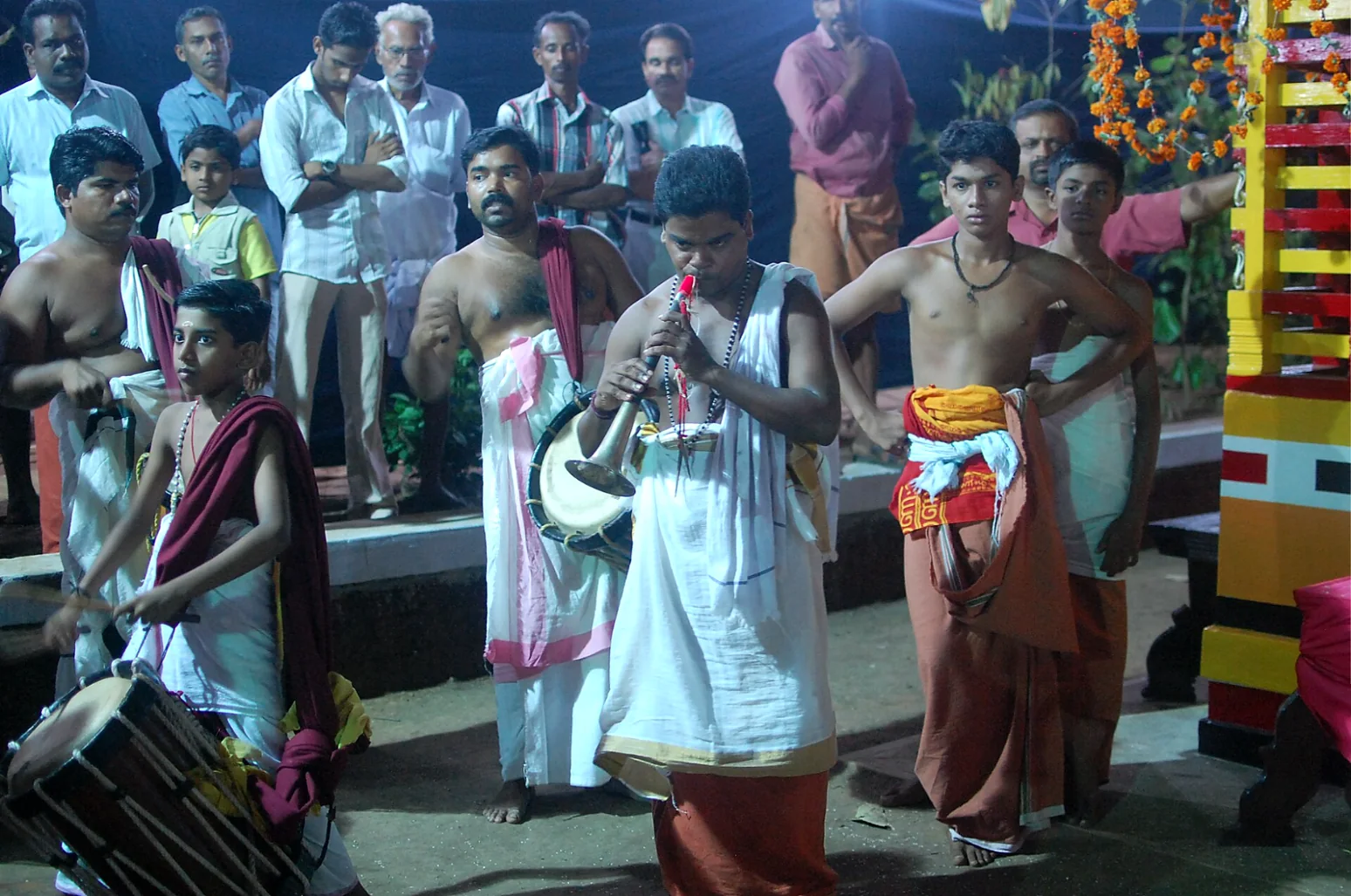
Theyyam lives in its rhythm. The main instrument is the chenda, the cylindrical drum of Kerala, played with sticks; with it come the small hourglass drum thudi, the hand cymbals elathalam, and the kuzhal, a loud oboe-like pipe (the 'rude and strident pipe' of the colonial description). The drumming follows the performer: slow and steady during the thottam, rising to a pounding climax as the god arrives and the dance begins. The songs are in an old Malayalam, close to the language of north Malabar folk song, and are passed down orally.
Watching theyyam respectfully
- Remember that it is worship, not a show. Dress modestly, take off footwear where others do, and follow the instructions of shrine volunteers.
- Never block the performer's path or the line of devotees, and keep well back from fire theyyams.
- Photograph without flash, and ask before photographing at close range; never use drones without permission.
- It is customary to receive the blessing with both hands and to offer a small amount of money.
- Most performances happen at night or before dawn. Shrine calendars are published locally, and the Kerala Tourism website has a theyyam calendar.
Our assessment: the god who is a man of a 'low' caste
The most remarkable fact about theyyam is social. In north Malabar, which was among the most caste-ridden places in India, the people who became gods were overwhelmingly from the castes that were then held 'untouchable' or 'polluting'. For a night, the order was reversed: Brahmins, Nairs and landlords bowed before them and took their blessing. Some scholars read this as a safety valve that let the old order continue; others as a real, if temporary, space of dignity and protest, in which the songs kept alive the memory of injustice. We think both are true, and that the balance has shifted over time. But honesty requires saying that the reversal ends at dawn. Reporting as recent as 2021 documented performers being made to sit on the floor in temple canteens, families threatened with exclusion, and inequality in pay and respect. Theyyam's dignity belongs first of all to those who perform it, and any visitor who admires the art should remember that.
Continue to Part 2: the gods: the types of theyyam, their names and stories, how they differ, and the shrines where they are performed.
Read also: Kannur, the Arakkal kingdom and theyyam · Thalassery and Hermann Gundert · Bekal Fort and Kasaragod · Kozhikode and the Zamorins
See it for yourself, with a local driver who knows these roads.
Book a Munnar Jeep SafariSources & further reading
- Hermann Gundert, A Malayalam and English Dictionary (1872), via Wikimedia Commons
- Edgar Thurston, Castes and Tribes of Southern India, vol. IV (1909), Project Gutenberg
- Wikipedia: Theyyam
- Kerala Tourism: theyyam costume and make-up
- MAP Academy: Theyyam
- Amritha Mohan, How caste still rules the social lives of theyyam practitioners, The Caravan (2021)
- Kerala Museum: Discovering theyyam characters within and without (PDF)
- Wikipedia: Devakkoothu
- Theyyam calendar: history and the Manakkadan legend
- K. K. N. Kurup, The Cult of Theyyam and Hero Worship in Kerala (Calcutta, 1973)
Figures are from the sources listed and were checked in October 2026. Park timings and road conditions change, so please confirm before you travel.