
Parassinikadavu Muthappan: The River Shrine Where the God Comes Every Day
On the bank of the Valapattanam river in Kannur, a god with a bow, a dog and a taste for toddy appears in person twice a day and speaks to anyone who comes. The legend of Muthappan, the Thiyya madappura and its keepers, how the daily Vellattam and Thiruvappana work, the dogs and the free food, the forest abode at Kunnathoor Padi, and how to visit.
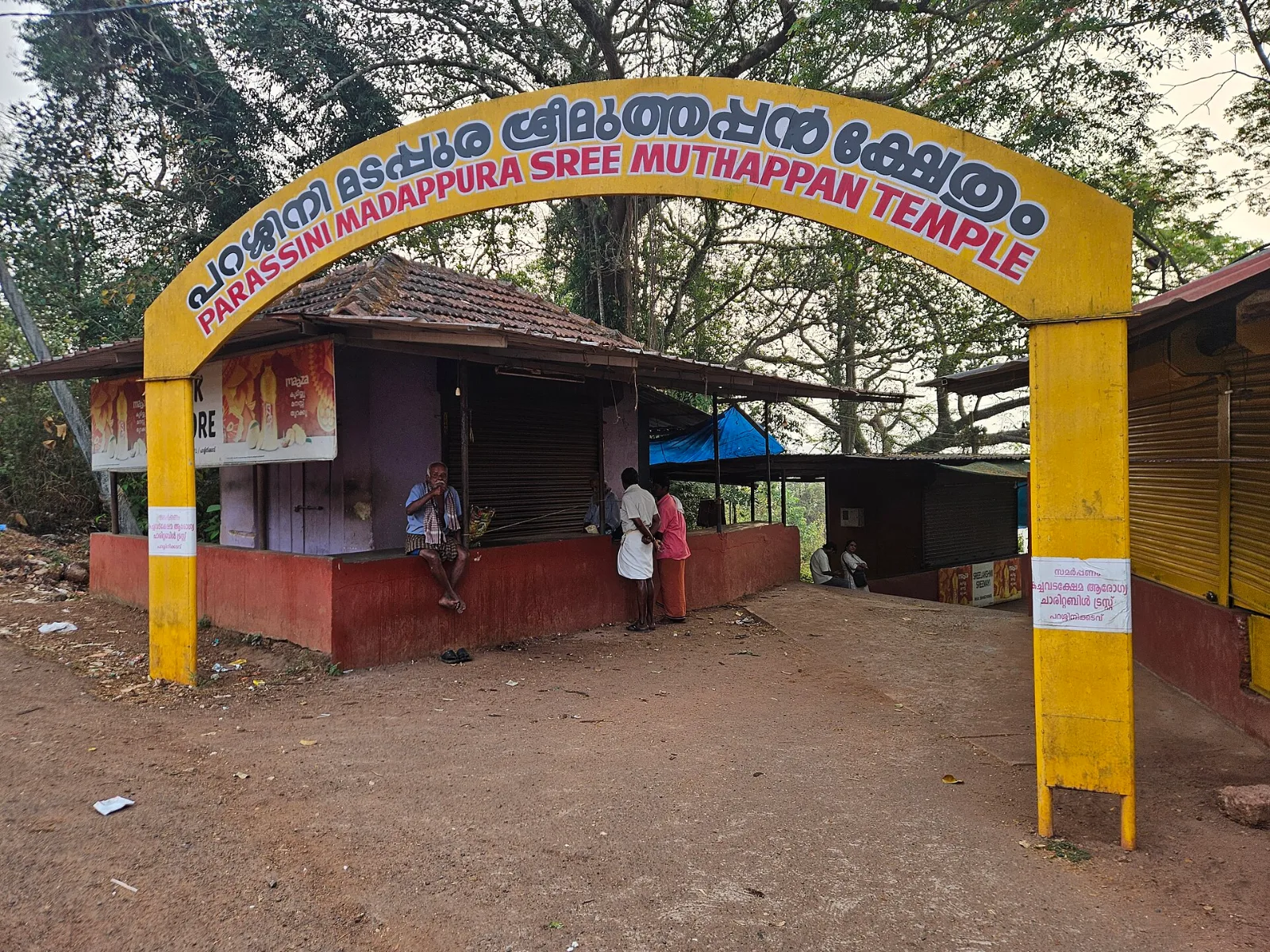
Most temples in Kerala keep their god behind a door and let a priest speak for him. At Parassinikadavu, about 20 km north-east of Kannur town, the god walks out into the courtyard every morning and every evening, dances, takes devotees by the hand, listens to their troubles and answers them in his own voice. This is Sree Muthappan, a folk god of North Malabar, and the Parassini Madappura on the bank of the Valapattanam river is his best-known shrine. It is also the only temple in Kerala where a theyyam is performed nearly every day of the year. Our Theyyam Part 2 introduced Muthappan among the gods of the north; this article goes deeper into the shrine itself. (For theyyam in general, start with Theyyam Part 1; for the town, see Kannur.)
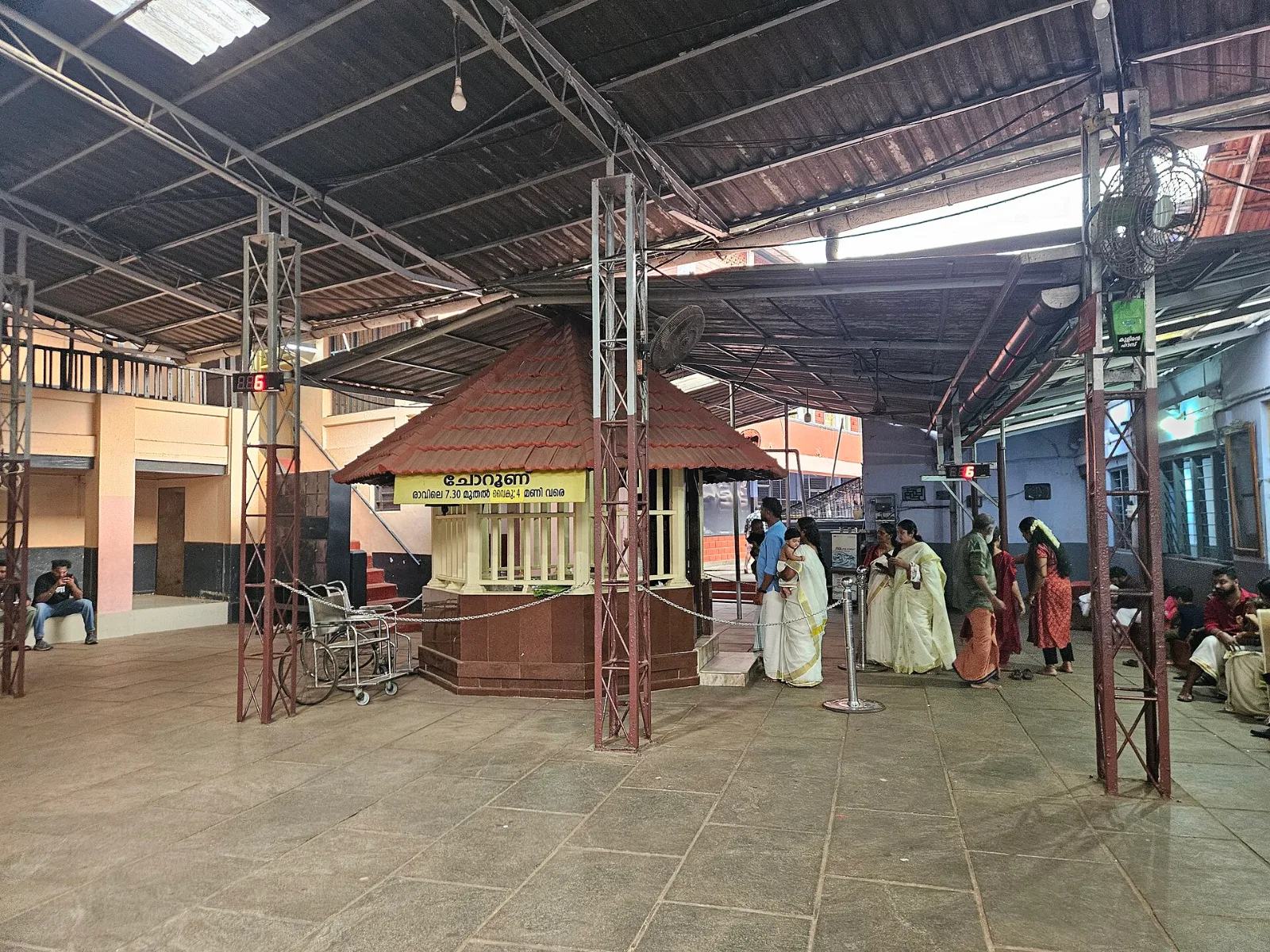
At a glance
- Where: Parassinikadavu, Anthoor municipality, Kannur district, on the Valapattanam river, about 10 km from Taliparamba and 20 km from Kannur.
- God: Muthappan, worshipped in two forms: Thiruvappana (Valiya Muthappan, identified with Vishnu) and Vellattam (Cheriya Muthappan, identified with Shiva).
- Worship: through theyyam rather than a fixed idol; pujas by the Thiyya madayan, the theyyam performed by men of the Vannan community.
- Daily: morning ritual from about 5:30 to 8 am, Vellattam in the evening from about 6:30 pm (not from 1 Thulam to 15 Vrischikam, roughly mid-October to the end of November).
- Open to: everyone, of any caste, religion or nationality. Free meals are served to all visitors.
The legend
The story is sung in the theyyam's own songs and retold, with variations, in every Muthappan shrine. A childless couple of Ayyankara, near Eruvessi in the hills east of Taliparamba, prayed for a son. Most versions call the husband Ayyankara Vazhunnavar, a landed chief (and in some a Nambudiri Brahmin), and the wife Padikutty, a devotee of Shiva. One morning, bathing in the river, she found a beautiful baby boy lying on a bed of flowers, and took him home as a gift from Shiva.
The boy grew up unlike anyone in the house. He went into the forest to hunt with a bow, ate meat and fish, drank toddy, and mixed freely with the hill people and the poor. His foster parents begged him to change. At last Padikutty saw him in his true form, a god with blazing eyes, and fell at his feet. To spare her, he covered his eyes with a shield (the poikkannu, or false eyes, which the theyyam still wears) and left home to wander.
His travels took him through villages whose names devotees recite: Kunnathoor, Puralimala, Padavil, Thillenkeri, Kannapuram, Parassinikadavu. At Kunnathoor, he was caught stealing toddy from the palms of Chandan, a toddy-tapper. Chandan shot an arrow at the thief, saw who it was, and fell unconscious. His wife prayed to the stranger, offering what she had in the house: boiled gram, slices of coconut, toddy and dried fish. Chandan revived. The god agreed to stay, and Kunnathoor became his abode, and that humble meal became his offering. The name Muthappan, "grandfather" or "venerable elder", is said to come from the old man's form he took in that story.
How he came to Parassinikadavu is told differently by different families and singers, but all agree that the god chose the riverbank himself, and the shrine stands where he is believed to have stopped.
Who keeps the shrine
A shrine of Muthappan is called a madappura, not a kshetram (temple), and it works differently from a Brahmin temple. At Parassinikadavu the pujas are performed by a madayan, the senior man of the Thiyya family that keeps the madappura, and the theyyam itself is performed by men of the Vannan community, whose families hold that right. Muthappan is above all the family god (kuladaivam) of the Thiyyas, who were once barred from Brahmin temples, and the madappura is one of the best examples in Kerala of a powerful shrine run outside the Brahmin priesthood.
The temple belongs to the Parassini Madappura family. In law it is a religious institution under the Malabar Devaswom Board, and court records show the trust, Parassinikkadavu Sree Muthappan Sathanam, represented by its madayan as trustee and general manager. As in many Malabar temples, questions about the temple's income and administration between the family, the Board and others have gone to the Kerala High Court.
Some historians link the cult to the Mannanar chiefs of Eruvessi, a Thiyya ruling family remembered in local tradition. The Mannanar palaces stood near Ayyankara, where the legend begins, and scholars of the cult have suggested that Muthappan grew out of a hunter god of the forest communities of these hills (the Mavilan among them), later identified with Shiva as the divine hunter (Kirata) and with Vishnu. These are interpretations rather than documented history; there are no early inscriptions or records for the shrine.
Two gods in one: Thiruvappana and Vellattam
Muthappan appears in two forms, and at Parassinikadavu the two often stand side by side.
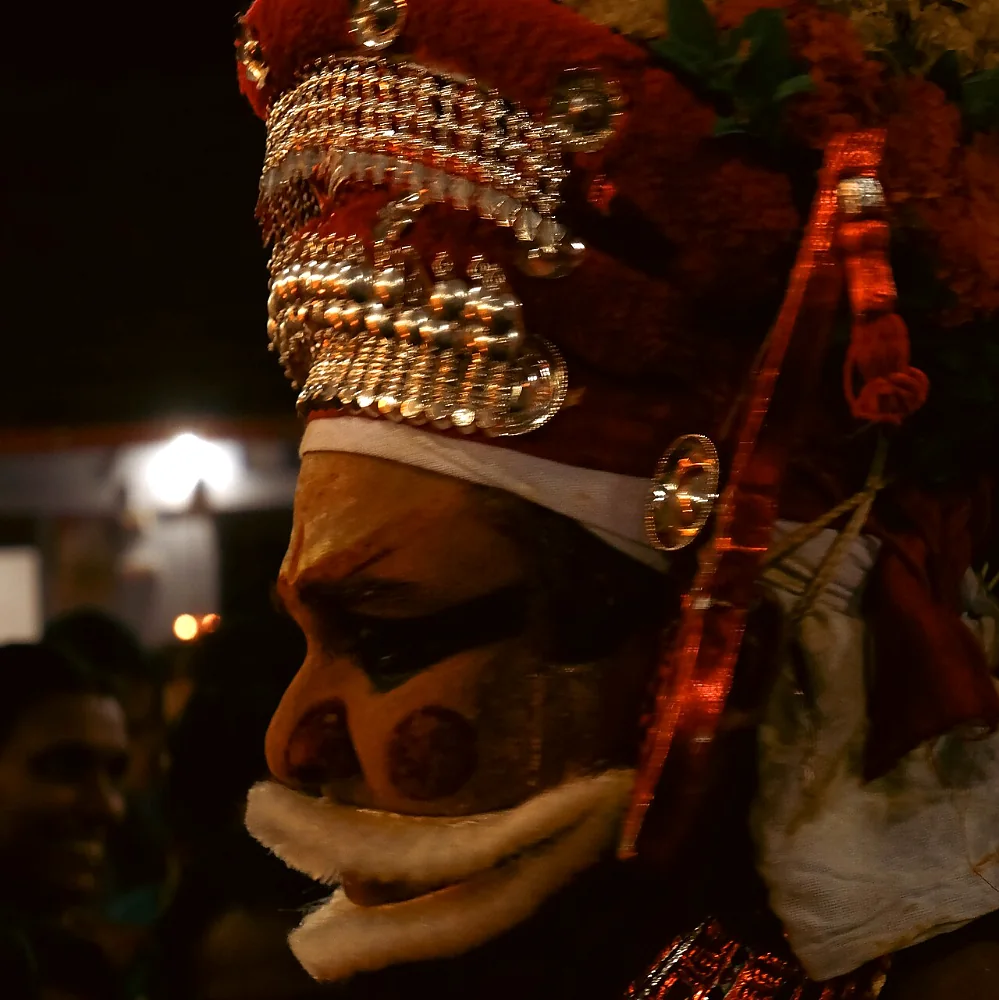
- Vellattam (Cheriya Muthappan, "the younger") is the simpler form, with light costume and a crown with a crescent moon, identified with Shiva. Because his dress is light, he dances and talks freely.
- Thiruvappana (Valiya Muthappan, "the elder") is the full form, with a tall crown shaped like a fish, identified with Vishnu, and heavy ornaments.
Both carry the bow and arrow of the hunter, and both wear the poikkannu over the eyes. The performer drinks toddy as part of the ritual, which is believed to set aside his own self so the god can enter. After the dance, the god speaks to devotees one by one: they tell him their problems, and he answers, consoles, scolds or blesses. This direct conversation with a god (arulappadu) is the heart of a visit.
A day at the madappura
The shrine opens before dawn. The morning ritual, with Thiruvappana and Vellattam, runs from about 5:30 to 8 am, and Vellattam returns in the evening from about 6:30 pm. The theyyam is not performed from 1 Thulam to 15 Vrischikam (mid-October to the end of November), on the new-moon days of Karkidakam and Thulam, on the temple's nira (first harvest) day, or when there has been a death in the Madappura family. Exact timings change from season to season, so check locally before travelling.
Visitors receive prasadam of boiled black gram (or green gram) with a slice of coconut, and tea, and lunch and dinner are served free in the dining hall (annadanam). The traditional offerings to the god are payankutti, the principal offering, made through the madayan, vellattam (paying for a performance), and lamps. Toddy and fish, unusual in a Kerala temple, are part of the god's own story and are customary offerings here.
The dogs
Muthappan, a hunter, is always accompanied by a dog, and dogs roam the temple freely. Two bronze dogs stand at the entrance. It is said that the first portion of the prasadam is given to a dog before devotees. A story told at the shrine says that the temple authorities once removed the dogs, and that the god then refused to come into the performer until they were brought back.
Festivals
- Puthari Thiruvappana, on 16 and 17 Vrischikam (1 to 3 December, falling on 2 and 3 December 2026), opens the theyyam season after the six-week break. Freshly harvested rice is offered and a feast is cooked from it. It is the first Thiruvappana of the temple year; the last is on 30 Kanni.
- Puthari Vellattam, in Thulam (around late October), is a harvest Vellattam.
- Thiruvappana Mahotsavam, on 19 to 21 Kumbham (early March), is the annual festival, opened by a procession led by a man of the Thayyil family from his ancestral house to the shrine. During festivals the temple provides free food and lodging for pilgrims.
Kunnathoor Padi: the abode in the forest
Devotees say that what Sabarimala is to Ayyappa, Kunnathoor Padi is to Muthappan: his aroodam, his true seat. It lies in the hills near Payyavoor, north-east of Parassinikadavu, on top of Udumbumala in the Western Ghats, about 3,000 feet up. There is no temple there. The god is believed to have said that fallen leaves, a spring, a mountain, a round stone, forest and palm trees are enough for him. For a month each year, from 2 Dhanu to 2 Makaram (mid-December to mid-January; 18 December 2026 to 16 January 2027), a thatched shrine is raised in a forest clearing, purification rites are performed, and theyyams of Muthappan and associated gods appear, with pilgrims climbing about a kilometre up the steep path. Tradition links the site to the Kunnummal Idathil family and the old chiefs of the region, and it is said that under British rule its management passed to the Karakattidam Nayanar family.
Spread
From Kannur and Kasaragod, Muthappan has followed his devotees. There are hundreds of madappuras across North Malabar and Kodagu (Coorg), Muthappan madappuras at several railway stations along the coast, and shrines wherever Malabar families have settled, in other Indian cities and abroad, where Vellattam is staged for devotees. The Nileshwar madappura has its own founding story, involving a Koroth family elder who drank toddy at the site.
What is certain and what is not
- Documented: the shrine's daily rituals and calendar; the Thiyya madayan and Vannan performers; its status under the Malabar Devaswom Board.
- Tradition: the Ayyankara legend and its versions; the arrival at Parassinikadavu; the dog story.
- Interpretation: origins in a forest hunter cult; the link to the Mannanar chiefs; the shrine's age.
Timeline (a typical year)
- Thulam (Oct)Puthari Vellattam; the theyyam break starts on 1 Thulam.
- 16 Vrischikam (Dec)Puthari Thiruvappana; daily theyyam resumes.
- Dhanu–Makaram (Dec–Jan)The month-long festival at Kunnathoor Padi.
- 19–21 Kumbham (Mar)Thiruvappana Mahotsavam at Parassinikadavu.
- 30 Kanni (Oct)The last Thiruvappana of the temple year.
Questions people ask
Can non-Hindus enter?
Yes. Muthappan's shrine is known for welcoming everyone, and many Christian and Muslim visitors come.
Is there a dress code?
Modest clothing is expected. Rules are relaxed compared with many Kerala temples, but follow any signs on the day.
How do I get there?
Kannur railway station is about 20 km away and Kannur International Airport is within an hour by road; buses run frequently from Kannur and Taliparamba. Boats on the Valapattanam river also stop near the shrine.
Is there anything else to see nearby?
The Parassinikadavu Snake Park is a short distance away, and the Rajarajeshwara temple at Taliparamba is about 10 km north.
(Read also: Theyyam Part 1, Theyyam Part 2, Kannur and Sabarimala.)
See it for yourself, with a local driver who knows these roads.
Book a Munnar Jeep SafariSources & further reading
- Wikipedia: Muthappan Temple
- Wikipedia: Muthappan
- Wikipedia: Kunnathoor Padi
- Kerala Tourism: Parassinikadavu Muthappan Temple
- Kerala Tourism: Parassini Madappura Sree Muthappan Temple
- Kerala Tourism: Puthari Thiruvappana
- Kerala Tourism: Kunnathurpadi festival (1000 festivals)
- Incredible India: Parassinikadavu Sri Muthappan Temple
- Onmanorama: Sree Muthappan, a theyyam for the masses (2019)
- Outlook Traveller: The Kerala temple where dogs are worshipped
- Indian Kanoon: writ petitions concerning Parassinikkadavu Sree Muthappan Sathanam
Figures are from the sources listed and were checked in November 2026. Park timings and road conditions change, so please confirm before you travel.