
Sabarimala: Ayyappa's Hill Shrine – Legends, History, the Pilgrimage and the Questions Around It
A forest temple on a hill in the Western Ghats that once drew mostly local villagers now receives more than five million pilgrims in two months. Who Ayyappa is, what the records actually say about the shrine, how the forty-one-day pilgrimage works, and the disputes, from tribal claims to the Supreme Court, that surround it.
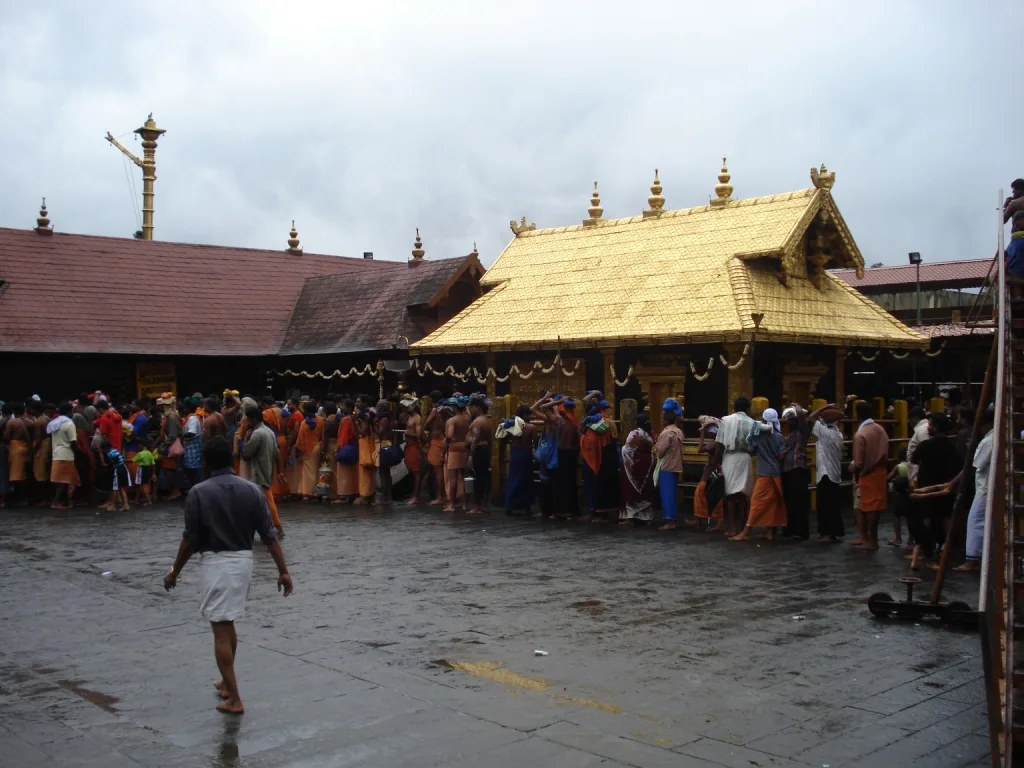
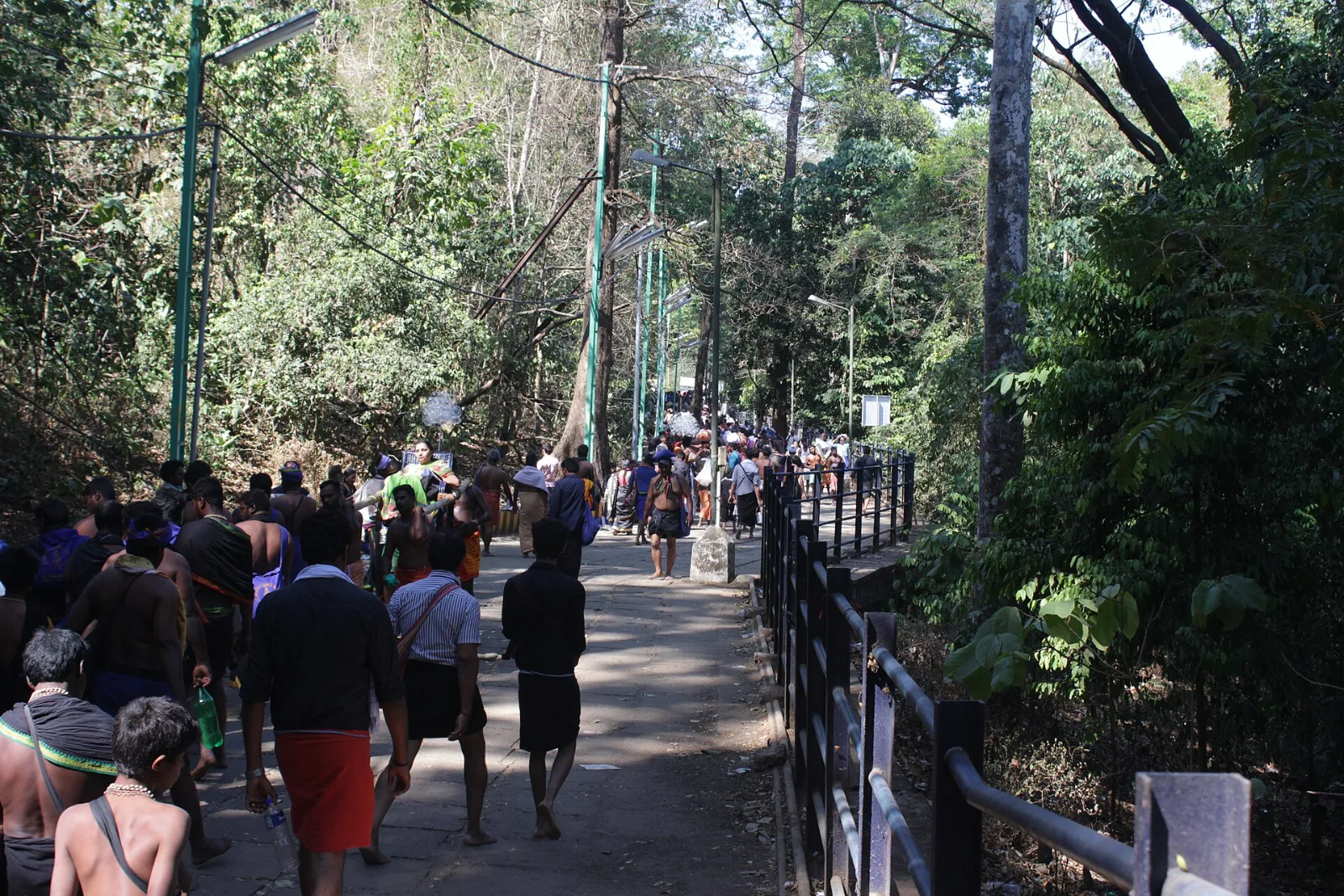
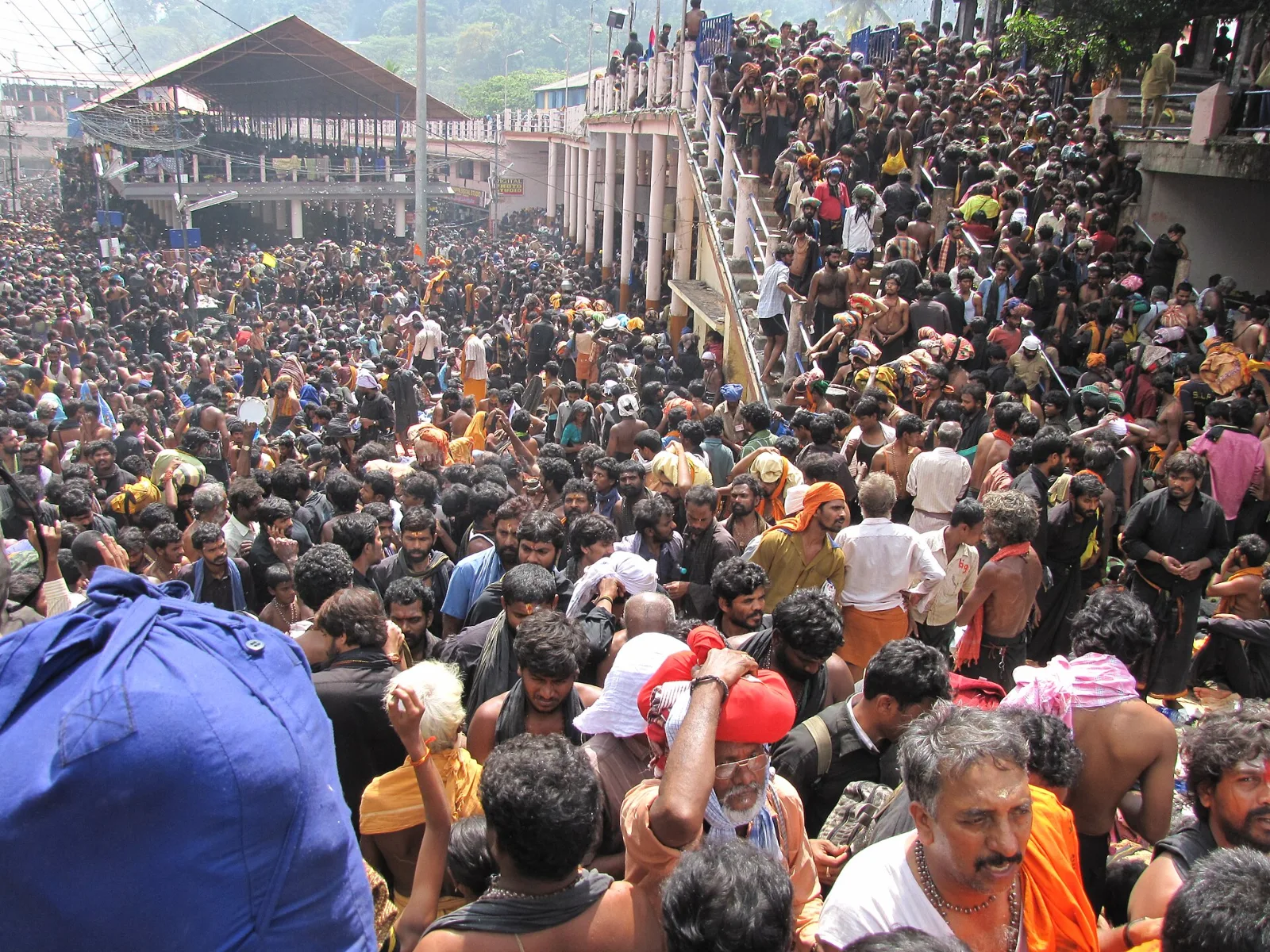
On a forested hill in the Periyar Tiger Reserve, about 1,260 metres above the sea, stands the temple that more people in South India walk to than perhaps any other: Sabarimala, the shrine of Ayyappa, also called Dharma Sastha. Most of the year it is closed. When it opens, for the two-month season from mid-November to mid-January and for a few days every month, the forest paths fill with men in black and blue, barefoot, carrying bundles on their heads and calling Swamiye saranam Ayyappa. This article separates what the legends say, what the records show and what is still argued over. (For the hill people of this region, see the Malayarayar; for the forest around the shrine, see Periyar Tiger Reserve.)
At a glance
- Where: Sabarimala, Ranni taluk, Pathanamthitta district, inside the Periyar Tiger Reserve. Pilgrims usually set out on foot from Pamba, the river base camp.
- Deity: Ayyappa (Ayyappan), identified with Dharma Sastha.
- Managed by: the Travancore Devaswom Board; rituals by the Thazhamon family of tantris.
- Open: the Mandala–Makaravilakku season (about mid-November to mid-January), the first five days of each Malayalam month, and festivals such as Vishu and Onam.
- Scale: about 51 lakh (5.1 million) pilgrims and Rs 429 crore in revenue in the 2025–26 season, up to 12 January 2026, according to the Devaswom Board.
Who is Ayyappa?
Ayyappa is worshipped as a form of Sastha, a guardian god whose shrines are found across Kerala and Tamil Nadu. The best-known story, told in a late devotional text, the Bhuthanathopakhyanam, makes him Hariharaputra, the son of Shiva (Hara) and of Vishnu (Hari) in his female form as the enchantress Mohini. He was born to destroy the buffalo-demoness Mahishi, sister of the demon Mahishasura, who had been granted the boon that only a child of Shiva and Vishnu could kill her.
The local Kerala legend adds a human childhood. The childless king of Pandalam, Rajasekhara, finds a baby with a bell around his neck on the bank of the Pamba and names him Manikandan, "the one with the bell on his neck". The queen later bears a son of her own and, urged by a scheming minister, feigns an illness that only tigress's milk can cure. The boy goes into the forest, kills Mahishi at Erumeli, and returns riding a tigress, with the gods as tigers behind him. Revealed as divine, he asks for a temple at Sabarimala and merges into the image there.
Two other figures belong to every pilgrim's story:
- Vavar, a Muslim warrior who fought Ayyappa and became his closest companion. His shrine is the Vavar mosque at Erumeli, and a small shrine to him also stands at the Sannidhanam (the temple courtyard). His place in the story is disputed; see below.
- Malikappurathamma, a goddess with her own temple next to the main shrine. In one telling she is Mahishi freed from her curse, who wished to marry Ayyappa; he promised to marry her in the year no first-time pilgrim (kanni ayyappa) came to Sabarimala. She waits still. The Pandalam family instead identifies her with their family goddess, a form of Madurai Meenakshi.
Vavar: legend, history and the dating dispute
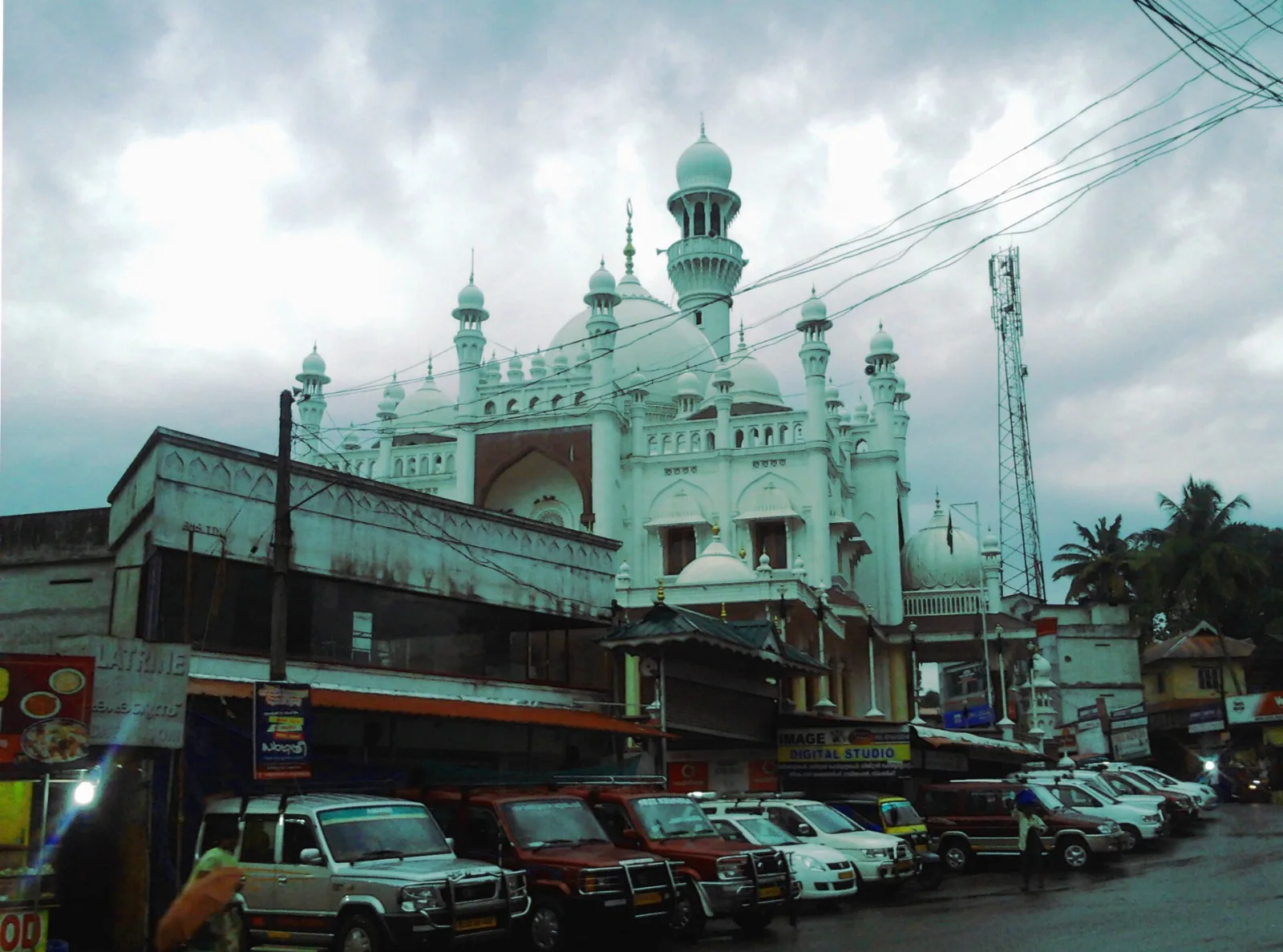
Vavar is the most argued-over figure in the Sabarimala story. The legends about him vary. In one, he is a Muslim trader or sea raider from the Pandya country around Madurai whose family settled in the Travancore hills; Ayyappa defeats him, and he becomes Ayyappa's companion and advisor. In another, he helps Ayyappa against the bandit Udayanan, who threatened the old Sastha shrine. The Vavar mosque at Erumeli, also called the Nainar Juma Masjid, is said to be where he died. Its caretakers, the Vettiplackal family, claim descent from him, and at the Vavar Nada at Sabarimala the offering is pepper.
The timeline objection. Since the 2010s, and more sharply since 2024, Hindu organisations and some writers have argued that Vavar was never Ayyappa's companion. Their main argument is about dates. They say Sastha worship is attested in inscriptions and texts centuries before Islam began in the seventh century, so a Muslim friend of Ayyappa is impossible. Some go further. A deva prashnam, an astrological ritual of divination, was held under Hindu organisations and its findings were announced by the VHP's Kerala president. It declared that Ayyappa's real companion was a pre-Islamic guardian figure called Vapuran, whose name was later turned into "Vavar". Others have said Vavar was not a Muslim at all, and in 2024 the VHP's Kerala unit called for the Vavar mosque to be removed. Remarks calling Vavar an invader led to a police case against a seer in 2025. Kerala's government and many devotees reject this campaign, and say the Erumeli tradition is an old and living part of the pilgrimage.
What historians say. Most scholars agree that there is no inscription or document from Vavar's lifetime, and that what we know of him comes from folk songs, the Erumeli and Sabarimala rituals, and family tradition. They also point out that the timeline objection mixes up two layers of the story:
- Sastha, the ancient guardian god, is indeed older than Islam.
- Manikandan, the Pandalam prince, who meets Vavar in the legend, belongs to a much later, medieval layer. The Pandalam family itself is generally dated to the medieval period, not antiquity.
Vavar could not have lived alongside the Sastha of early inscriptions. But the story that pairs him with the prince of Pandalam is itself medieval, so it does not have the same problem. Scholars place Vavar's entry into the legend after the seventh century, when Arab trade with Kerala grew again after the rise of Islam. One study links his descendants to Tamil Muslims who came to the region in or after the 14th century, citing a Pandalam royal copper plate. On this view, Vavar may well be a later figure, a Muslim chief or holy man remembered locally, who was joined to Ayyappa's story as the legend grew. That makes him a legend rather than a historical friend of the god, but it is not proof that the tradition was invented in modern times.
So the honest answer is that neither side can prove its case from records. Vavar's friendship with Ayyappa is a matter of tradition, not documented history. The same is true of Manikandan's own life.
Malikappurathamma: three legends
Malikappurathamma has her own shrine just beside the Sannidhanam. Like Ayyappa himself, she gathers several regional traditions into one figure.
- Leela, the freed Mahishi. The most widely told story makes her Leela, a celestial being cursed to live as the buffalo-demoness Mahishi. When Ayyappa defeated Mahishi at Erumeli, the curse broke and Leela, restored, asked to marry him. Bound by his vow of lifelong celibacy (naishtika brahmacharya), he refused, but promised to marry her in the year that no kanni ayyappa, no first-time pilgrim, came to Sabarimala. Every year at the Makaravilakku festival her image is carried in procession to Saramkuthi, where first-time pilgrims leave the arrows they have carried. Seeing the heap of arrows, she returns to her shrine to wait another year.
- The Pandalam family goddess. The Pandalam royal family does not see her as the freed Mahishi. For them she is their kuladevata, family deity, a form of Madurai Meenakshi who came with their ancestors when they migrated from the Pandya country to Kerala.
- The Cheerappanchira tradition. A third telling, from Alappuzha, links her to the Cheerappanchira family, the Kalaripayattu masters said to have trained the young Manikandan. Here the master's daughter fell in love with Ayyappa; he could not marry her, but honoured her devotion with a permanent place beside him at Sabarimala.
All three are traditions; none can be dated, and the shrine's own history is no clearer than the main temple's.
What scholars say
Historians treat these stories as later layers on an older forest cult, and they do not agree on what lay underneath. Several explanations are put forward:
- A Sastha and Ayyanar cult. Ayyappa is closely related to Ayyanar, the village guardian god of Tamil Nadu. Some scholars think the story of a son of Shiva and Vishnu grew out of the worship of Harihara, the combined form of the two gods, which rulers in South India promoted in the late medieval period.
- A Buddhist inheritance. The historian A. Sreedhara Menon pointed to Buddhist echoes in the pilgrimage: vegetarianism, celibacy, non-violence, disregard of caste during the pilgrimage, and the chanted refrain saranam, "refuge". Others have suggested Sabarimala was once a Buddhist site. There is no archaeological evidence for this, and it remains a hypothesis (see Buddhism in Kerala).
- A tribal god. The Mala Araya (Malayaraya) community, a Scheduled Tribe of the hills of Pathanamthitta, Kottayam and Idukki, holds that Ayyappa was born to a Mala Araya couple, Kandan and Karuthamma, in a cave at Ponnambalamedu. Its leaders say their ancestors served as priests at Sabarimala and lit the Makaravilakku until they were displaced by the Pandalam family and a Brahmin priesthood around the late 19th and early 20th centuries, and in 2018 they publicly pressed a claim to the shrine. A missionary account cited by them names a man called Thalanani as priest and oracle at the temple. The tantri family rejects these claims.
What the records show
Written evidence for Sabarimala is late and thin, which is one reason the debates continue.
- Pandalam and Travancore. The Pandalam royal family, a small principality whose rulers claimed descent from the Pandyas of Madurai, pledged the temple's revenues to Travancore in a document of 1793 and handed over its properties, Sabarimala among them, around 1820 in return for protection. The family still has privileges at the shrine, above all the Thiruvabharanam, the procession that carries the god's gold ornaments from Pandalam palace to Sabarimala for the Makaravilakku.
- The first survey. Lieutenants Benjamin Ward and Peter Conner surveyed Travancore and Cochin between 1816 and 1820; their memoir was published much later, in the 1890s and 1900s. They describe "Chowrymulla" as a small temple sheathed in copper on a stone-faced mound, reached by a flight of 18 granite steps, drawing large numbers of pilgrims to a five-day festival from 12 January. They also record that girls and old women could approach the temple, but women of child-bearing age kept away. This passage has been cited by both sides of the modern dispute.
- Fires. The temple burned in the early 20th century, and a 1902 order of the Travancore government provided for its restoration. In mid-1950 the shrine was found gutted and the image broken. The fire was investigated as arson and never solved. A new panchaloha (five-metal) image, cast by the sculptors Ayyappa Panikkar and Neelakanta Panikkar of Chengannur, was installed, and the reconstruction contract was carried out by Kochu Thomman, a Christian from Mavelikkara.
- From local shrine to mass pilgrimage. The historians M. G. S. Narayanan and Rajan Gurukkal have both argued that Sabarimala was a mainly local temple before 1950. Its fame grew after the rebuilding, peaked in the 1970s and 1980s, and by the 1990s pilgrims were arriving in huge numbers from Tamil Nadu, Karnataka and Andhra Pradesh. New roads to Pamba, the 1975 film Swami Ayyappan and the spread of Ayyappa devotion among migrant workers all played a part.
Since 1950 the temple has been administered by the Travancore Devaswom Board. The Thazhamon family, which according to its own tradition came from Andhra and was brought by the Pandalam king, holds final authority in ritual matters. Two branches of the family serve as tantri in alternate years.
The pilgrimage
The vow
A pilgrim begins by wearing a mala, a chain of rudraksha or tulasi beads with an Ayyappa locket, and then keeps the vratham, traditionally 41 days long: celibacy, a vegetarian diet, no alcohol or tobacco, prayer, and usually simple black, blue or saffron clothes and bare feet. From that moment he is addressed as Swami or Ayyappa, and caste and rank are meant to fall away. Those who have made many pilgrimages, called guruswamis, lead groups and guide first-timers, the kanni ayyappas.
The bundle
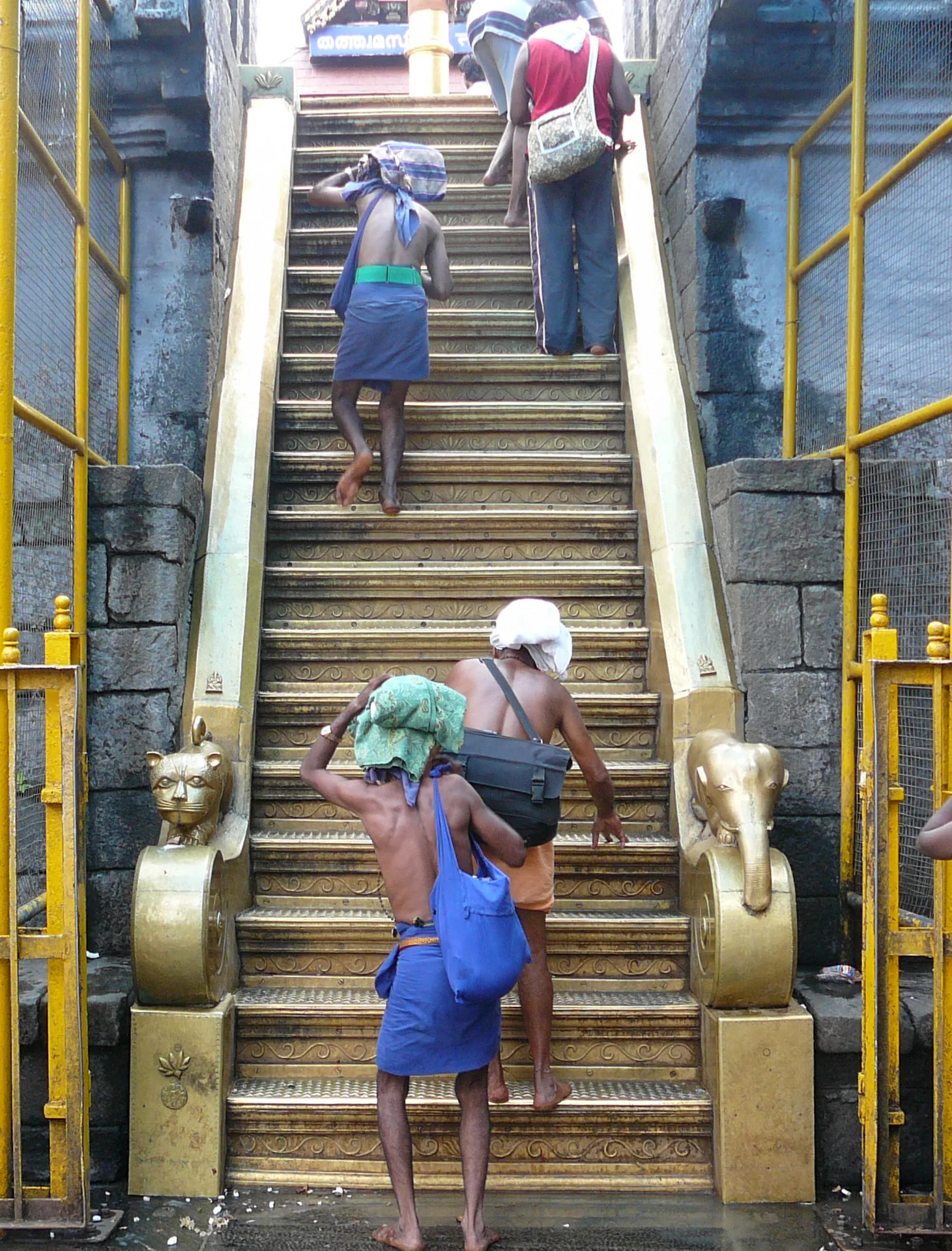
On the eve of departure comes the kettunira, the filling of the irumudi kettu, a cloth bundle with two compartments. The front one, the munmudi, holds the offerings: above all a coconut filled with ghee for the god, with rice and other items. The back one, the pinmudi, holds the pilgrim's own provisions. It is carried on the head, and only those carrying it may climb the 18 holy steps.
The bundle is also read as a picture of the weight every person carries through life. The munmudi, carried in front, holds what is offered to the god, above all the ghee-filled coconut (neythenga): it stands for punya, merit, and for spiritual aspiration, the pilgrim's first concern. The pinmudi, behind, holds the pilgrim's food for the journey: it stands for papa, past karma, and worldly attachment. As the food is eaten on the forest path, the back compartment empties, just as worldly baggage is meant to fall away on the approach to the shrine.
Erumeli and the forest
Pilgrims on the traditional route stop at Erumeli, where the killing of Mahishi is re-enacted in the petta thullal: groups paint their faces and bodies, dress in leaves and dance in procession with drums from the Sastha temple, passing through the Vavar mosque, where they are welcomed. The old forest path, the peruvazhi, runs from Erumeli over Azhutha and Karimala to Pamba and takes several days on foot. Most pilgrims today drive to Pamba, bathe in the river and climb the last few kilometres via Neelimala and Sabari peedam. At Saramkuthi, first-time pilgrims traditionally leave arrows they have carried, in memory of the warriors of the legend.
At the top
The Pathinettam padi, the 18 steps, now covered in gold-plated metal, lead to the sanctum. Each step is associated with a virtue, with one of the hills around, or, in the Vedantic reading below, with one of the layers that stand between a person and the divine. At the top, pilgrims break open the ghee-filled coconut; the ghee is used to anoint the image (neyyabhishekam) and the shell is thrown into the great fire (azhi) below the steps. The prasadam is aravana, a dark, sweet rice-and-jaggery pudding, and appam (unni appam), small sweet fritters of rice flour, jaggery and banana. Each night the temple closes to Harivarasanam, the god's lullaby. Its authorship is disputed: it was long credited to Kumbakudi Kulathur Iyer, but the family of Konnakathu Janaki Amma, daughter of a Sabarimala head priest in the 1920s, has claimed it as hers. The version played every night was set to music by G. Devarajan in the Madhyamavati raga and sung by K. J. Yesudas for the 1975 film.
The 18 steps: a Vedantic reading
Sabarimala's pilgrimage is often explained as a lived form of Advaita Vedanta, the philosophy of non-duality, in which the individual self and the ultimate reality are one. In the most widely taught interpretation, the Pathinettam padi stands for eighteen layers of human conditioning that a pilgrim leaves behind:
- Steps 1–5, the panchendriyas (five senses): sight, hearing, smell, taste and touch. Climbing them means mastering the senses instead of being ruled by them.
- Steps 6–13, the ashtaragas (eight passions): kama (desire), krodha (anger), lobha (greed), moha (delusion), mada (pride), matsarya (jealousy), asooya (envy) and dambha (boastfulness), the afflictions that feed the sense of a separate ‘I’.
- Steps 14–16, the trigunas (three qualities of nature): tamas (inertia), rajas (restless activity) and sattva (purity and balance). In Advaita even sattva, the highest worldly virtue, is a subtle bond to be transcended.
- Steps 17–18, vidya and avidya (knowledge and ignorance): the last two steps take the pilgrim beyond the pair of ‘knowing’ and ‘not knowing’, to the Sannidhanam, where the seeker and the sought are one.
Other traditions link the steps to the eighteen hills around Sabarimala, or to the eighteen Puranas; the readings are not exclusive.
The ghee-filled coconut
The ritual at the top of the steps completes the picture:
- The coconut shell stands for the body and the ego (ahamkara).
- The ghee inside stands for the individual soul (jivatma).
- Neyyabhishekam, pouring the ghee over Ayyappa's image, is the jivatma merging into the paramatma, the supreme consciousness.
- The azhi, the sacred fire: the empty shell is thrown into the fire below the steps. Once the soul has united with the divine, the ego has no further purpose and is burned away.
Tat Tvam Asi and Aham Brahmasmi
Two of the four mahavakyas, the ‘great sayings’ of the Upanishads, sum up the inner arc of the journey.
Tat Tvam Asi (Tattvamasi). Written prominently above the entrance to the sanctum, the phrase comes from the Chandogya Upanishad and means ‘That thou art’ or ‘You are That’. The divinity the pilgrim has walked through the forest to find is not something outside, sitting in the shrine: it is the pilgrim's own true self. The pilgrimage has been teaching this from the start. From the day a devotee puts on the mala for the 41-day vow, the devotee is no longer called by their own name but addressed as Swami or Ayyappa. The words over the sanctum state what the journey has been showing all along: the seeker and the sought are one.
Aham Brahmasmi. From the Brihadaranyaka Upanishad, it means ‘I am Brahman’, the ultimate reality. In Vedantic teaching, Tat Tvam Asi is the upadesha, the instruction given to the seeker, and Aham Brahmasmi is the anubhava, the seeker's own realisation. Setting aside caste, rank and ego during the vow, climbing the 18 steps and offering the ghee are all meant to strip away the sense of separation. When the pilgrim stands before the words Tat Tvam Asi, the hoped-for answer within is Aham Brahmasmi.
Makaravilakku
The season ends with Makaravilakku on or around 14 January (Makara Sankranti). As the Thiruvabharanam arrives from Pandalam and the evening lamp is waved before the god, a flame appears three times on Ponnambalamedu, a hill across the valley, and hundreds of thousands of pilgrims watching from vantage points cry out. For years it was popularly believed to be a divine light. In 2008 and again later, presidents of the Devaswom Board said publicly that the flame is lit by people: officials of the Board with the forest department and police, continuing a ritual once performed by the hill tribes. The Makarajyothi, the star many pilgrims watch for, is usually identified as Sirius.
Crowds and tragedy
Numbers have brought danger. On Makaravilakku night in 1952, 66 pilgrims died when a fireworks shed caught fire; on the same night in 1999, 52 died in a crowd crush at Pamba. On 14 January 2011 a jeep ran into home-bound pilgrims at Pulmedu, near Vandiperiyar, triggering a crush in which at least 102 people died. Crowd management, spot booking and virtual-queue systems, and the use of the forest routes have been contested every season since.
The question of women's entry
For as long as there are records, women of menstruating age, conventionally defined as 10 to 50, did not go to Sabarimala. Supporters of the custom say it follows from the nature of the deity at this shrine: here Ayyappa is a naishtika brahmachari, a celibate bound by a lifelong vow, and the custom protects that character. Critics say the restriction is discrimination, and point out that in the past it was not uniformly enforced; in 1955–56 the Devaswom Board issued notifications banning women between 10 and 55, which suggests that some had been coming.
- 1991. Acting on a petition by S. Mahendran, prompted by a newspaper photograph of a family ceremony at the shrine attended by women, the Kerala High Court directed the Devaswom Board not to allow women between 10 and 50 to make the pilgrimage, citing the celibate nature of the deity.
- 28 September 2018. A five-judge Supreme Court bench ruled 4:1 in Indian Young Lawyers Association v. State of Kerala that the exclusion was unconstitutional. The majority held that Ayyappa's devotees are not a separate religious denomination and that the custom is not an essential religious practice. Justice Indu Malhotra, the only woman on the bench, dissented, holding that courts should not interfere with the essential practices of a faith.
- 2018–19. Large protests followed, led by devotees' groups and supported by Hindu organisations and political parties; women attempting the climb were turned back. In the early hours of 2 January 2019, Bindu Ammini and Kanakadurga, both in their forties, entered the shrine under police protection. The tantri closed the temple for purification, a statewide shutdown was called, and thousands were arrested in the violence that followed.
- 14 November 2019. Hearing more than 50 review petitions, a five-judge bench decided by 3:2 to refer broader questions of religious freedom to a larger bench, linking Sabarimala with cases on Muslim women's entry to mosques, Parsi women and the Dawoodi Bohra community.
- 2026. A nine-judge Constitution Bench led by Chief Justice Surya Kant heard the reference from 7 April to 14 May 2026, when it reserved judgment. The Union government urged the court to uphold the traditional restrictions. As of November 2026 the judgment has not been delivered.
The arguments are well rehearsed. Those defending the custom say temple practice is a matter of faith protected by Articles 25 and 26 of the Constitution, that women devotees themselves wish to keep it, and that women of all ages can worship at many other Ayyappa temples. Those opposing it say a constitutional guarantee of equality cannot stop at a temple door, and that a rule tied to menstruation stigmatises women.
The gold-plating case
In 2025 the shrine faced a different scandal. In September the Kerala High Court took up reports that the gold-plated copper coverings of the two Dwarapalaka (door-guardian) figures at the sanctum had been taken away for repair without permission. A court-monitored special investigation team was set up in October 2025 and found that gold had been lost from the coverings since a re-plating in 2019, and from the sanctum's door frames and other panels. A sponsor, Unnikrishnan Potti, officials of the Devaswom Board and two former Board presidents, A. Padmakumar and P. S. Prasanth (arrested in July 2026), were among those arrested. The cases were still under investigation and trial in late 2026, and the accused are presumed innocent until proven guilty.
What is certain and what is not
- Documented: the 1793 and c. 1820 arrangements with Travancore; the Ward and Conner description; the 1950 fire and the new image; the court rulings of 1991, 2018 and 2019; pilgrim and revenue figures published by the Devaswom Board.
- Tradition: the Pandalam birth story, Vavar and Malikappurathamma; the antiquity claimed by the tantri family.
- Debated: Ayyappa's origins (Sastha and Ayyanar, Buddhist, tribal); whether Vavar was a real person and when he lived; the Mala Araya claims to the shrine and the Makaravilakku; the authorship of Harivarasanam.
- Pending: the nine-judge Supreme Court judgment on the reference that includes women's entry; the gold-plating prosecutions.
Timeline
- 1793The Pandalam family pledges the temple's revenues to Travancore.
- c. 1820Pandalam's properties, including Sabarimala, pass to Travancore; Ward and Conner complete their survey.
- 1902Travancore orders the restoration of the temple after a fire.
- 1950Fire guts the shrine; a new five-metal image is installed; the Travancore Devaswom Board takes charge.
- 195266 pilgrims die in a fireworks shed fire on Makaravilakku night.
- 1975The film Swami Ayyappan popularises Harivarasanam.
- 1991Kerala High Court upholds the restriction on women aged 10 to 50.
- 199952 die in a crowd crush at Pamba.
- 2011At least 102 die in the Pulmedu crowd crush.
- 2018Supreme Court strikes down the restriction (4:1); protests follow.
- 2019Two women enter the shrine (2 Jan); review referred to a larger bench (14 Nov).
- 2025High Court orders an investigation into lost gold plating.
- 2026Nine-judge bench hears the reference and reserves judgment (14 May).
Questions people ask
When is Sabarimala open?
During the Mandala–Makaravilakku season from about mid-November to mid-January, for the first five days of each Malayalam month, and on festivals such as Vishu and Onam.
Do you have to keep the 41-day vow?
It is the tradition, and first-time pilgrims are especially expected to keep it. Only pilgrims carrying the irumudi kettu may climb the 18 steps.
Is the Makaravilakku lit by people?
Yes. Devaswom Board presidents have said the flame on Ponnambalamedu is lit by officials, continuing an old tribal ritual. Many devotees regard the moment as sacred regardless.
Can women visit Sabarimala now?
Legally, the 2018 Supreme Court ruling has not been stayed, but the larger constitutional questions are still before a nine-judge bench, and in practice very few women of the formerly restricted age group have gone. Girls under 10 and women over 50 have always been able to make the pilgrimage.
Did Ayyappa and Vavar live at the same time?
No record can show it either way. Sastha worship is older than Islam, but the legend of the Pandalam prince who befriends Vavar is medieval. Historians treat their friendship as a tradition, not documented history.
Can non-Hindus go to Sabarimala?
Yes. Sabarimala is known for admitting pilgrims regardless of religion who keep the vow, and the pilgrimage passes through the Vavar mosque at Erumeli.
(Read also: the Malayarayar of the Travancore hills, Buddhism in Kerala, Periyar Tiger Reserve and Parumala and St Gregorios.)
See it for yourself, with a local driver who knows these roads.
Book a Munnar Jeep SafariSources & further reading
- Wikipedia: Sabarimala
- Wikipedia: Ayyappan
- Wikipedia: Makaravilakku
- Wikipedia: Vavar
- The Wire: A God, a Pirate and the Birth of a New Urban Religion in the Deccan (2022)
- Sakhariya T: Myths and Legends in the Making of Cultural Symbiosis – the Ayyappan and Vavar myth
- Kerala Tourism: Vavar Swami
- The Pioneer: Lord Ayyappa had no associate named Vavar, say scholars (2025)
- The News Minute: Kerala seer calls Vavar a terrorist, FIR filed (2025)
- Wikipedia: Harivarasanam
- Wikipedia: Indian Young Lawyers Association v. State of Kerala
- Wikipedia: 2011 Sabarimala crowd crush
- Business Standard: 102 killed in Sabarimala stampede (PTI, 2011)
- Kerala Tourism: Sabarimala
- Supreme Court Observer: Sabarimala cases
Figures are from the sources listed and were checked in November 2026. Park timings and road conditions change, so please confirm before you travel.