
The Dance Forms of Kerala: From Bharata's Natyashastra to Temple Theatre, Folk Ritual, Cinema and Fusion
A scholarly guide to Kerala's dance and performance traditions: Bharata's Natyashastra and Kerala's own treatises, Koodiyattam and the temple theatres, Krishnanattam and Kathakali, Mohiniyattam, Thullal, ritual and community dances, the 20th-century revival, cinema and today's fusion stage.
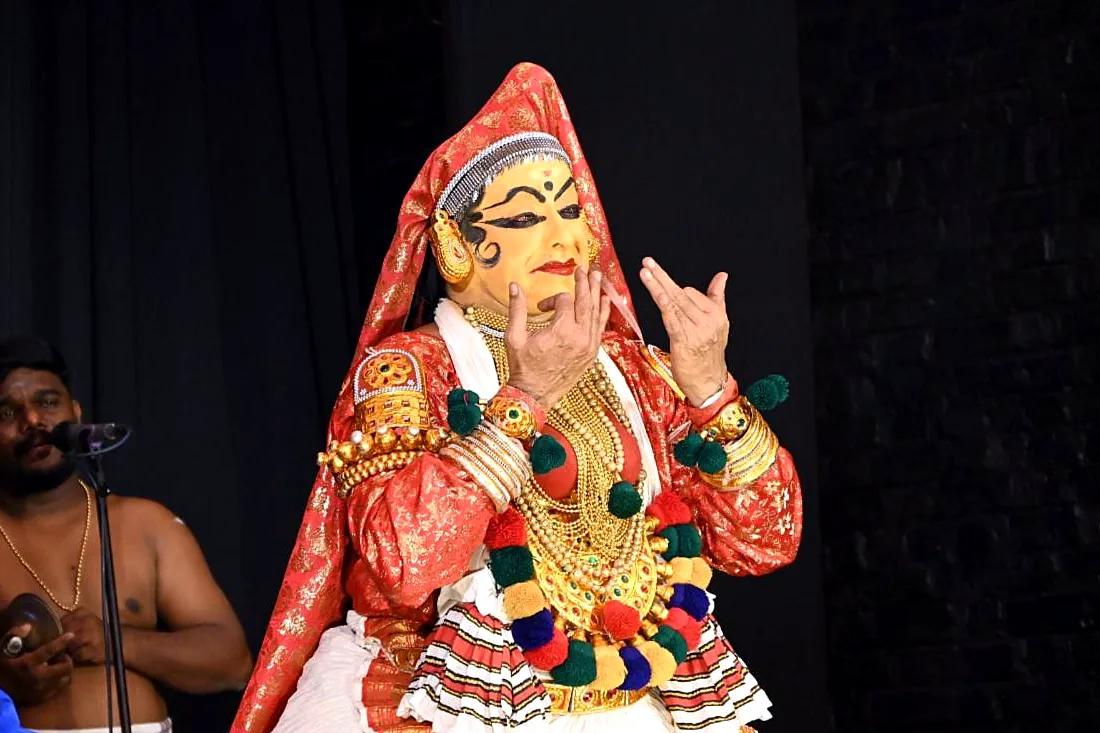
Few places on earth pack so many living dance traditions into so small a space as Kerala. Within a day's drive, you can watch a Sanskrit play acted in a temple theatre much as it was a thousand years ago. You can see a god possess a dancer in a village shrine at dawn, a Muslim bride's friends clap through an Oppana, and Christian women circle a lamp in Margamkali. And you can see a teenager win a state prize for Mohiniyattam, or a film star borrow a Kathakali gesture for a song sequence.
This article surveys that whole landscape. It begins with Bharata's Natyashastra, the ancient Sanskrit treatise that gave Indian theatre and dance its grammar. It then follows the arts of Kerala through temple theatre, the dance-dramas of the 17th century, the lasya tradition of Mohiniyattam, satire, ritual and community dance, the 20th-century revival, the cinema, and today's fusion and contemporary work. Where the site already has a full article, such as on Kathakali, Theyyam or Kalaripayattu, we link to it rather than repeat it.
At a glance
- Foundations: Bharata's Natyashastra (dated variously between about 200 BCE and 200 CE), later Sanskrit manuals, and Kerala's own treatises such as Balarama Bharatam and Hasta Lakshana Deepika.
- Temple theatre: Chakyar Koothu, Koodiyattam and Nangiar Koothu; Koodiyattam was the first Indian art recognised by UNESCO (2001).
- Dance-drama: Krishnanattam and Ramanattam (17th century), leading to Kathakali.
- Lasya dance: Mohiniyattam, shaped at the 19th-century Travancore court and revived at Kerala Kalamandalam in the 1930s.
- Ritual arts: Theyyam, Mudiyettu (UNESCO 2010), Padayani, Thira, Arjuna Nritham and Poorakkali.
- Community and folk dances: Thiruvathirakali, Oppana, Duffmuttu, Kolkali, Margamkali, Chavittu Nadakam and many tribal forms.
- Modern: Kerala Natanam, women's Kathakali, the School Kalolsavam, cinema, and contemporary and fusion choreography.
1. The foundation: Bharata and the Natyashastra
Every classical art of India traces its theory to the Natyashastra, the treatise on drama traditionally credited to the sage Bharata. Its date is uncertain. Scholars have proposed anything from the last centuries BCE to the first centuries CE, and many believe it grew over time before reaching the form we know. The text has about 6,000 verses in 36 chapters. It covers the building of the theatre, the stage, the actors' training, movement and gesture, music and instruments, language, costume, make-up and, above all, the emotional experience of the audience. Indian tradition calls it the "fifth Veda". The legend is that Brahma created it so that people of every class could share in the wisdom of the four Vedas through performance.
Bharata's central idea is rasa, the "flavour" or aesthetic emotion the spectator tastes. The performer portrays a bhava, a state of mind such as love or anger, through its causes, its outward signs and its passing moods. The audience then experiences the corresponding rasa. Bharata named eight rasas: love, humour, compassion, fury, heroism, terror, disgust and wonder. Later writers added a ninth, peace (shanta). The great Kashmiri philosopher Abhinavagupta, writing around 1000 CE, produced the most influential commentary on the text.
For the performer, the most practical part of the Natyashastra is its account of abhinaya, the means of carrying meaning to the audience. There are four kinds:
| Natyashastra concept | Meaning | How it lives in Kerala's arts |
|---|---|---|
| Angika abhinaya | Expression through the body: head, eyes, hands, feet, postures and gaits | The codified hand gestures (mudras) of Kathakali and Koodiyattam; the eye exercises of Koodiyattam actors |
| Vachika abhinaya | Expression through speech and song | The chanted Sanskrit of Koodiyattam, the singers of Kathakali, the sung verse of Thullal |
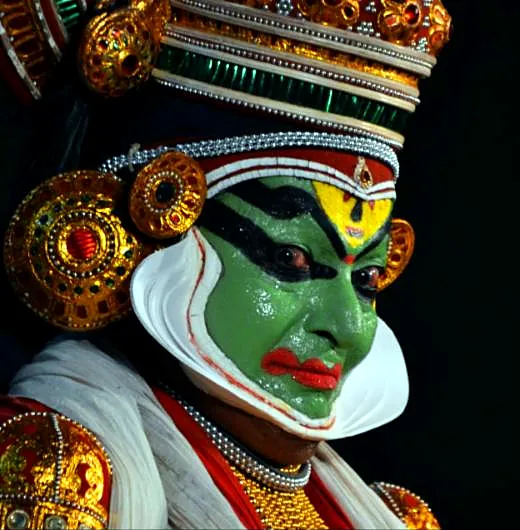
| Aharya abhinaya | Costume, make-up, ornaments and stage properties | Kathakali's green pacha and red-bearded characters, the crowns of Koodiyattam and Theyyam |
| Sattvika abhinaya | Inner feeling shown through involuntary signs such as tears, trembling or a change of colour | The intense facial acting of Koodiyattam and Kathakali, in which an actor may take many minutes over a single emotion |
| Nritta / Nritya / Natya | Pure dance; expressive dance; full drama | Kalasams (pure dance passages) in Kathakali; padams in Mohiniyattam; complete plays in Koodiyattam |
| Tandava / Lasya | Vigorous "masculine" style; gentle "feminine" style | Kathakali as the great tandava form of Kerala; Mohiniyattam as its lasya counterpart |
| Natyagriha | The ideal theatre building | The koothambalam, the temple theatre built for Koodiyattam on lines said to follow Bharata |
Kerala did not simply inherit Bharata. It also wrote its own commentaries and manuals. The Chakyar actors kept detailed acting manuals, the attaprakarams and kramadeepikas, which prescribe exactly how each scene of a play is to be performed. Two later texts matter especially for dance. One is Hasta Lakshana Deepika, a manual of hand gestures used as the basis of Kathakali's gesture language. The other is Balarama Bharatam, a Sanskrit treatise on natya by the 18th-century Travancore king Karthika Thirunal Rama Varma, known as Dharma Raja. It builds on Bharata and on Nandikeshvara's later work, and it adapts them to the practice of Kerala in its time. Scholars have recently urged that it be studied far more seriously by Mohiniyattam dancers.
2. Ancient roots: koothu and the Chakyars
Long before Sanskrit drama reached the temples, the Tamil-speaking world to which ancient Kerala belonged had its own word for performance: koothu. It appears in the Sangam poems of the early centuries CE. The epic Silappatikaram, set partly in the Chera country, mentions a chakkaiyan, a dancer whose name is usually linked to the later Chakyar community of actors. Over the following centuries, Sanskrit plays, Bharata's theory and local koothu traditions came together in the temples of the Chera kingdom.
A key figure is the Chera king Kulasekhara Varman of Mahodayapuram, near present-day Kodungallur. He wrote two Sanskrit plays, Subhadradhananjaya and Tapatisamvarana, and with the help of a Brahmin scholar called Tolan is said to have reformed the stage. Among his changes was letting the jester, the Vidushaka, speak in Malayalam so that ordinary people could follow the play. Historians date him differently, anywhere from the late 10th to the early 12th century. All agree that by his time the Sanskrit theatre of Kerala was already old and sophisticated.
3. The temple theatres: Chakyar Koothu, Koodiyattam and Nangiar Koothu
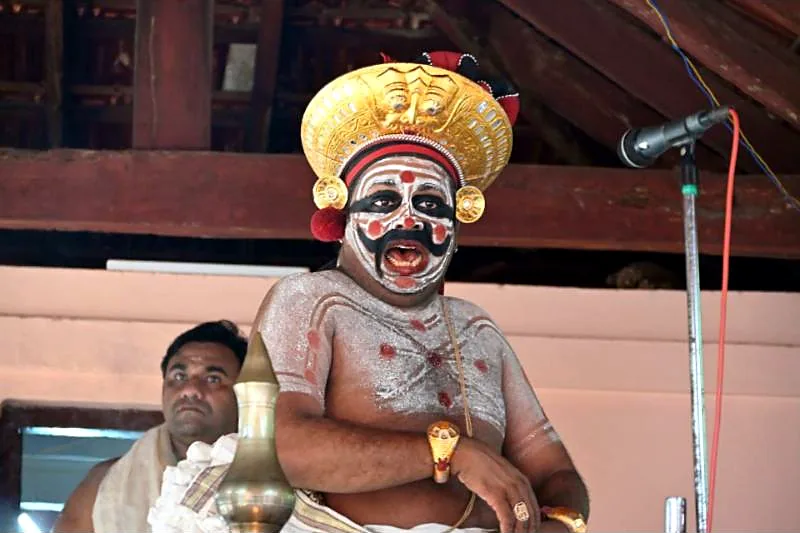
Chakyar Koothu is a solo storytelling performance. The Chakyar, his face painted and his head crowned with a headdress said to recall the serpent Ananta, retells stories from the epics and Puranas, mixing Sanskrit verse with prose explanation. Its fame rests on its humour. The Chakyar was traditionally free to satirise anyone in the audience, and custom forbade the victims to protest. He is accompanied by the mizhavu, a large copper drum played by men of the Nambiar community, and by cymbals.
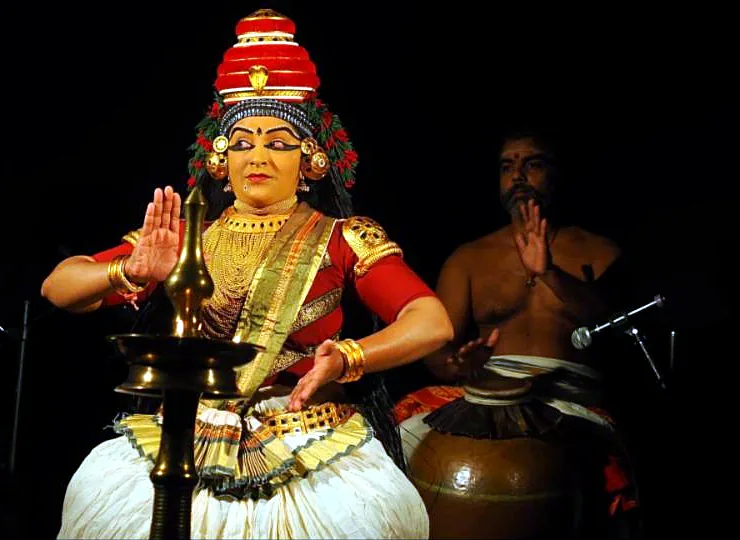
Koodiyattam, "acting together", is the full staging of Sanskrit plays by Bhasa, Harsha, Shaktibhadra and Kulasekhara himself. It takes place in the koothambalam, a pillared theatre hall inside the temple. Men of the Chakyar caste play the male roles, Nangiar women of the Nambiar caste play the female roles and keep time on cymbals, and Nambiar men play the mizhavu. Its pace is famously slow. A single act may be performed over many nights, because the actor first elaborates, in pure mime, the background, the emotions and even the imagined landscape of a scene. Complete performances can last from 12 to more than 100 hours. Koodiyattam is often described as the only surviving form of ancient Sanskrit theatre, and scholars have found its stage practice remarkably close to what Bharata prescribes.
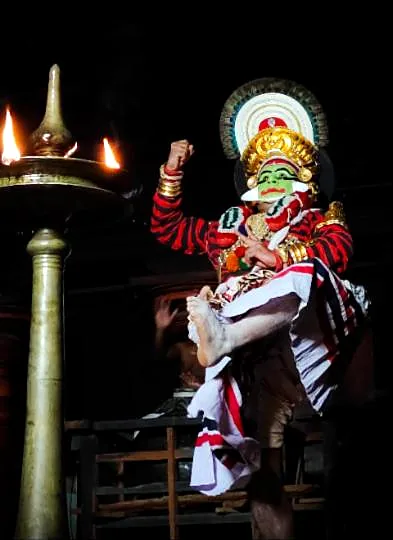
For centuries these arts belonged to the temple and to particular families. The 20th century opened them up. Painkulam Rama Chakyar taught and performed at Kerala Kalamandalam. Mani Madhava Chakyar began performing outside temples in the 1950s and took Koodiyattam outside Kerala for the first time, to Madras in 1962. Ammannur Madhava Chakyar trained a new generation at the Ammannur Gurukulam in Irinjalakuda. In 2001 UNESCO proclaimed Koodiyattam a Masterpiece of the Oral and Intangible Heritage of Humanity, the first Indian art to be so honoured. It was inscribed on the Representative List in 2008.
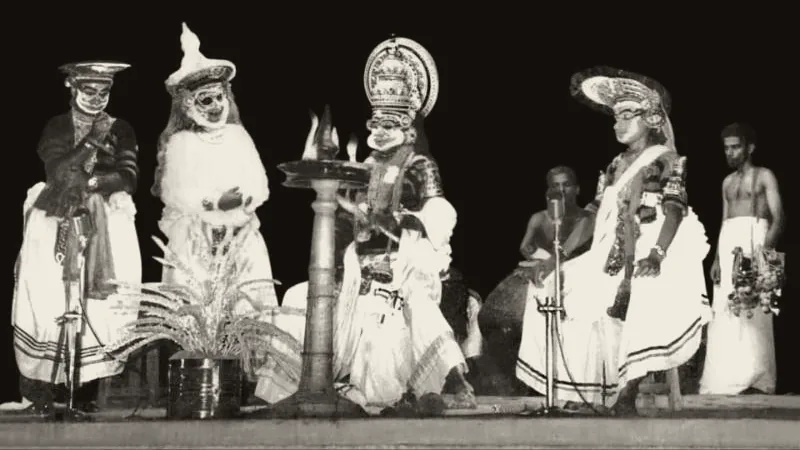
Nangiar Koothu is the women's solo form. It is drawn from a single Koodiyattam play in which a Nangiar narrates the life of Krishna in the 217 verses of Sreekrishna Charitam. By the late 20th century the full text was hardly performed. Its revival began at the Ammannur Gurukulam in the 1980s under Ammannur Madhava Chakyar, with the scholar-dancer Nirmala Paniker and others. A new generation of women, most notably Usha Nangiar, now performs it in full and has pressed for women's wider place in Koodiyattam.
4. The 17th century: Krishnanattam, Ramanattam and the birth of Kathakali
In 1653 or 1654 the Zamorin of Calicut, Manaveda, completed Krishnagiti, a Sanskrit poem on the life of Krishna in eight parts. It was staged over eight nights as Krishnanattam. Legend says that Krishna appeared to the devout king at Guruvayur and left behind a peacock feather, which Krishnanattam actors still wear in their crowns. The troupe passed to the Guruvayur temple in 1958, and Krishnanattam is still performed there as an offering.
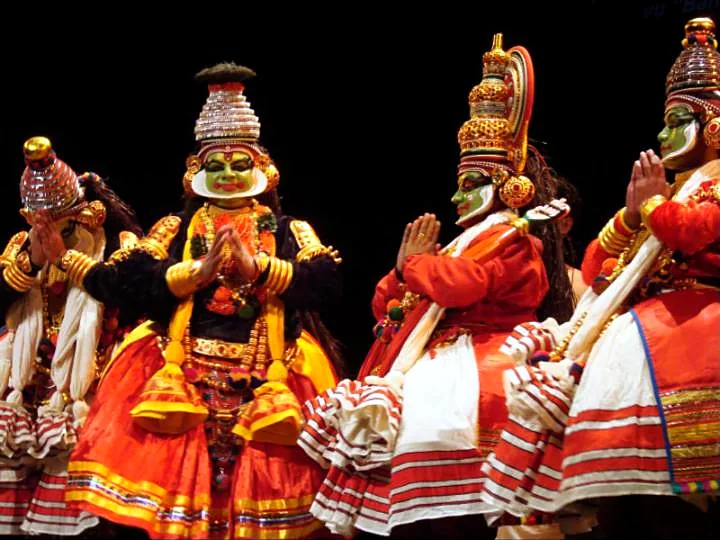
According to a well-known story, the ruler of Kottarakkara, Vira Kerala Varma, asked the Zamorin to lend him the Krishnanattam troupe for a wedding. The Zamorin refused, reportedly saying that the southern audience could not appreciate it. Stung, Kottarakkara Thampuran composed eight plays on the story of Rama, the Ramanattam, written not in Sanskrit but in Malayalam. Ramanattam is widely regarded as the immediate parent of Kathakali.
Over the next century, Kathakali grew from it. The Kottayam Thampuran wrote plays from the Mahabharata, and Unnayi Warrier's Nalacharitham became one of the greatest works of Malayalam literature. The make-up, costume, gesture language and dance became fully codified. Kathakali took its acting from Koodiyattam, its rhythms and footwork from Kalaripayattu, its colour and drama from ritual arts like Theyyam and Mudiyettu, and its theory from Bharata and Kerala's own treatises. Its sophisticated gesture language, built from 24 basic mudras, can render whole sentences of poetry. Our dedicated history of Kathakali covers the vesham types, music and patrons in detail.
5. The dance of the enchantress: Mohiniyattam
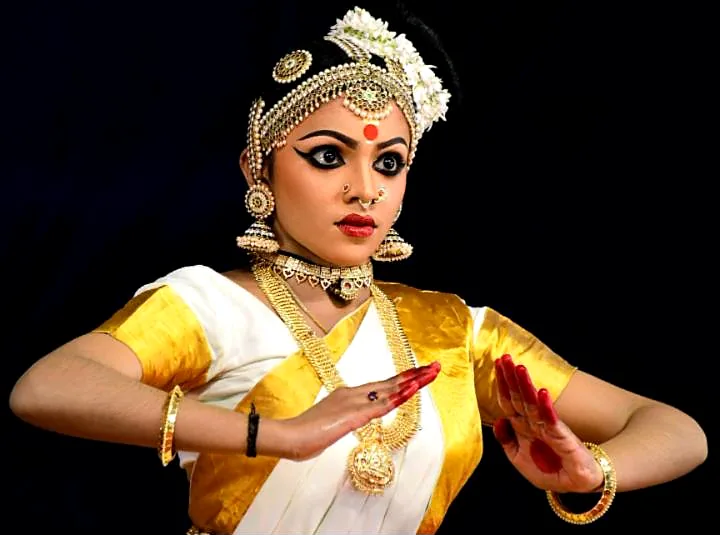
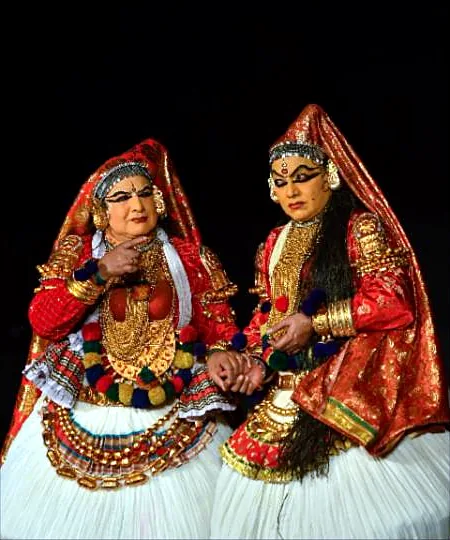
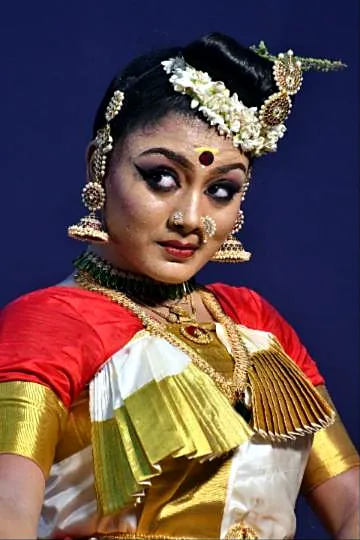
Mohiniyattam, "the dance of Mohini", Vishnu in the form of an enchantress, is Kerala's classical solo dance for women. It is the lasya counterpart to Kathakali's tandava. Its movements sway gently from side to side, like the palms or the waters of the backwaters, and its expression is intimate and lyrical. Its origins are debated. Some trace it to ancient temple-dancing traditions of the south; others see it largely as the creation of the 19th-century Travancore court.
What is clear is the role of Maharaja Swathi Thirunal, the composer-king whose palace is described in our article on Kuthiramalika. Vadivelu, one of the Thanjavur Quartet who shaped Bharatanatyam, joined his court. With the king's music, Mohiniyattam was given a structured repertoire much like Bharatanatyam's: the invocatory cholkettu, jatiswaram, varnam, padam and tillana. After the king's death in 1846 the dance declined and came to be viewed with suspicion. In the 1930s, laws against temple dancing in the Madras Presidency and attacks on the devadasi system made matters worse.
The revival came through the poet Vallathol Narayana Menon and Kerala Kalamandalam. Vallathol struggled to find teachers and students. Orikkaledathu Kalyani Amma was appointed the first Mohiniyattam teacher in 1932. He then persuaded young women from respected families, above all Kalamandalam Kalyanikutty Amma, to learn and perform, to restore the art's social standing. Kalyanikutty Amma, later called the mother of Mohiniyattam, systematised its grammar. Thottassery Chinnammu Amma became the first Sangeet Natak Akademi awardee in the form in 1972. Today Mohiniyattam has several recognised schools of style, including those of Kalamandalam, Kalyanikutty Amma, Bharati Shivaji and Kanak Rele, and it is taught across India and abroad.
6. Satire for the people: Thullal
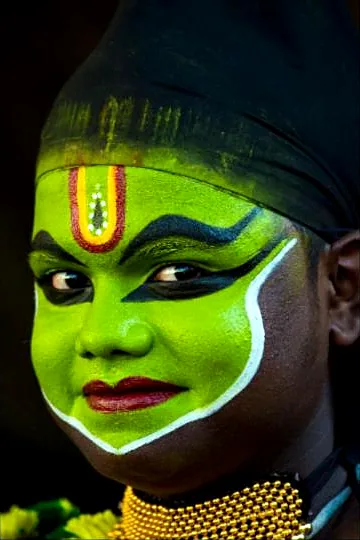
The 18th-century poet Kunchan Nambiar is said to have played the mizhavu for a Chakyar Koothu performance and dozed off, and the Chakyar mocked him in front of the audience. Nambiar took his revenge by inventing a new art, Thullal ("leaping"). The performer sings his own verses in simple, racy Malayalam, dances, and acts out the story. Puranic tales become vehicles for biting satire on greed, caste pride, corrupt officials and foolish nobles. Nambiar wrote dozens of Thullal works, and the form has three styles, Ottan, Seethankan and Parayan, which differ in costume, metre and pace. Ottamthullal, the most popular, remains a favourite at temple festivals. Since the late 20th century, women have also performed it.
7. Ritual dance-theatre: goddesses, heroes and ancestors
Alongside the Sanskrit-based arts runs an older stream of ritual performance, in which dance is worship and the dancer may become the deity. These forms belong to villages, sacred groves and goddess temples, and to particular communities who hold the hereditary right to perform them.
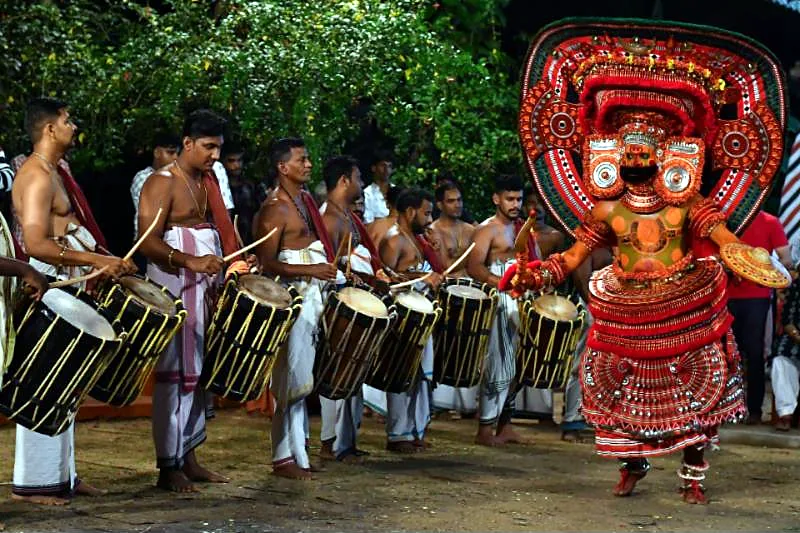
| Form | Region | What it is |
|---|---|---|
| Theyyam (Kaliyattam) | Kannur and Kasaragod | Hundreds of deities, heroes and ancestors embodied by performers of particular communities in sacred groves and shrines, with spectacular make-up and headdresses. See our two-part series, Theyyam part 1 and part 2. |
| Thira / Thirayattam | Kozhikode and Malappuram | The southern cousin of Theyyam, performed in Bhagavathi and other village shrines. |
| Mudiyettu | Ernakulam, Kottayam, Thrissur and Idukki | A ritual drama of the goddess Bhadrakali slaying the demon Darika, performed in goddess temples after the harvest, with seven heavily made-up characters. Inscribed by UNESCO in 2010, Kerala's second art on the list. |
| Padayani | Pathanamthitta and Alappuzha (central Travancore) | Night-long processions of kolams, masks made from areca-palm sheaths and tender coconut leaves, dancing to the thappu drum to calm the goddess after her battle; famous at Kadammanitta. |
| Arjuna Nritham (Mayilpeeli Thookkam) | Kottayam and Alappuzha | An all-night ritual dance by men in Bhagavathi temples, with a skirt of peacock feathers and movements close to Kalaripayattu. |
| Poorakkali | North Malabar | A vigorous group dance by men around a lamp during the Pooram festival in Bhagavathi temples, in the month of Meenam. |
| Sarpam Thullal and Kolam Thullal | Various | Serpent worship and healing rituals with drawn floor designs, song and trance-dance. |
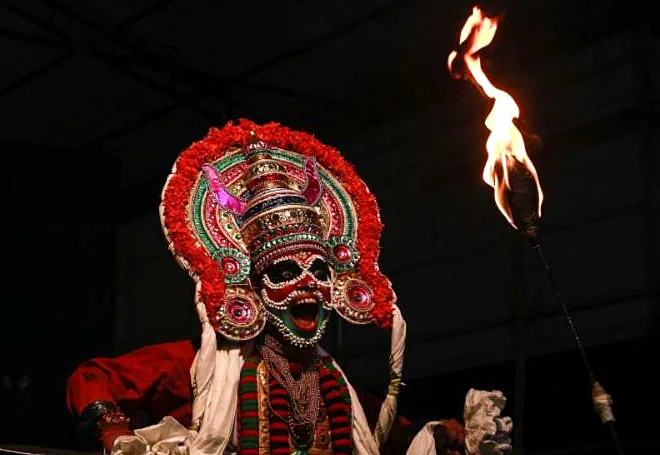
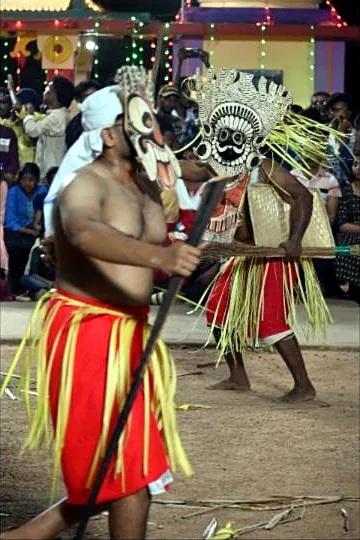
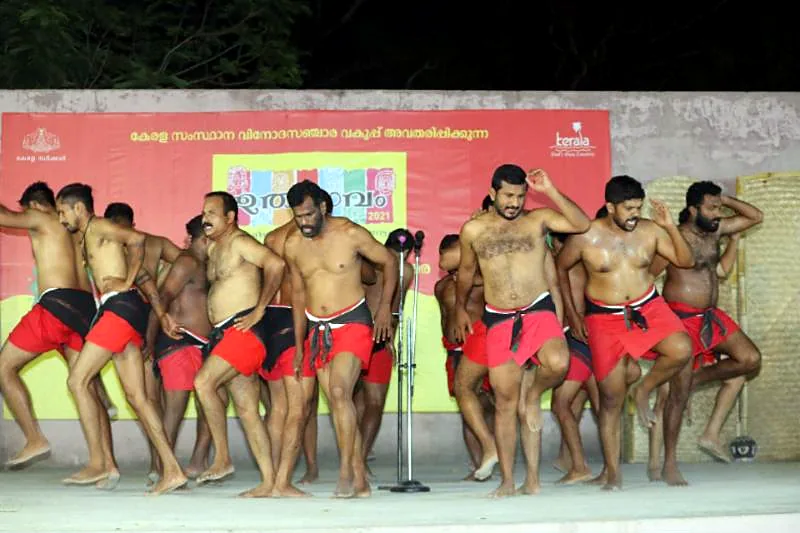
These ritual forms are the deep soil from which the classical arts drew. Kathakali's towering headdresses, its painted faces and the terrifying entry of its demons all echo Theyyam and Mudiyettu. The influence also ran the other way: Thullal took elements from Padayani and Kolam Thullal.
8. Dances of the community: Hindu, Muslim and Christian
Kerala's three great religious communities each developed their own social dances. They are performed at festivals, weddings and church feasts, and now, above all, on the competition stages of the school and university youth festivals.
| Dance | Community | Character |
|---|---|---|
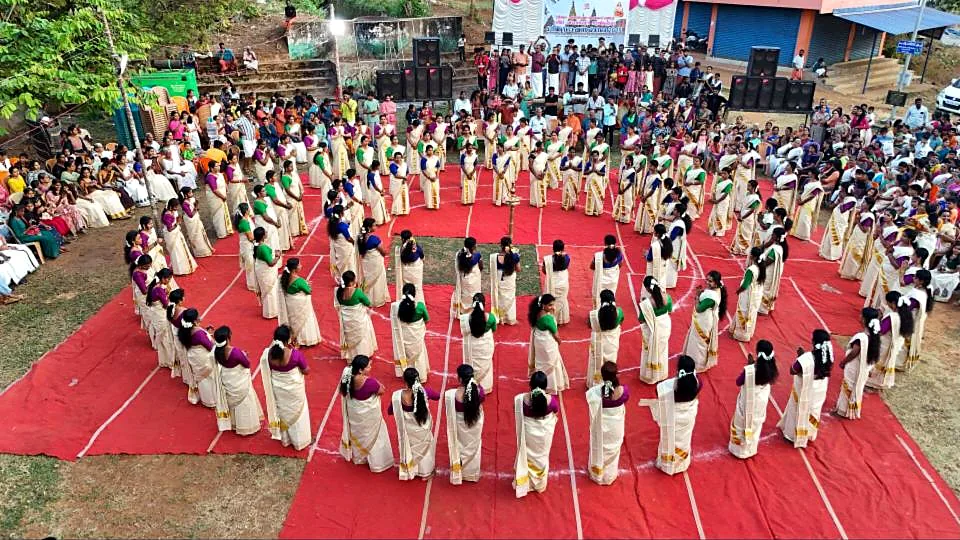
| Thiruvathirakali / Kaikottikali | Hindu women | A graceful circle dance with clapping, sung in praise of Shiva and Parvati on Thiruvathira night in Dhanu (December–January) and at Onam; tradition says it brought Kamadeva back to life. |
| Oppana | Mappila Muslims, especially of Malabar | Sung and clapped by young women around the seated bride on the eve of a wedding, to Mappilappattu songs; men's versions also exist. |
| Duffmuttu (Aravanmuttu) | Mappila Muslims | Men sing and dance in a circle beating the duff, a frame drum, at festivals and celebrations. |
| Kolkali | Many communities, especially in Malabar | Men strike short sticks in intricate rhythms while moving in a circle, with steps drawn from Kalaripayattu. |
| Margamkali | Saint Thomas (Syrian) Christians, originally the Knanaya | Women circle a lamp, which represents Christ, singing verses on the mission of Saint Thomas; traditionally performed without instruments. |
| Chavittu Nadakam | Latin Christians of the coast, especially around Kochi | A 16th-century operatic dance-drama shaped under Portuguese influence, with stamping footwork (chavittu), European-style costume and stories of Charlemagne and Christian heroes. |
| Kakkarissi Nadakam | Popular theatre of central Kerala | A comic dance-drama of the Kakkalan wandering community and Shiva and Parvati in disguise. |
Kerala has dozens of other folk dances, from Kummattikali masked dancers at Onam to the Pulikali tiger dance of Thrissur; see our article on Pulikali.
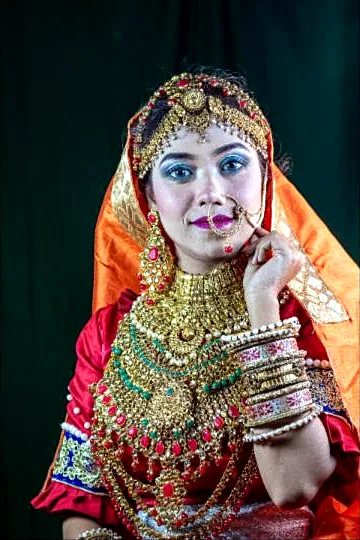
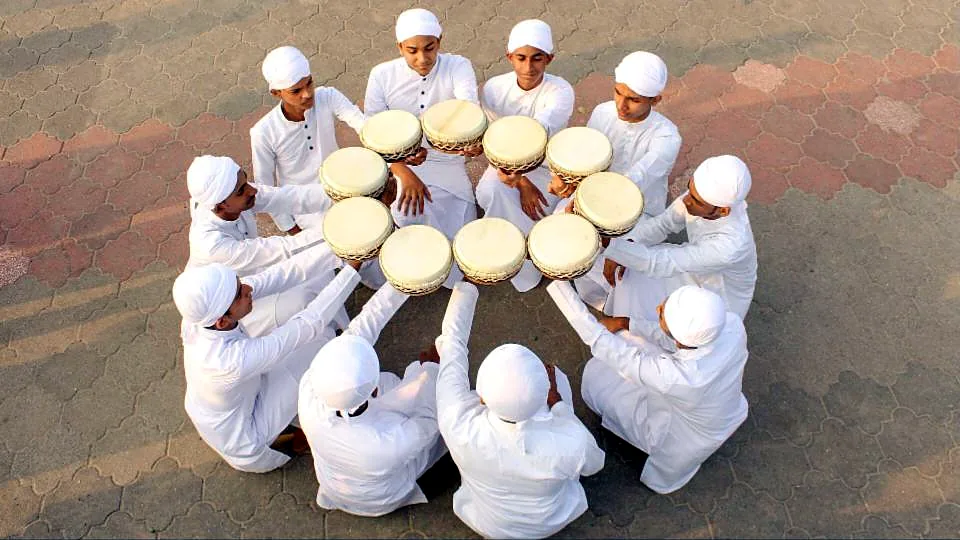
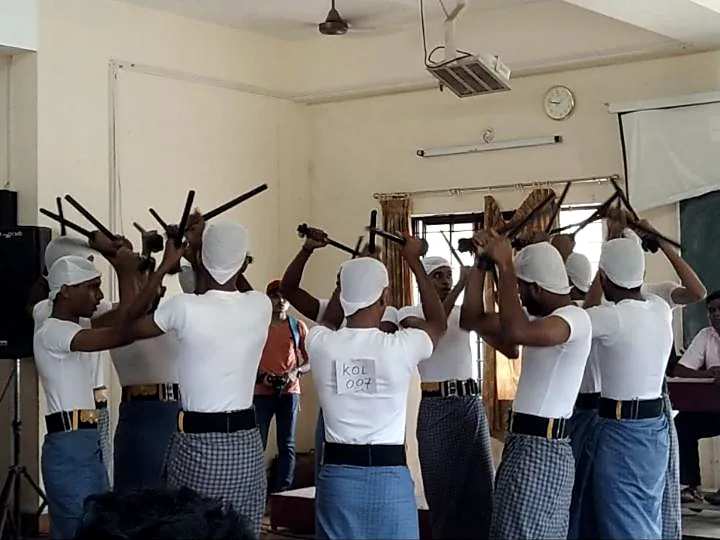
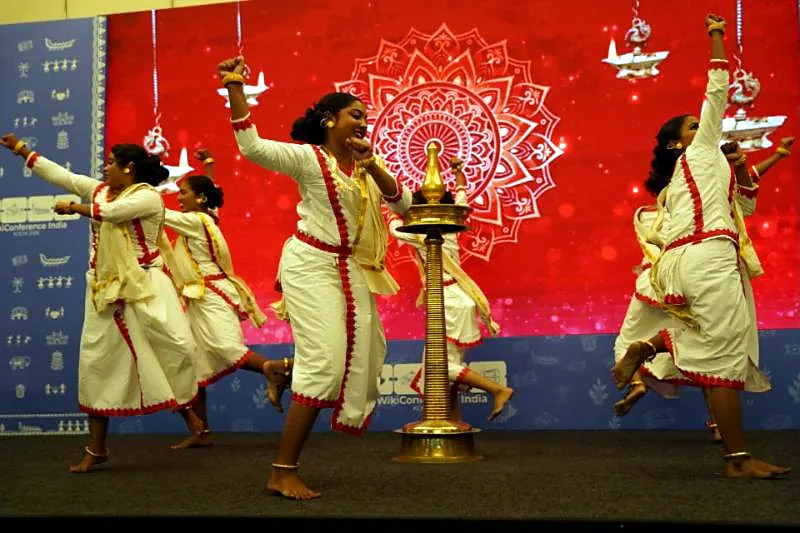
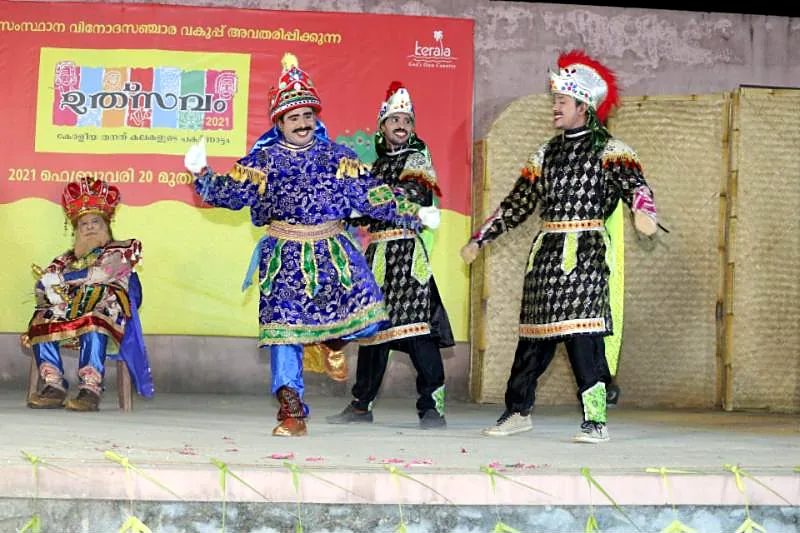
Tribal communities have their own dances, such as the Irula dances of Attappadi and the Mangalamkali of Kasaragod. Mainstream stages long ignored them. In 2025 the state school arts festival included tribal dance forms for the first time. Tribal artists immediately raised the question of who was qualified to judge them, a reminder that the politics of who owns and judges an art is as old as Koodiyattam's caste rules.
9. The 20th-century revival
By the early 20th century many of Kerala's classical arts were in danger. Royal and temple patronage was shrinking, the old landed households that kept Kathakali troupes were breaking up, and colonial education looked down on the traditional arts. Three developments turned the tide.
Kerala Kalamandalam. In 1930 Vallathol, with Manakkulam Mukunda Raja, founded Kerala Kalamandalam to train artists in Kathakali, Mohiniyattam and the temple arts. It moved in 1936 to the banks of the Bharathapuzha at Cheruthuruthy. It raised money from the public and even ran a lottery, and its graduates took Kathakali to the world. In 2006 it became a deemed university for art and culture. In recent years it has admitted girls to its Kathakali course for the first time in its history. Other institutions, such as Margi in Thiruvananthapuram and the Ammannur Gurukulam, did the same for Koodiyattam and Kathakali.
New forms for new stages. Guru Gopinath, one of Kalamandalam's first Kathakali students, began performing with the American dancer Ragini Devi in 1931 and 1932. He developed a lighter style based on Kathakali for concert stages beyond Kerala, which became known as Kerala Natanam. With his wife Thankamani, Kalamandalam's first Mohiniyattam student, he created solos, duets and dance-dramas on themes far beyond the Puranas. In Kerala Natanam, men and women could dance together.
Women in the men's arts. Kathakali had been a male art for three centuries. A short-lived women's troupe, Nadananiketan in Thrissur, was formed in 1962. In 1975 young women of the royal households of Tripunithura founded the Tripunithura Kathakali Kendram's women's troupe, which has performed nearly the whole repertoire. In 2017 it received the Nari Shakti Puraskar, India's highest award for women. Artists such as Chavara Parukutty Amma built long careers in Kathakali. Usha Nangiar and her colleagues have done the same in Koodiyattam.
The School Kalolsavam. Since 1957, the Kerala School Kalolsavam has brought tens of thousands of students to compete in Mohiniyattam, Bharatanatyam, Kuchipudi, Kathakali, Ottamthullal, Kerala Natanam, Oppana, Margamkali, Duffmuttu, Kolkali, Chavittu Nadakam and many other items. It is often described as Asia's largest school arts festival. It has trained generations of dancers and become a launch pad for film stars. It has also drawn criticism for competitive pressure, expensive coaching and costumes, and a uniform "festival style" that can flatten regional variety.
10. Classical dance on the screen
Cinema reached Kerala in the 1930s, and dance came with it. Guru Gopinath and Thankamani appeared in one of the earliest Malayalam films, Prahlada (1941). From the 1950s, Mappilappattu songs and Oppana sequences became staples of Malayalam films. Many leading actresses trained in classical dance and came to films through the school youth festival, among them Manju Warrier, Navya Nair and Kavya Madhavan.
| Film | Year | Dance connection |
|---|---|---|
| Kamaladalam | 1992 | Mohanlal plays a dance teacher at a Kalamandalam-like academy; built around classical dance and Carnatic ragas. |
| Manichitrathazhu | 1993 | Its climactic song "Oru Murai Vanthu Parthaya", danced by the Bharatanatyam-trained Shobana, is one of the most celebrated dance sequences in Malayalam cinema; Shobana won the National Film Award for Best Actress. |
| Vanaprastham | 1999 | Shaji N. Karun's film about a low-caste Kathakali actor, with Mohanlal performing Kathakali on screen; shown at Cannes and widely honoured. |
| Song sequences | 1950s onwards | Oppana, Thiruvathirakali and Mohiniyattam movements used freely in film songs, often simplified and mixed with folk and Western dance. |
A selection; many other films feature Kathakali, Theyyam or Mohiniyattam in their stories or songs.
The influence runs both ways. Film songs taught millions of viewers to recognise Kathakali mudras or the Mohiniyattam sway, and gave classical dancers new fame and income. But cinema also spread a simplified, glamorised "classical" look, with heavy make-up, generic mudras and studio music. That look has now returned to the competition stage. Recent research on the school festival shows how the "nadodi nritham" (folk dance) category often uses film-style recorded music, classical-style make-up and melodramatic stories about marginalised communities. In 2026 several group-dance teams built their entries around a popular film. Critics ask whether such performances represent the folk at all.
11. Fusion, experiment and the contemporary stage
Kerala's dancers have experimented for a century, and the pace has quickened. Notable directions include:
- Kathakali beyond the Puranas. The French dancer Annette Leday and the playwright David McRuvie created Kathakali King Lear in 1989, with Kalamandalam masters, translated into Malayalam by K. Marumakan Raja. It toured the world, played at Shakespeare's Globe in London in 1999, and was revived in 2018. Kathakali has since staged other Western and Christian stories.
- Theatre of roots. From the 1970s, playwright-directors such as Kavalam Narayana Panicker drew on Koodiyattam, Theyyam and folk forms to build a modern Malayalam theatre.
- Contemporary dance. The Daksha Sheth Dance Company, set up in Thiruvananthapuram in 1993, combines Kalaripayattu, Chhau and Mallakhamb with contemporary choreography and has toured more than 30 countries. Kalaripayattu training is now common among contemporary dancers in India and abroad.
- New Mohiniyattam. Dancers such as Neena Prasad, Gopika Varma and others have created new themes, research-based reconstructions and group choreography while keeping the classical grammar.
- Festivals and digital stages. The Nishagandhi Dance Festival in Thiruvananthapuram brings classical and contemporary work together, and short-video platforms are full of fusion pieces mixing Mohiniyattam, Kathakali and Oppana with film and Western music.
The debates are familiar to every living tradition. Purists worry about dilution, glamour and the loss of slow, deep abhinaya. Innovators reply that the forms were always changing: Koodiyattam itself was a reform, Kathakali an upstart, and Mohiniyattam a 19th-century restructuring and a 20th-century revival. Meanwhile, old questions of caste and gender remain alive: who may learn, who may perform in the temple, and who gets to judge.
Timeline
- c. 200 BCE–200 CEThe Natyashastra attributed to Bharata takes shape (dates disputed).
- Early centuries CEKoothu and chakkaiyan named in Sangam literature and the Silappatikaram.
- 10th–12th centuryKulasekhara Varman reforms Sanskrit theatre; Koodiyattam takes its classic form.
- 1653–54Manaveda completes Krishnagiti; Krishnanattam is born.
- Later 17th centuryKottarakkara Thampuran's Ramanattam; the beginnings of Kathakali.
- 18th centuryKunchan Nambiar creates Thullal; Karthika Thirunal writes Balarama Bharatam.
- 1829–1846Swathi Thirunal's court shapes Mohiniyattam's repertoire.
- 1930Kerala Kalamandalam founded by Vallathol and Mukunda Raja.
- 1931–32Guru Gopinath and Ragini Devi perform; Kerala Natanam emerges.
- 1957First Kerala School Youth Festival (Kalolsavam).
- 1962Koodiyattam performed outside Kerala for the first time, in Madras.
- 1975The Tripunithura women's Kathakali troupe is formed.
- 1980sRevival of Nangiar Koothu at the Ammannur Gurukulam.
- 1989Kathakali King Lear premieres.
- 2001UNESCO proclaims Koodiyattam a Masterpiece of Intangible Heritage.
- 2006Kerala Kalamandalam becomes a deemed university.
- 2010Mudiyettu inscribed by UNESCO.
- 2025Tribal dances included in the School Kalolsavam for the first time.
Where to see Kerala's dance today
- Kerala Kalamandalam, Cheruthuruthy: classes and performances of Kathakali, Koodiyattam, Mohiniyattam and Thullal; visitors can often watch morning training.
- Temple festivals: all-night Kathakali, Ottamthullal and Chakyar Koothu, especially from October to May.
- Theyyam season: roughly November to May in Kannur and Kasaragod.
- Koodiyattam: Ammannur Gurukulam at Irinjalakuda, Margi in Thiruvananthapuram, and temple koothambalams such as Vadakkunnathan in Thrissur.
- Festivals: the Nishagandhi Dance Festival in Thiruvananthapuram (January), the School Kalolsavam (December–January), and Onam programmes across the state.
- Daily shows: short Kathakali performances for visitors in Kochi, Thekkady and Munnar, with a chance to watch the make-up being applied.
Questions people ask
What are the classical dance forms of Kerala?
The two Kerala forms on India's list of classical dances are Kathakali and Mohiniyattam. Koodiyattam, the ancient Sanskrit theatre, is also recognised as one of India's oldest classical performing arts and by UNESCO.
What is Bharata Muni's connection to Kerala's dances?
Bharata's Natyashastra gave Indian performance its theory: rasa and bhava, the four kinds of abhinaya, gestures and the theatre building. Koodiyattam follows its conventions closely, and Kathakali and Mohiniyattam draw on it through later Kerala treatises such as Balarama Bharatam and Hasta Lakshana Deepika.
Which is the oldest art form of Kerala?
Koodiyattam is usually considered the oldest surviving performing art of Kerala, with roots in the ancient koothu tradition and over a thousand years of documented history.
What is the difference between Kathakali and Mohiniyattam?
Kathakali is a vigorous dance-drama with elaborate make-up and costumes, traditionally performed by men; Mohiniyattam is a graceful solo dance traditionally performed by women, in the gentle lasya style.
Which Kerala art forms are on UNESCO's list?
Koodiyattam (proclaimed 2001, inscribed 2008) and Mudiyettu (2010).
Who created Ottamthullal?
The 18th-century poet Kunchan Nambiar, as a satirical art in simple Malayalam.
What are the folk dances of Kerala?
Among many: Thiruvathirakali, Oppana, Duffmuttu, Kolkali, Margamkali, Chavittu Nadakam, Kummattikali, Poorakkali and Pulikali, alongside ritual arts such as Theyyam, Padayani and Mudiyettu.
(Read also the history of Kathakali, Theyyam: origins and ritual, Kalaripayattu, Swathi Thirunal and Kuthiramalika and Thrissur Pooram.)
See it for yourself, with a local driver who knows these roads.
Book a Munnar Jeep SafariSources & further reading
- Wikipedia: Natya Shastra
- New World Encyclopedia: Natya Shastra
- Indian Culture Portal (Ministry of Culture): Kutiyattam, Sanskrit theatre
- K. Kunjunni Raja, Kootiyattam: a general survey (Sahapedia PDF)
- Kerala Tourism: Kutiyattam, theatre art
- UNESCO: Mudiyettu, ritual theatre and dance drama of Kerala
- Wikipedia: Balarama Bharatam
- India Art Review: Balaramabharatham, a treasure yet to be explored
- Indian Culture Portal: Kathakali
- Wikipedia: Krishnanattam
- Wikipedia: Ramanattam
- Indian Culture Portal: Mohiniyattam
- Sahapedia: Traditions in Mohiniyattam
- CCRT: Mohiniyattam
- Wikipedia: Ottan Thullal
- India Art Review: Nangiarkoothu and Nirmala Paniker's research
- Kerala Tourism: Padayani
- Kerala Tourism: Chavittu Natakam
- Sahapedia: Margamkali
- Wikipedia: Kerala Kalamandalam
- Wikipedia: Guru Gopinath
- India Art Review: Tripunithura Vanitha Kathakali Sangham
- Wikipedia: Kerala School Kalolsavam
- Rajashree Raju, Exclusion in plain sight: folk dance in Kerala's arts festivals (ALA Blog)
- Global Shakespeares (MIT): Kathakali King Lear
- Open magazine: When Indian films took the classical arts seriously
- Narthaki: Daksha Sheth, my journey in dance
Figures are from the sources listed and were checked in November 2026. Park timings and road conditions change, so please confirm before you travel.