
Pulikali: The Tiger Dance of Thrissur
On the fourth day of Onam, hundreds of painted tigers take over Thrissur. Where the tiger dance came from, how a tiger is painted, the belly, the bells and the hunters, and the family of tiger dances across South India.
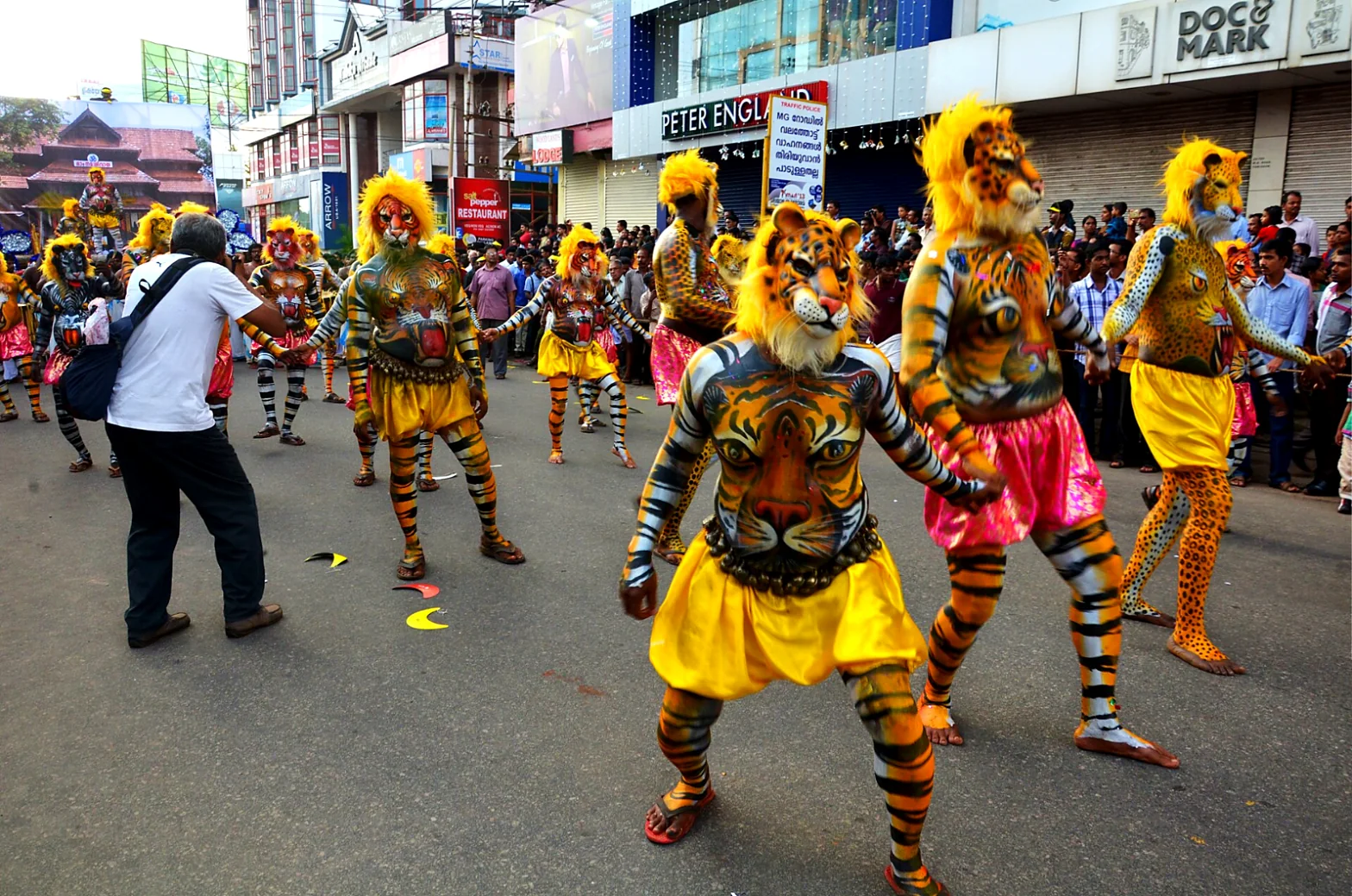
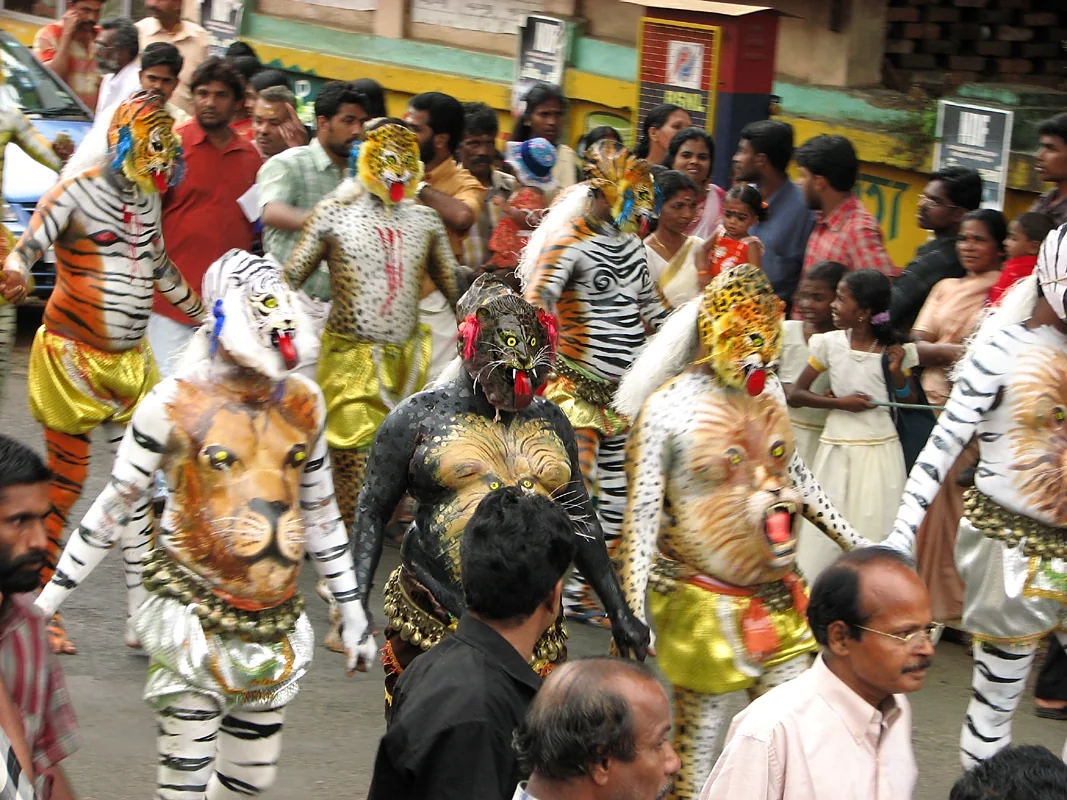
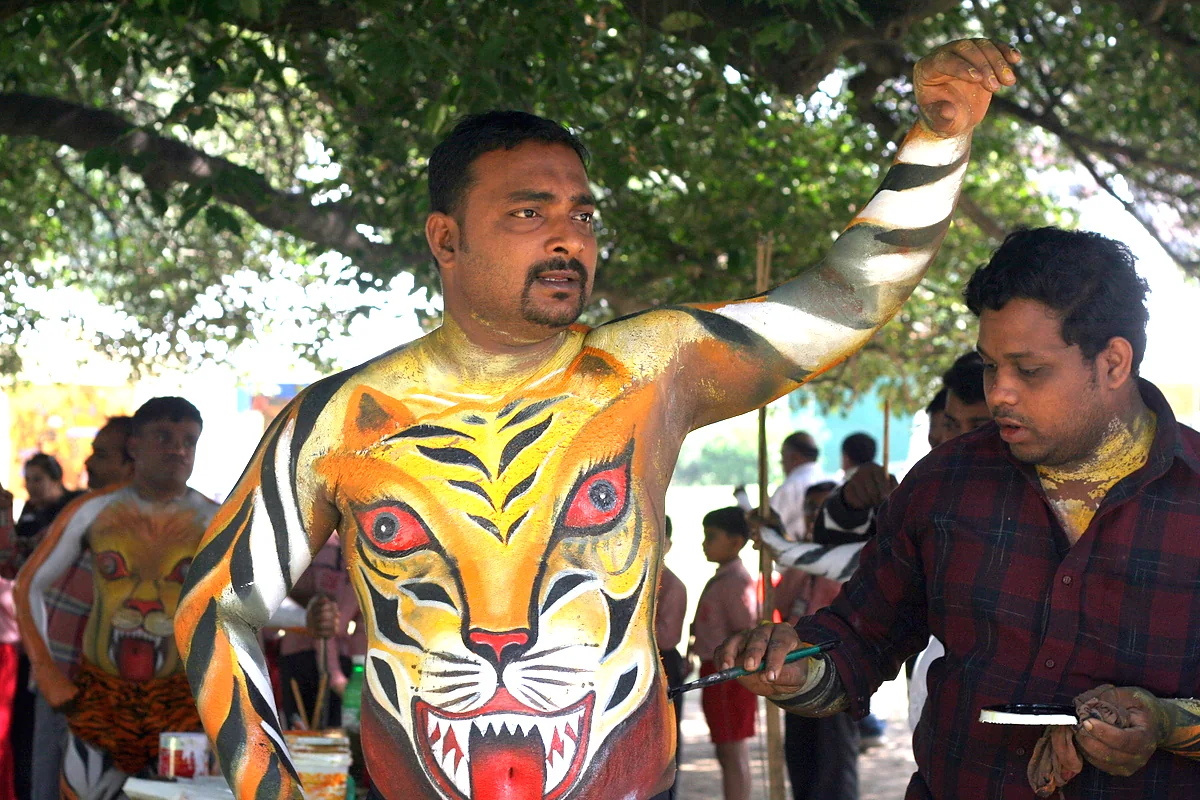
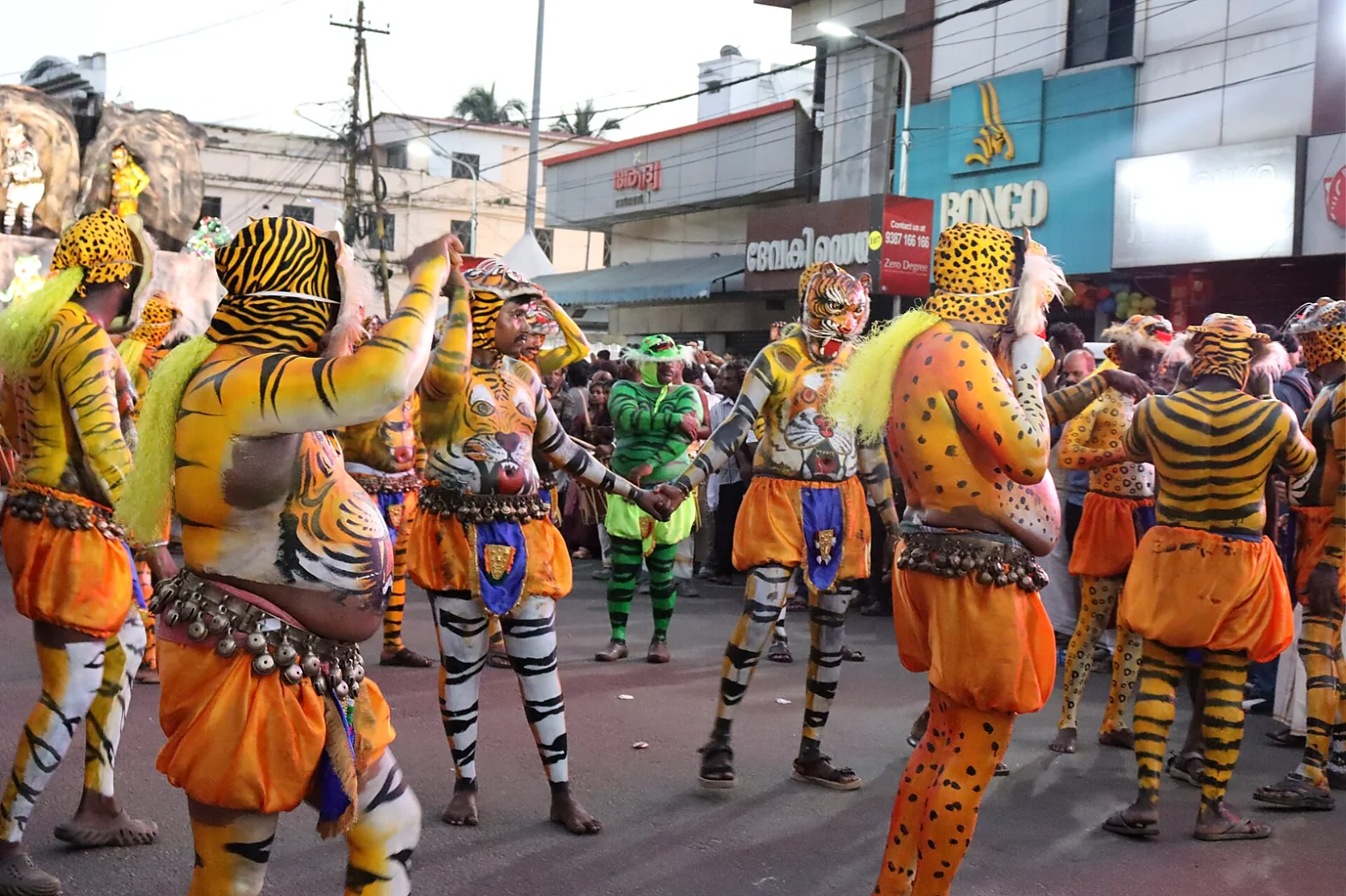
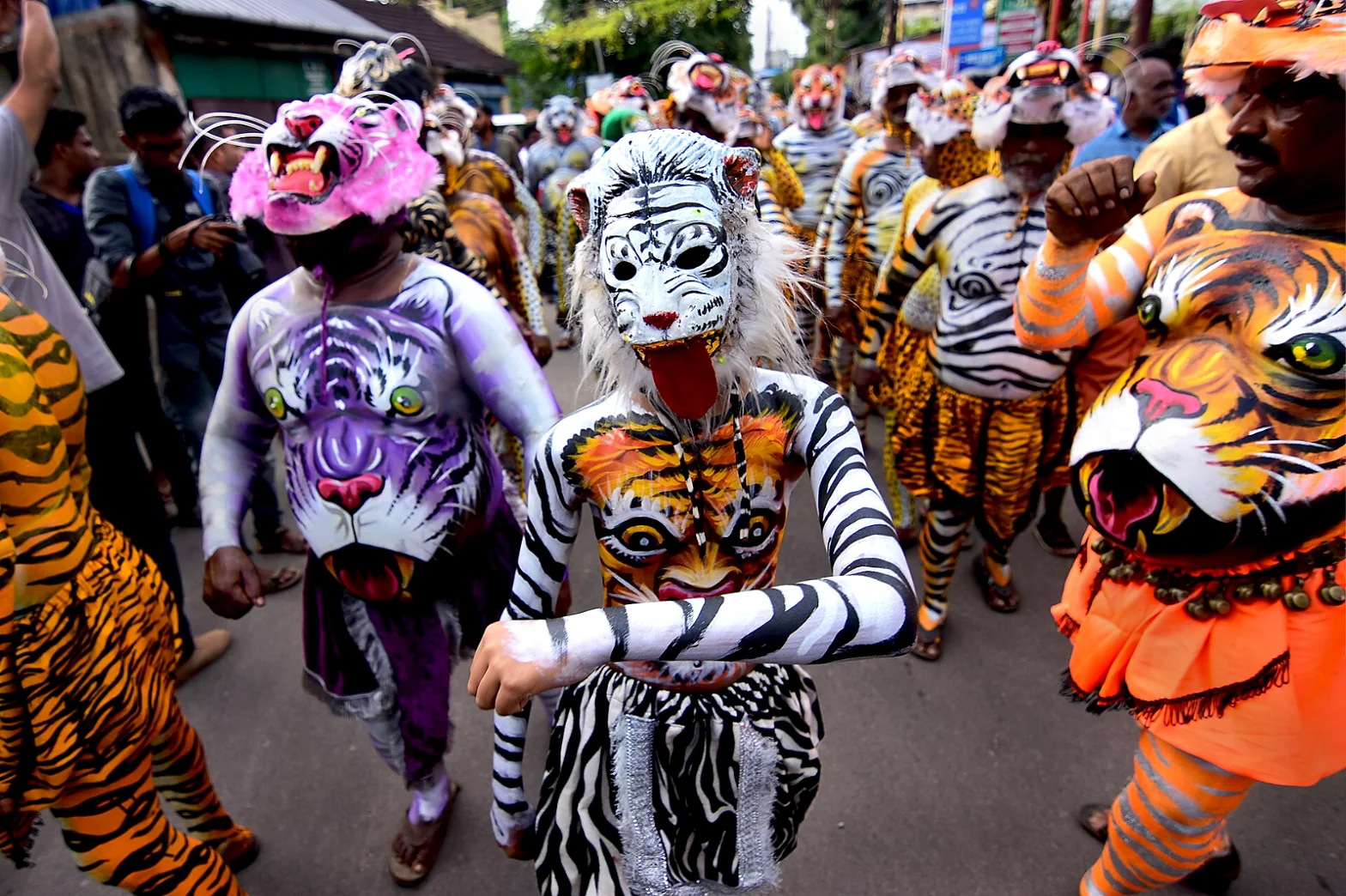
On the fourth day of Onam, the town of Thrissur is invaded by tigers. Hundreds of men, their bodies painted from neck to ankle in yellow, orange and black, with great tiger faces painted across their bellies and masks with glaring eyes and lolling red tongues on their heads, dance through the streets to the drumming of their troupes. They prowl, crouch, leap and shake their bellies, and the jingling of the bells at their waists mixes with the roar of the crowd. This is Pulikali, 'the play of the tigers', also called Kaduvakali: one of the most joyful and most photographed folk arts of Kerala.
In our article on Thrissur and the Pooram we met the king who shaped the modern town. Pulikali, too, is said to begin with him. In this article we look at what is known and what is told about its origins, how a tiger is made, how the festival works today, and how it fits into a wider family of 'tiger dances' across South India. As always, our own assessments are clearly marked.
At a glance
- What: a street performance of men (and, in recent years, women and children) painted and masked as tigers and leopards, with drummers, hunters and decorated floats.
- When: on Nalaam Onam, the fourth day of Onam, in the Malayalam month of Chingam (August–September).
- Where: Thrissur, with the troupes converging on the Swaraj Round around the Vadakkunnathan temple; smaller Pulikalis are held elsewhere in Kerala.
- Who: neighbourhood teams (desams), each of about 30 to 50 tigers with a percussion troupe; nine teams took part in 2026, with more than 400 tigers.
- Music: the small hand drum udukku and the barrel drum thakil, with cymbals.
- Organised by: the teams, through a Pulikali Coordination Committee formed in 2004, with grants from the Thrissur Corporation.
A king, his soldiers and a tiger dance
The tradition repeated in Thrissur, and in most accounts of the festival, is that Pulikali was introduced more than two hundred years ago in the time of the Cochin ruler Sakthan Thampuran (r. 1790–1805), the founder of the Thrissur Pooram. A second, more specific strand of the story says that it was Muslim soldiers, stationed in the town near what is still called Pattalam Road ('army road'), who first performed a tiger dance during their own festivals, and that the people of Thrissur took it up and made it part of Onam. In early days the performance was called Pulikkettikali.
The details vary in the telling: some say the soldiers were in the king's army, others in the army of the East India Company that was later quartered in the town. No document from the period that describes a tiger dance in Thrissur has been brought forward, and even the encyclopaedias disagree on a date of origin.
Our assessment: a dance that travelled
We think the 'soldiers' story deserves to be taken seriously, because of what we find elsewhere in South India. Men painted as tigers, dancing in processions, are a well-known feature of Muharram in the Deccan and North Karnataka, where they are called huli vesha, 'tiger guise', and where, even today, Hindus and Muslims both take part, often as a vow. On the coast of Karnataka, in Mangaluru and Udupi, the same art, pili vesha, became part of Hindu festivals such as Dasara and Krishna Janmashtami. Scholars of Karnataka's tiger dances see the tiger as a local symbol of strength that Muslim communities adopted into Muharram.
Seen against this background, the Thrissur story is very plausible: soldiers from the Deccan or the Mysore country, Muslim or not, bringing their Muharram or festival tiger dance to a garrison town in Kerala, and the people of Thrissur adopting it into their own great festival, Onam, just as the coastal Karnataka towns adopted it into Dasara. If so, Pulikali is a beautiful example of how a festival art can cross communities and regions and take root somewhere new. What we cannot confirm from the evidence available to us is the exact date, or the link with Sakthan Thampuran himself; the king may simply have become, in popular memory, the patron of everything old and grand in Thrissur.
Making a tiger
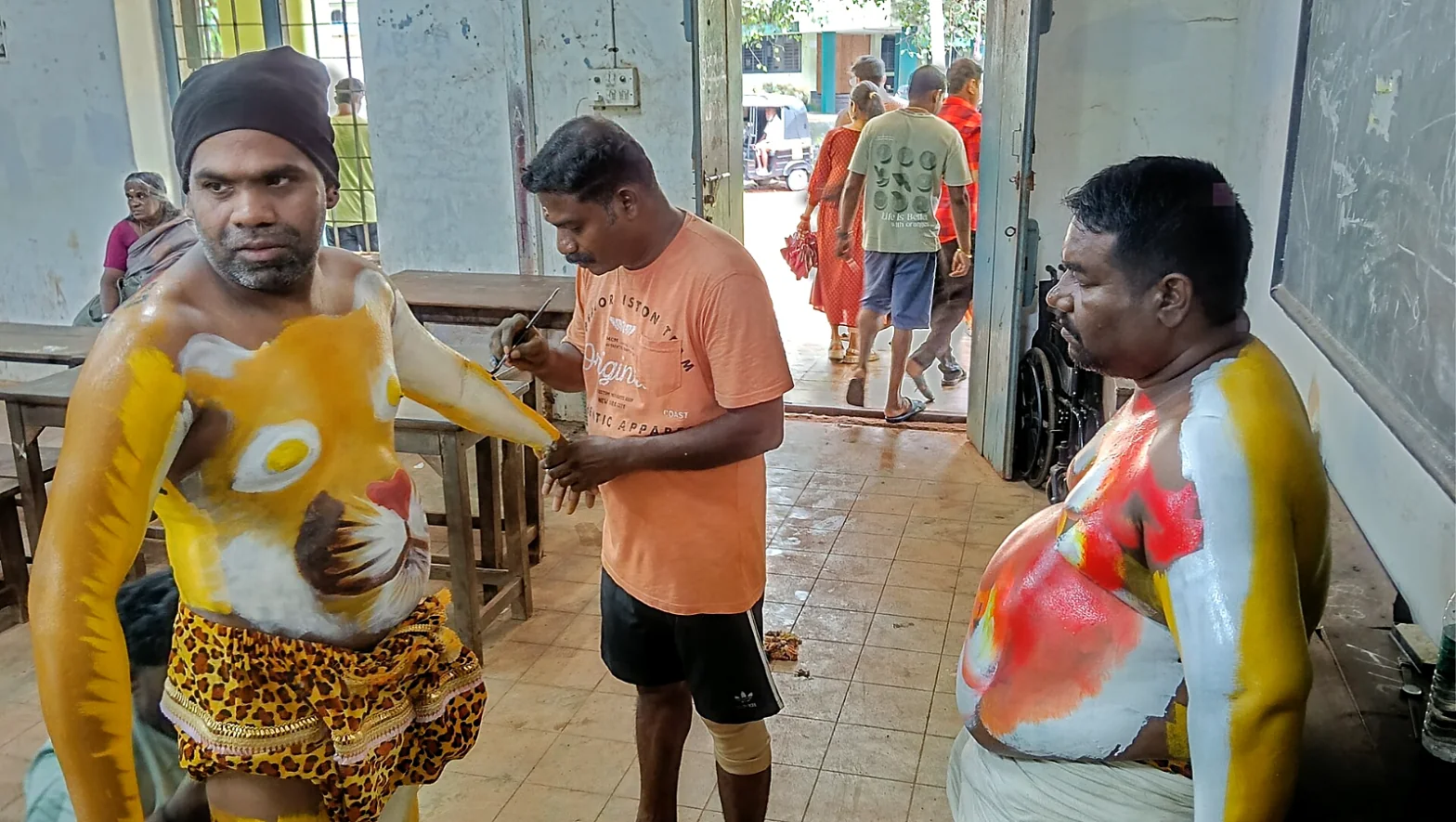
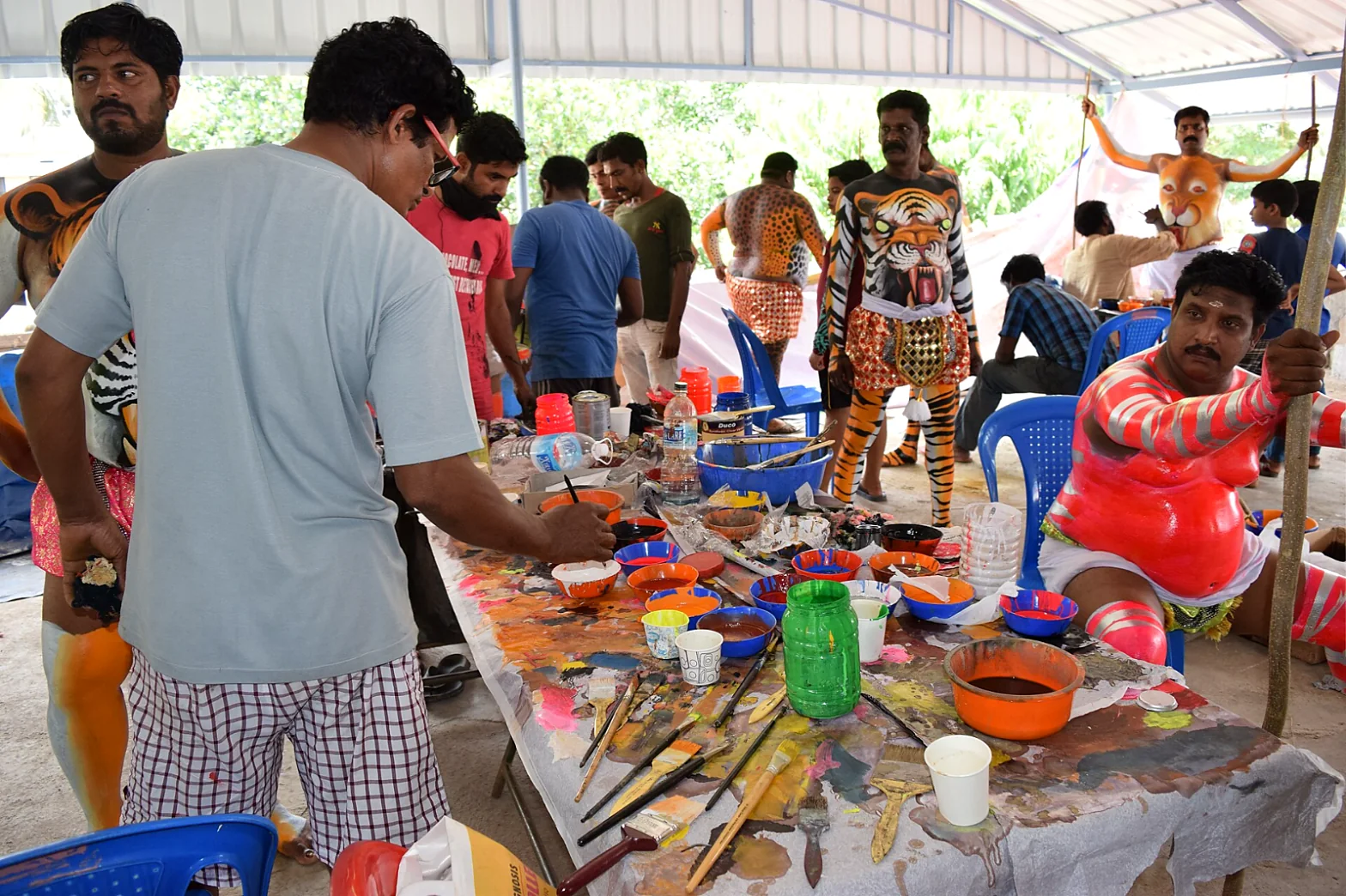
A Pulikali tiger takes a whole day to make. The work begins in the early morning, often around five or six o'clock, at the team's camp, usually a school, hall or shed in the neighbourhood:
- Preparation of the body. The performers' body hair is removed, since paint does not lie smoothly over it.
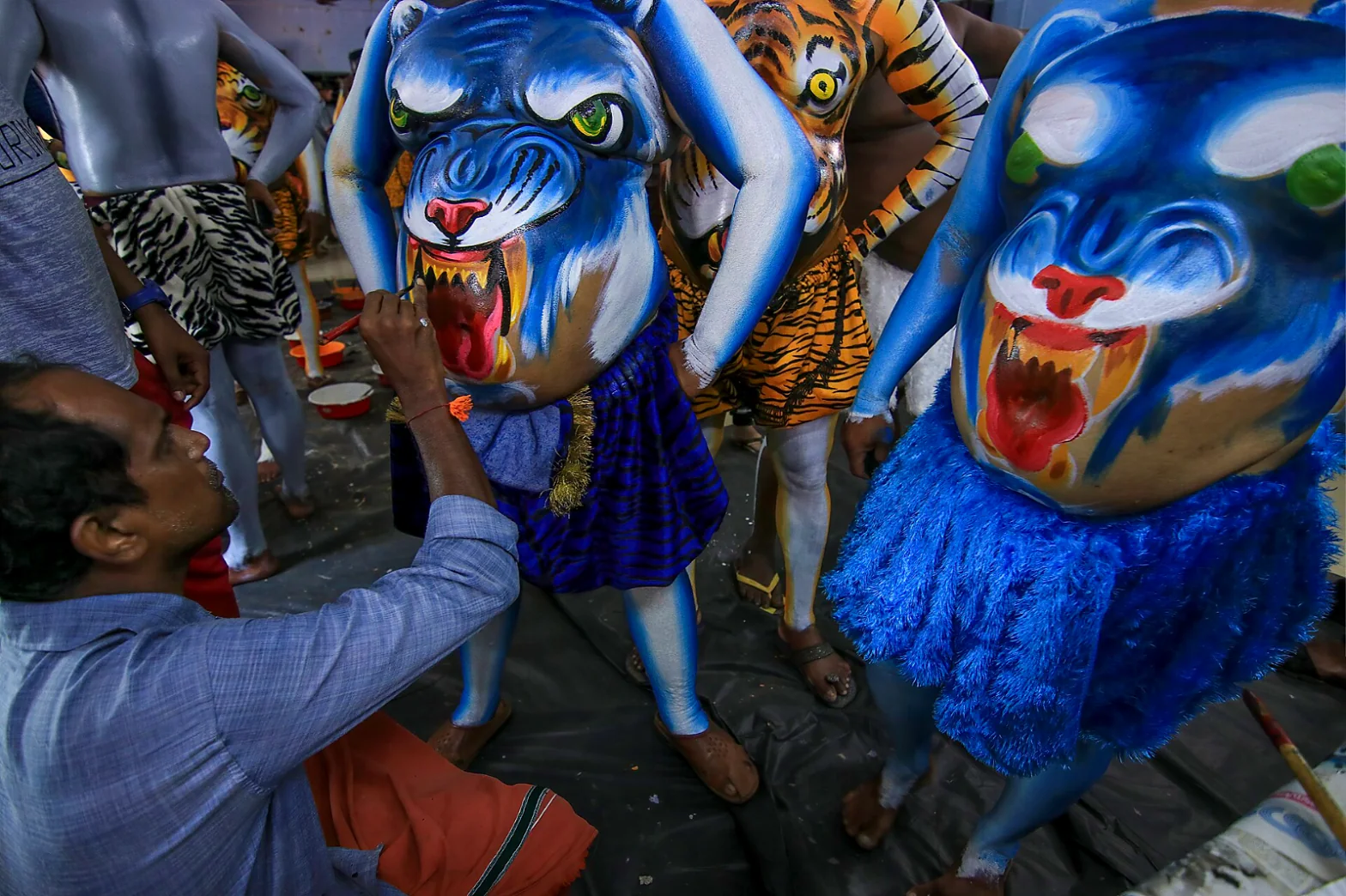
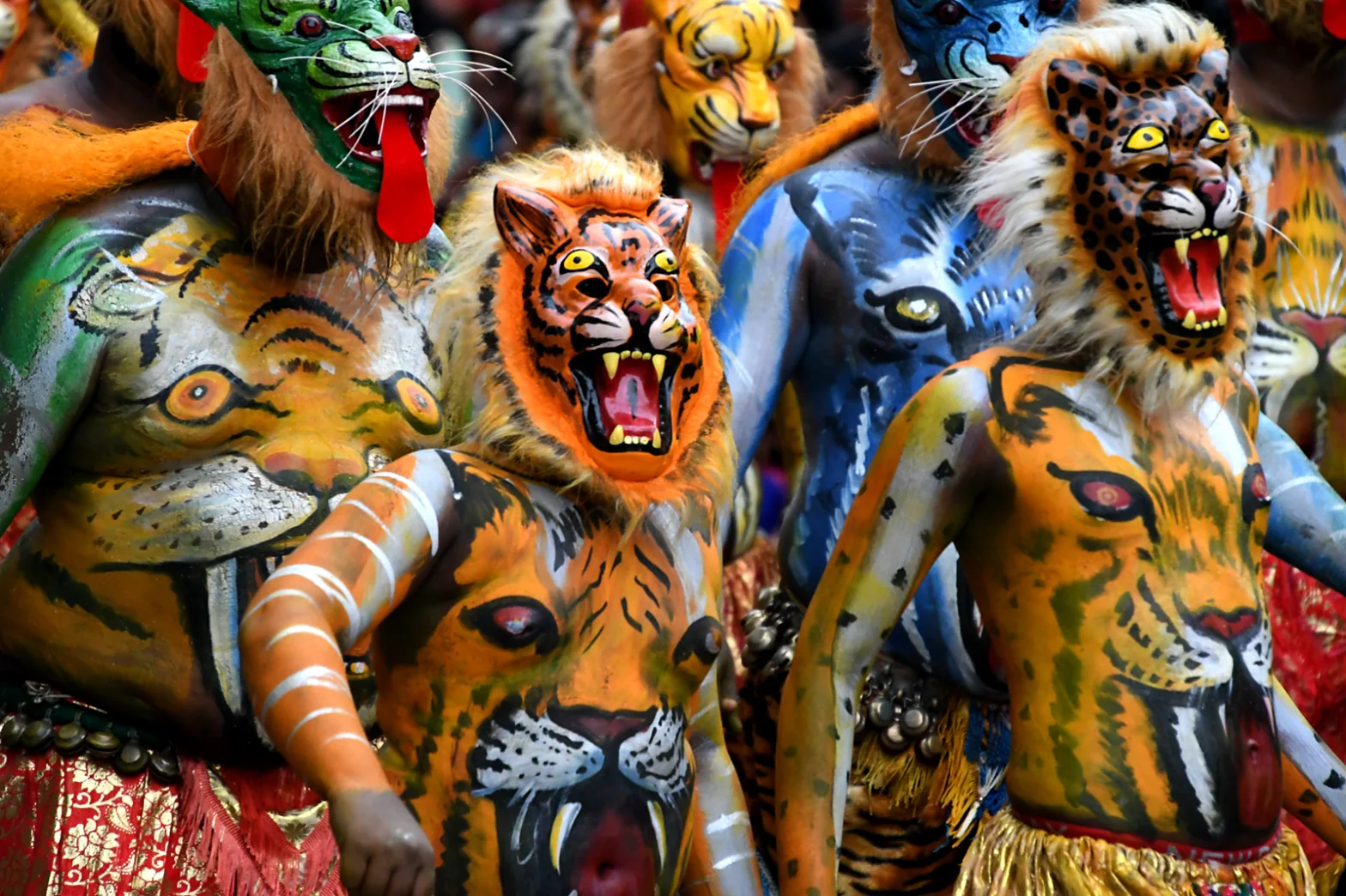
- The base coat. The whole body is painted with a first coat of colour, usually yellow or orange for tigers, white or grey for white tigers, and other colours for leopards and panthers.
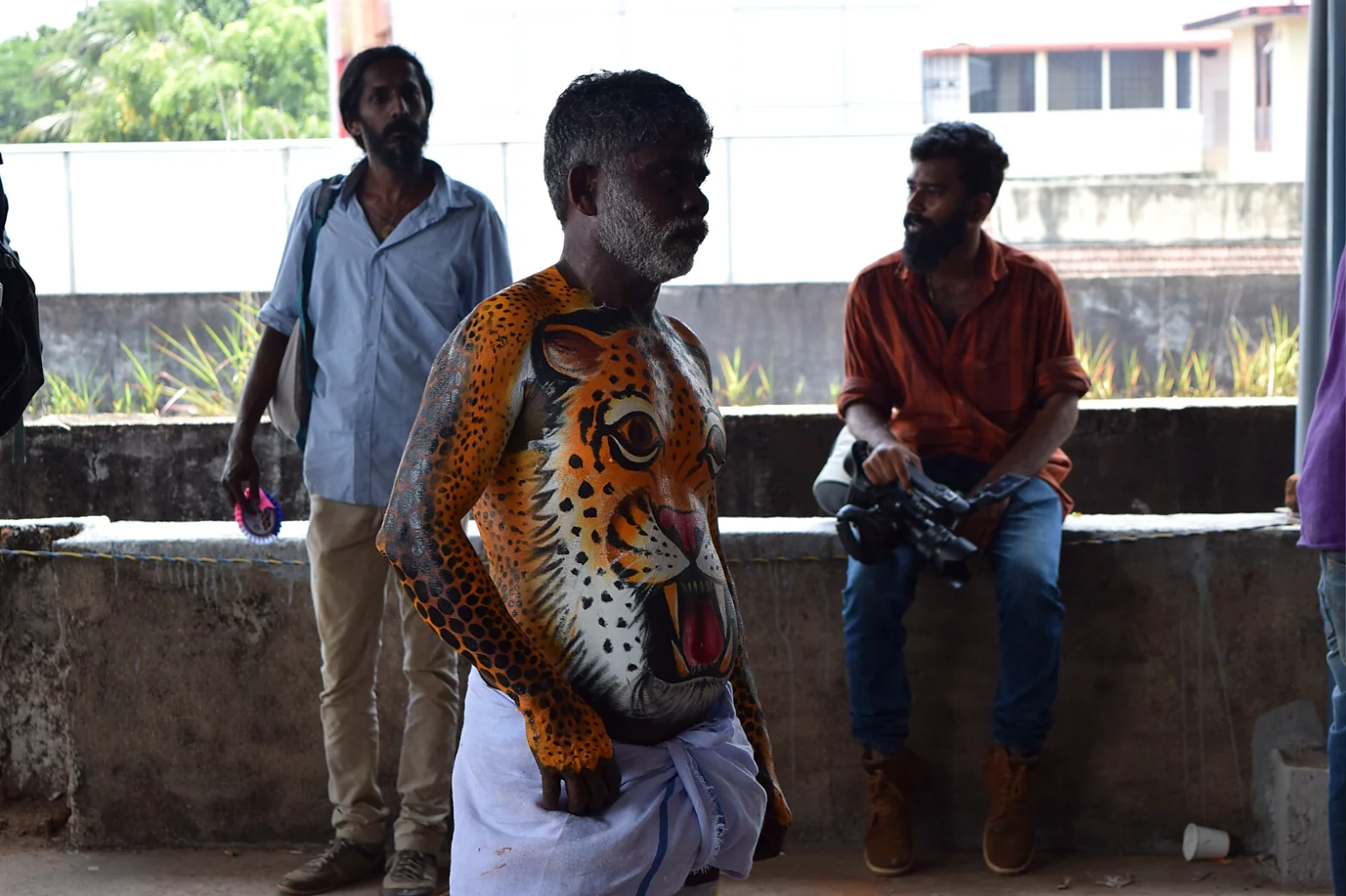
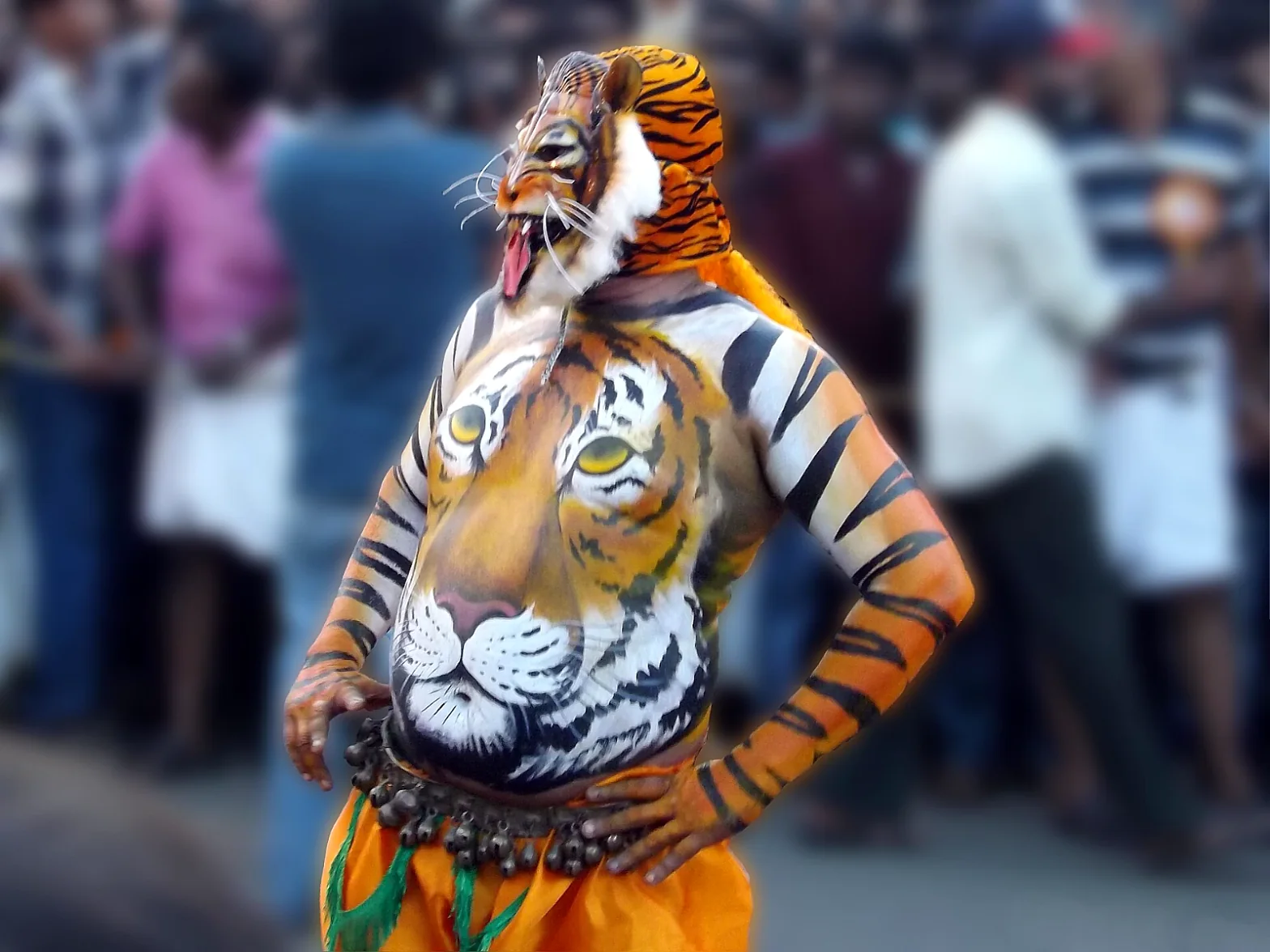
- The design. When the base has dried, the artists paint the stripes, spots and, above all, the great tiger face across the chest and belly, with the eyes on the chest and the mouth over the navel, so that the face seems to come alive when the performer moves. The paint is traditionally a powder pigment mixed with a binder such as varnish; it dries hard and, as performers say, can irritate and burn the skin by the end of the day.
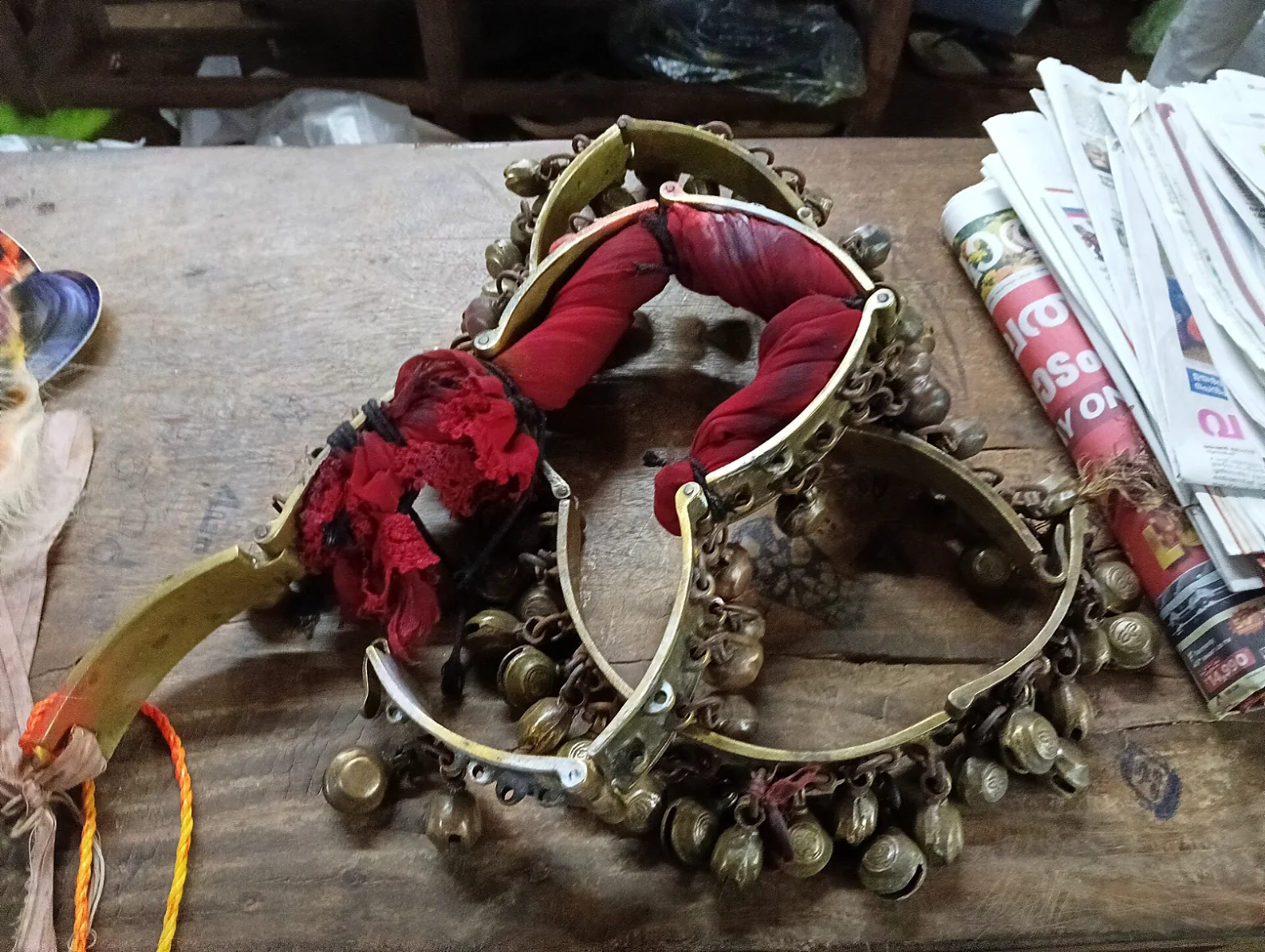
- Mask and costume. Each tiger wears a mask with fangs, a tongue, whiskers and a mane, a short skirt, and around the waist the aramani, a heavy belt of brass bells that jingles at every step and can weigh several kilograms.
The whole process takes six to eight hours; the tigers then wait, unable to sit comfortably or eat much, until the procession sets out in the late afternoon.
The belly
One feature of Pulikali surprises every first-time visitor: the most admired tigers have large round bellies. The belly is the canvas for the tiger's face, and a big belly gives the painter room for a big, expressive face that bulges and 'roars' when the dancer shakes it. Some of the most celebrated performers have, over the years, become famous for their bellies.
In 2026 this became the subject of a public controversy in Kerala, when a writer criticised the performers' bodies on social media and the performers and organising committees protested; he later deleted his post and apologised. Doctors have also pointed out the health risks of abdominal obesity. We mention this because it shows how much Pulikali matters to the people of Thrissur: the performers are not costumed entertainers but neighbours and working men who give their bodies, their skin and their whole day to a tradition they love.
The day of the tigers
On the fourth day of Onam, the teams leave their camps in the afternoon and are flagged off towards the Swaraj Round. Each team brings its tigers and leopards, a hunter with a toy gun, sometimes a goat or other prey, its percussion troupe and a decorated float, or tableau, on a mythological or topical theme. As they move, the tigers act out the hunt: stalking, pouncing, being shot at and 'dying' dramatically in the road, then springing back to life.
When they reach the Round, the teams offer coconuts at the small Ganapathi shrine there (the Naduvilal Ganapathi) and then circle the Round, dancing, while tens of thousands of spectators watch from the roads, balconies and rooftops. Prizes are given for the best team, the best tiger, percussion, floats and costumes; in 2026 the first prize was ₹70,000. The festival now receives grants from the Thrissur Corporation and, since 2025, from the central government as well.
Women and children
For most of its history, Pulikali was performed by men, with boys joining as cubs. In 2016 three women performed as tigers for the first time in a Thrissur team, and since then women have taken part in several teams. Children, sometimes very young, are part of most teams, and many of today's veteran performers began as cubs.
Pulikali and Onam
Onam is Kerala's harvest festival, remembering the return of the just king Mahabali to visit his people. It has always had its games and street performances, such as kummattikali, the masked dance of the Thrissur and Palakkad area. Pulikali has no religious ritual of its own: it is pure festivity, a carnival of the people, organised by neighbourhoods, open to anyone of any community, and loved by all. That, too, fits the spirit of Onam, the festival that recalls a time when, as the old song says, all people were equal.
Our assessment: why tigers?
Why should a harvest festival be celebrated with tigers? The tiger was, until the 20th century, a real presence in the forests around Thrissur, and it is a natural symbol of strength and courage. But there is also, we think, the pleasure of reversal: for one day, ordinary men, labourers, drivers, shopkeepers, become the most feared animal of the forest, and the town that fears nothing all year is 'hunted' by its own neighbours. Like many carnival traditions around the world, Pulikali lets a community play with fear and make it into laughter. And the hunter, who is always outdone by the tigers, gives the performance its comic heart.
Watching Pulikali
- When: on the fourth day of Onam, usually in late August or early September; check the date each year.
- Where to stand: along the Swaraj Round in Thrissur from mid-afternoon; the teams are flagged off at about 4 pm and dance on the Round until dusk. Roads into the centre are closed to traffic.
- Best experience: visit a team's camp in the morning (ask politely first) to watch the painting; it is as remarkable as the procession.
- Respect: the performers have worked and suffered for hours; do not touch their paint, and ask before close-up photographs.
- From Munnar: Thrissur is about four to five hours by road. Combine Onam in Thrissur with the hills and the tea gardens.
Read also: Thrissur, the Vadakkunnathan temple and the Pooram · Theyyam: the ritual and its painted faces · Thiruvananthapuram
See it for yourself, with a local driver who knows these roads.
Book a Munnar Jeep SafariSources & further reading
- Wikipedia: Puli Kali
- The South First (21 August 2026): What lies beneath the stripes: Pulikali's tradition, toil and a controversy
- Onmanorama (29 August 2026): Pulikali takes over Thrissur
- Onmanorama (7 September 2025): Pulikali gets central funding for the first time
- Deccan Herald: Tigers of Muharram and the colours of harmony
- Wikipedia: Pili Yesa (tiger dance of coastal Karnataka)
- Kerala Tourism: Pulikali
Figures are from the sources listed and were checked in October 2026. Park timings and road conditions change, so please confirm before you travel.