
Thrissur: The Vadakkunnathan Temple, Sakthan Thampuran and the Birth of the Pooram
How a strong king of Cochin cleared a teak forest, broke the power of the temple lords and, in the 1790s, created Kerala's greatest temple festival: the story of Thrissur, its temple of Shiva, and the elephants, parasols and drums of the Pooram.
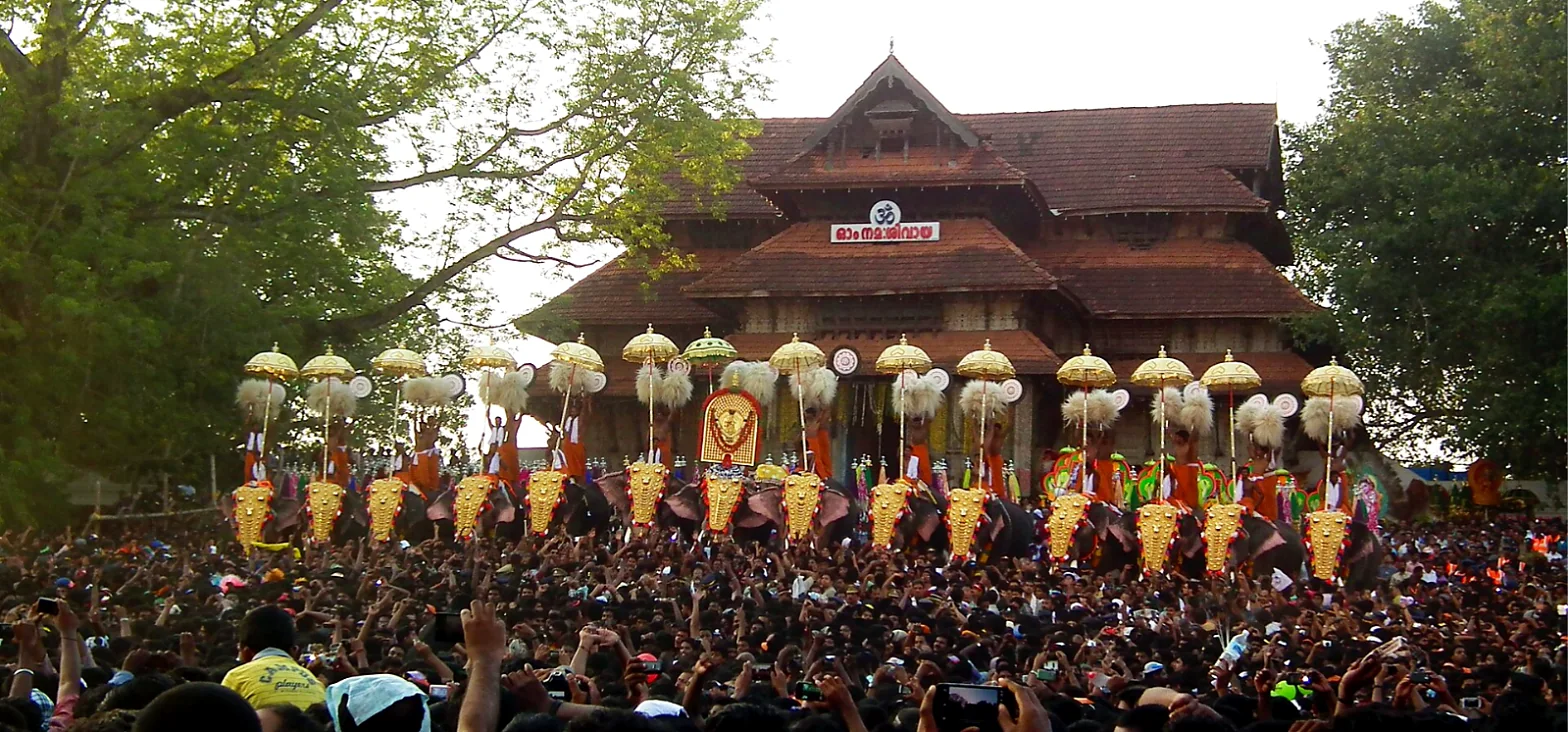
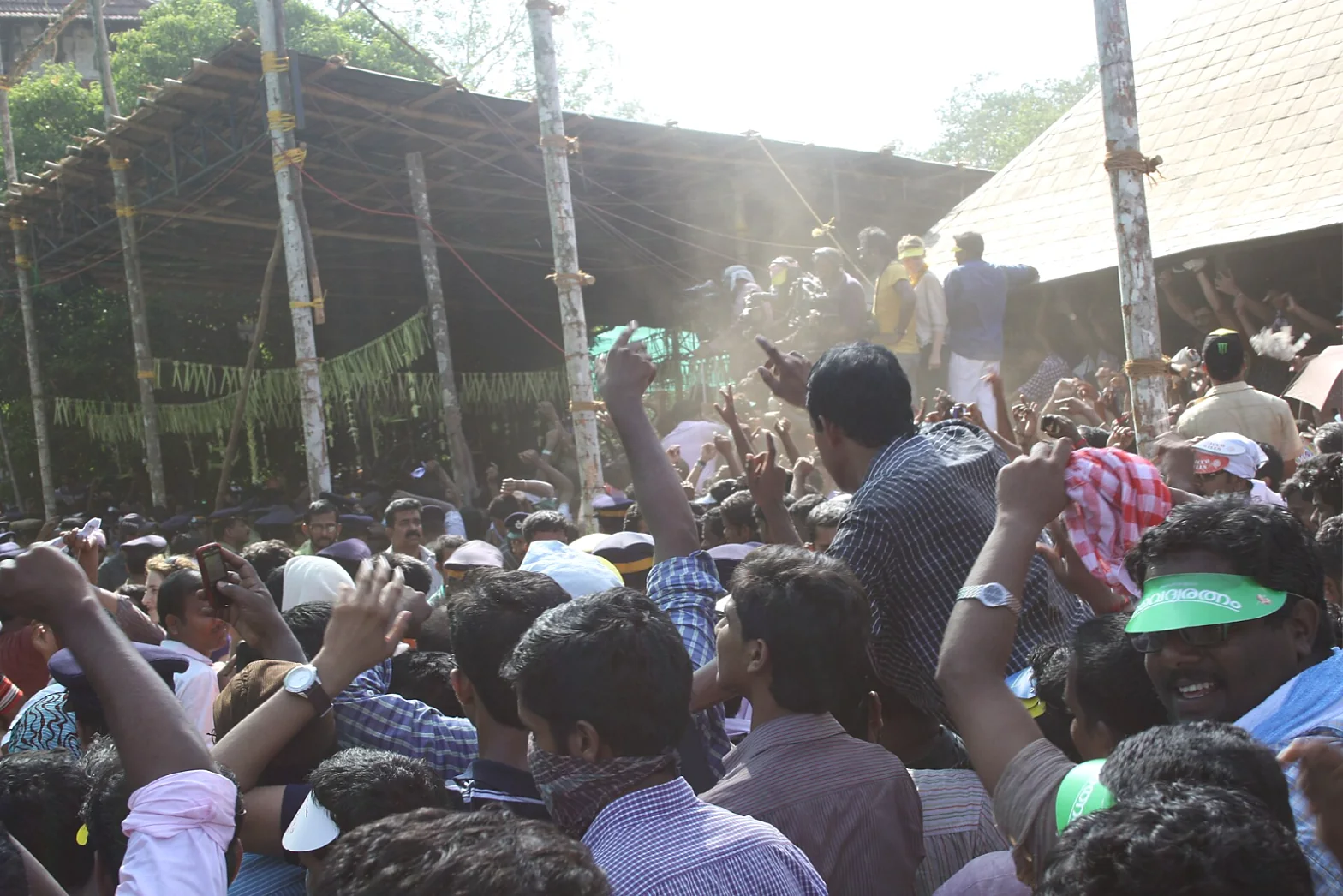
Once a year, in the hot month of Medam, the centre of Thrissur disappears under a sea of people. Some thirty elephants in golden caparisons stand in two lines facing each other in front of an ancient temple gateway; on their backs, young men raise and change brilliant silk parasols in a silent contest of colour, while hundreds of drummers and cymbal players build a wall of sound behind them. This is the Thrissur Pooram, the most famous temple festival of Kerala.
It is, as festivals go in India, quite young: it was created in the 1790s by a king. To understand it, we need to understand the town, its great temple of Shiva, and the ruler the people of Thrissur still call Sakthan Thampuran, 'the powerful king'. As always, our own assessments are clearly marked.
At a glance
- Where: Thrissur (Trichur), central Kerala, about 75 km north of Kochi.
- Heart of the town: the Vadakkunnathan temple, dedicated to Shiva, standing on a low hill in the middle of the Thekkinkadu Maidan, encircled by the road called Swaraj Round.
- Founder of modern Thrissur: Raja Rama Varma, 'Sakthan Thampuran', Maharaja of Cochin 1790–1805.
- Thrissur Pooram: on the day of the Pooram star in Medam (April–May); begun in the 1790s; two 'sides', Paramekkavu and Thiruvambadi, with ten participating temples.
- Today: the 'cultural capital of Kerala', home of the state's academies of literature, music and drama, and of fine arts.
The town of Shiva
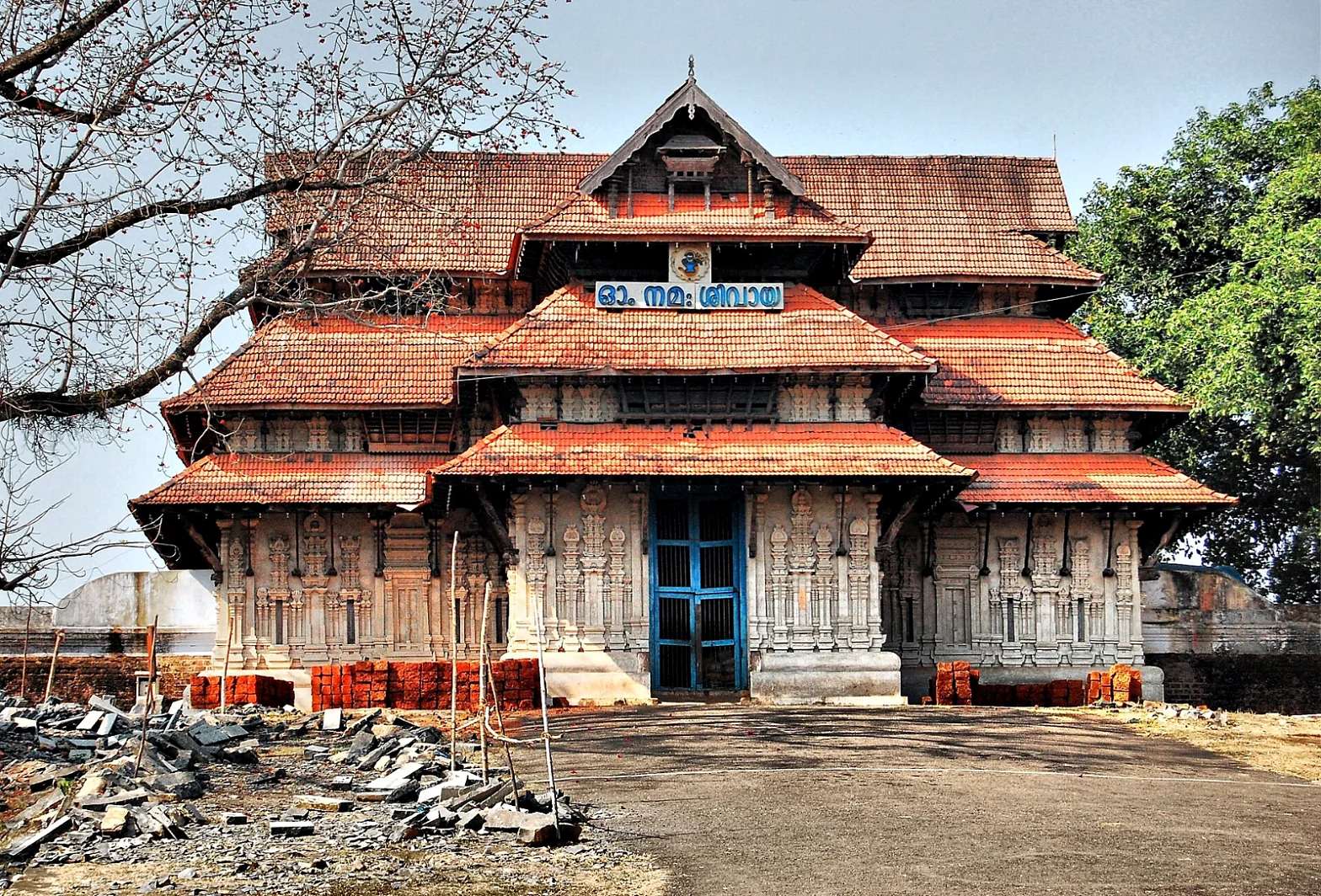
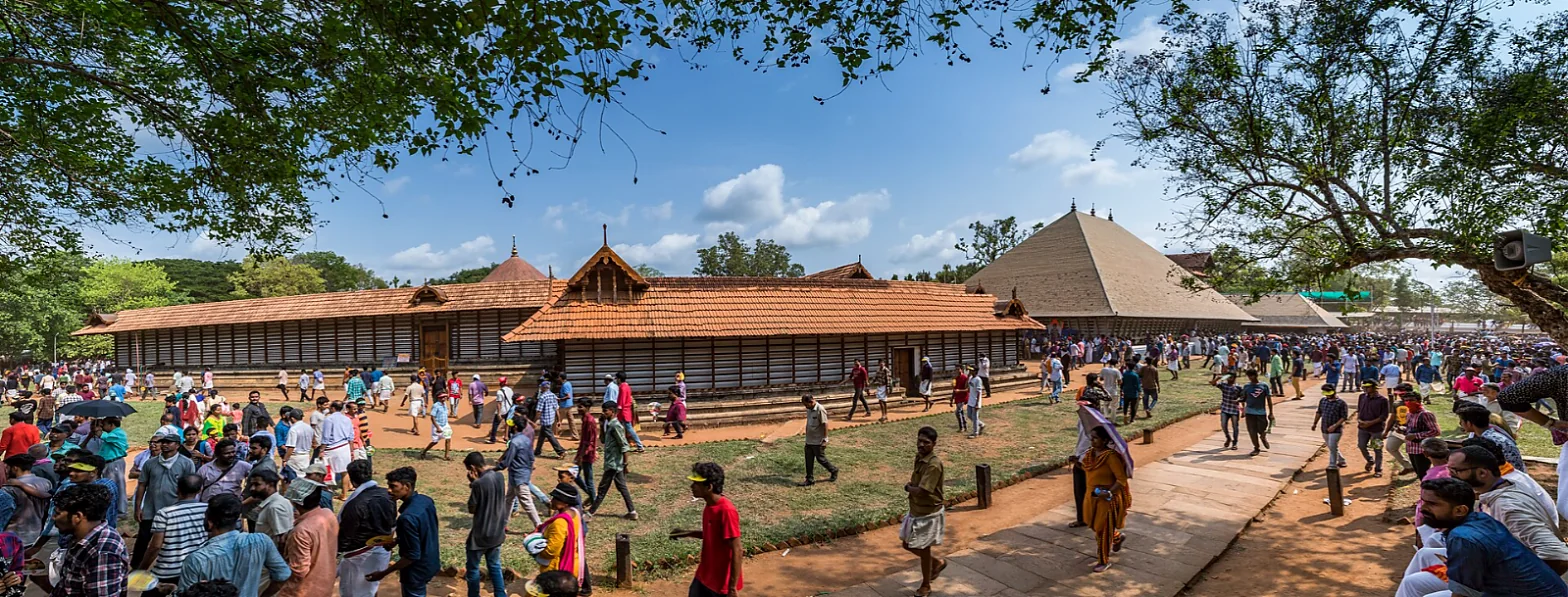
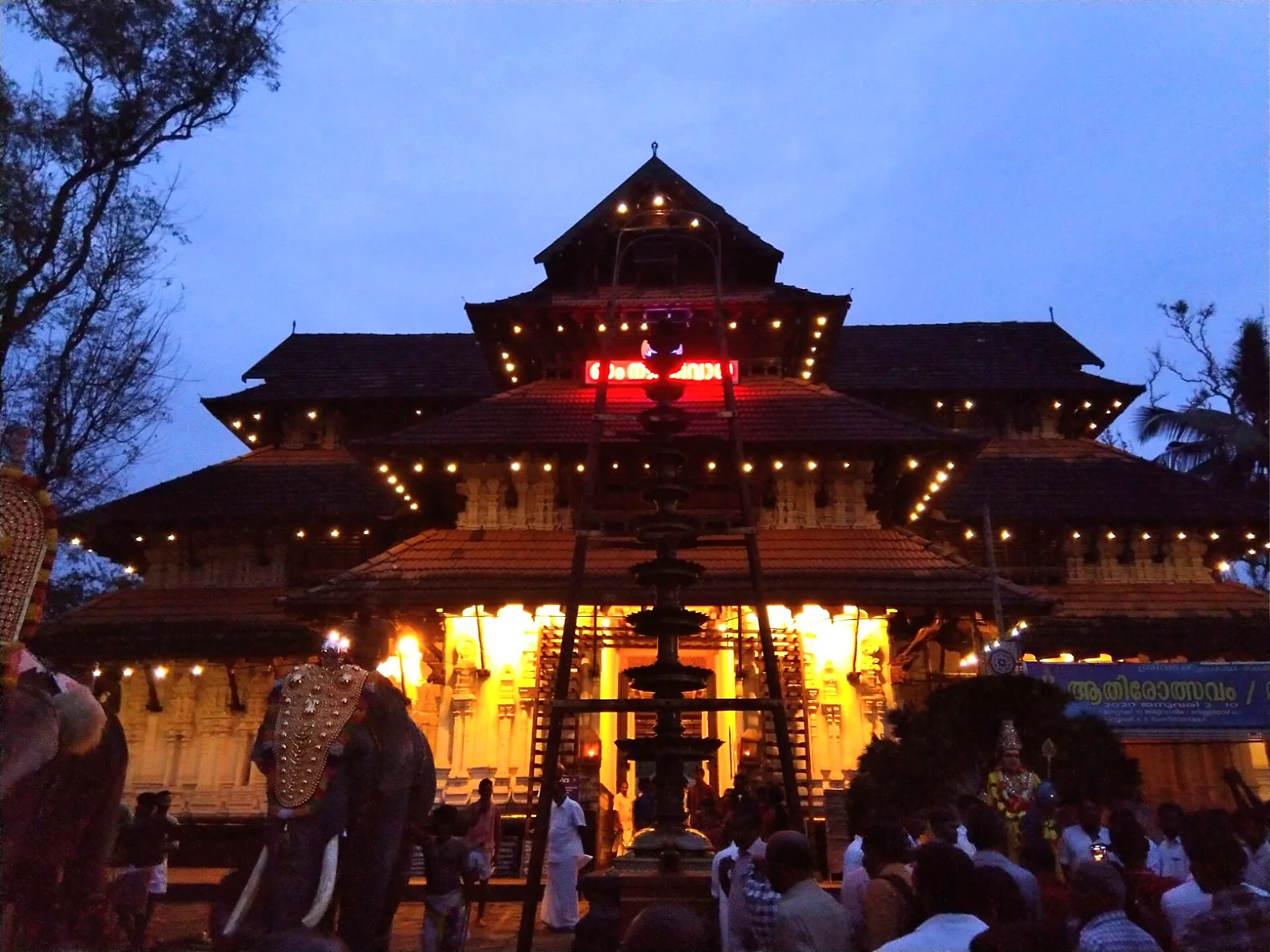
The name Thrissur is usually explained as a shortening of Thiru-Shiva-Perur, 'the great town of holy Shiva', and the town has grown around its Shiva temple. The Vadakkunnathan ('the Lord of the North') temple stands on a rise in the centre of a great open ground, the Thekkinkadu Maidan. Within its high laterite walls are shrines to Shiva, to Parvati, to Rama and to Shankaranarayana, a tall gateway tower (gopuram) on each of its four sides, and one of the finest temple theatres (koothambalam) in Kerala, where the ancient Sanskrit drama Koodiyattam is performed.
The temple's traditions are remarkable. The Shiva linga is invisible: it lies beneath a mound of ghee, built up over centuries from the daily offerings, which, the priests say, never melts or smells even in the summer heat. Legend attributes the temple to Parashurama, the warrior sage who in Kerala's sacred history raised the land from the sea, and connects it with the philosopher Adi Shankara, said to have been born to parents who prayed here. Its walls carry mural paintings of the 17th and 18th centuries, among them a reclining Shiva and a twenty-armed dancing Shiva, which are themselves worshipped.
For centuries this was also a seat of Brahmin learning. The anthropologist Edgar Thurston, writing in 1909, recorded the tradition that three disciples of Shankara founded religious houses (mathams) in Thrissur; when one of them lapsed, its property passed to the Raja of Cochin, who used its funds for a Vedic school. 'Trichūr then became the centre of Brāhmanical learning', Thurston wrote, and the Nambudiri Brahmins of Kerala were divided into two great 'unions' of learning, the Trichur Yogam and the Tirunavaya Yogam. The Vadakkunnathan temple itself was managed for a long time by the Brahmin heads of these institutions, the Yogiatiris.
Our assessment: how old is the temple?
You will often read that the Vadakkunnathan temple, or its koothambalam, is 1,500 or even 2,000 years old. We have not found firm evidence for such dates. The present buildings, in the classic Kerala style of laterite, timber and tiled roofs, have been repaired and rebuilt many times, and the murals are of the 17th–18th centuries. What is certain is that the temple was the centre of an important Brahmin settlement and centre of learning in medieval times, and that the town grew around it. We think it is best described as very old in its traditions and continuously renewed in its fabric, which is true of most great Kerala temples, whose wooden structures could not survive unchanged through centuries of monsoons. The temple's careful restoration, completed in 2015, won a UNESCO Asia-Pacific award for heritage conservation, and its murals are protected as a national monument.
Sakthan Thampuran: the king who made the town
At the end of the 18th century the kingdom of Cochin was in crisis. Its rulers had been overshadowed by the Portuguese and the Dutch; Mysore's armies under Hyder Ali and Tipu Sultan had overrun its northern lands; powerful feudal lords and temple corporations governed much of the country in practice. Into this came Raja Rama Varma (1751–1805), known in his youth as Kunji Pillai Thampuran, who ruled Cochin from 1790 to 1805.
His name in popular memory, Sakthan, 'the strong', tells how he ruled. He broke the power of the feudal chiefs, taking their lands into royal control; he took the management of the temples, including the Vadakkunnathan, out of the hands of the Yogiatiris; and he is remembered, in many stories, for his strict and sometimes harsh justice. He moved the royal residence to Thrissur and set out to make it a real capital:
- He cleared the teak forest that surrounded the Vadakkunnathan temple, creating the open Thekkinkadu Maidan (the name means 'southern teak forest').
- He laid out the ring road around it, today's Swaraj Round, which is still the centre of Thrissur's life.
- He encouraged trade and markets in the town; tradition credits him with inviting merchant communities, including Syrian Christian traders, to settle there.
- He rebuilt the Vadakkechira palace in 1795 in a blend of Kerala and Dutch styles. It is now the Sakthan Thampuran Palace museum, and in its grounds is the memorial at the place where the king was cremated after his death at Thrissur on 26 September 1805.
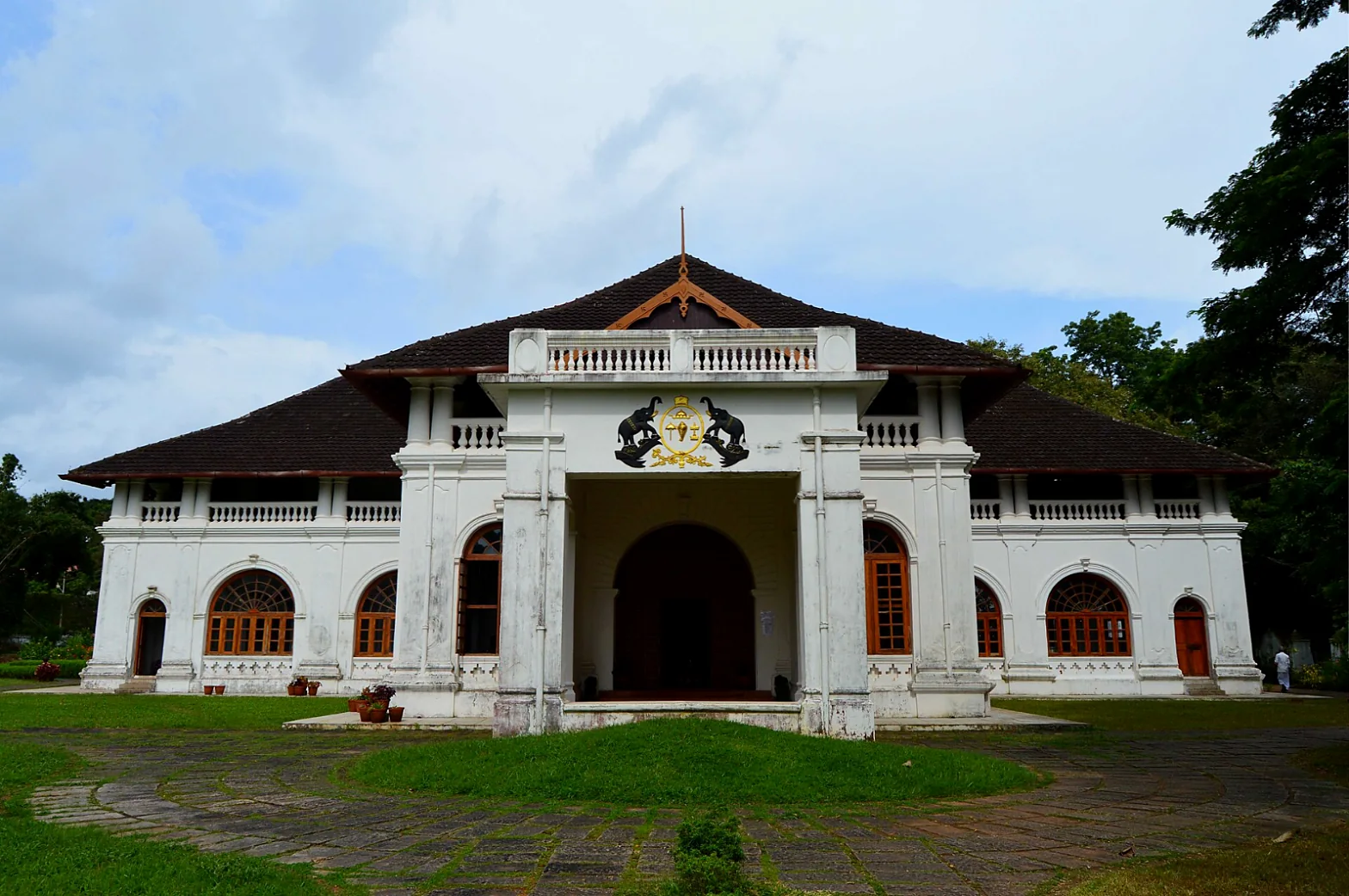
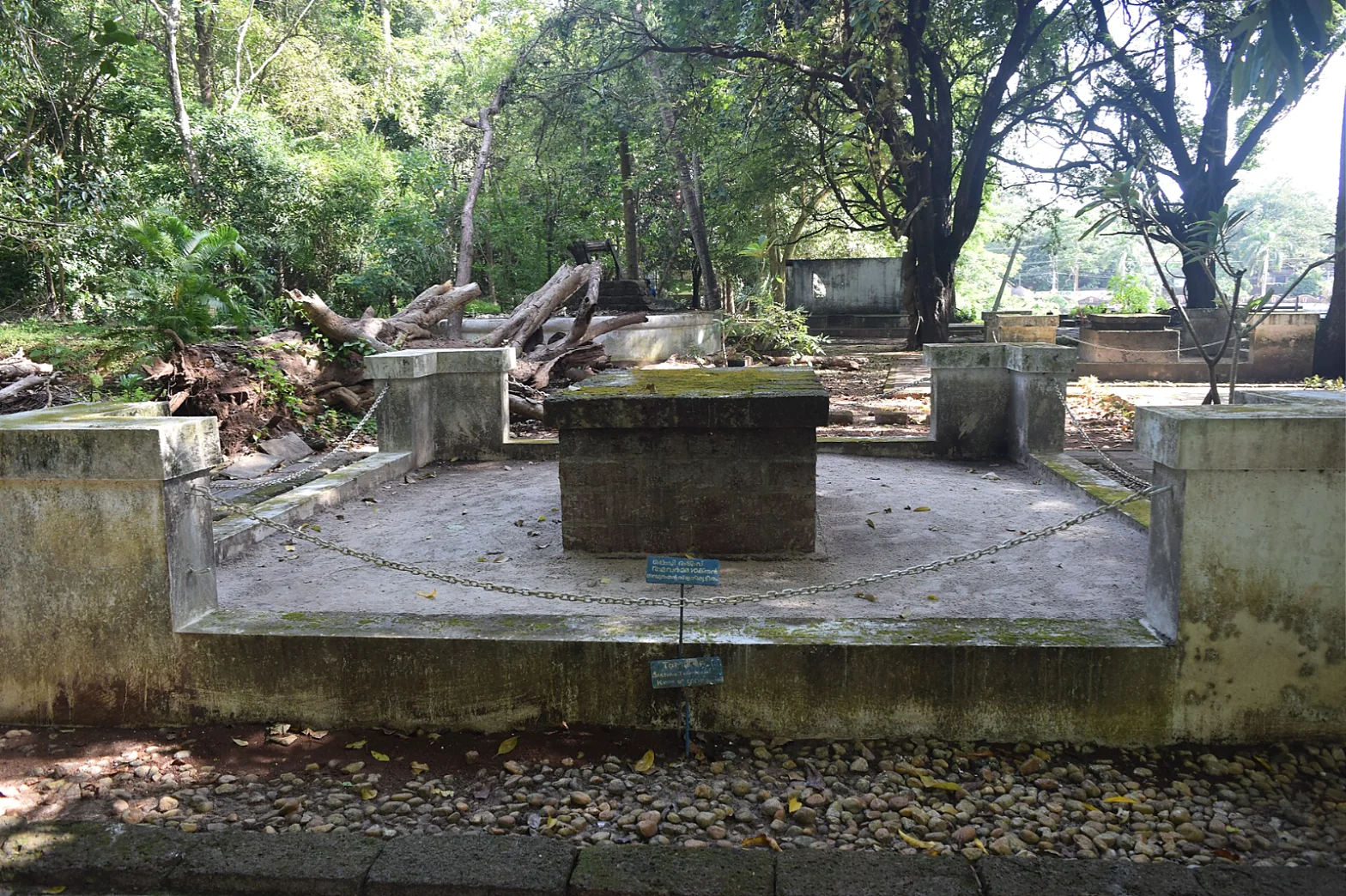
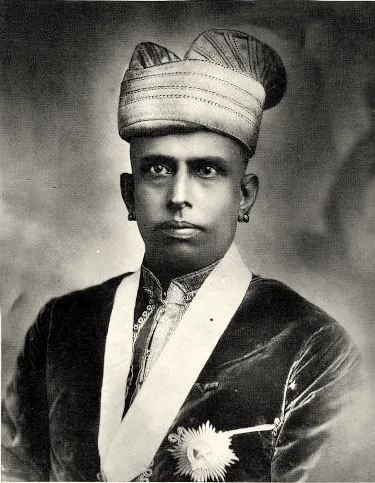
The birth of the Pooram
Before Sakthan Thampuran, the great temple gathering of the region was the Arattupuzha Pooram, held a few kilometres south of Thrissur, to which the deities of many temples were carried in procession every year. The story told in Thrissur is that in 1796 heavy rain delayed the processions of the temples around Thrissur, and when they arrived late they were refused entry to the Arattupuzha festival. The humiliated temples appealed to the king. Sakthan Thampuran's answer was characteristic: he created a festival of their own, centred on the Vadakkunnathan temple, on the same day.
He organised the temples into two groups. The Paramekkavu side and the Thiruvambadi side are the principal participants, each leading a group of smaller temples, with ten temples in all: Thiruvambadi, Paramekkavu, Laloor, Ayyanthole, Neythalakkavu, Kanimangalam, Chembukkavu, Panamukkumpally, Choorakkottukavu and Karamukku. The two great goddesses come to pay homage to the Lord of the North, and then compete, in friendly rivalry, in splendour.
Our assessment: a royal festival
The story of the rain and the refusal is the popular explanation, and it may well be true. But we think it is also worth looking at what the Pooram did for the king. It gathered the temples of the whole Thrissur region in his new capital, around the temple he had just taken under royal control, on a ground he had just cleared, under rules he laid down. It turned Thrissur, at a stroke, into the religious centre of the region, at the expense of Arattupuzha, which lay in the old Brahmin-dominated system. The Pooram was a festival of devotion, but it was also, very clearly, a statement of royal power and a reorganisation of the region around a new capital. That it has outlived the kingdom by so long is a measure of how well it was designed.
The day of the Pooram
The Pooram falls on the day when the moon is in the Pooram star in the Malayalam month of Medam (April–May). The flags go up a week before; sample fireworks are fired a few days later. On the great day:
- Morning: the smaller temples arrive one by one with their elephants and drummers to pay homage at the Vadakkunnathan temple.
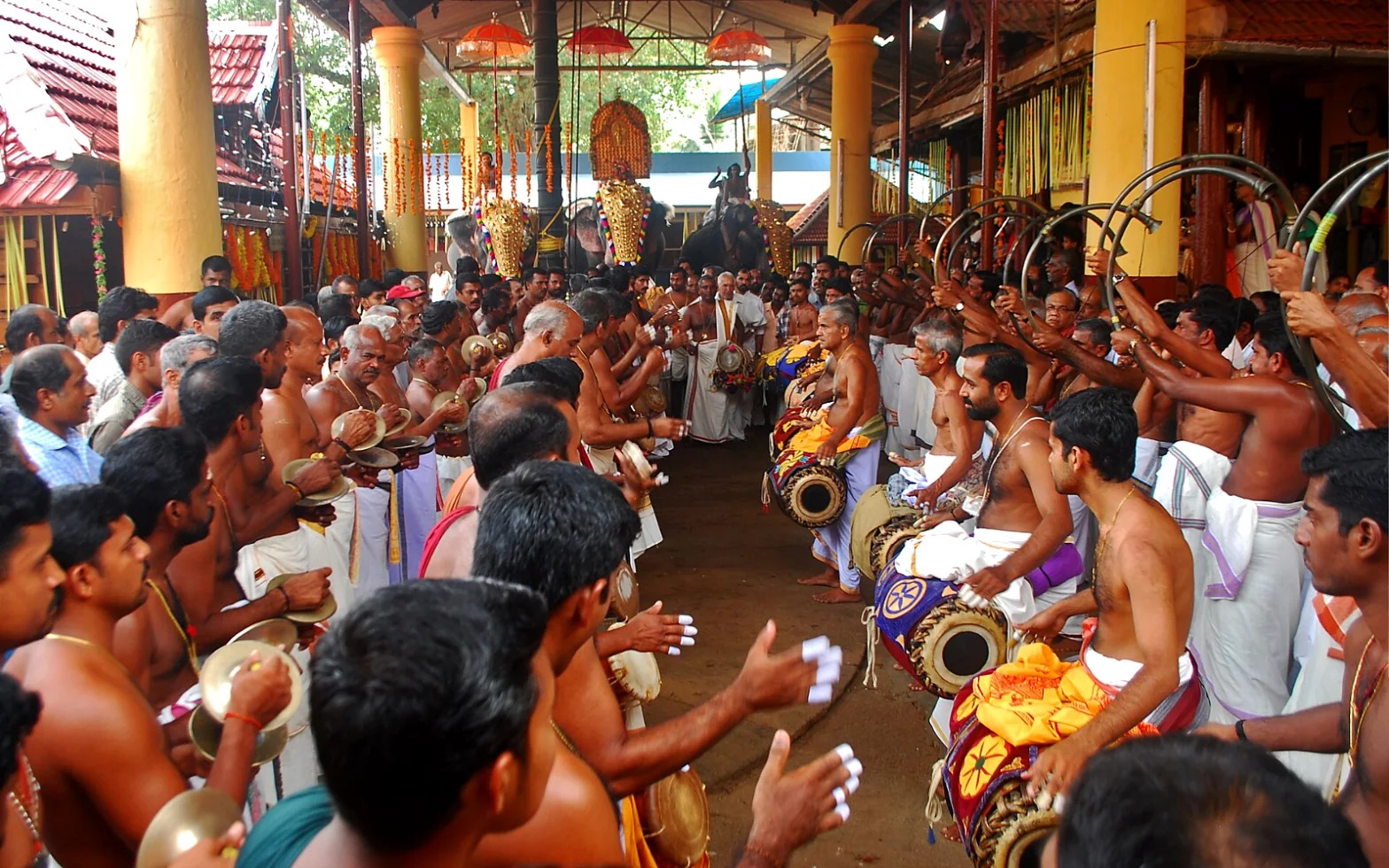
- Madathil Varavu: the Thiruvambadi procession, with a famous panchavadyam, an orchestra of five kinds of instruments (the hourglass drum timila, the maddalam, the cymbals ilathalam, the horn kombu and the idakka), played by dozens of musicians.
- Ilanjithara Melam: in the afternoon, inside the temple precinct, under an ilanji tree, the Paramekkavu side's chenda melam, a performance of hundreds of drummers and cymbal and horn players that builds over two hours to a thunderous climax. It is considered one of the greatest performances of percussion in India.
- Kudamattam: towards evening, the two sides come out through the south gate and face each other across the ground, about fifteen elephants on each side, and the 'exchange of parasols' begins: sets of brilliantly decorated parasols are raised, displayed and changed in quick succession, each side trying to outdo the other with its designs, which are kept secret until the moment they appear.
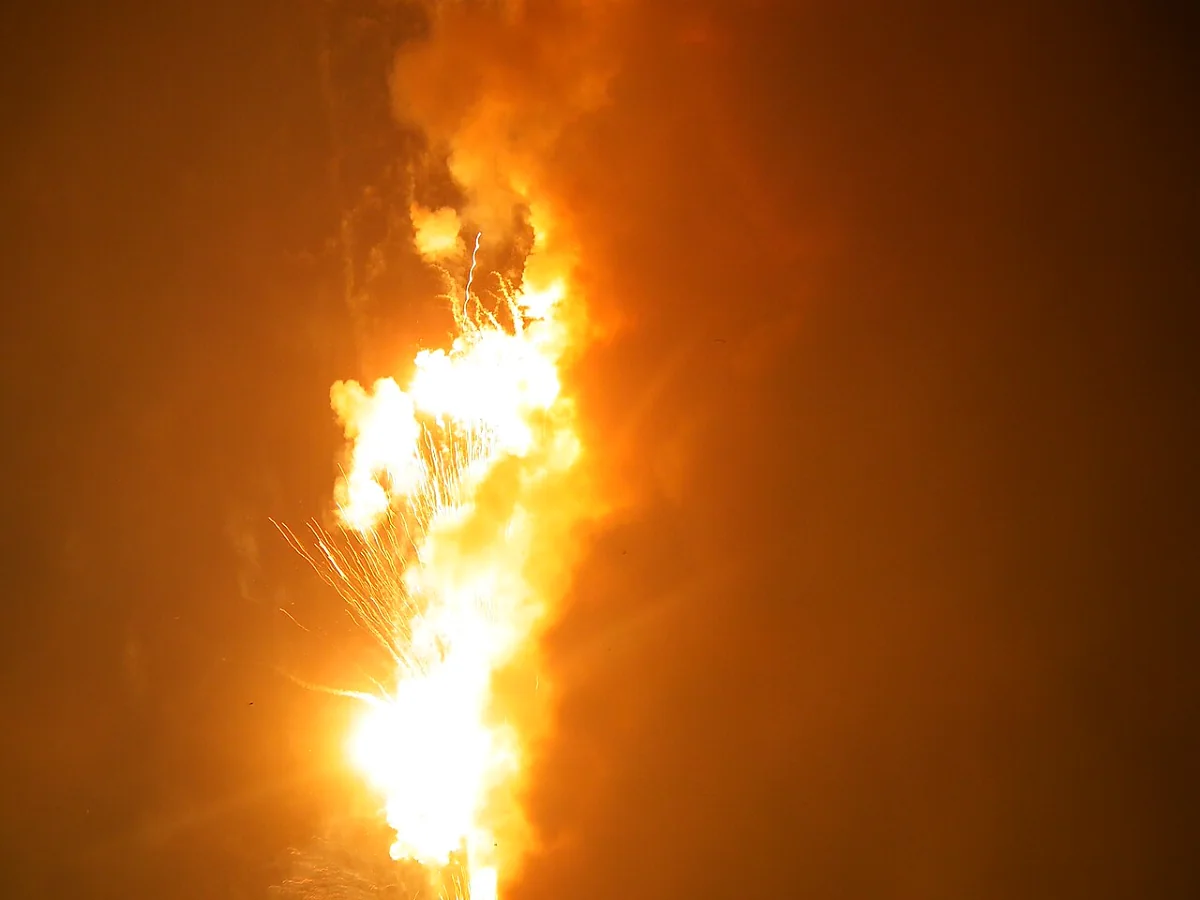
- Night and dawn: the processions are repeated by night, and at about three in the morning the great fireworks light up the Thekkinkadu Maidan.
- The farewell: the next day the goddesses of the two sides take leave of each other in the ceremony of upacharam cholli piriyal, and the date of the next year's Pooram is announced.
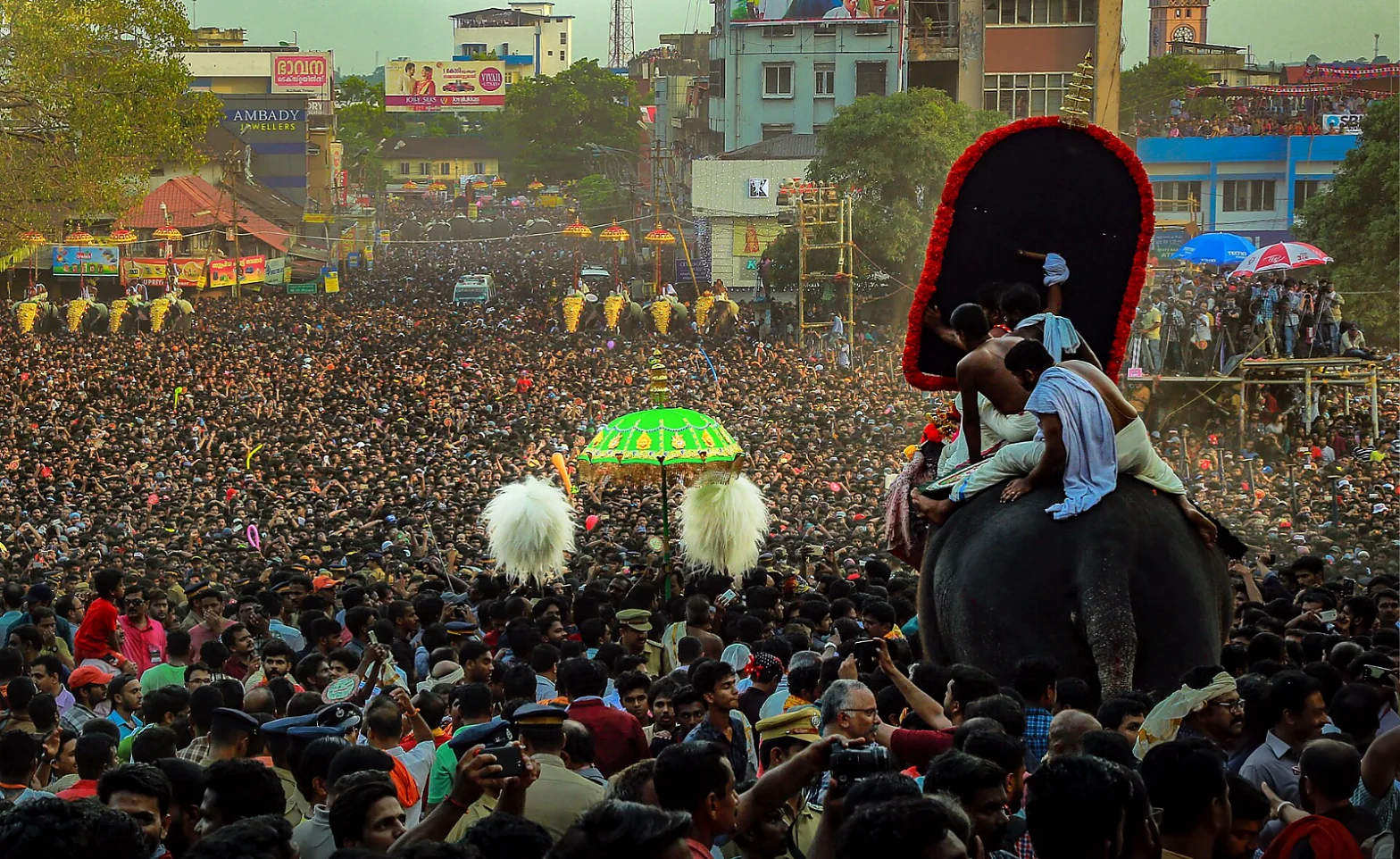
Our assessment: elephants, fireworks and the future
The Pooram today faces real questions, and it would not be honest to ignore them. The welfare of captive elephants, made to stand for long hours in the heat and noise, is a serious concern; there have been accidents with elephants and, at other festivals in Kerala, terrible fireworks disasters. Courts and the government now regulate the number and treatment of elephants, the distances crowds must keep, and the size and storage of fireworks, and each year's Pooram is preceded by negotiation between the temples, the authorities and animal-welfare groups. We think the festival's long history shows it can adapt: it was itself the creation of a reformer, and the essence of the Pooram, the gathering of the temples, the music and the generous rivalry of the two sides, does not depend on any single practice. Protecting the people, and the animals, is part of protecting the Pooram.
The cultural capital
Modern Thrissur deserves its title of 'cultural capital of Kerala'. The state academies of literature (the Kerala Sahitya Akademi), of music and drama (the Sangeetha Nataka Akademi) and of fine arts (the Lalithakala Akademi) all have their headquarters in the town, and the great school of Kathakali and the other classical arts, the Kerala Kalamandalam, founded in 1930 by the poet Vallathol Narayana Menon, is at Cheruthuruthy in the same district.
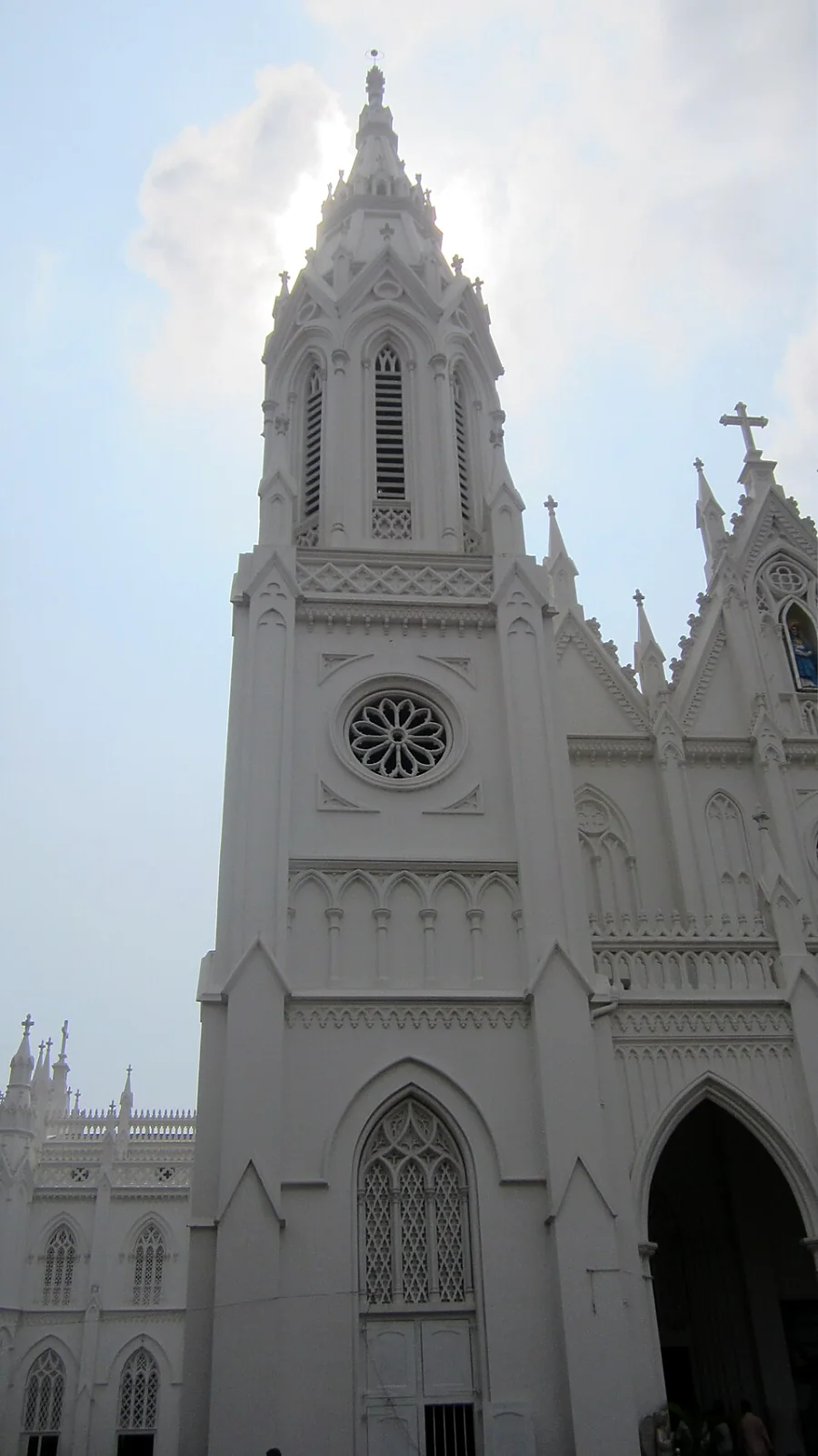
The town is also a centre of Christian Kerala. Thrissur has one of the oldest Christian communities of the region, and the Basilica of Our Lady of Dolours, the 'Puthan Pally' ('new church') of the Syro-Malabar Catholics, begun in 1929, rises above the town with a central 'Bible Tower' about 79 metres high, among the tallest church towers in Asia. Christmas in Thrissur, with its great 'Buon Natale' procession of thousands of Santa Clauses, has become a festival in its own right.
Visiting Thrissur
- Getting there: Thrissur is on the main railway line between Kochi and Kozhikode; Cochin International Airport is about 55 km away.
- Vadakkunnathan temple: entry is for Hindus only, following the temple's custom, and a traditional dress code applies; the Thekkinkadu Maidan around it is open to all.
- Thrissur Pooram: in April–May; dates vary each year with the star. Expect enormous crowds, heat and noise, and follow police instructions; book accommodation months ahead.
- Also see: the Sakthan Thampuran Palace museum, the Archaeological Museum and Art Museum, the Basilica of Our Lady of Dolours, Kerala Kalamandalam at Cheruthuruthy, and the Guruvayur temple, about 30 km away.
- From Munnar: Thrissur is about four to five hours by road from Munnar by way of Kothamangalam and Angamaly.
Read also: Muziris and Kodungallur · Thiruvananthapuram and the Padmanabhaswamy temple · Theyyam · Kozhikode and the Zamorins · Pulikali: the tiger dance of Thrissur
See it for yourself, with a local driver who knows these roads.
Book a Munnar Jeep SafariSources & further reading
- Wikipedia: Thrissur Pooram
- Wikipedia: Sakthan Thampuran
- Wikipedia: Vadakkunnathan Temple
- Edgar Thurston, Castes and Tribes of Southern India, vol. V (1909), 'Nambutiri Brahman', Project Gutenberg
- Thrissur Corporation: History
- Kerala Tourism: Vadakkumnathan Temple
- Wikipedia: Basilica of Our Lady of Dolours, Thrissur
- Wikipedia: History of Thrissur district
Figures are from the sources listed and were checked in October 2026. Park timings and road conditions change, so please confirm before you travel.