
Parumala: St Gregorios, the Boy Bishop of the Pampa, and Kerala's Great Christian Pilgrimage
On a river island in Alappuzha district lies the tomb of Geevarghese Mar Gregorios, consecrated a bishop at 28, dead at 54, and declared a saint in 1947. The life behind the legend, the miracles people tell, the round church Charles Correa built over his grave, and the perunnal that brings walkers from across Kerala every November.
Every year at the end of October, roads across central Kerala fill with walkers in white, many carrying small flags and crosses, heading for an island in the Pampa river near Mannar. They are going to Parumala, to the tomb of Geevarghese Mar Gregorios, known to Malayalis simply as Parumala Thirumeni ("the holy father of Parumala") or Kochu Thirumeni ("the little bishop"). He died in 1902. He was declared a saint by the Malankara Orthodox Church in 1947, and he is venerated by both branches of the Malankara Syrian Christian tradition, and by many Hindus and Catholics as well. This article tells his life as the records give it, notes where devotion takes over, and describes the place as it is now. (For Kerala's earlier religious history, see Buddhism in Kerala and Sabarimala.)
At a glance
- Who: St Gregorios of Parumala (Geevarghese Mar Gregorios), 15 June 1848 to 2 November 1902, metropolitan of the Malankara Church.
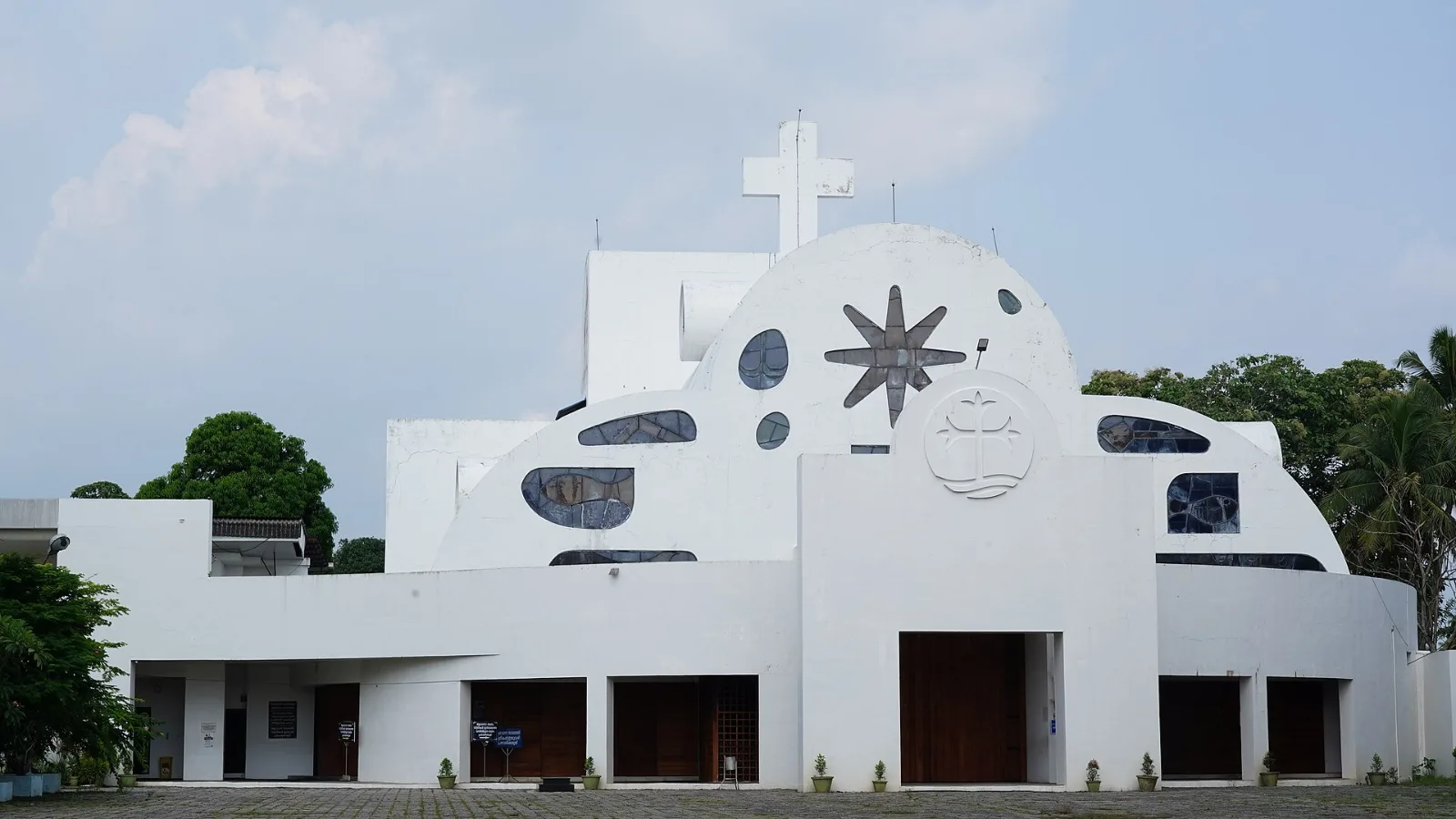
- Where: St Peter's and St Paul's Orthodox Church, Parumala, on an island in the Pampa near Mannar, Alappuzha district, about 11 km from Thiruvalla.
- Church: Malankara Orthodox Syrian Church; he is also venerated by the Jacobite Syrian Christian Church.
- Feast: the Ormaperunnal (memorial feast) from 26 October to 2 November, ending on the anniversary of his death.
- Recognised as a saint: 2 November 1947 by the Catholicos of the East; by the Syriac Orthodox Patriarch in 1987.
A boy from Mulanthuruthy
He was born Kochaippora on 15 June 1848 at Mulanthuruthy, near Kochi, into the Chathuruthy house of the Pallathetta family, the youngest of five children of Kochu Mathai and Mariam. His mother died when he was a small child, and his elder sister, also called Mariam, raised him. He learned Syriac and the liturgy from a relative, Geevarghese Malpan (a malpan is a teacher of the church). When smallpox swept the household, the teacher died; the boy caught it too and survived, which his biographers take as the first sign that he was set apart.
Deacon, priest, monk, bishop
His rise was fast even by the standards of the time:
- At nine he was made a sub-deacon (korooyo), on 26 September 1857, by Metropolitan Mathews Mar Athanasius at Karingachira.
- In 1865, aged 17, he was ordained deacon and then priest by Yuyakim Mar Koorilos, a bishop sent from the Syriac Orthodox Patriarchate.
- He withdrew to a life of prayer at Vettikkal Dayara, a monastery near Mulanthuruthy, and in 1872 was professed a ramban (monk) by Joseph Mar Dionysius.
- On 10 December 1876, at St Thomas Church, North Paravur, Patriarch Ignatius Peter IV of Antioch, who had come to Kerala in person, consecrated him one of six new metropolitans. He took the name Gregorios. He was 28, the youngest of the six, and it was then that people began to call him Kochu Thirumeni.
He was given charge of the Niranam diocese, later with Thumpamon and Kollam, at a time when the Malankara Church was divided between a reform party influenced by Anglican missionaries and those loyal to the Patriarch of Antioch. Gregorios belonged firmly to the second group.
The seminary on the island
In the 1880s Arikupurathu Mathen Karnavar gave land on Parumala, a low island formed by branches of the Pampa, to Metropolitan Joseph Mar Dionysius for a seminary to train priests. Gregorios made it his home. A small seminary building, the Azhippura, was built and blessed in 1887, and he lived and taught there, with a small chapel beside it. A stone church dedicated to Sts Peter and Paul was consecrated in 1895. The island became known for his routine: prayers from four in the morning, the canonical hours kept through the day, fasting on Wednesdays and Fridays, and visitors who came to ask his blessing, his advice or his prayer for the sick.
Jerusalem, 1895
In 1895 he made a pilgrimage to the Holy Land, leaving at the end of January and reaching Jerusalem in early April, in time to share in the Passion Week services. He wrote an account of the journey, Oorslem Yathra Vivaranam (An account of the Jerusalem journey), which is one of the earliest travel narratives in Malayalam. (Kerala Tourism calls it the first; most historians of Malayalam literature give that place to Paremmakkal Thoma Kathanar's Varthamanappusthakam, written in the 1780s.)
Schools and disciples
Gregorios is remembered as much for education as for prayer. He was behind the founding of several schools at a time when English education was opening careers to Syrian Christians, among them St Thomas School at Mulanthuruthy, St Ignatius School at Kunnamkulam and the Syrian English School at Thiruvalla, today the MGM Higher Secondary School. His students and close followers included men who shaped the next generation of the church: Vattasseril Geevarghese, later Malankara Metropolitan Dionysius VI; Kallasseril Geevarghese, later the Catholicos Baselios Geevarghese II; and Paulose Mar Athanasius and Sleeba Mar Osthathios.
Death and sainthood
He suffered from a stomach ailment for some years and died at Parumala on 2 November 1902, aged 54. He was buried the next day in the church there. Very soon people began to come to the tomb to pray, and stories of healings and answered prayers spread. On 2 November 1947 Catholicos Baselios Geevarghese II, one of his own former students, formally declared him a saint, which the Malankara Orthodox Church describes as the first canonisation of an Indian-born Christian by an Indian church. The Syriac Orthodox Patriarch Ignatius Zakka I confirmed his sainthood for the Jacobite Church in 1987.
The "first Indian saint" title needs care. It is accurate within the Orthodox tradition, but the Catholic Church canonised St Gonsalo Garcia, born at Vasai near Mumbai, in 1862, and Alphonsa of Kerala in 2008. Each tradition counts its own saints.
The miracles people tell
Devotion to Parumala Thirumeni rests on personal stories more than on official lists: a child cured, a lost job found, a family quarrel healed after a vow at the tomb. Common practices include lighting candles at the tomb, offering coins or oil, walking to Parumala, and naming children Gregorios or Geevarghese. Many visitors are Hindus; the saint's reputation as a healer and helper of the poor has always crossed community lines, and Kerala Tourism lists the church as a place of pilgrimage for all faiths. These stories are part of the living tradition and are not claims the church has investigated in each case.
The round church
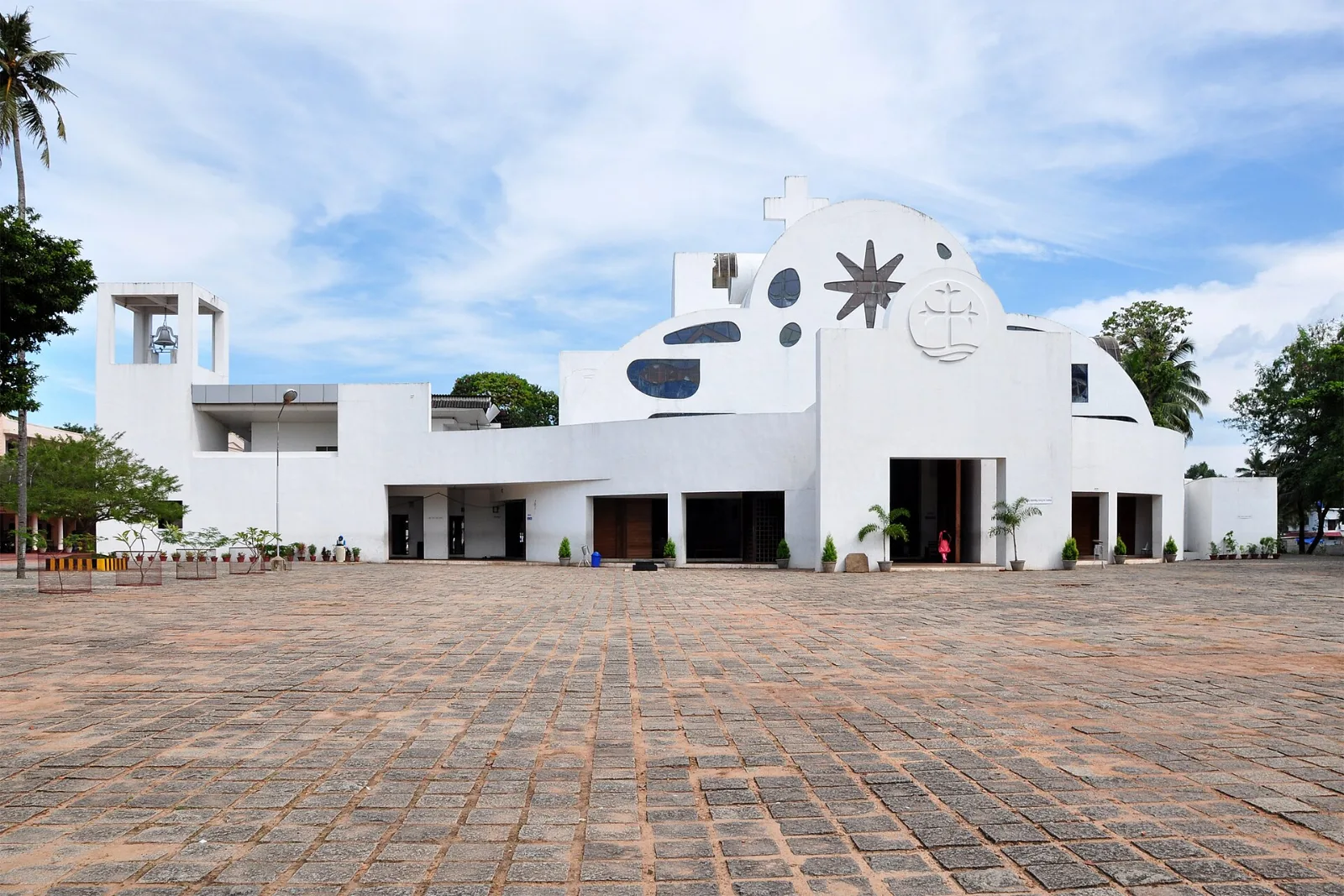
By the 1980s the 1895 church could no longer hold the crowds. The architect Charles Correa was commissioned, and his design, revised and accepted in the early 1990s, replaced the old building. The old church was taken down in 1995, its materials reused, and the new church was consecrated on 27 October 2000. Correa's plan is a large circle, about 39 metres across inside, cut by two straight walls that face each other and frame the altar and the entrance; a sloping copper-coloured roof rises over it, and the saint's tomb has its own chapel within the complex. It can hold more than 2,000 people.
The perunnal
The Ormaperunnal begins with the hoisting of the flag (kodiyettu) on 26 October. Over the following days there are liturgies, conventions, a continuous vigil of prayer, and charity programmes. From 1 November, padayatras (pilgrim walks) arrive from parishes across Kerala, some having walked for days. On the evening of 1 November there is a great procession with lamps, and on 2 November the Catholicos and bishops celebrate the Holy Qurbana, followed by a blessing and a shared meal. The roads around Mannar and Thiruvalla are closed or diverted, and in wet years, such as 2026, the approach paths through the low fields flood.
The hospital and other works
In his name the church runs the St Gregorios Medical Mission Hospital at Parumala, opened on 11 September 1975 with 50 beds and now a large hospital with cancer and heart centres; former President A. P. J. Abdul Kalam visited it in 2005. There are also schools, a home for the aged and a spirituality centre on the campus.
A church divided, a saint shared
The Malankara Syrian Christians split in 1912 into two bodies: the Malankara Orthodox Syrian Church, under its own Catholicos at Kottayam, and the Jacobite Syrian Christian Church, which remains under the Patriarch of Antioch. Ownership of parishes and churches has been fought through the courts for more than a century; the Supreme Court has ruled, in 1958, 1995 and 2017, that parishes are to be governed by the Orthodox church's 1934 constitution, and the Jacobite side continues to contest how those rulings are enforced. Parumala itself is an Orthodox church. Both churches, however, regard Gregorios as their own saint, and members of both come to his tomb.
What is certain and what is not
- Documented: his dates of birth and death, his ordinations and consecration at North Paravur in 1876, the Parumala seminary, the Jerusalem journey and travelogue, the 1947 and 1987 declarations, and the Correa church of 2000.
- Tradition: the miracles in his lifetime and at the tomb; stories of his visions and prophecies.
- Contested: the wording "first Indian saint", which depends on which church is counting; the claim that his travelogue is the first in Malayalam.
Timeline
- 1848Born at Mulanthuruthy (15 June).
- 1857Made a sub-deacon at the age of nine.
- 1865Ordained deacon and priest.
- 1872Professed a monk (ramban).
- 1876Consecrated metropolitan at North Paravur (10 December), aged 28.
- 1887The Parumala seminary building is blessed.
- 1895Pilgrimage to Jerusalem; the church of Sts Peter and Paul is consecrated.
- 1902Dies at Parumala (2 November).
- 1912The Malankara Church divides.
- 1947Declared a saint by Catholicos Baselios Geevarghese II.
- 1975St Gregorios Medical Mission Hospital opens.
- 1987Sainthood confirmed by the Syriac Orthodox Patriarch.
- 2000Charles Correa's new church is consecrated (27 October).
Questions people ask
When is the Parumala perunnal?
From 26 October to 2 November every year, with the largest crowds on 1 and 2 November.
How do I get to Parumala?
The nearest railway stations are Thiruvalla and Chengannur, each about 10 to 12 km away. The church is reached by road via Mannar or Kadapra. Kochi airport is about 120 km north, Thiruvananthapuram about 125 km south.
Can non-Christians visit?
Yes. Visitors of all faiths come to the tomb, and the church welcomes them. Dress modestly and keep silence near the tomb.
Why is he called the "little bishop"?
Because he was consecrated at 28, the youngest of the bishops made at North Paravur in 1876.
(Read also: Sabarimala, Attukal Pongala and Parassinikadavu Muthappan.)
See it for yourself, with a local driver who knows these roads.
Book a Munnar Jeep SafariSources & further reading
- Wikipedia: Geevarghese Mar Gregorios of Parumala
- Wikipedia: Parumala
- Wikipedia: Malankara Orthodox Syrian Church
- Wikipedia: Malankara Church dispute
- Wikipedia: Charles Correa
- Kerala Tourism: Parumala Church
Figures are from the sources listed and were checked in November 2026. Park timings and road conditions change, so please confirm before you travel.