
The Buddha in Kerala: A Forgotten Chapter of History
For perhaps a thousand years, Buddhist monks, monasteries and merchants were part of Kerala's life. Then the faith faded, leaving behind a handful of stone Buddhas, a royal copper plate, a legendary monastery lost to the sea, and traces in Kerala's language, learning and worship that scholars still debate. What we know, and what we only suspect.
Beside a quiet temple pond near Ambalappuzha sits a black granite figure, its legs folded, its hands in its lap, half its head broken away. Local people call him Karumadikkuttan, "the boy of Karumadi". He is the Buddha, one of a small number of stone Buddhas found across central Kerala, and he is among the clearest witnesses to a chapter of Kerala's history that was almost forgotten: the centuries when Buddhism was a living faith on the Malabar Coast.
The evidence for that chapter is scattered and incomplete, and the subject has attracted both careful scholarship and enthusiastic speculation. This article follows the evidence, and at each step it separates what historians broadly agree on from what remains a theory.
At a glance
- Earliest evidence: a pottery fragment inscribed sramana ("ascetic") in Brahmi, found at Pattanam (ancient Muziris), about the 2nd century CE; Sangam-period Tamil literature describes Buddhist centres in the Chera country.
- Key document: the Paliyam copper plates (898 CE) of the Ay king Vikramaditya Varaguna, granting land to the Buddhist vihara of Srimulavasam.
- Physical remains: stone Buddha images at Karumadi, Mavelikkara, Bharanikkavu, Maruthurkulangara, Pallikkal, Paruvassery and other places, mostly in the old Alappuzha–Kollam region, dated roughly between the 7th and 11th centuries.
- Decline: gradual, from about the 8th century, as temple-centred Hinduism grew; largely gone by about the 12th–13th centuries.
- Revival: a modern Buddhist movement among social reformers in the early 20th century.
How Buddhism came to Kerala
The Mauryan emperor Ashoka (3rd century BCE) names the Keralaputras, the Cheras, among the independent peoples beyond his borders in his second rock edict, and says that he arranged medical care for people and animals in their lands. The edict shows that Kerala was known to the Buddhist emperor, but it does not prove that Buddhism had reached it. Buddhist chronicles of Sri Lanka tell of missionaries sent south in Ashoka's time, and some traditions say they reached Kerala, but there is no direct evidence of this.
Firmer evidence comes a few centuries later. At Pattanam, the excavated site identified by many archaeologists with the great port of Muziris, a potsherd bearing the word sramana in Tamil Brahmi, dated to around the 2nd century CE, suggests the presence of Buddhist or Jain monks among the traders. Buddhism, like Jainism, travelled with merchants: monasteries were often founded on trade routes and in port towns, supported by traders' gifts.
Kerala then formed part of Tamilakam, the Tamil-speaking south, and the close links between the Malabar Coast and Sri Lanka, across a short sea, were probably the main channel of Buddhist influence. Several scholars have noted the similarity between Kerala's stone Buddhas and the Anuradhapura style of Sri Lanka.
Buddhism in the Tamil epics
The Tamil epic Manimekalai, attributed to the Buddhist poet Sittalai Sattanar, is the great literary monument of early South Indian Buddhism. It tells of Manimekalai, daughter of the hero and heroine of Silappatikaram, who becomes a Buddhist nun, and it describes Buddhist teachers and centres in the Chera capital, Vanchi. Where Vanchi stood is still debated: many Kerala historians place it at or near Kodungallur and Thiruvanchikulam, while others identify it with Karur in Tamil Nadu. Scholars also disagree on the date of the epic, placed anywhere from the 2nd to the 6th century CE, and on whether its Buddhism is of the older Theravada or the later Mahayana school.
(Read about the companion epic Silappatikaram and its Jain links in The Jains of Kerala.)
Srimulavasam: the lost monastery
The most important Buddhist centre of medieval Kerala was the vihara of Srimulavasam (Tirumulavadam), on the coast of central Kerala, probably between Ambalappuzha and Thrikkunnappuzha in today's Alappuzha district. Three kinds of evidence speak of it:
- The Paliyam copper plates (898 CE). In them, the Ay king Vikramaditya Varaguna, ruler of southern Kerala, grants land to the Buddha of Srimulavasam. The plates open with three Sanskrit verses in praise of the Buddha (called the son of Suddhodana), the Dharma and Sangha, and the bodhisattva Avalokiteshvara, and they ask a member of the Chera royal family to protect the gift. They are the clearest proof of royal patronage of Buddhism in Kerala. The same king also made gifts to Hindu temples and to the Jain shrine at Chitharal: a reminder that Kerala's kings supported several faiths at once.
- The Mushika-vamsa, an 11th-century Sanskrit chronicle of the Ezhimala kings of north Kerala, says that one of their princes protected Srimulavasam from the encroaching sea by throwing great stones into the water, and that another visited it.
- A Buddha image from Gandhara, studied by the French scholar Alfred Foucher, bears a Sanskrit label referring to the Lord of Mulavasa in the southern country (Dakshinapatha), suggesting that Srimulavasam was known far beyond Kerala as a place of pilgrimage, probably linked with Avalokiteshvara.
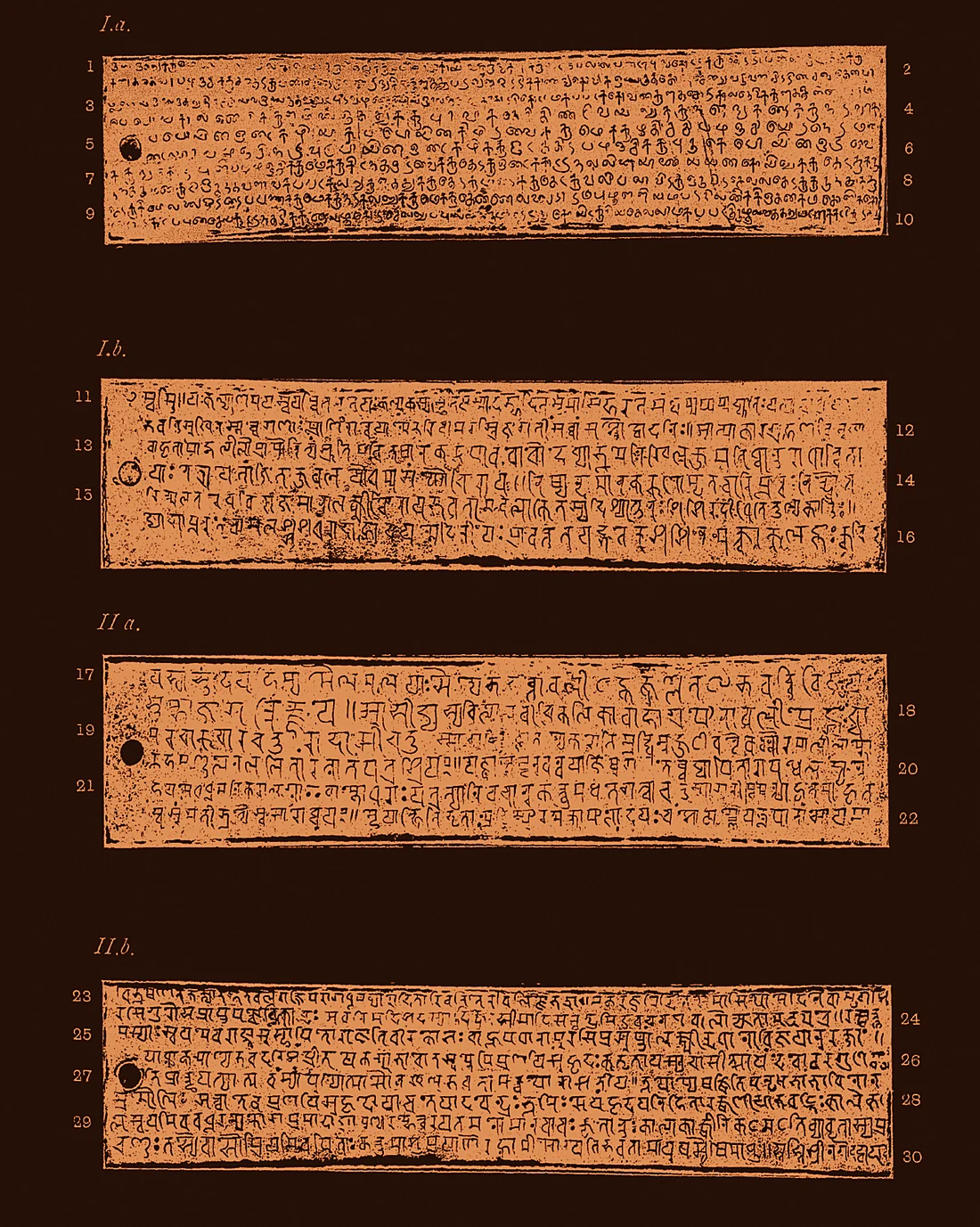
What the Paliyam plates say (in summary)
- Invocation (Sanskrit): three verses praising the Buddha, son of Suddhodana; the Dharma and the Sangha; and the compassionate bodhisattva Avalokiteshvara.
- The donor: King Vikramaditya Varaguna of the Ay dynasty, lord of Vizhinjam, issuing the grant in a dated year (898 CE, as fixed by M. G. S. Narayanan) on a Thursday in the month of Makara.
- The gift (Tamil): lands in the Ay country, with their boundaries described in detail, granted to the deity (bhattaraka) of the vihara of Srimulavasam, for its upkeep and worship.
- Protection: a prince of the Chera family is charged with protecting the gift, and the king's successors are called on to uphold it as an act of dharma.
Summary based on the published readings of the plates; they take their name from the Paliyam family of Chendamangalam, in whose possession they came to light.
No remains of Srimulavasam have ever been found. It is widely believed that the sea, which the Ezhimala princes once held back, finally swallowed it.
The stone Buddhas of central Kerala
The most tangible survivals are a group of stone Buddha images, almost all seated in meditation, found in what was once the coastal kingdom around Alappuzha and Kollam. Most were found in ponds, fields or temple grounds, often damaged, and some are still honoured by local people under other names.
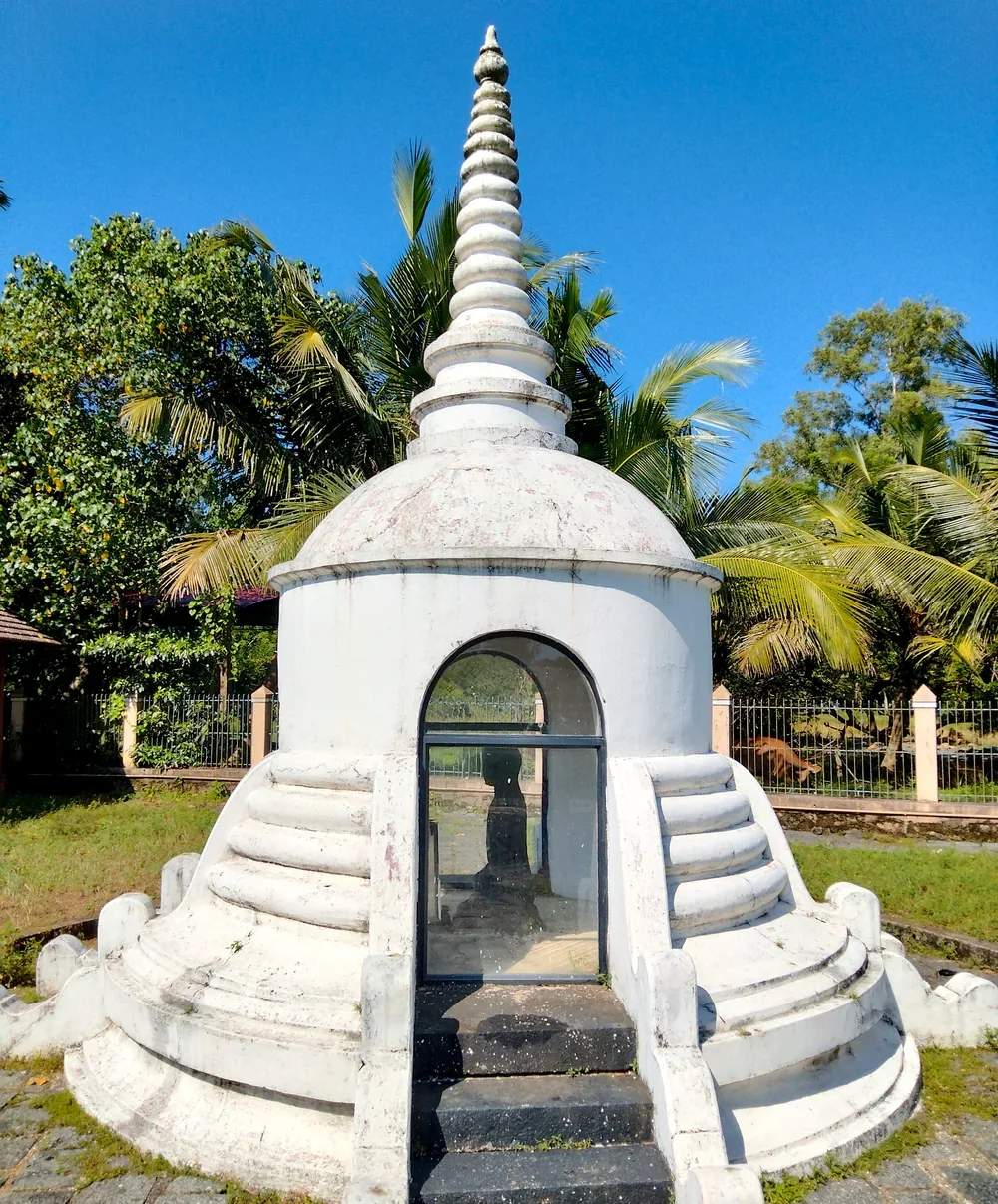
- Karumadikkuttan, at Karumadi near Ambalappuzha: a black granite seated Buddha, its head partly broken, now housed in a stupa-shaped shrine and protected by the State Archaeology Department. Local legend tells that it was damaged by an elephant.
- Mavelikkara: a seated Buddha found near the Kandiyoor area, now in a small shrine.
- Bharanikkavu (near Kayamkulam): a seated Buddha generally dated to around the 9th–10th century.
- Maruthurkulangara (near Karunagappally): a Buddha recovered from a pond, considered by some scholars among the oldest of the group.
- Pallikkal (Kollam): a headless seated Buddha, now in a museum in Thiruvananthapuram.
- Paruvassery (Thrissur district): a meditating figure at a Durga temple.
Their dates are uncertain, since few have been studied in depth, but most scholars place them between the 7th and 11th centuries. Their concentration along the central coast fits the location of Srimulavasam and the trade links with Sri Lanka.
Buddhism and Kerala's learning
Several features of traditional Kerala education are often traced to Buddhist and Jain influence.
- The word palli. In early Tamil and Malayalam, palli meant a Buddhist or Jain monastery or place of worship. It survives in pallikkoodam (school), in the ezhuthupalli, the traditional village school, and in the names of many places ending in -palli. Later, Christians and Muslims used palli for their churches and mosques. The word's history is well established; how far it shows direct Buddhist (rather than Jain) influence is debated.
- The first lesson. A tradition, recorded by some writers, holds that children in Kerala's village schools once began their lessons with the formula "Namostu Jinatam", a salutation to the Jina, a title used of both the Buddha and the Jain teachers, before it was replaced by "Hari Sri Ganapataye Namah".
- Sanskrit learning. Some traditions associate Buddhist scholars with Kerala, such as the claim that Amarasimha, author of the famous Sanskrit dictionary Amarakosha, who was probably a Buddhist, lived for a time in central Kerala. These are traditions rather than established facts.
Buddhism and Ayurveda
Kerala's classical Ayurveda is built above all on the Ashtanga Hridaya of Vagbhata (around the 7th century CE), the text studied and memorised by the Ashtavaidya families of physicians. Many scholars believe Vagbhata was a Buddhist, pointing to the text's opening invocation and its Buddhist outlook, though this is not universally accepted. Buddhist monasteries across Asia were centres of medical care and teaching, and the historian Malavika Binny has argued that Buddhism was a major force in Kerala's medical traditions between about the 6th and 11th centuries. Local tradition also connects a Buddhist physician, Bhadanta Nagarjuna, with Thiruvizha near Cherthala. The general link between Buddhism and medicine is well founded; the details of its role in Kerala remain a subject of research.
Theories of assimilation: Sastha, Ayyappan and the Goddess
As Buddhism declined, some of its sacred places, images and practices may have been absorbed into Hindu worship, as happened elsewhere in India, where the Buddha was eventually counted as an avatar of Vishnu. Several theories about Kerala are widely discussed:
- Sastha and Ayyappan. Sastha ("teacher") was a title of the Buddha in early texts, and Sastha is also the name of the Kerala deity worshipped at Sabarimala as Ayyappan. Scholars including P. C. Alexander, whose 1949 study Buddhism in Kerala remains a landmark, and M. G. S. Narayanan have pointed to parallels: the title Sastha, the open admission of all castes, the vows of austerity taken by pilgrims, and the cry of "Saranam" ("refuge"), which echoes the Buddhist "Buddham saranam gacchami". Both scholars, however, concluded that there is no conclusive proof that Sabarimala was ever a Buddhist shrine. Other historians see Ayyappan as a forest and tribal deity drawn into the Hindu fold, and many devotees reject the Buddhist theory outright.
- Temples and goddesses. It has been suggested that some Kerala temples, especially those named palli or associated with Buddhist legends, were once viharas, and that the goddess of Kodungallur is linked with Kannagi, who is revered as the goddess Pattini by Sri Lankan Buddhists. These connections are possible but mostly unproven.
- Festivals and arts. Some writers see Buddhist influence in temple processions with elephants (comparing Thrissur Pooram with Kandy's Esala Perahera), in the kettukazhcha festivals of central Kerala and in other rituals. Similarities are real, but they may also come from a shared South Asian culture rather than direct borrowing.
- Kalaripayattu. The popular story that the Buddhist monk Bodhidharma carried martial arts from South India to China's Shaolin monastery is a legend, not established history.
Why Buddhism declined
Buddhism did not vanish suddenly or through a single cause. Historians point to several processes working over centuries:
- The rise of temple Hinduism and Brahmin settlements (from about the 8th century): Brahmin villages and great temples, endowed with land by kings, became the centres of religious, economic and social life in Kerala, and drew royal patronage away from Buddhist and Jain institutions.
- The Bhakti movement: the devotional poet-saints of the Tamil country, the Shaiva Nayanars and Vaishnava Alvars, preached a passionate personal devotion and often attacked Buddhism and Jainism. Two of them, Cheraman Perumal Nayanar and Kulasekhara Alvar, are traditionally identified with Chera kings.
- Philosophy: tradition credits Adi Shankara, born at Kalady in Kerala, with defeating Buddhist philosophers in debate. Historians caution that his role is often exaggerated, though his Advaita philosophy did absorb some Buddhist ideas while opposing Buddhist doctrine.
- Loss of trade and patronage: as trade patterns shifted and kings turned to temple-based Hinduism, the merchant communities and royal grants that supported monasteries declined.
- Assimilation: many Buddhist practices, places and perhaps images were gradually absorbed into Hindu worship, so that Buddhism faded into the wider religious culture rather than being destroyed.
The 13th-century Chinese writer Zhao Rukuo described the people of Kollam as devout Buddhists, but historians such as K. A. Nilakanta Sastri considered this a confusion with Hindu practice. By then, Buddhism as an organised faith had probably all but disappeared from Kerala.
The modern revival
In the late 19th and early 20th centuries, as reformers challenged caste discrimination, some of them looked to Buddhism as a faith of equality and reason. The poet Kumaran Asan wrote celebrated poems on Buddhist themes, such as Chandalabhikshuki, Karuna and Sri Buddha Charitham. Reformers including the journalist C. Krishnan of the newspaper Mitavadi promoted Buddhism, and a small Buddhist movement grew among communities that had suffered caste exclusion. Interest in Kerala's Buddhist past has continued to grow, and the Buddha statues of Alappuzha and Kollam now draw visitors, scholars and pilgrims, including from Sri Lanka.
The historians
- P. C. Alexander, Buddhism in Kerala (1949): the first full study, arguing for wide Buddhist influence absorbed into Kerala Hinduism.
- Elamkulam P. N. Kunjan Pillai: pioneering studies of medieval Kerala, including the Paliyam plates.
- M. G. S. Narayanan: dated the Paliyam plates to 898 CE and studied the Perumals of Kerala and the Ayyappan question.
- Kesavan Veluthat, Rajan Gurukkal and Raghava Varier: studies of the early medieval Kerala state, temples and religious patronage.
- S. N. Sadasivan and Ajay Sekher: works emphasising Buddhist influence on Kerala's culture and on caste history; some of their interpretations are debated by other historians.
- Malavika Binny: research on Buddhism and medicine in Kerala.
Visiting Kerala's Buddhist heritage
- Karumadikkuttan, Karumadi, near Ambalappuzha, Alappuzha district.
- The Buddha statue at Mavelikkara, Alappuzha district.
- Bharanikkavu Buddha, near Kayamkulam.
- The Napier Museum and other museums in Thiruvananthapuram.
(Read about the other faiths that came, flourished and faded in Kerala: the Jains of Kerala and the Jews of Kerala, and about the region's places of worship in Munnar's churches, temples and mosques.)
A note on the evidence
- The history of Buddhism in Kerala rests on a small body of firm evidence: the Paliyam copper plates, the Mushika-vamsa, a few inscriptions and archaeological finds, the Tamil epics and the surviving Buddha images. Much else, including the Buddhist origins of particular temples, deities and festivals, is inference or tradition, and is contested among historians. We have tried to make clear which is which.
- If you have photographs or knowledge of Buddhist remains in Kerala, please contact us.
See it for yourself, with a local driver who knows these roads.
Book a Munnar Jeep SafariSources & further reading
- Wikipedia: Buddhism in Kerala
- Wikipedia: Srimulavasa Vihara
- Wikipedia: Vikramaditya Varaguna (Paliyam copper plates)
- Wikipedia: Lists of Buddhist sites and traditions in Kerala
- Onmanorama (May 2021): How Kerala's Buddhist heritage and legacy live on
- Onmanorama (2018): Karumadikuttan and Buddhism in Alappuzha
- The Week (Jan 2019): Sabarimala, historians and the myth
- Way of Bodhi: Sreemoolavasam, an ancient Buddhist monastery in Kerala
Figures are from the sources listed and were checked in October 2026. Park timings and road conditions change, so please confirm before you travel.