
Lakshadweep, Part 7: The Islands Since 1956 – Administration, Tuna, Tourism and Reefs
Since 1956 the islands have been governed from Delhi through an appointed administrator, with one elected MP and village panchayats. Tuna landings have grown thirtyfold, tourists are arriving in numbers never seen before, and a fibre-optic cable now links every inhabited island to Kochi. At the same time, land laws, schooling, shipping and the islands' fragile reefs have become matters of open dispute.
The last part of this series covers the islands from the day they became a separate territory to the present. It is the part where sources are most plentiful and most partisan: much of what has happened since 2020 is the subject of court cases and political argument, and this article tries to set out what each side says and what the courts have decided, without taking a side. Figures are the latest we could find in November 2026. (Part 6 covers music, dance and food.)
At a glance
- Status: Union Territory since 1 November 1956; one district; capital Kavaratti.
- Government: an administrator appointed by the President; no legislature; one Lok Sabha seat, reserved for Scheduled Tribes.
- Courts: under the jurisdiction of the Kerala High Court.
- People: 64,473 at the 2011 census, almost all native islanders listed as a Scheduled Tribe.
- Economy: government jobs, fishing (16,891 tonnes of fish in 2024–25), coconut and a fast-growing tourism sector.
A territory is made, 1956–1973
When India reorganised its states on linguistic lines on 1 November 1956, the islands were taken out of the Madras districts of Malabar and South Canara and joined into a single centrally ruled territory, the Laccadive, Minicoy and Amindivi Islands. For its first years it was run from Kozhikode on the mainland; in 1964 the administrator's seat moved to Kavaratti. On 1 November 1973 the territory was renamed Lakshadweep.
The decades that followed brought the services the islands had never had. The fisheries department, set up in 1959, mechanised the tuna fleet (Part 4). Schools and hospitals were built on every inhabited island, and by 2011 literacy stood at about 92%. Diesel power, desalination plants and helicopter ambulances followed, and an airstrip opened on Agatti. Most islanders took government jobs or went to Kerala to study and work, and the islands became tightly bound to Kochi and Kozhikode.
How the islands are governed
Lakshadweep has no elected assembly. Executive power lies with an administrator appointed by the President of India, usually a senior civil servant, and laws for the territory are made as presidential regulations under Article 240 of the Constitution. Islanders elect one Member of Parliament. P. M. Sayeed of the Congress held the seat for ten consecutive terms, from 1967 to 2004; his son Muhammed Hamdullah Sayeed won it in 2009, aged 26; Mohammed Faizal of the Nationalist Congress Party won in 2014 and 2019; and in 2024 Hamdullah Sayeed won it back with 25,726 votes to Faizal's 23,079, on a turnout of about 84%.
Below that sit panchayats: village panchayats on each island and a district panchayat. A new Lakshadweep Panchayat Regulation replaced the 1994 law in 2022. The elected committees' terms ended in December 2022, and the administration says elections could not be held because of a case pending in the Kerala High Court; since then the panchayats have been run by special officers appointed by the administrator.
Since 2020: reforms and resistance
In December 2020 Praful Khoda Patel, a former Gujarat minister and the administrator of Dadra and Nagar Haveli and Daman and Diu, was given additional charge of Lakshadweep. Most of his predecessors had been career civil servants. Within months his administration published a set of draft regulations:
- a Lakshadweep Development Authority Regulation, creating planning authorities with wide powers to plan areas, acquire land and relocate residents;
- a Prevention of Anti-Social Activities Regulation, allowing preventive detention for up to a year;
- an Animal Preservation Regulation, banning the slaughter of cattle and the sale of beef;
- a Panchayat Regulation that would bar people with more than two children from contesting panchayat elections.
Alongside these, the administration closed government dairy farms, removed meat from school midday meals, allowed liquor permits for some tourist resorts and demolished fishermen's sheds that it said violated coastal zone rules.
The administration's case was that the islands had stagnated. Patel and the then Collector, S. Asker Ali, said Lakshadweep had lagged in development for decades and could prosper through tourism as the Maldives had; that planned development needed clear land-use powers; and that the detention law was a security measure. Supporters pointed out that a Planning Commission report of 2007 had itself compared Lakshadweep unfavourably with the Maldives.
Opponents – the island's MP and almost every local party, including members of the BJP's own youth wing who resigned in protest – said the drafts had been prepared without consulting elected representatives, threatened islanders' small landholdings, ignored the territory's fragile ecology and an existing Integrated Island Management Plan, and targeted islanders' diet and way of life in a territory with very little crime. Several former administrators criticised the measures publicly. Protests under the banner of the Save Lakshadweep Forum, including hunger strikes and a "black day" in June 2021, drew national attention, and the hashtag #SaveLakshadweep trended across India.
The courts have ruled both ways. In September 2023 the Supreme Court upheld the decisions on school meals and dairy farms, holding that menus were a policy matter and noting that eggs and fish remained on the menu. In June 2025 the Kerala High Court stayed the order replacing Arabic and Mahal with Hindi in schools (Part 5).
Land: the 2026 planning law and pandaram land
The land question returned in 2026. On 28 July 2026 the President signed the Lakshadweep Town and Country Planning and Development Regulation, 2026, which came into force the next day. It provides for regional plans, master plans, town planning and land-pooling schemes and planning authorities across the territory, and draft rules under it were published for comment in September 2026. The administration presents it as the basis for planned infrastructure, tourism and environmental protection. Critics, including island groups and an open letter to the National Commission for Scheduled Tribes, say it concentrates control over islanders' land in appointed officials and was issued without the consultation with the Commission that the Constitution requires for measures affecting Scheduled Tribes.
A week later, on 5 August 2026, the Kerala High Court decided a long-running dispute over pandaram land – land once held from the ruler (Part 4) and recorded as government land, but occupied and planted by island families for generations. The court held that families holding such land as cowledars when the 1965 land regulation came into force are its owners; quashed orders resuming such land, after the administration had moved in 2024 to take possession of pandaram land while paying only for trees and buildings; held unconstitutional a 2023 amendment that deleted a 2020 provision validating transfers of such land to Scheduled Tribe islanders; and ordered occupancy rights to be granted within six to eight months. The ruling settles ownership but not how the land may be used, which falls under the new planning law.
On 11 July 2025 the administration issued a notification proposing to acquire the whole of Bitra, the smallest inhabited island (about 0.1 sq km, with a few hundred residents), for transfer to defence and strategic agencies, citing its strategic location and the difficulty of administering civilian settlement there. Residents and the MP opposed it, and island groups said they would go to court. We have not found a final decision.
A strategic frontier
The islands' position on the sea lanes of the Arabian Sea has brought a growing military presence. The Navy has a base at Kavaratti, INS Dweeprakshak, and on 6 March 2024 commissioned a second, INS Jatayu, on Minicoy, close to the Maldives. A new dual-use airfield on Minicoy, able to take military and civilian aircraft, has been planned.
Getting there: ships, planes and a cable
For most islanders the mainland means a ship from Kochi. The passenger fleet of seven ships run for the administration has repeatedly fallen short: in 2022 and again in 2025 only two or three ships were in service while others were under repair, thousands of islanders were left waiting in Kochi for passage home, and protests followed. In June 2025 the administration raised fares, which opposition politicians asked it to roll back. Inter-island travel relies on high-speed passenger craft. Agatti has the territory's only airport, with flights to Kochi.
Communications changed overnight in January 2024, when the Kochi–Lakshadweep Islands Submarine Optical Fibre Connection was opened: 1,868 km of undersea cable linking Kochi to eleven islands, built for about Rs 1,072 crore and raising the islands' bandwidth from 1.7 Gbps to 200 Gbps.
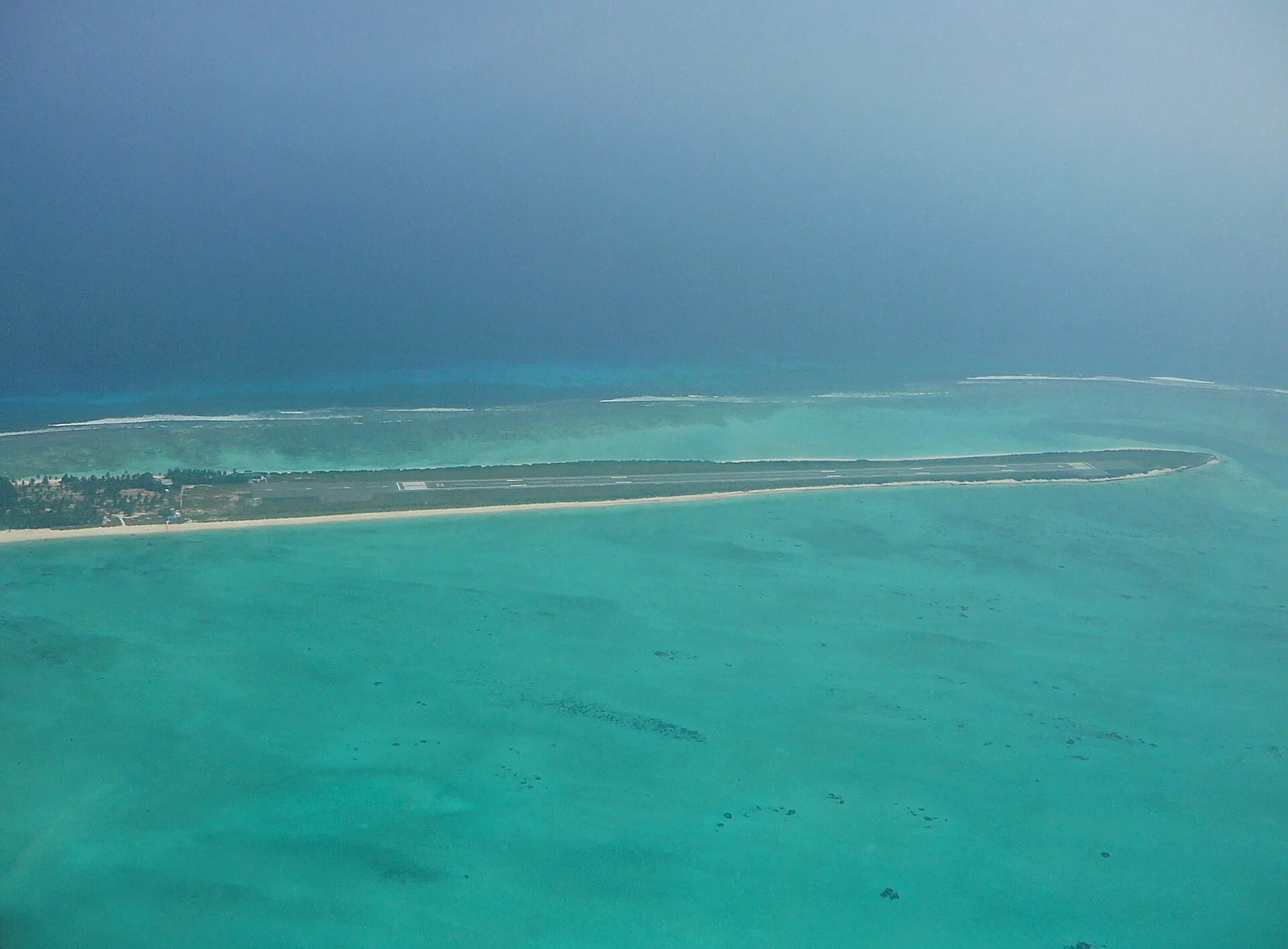
Tuna today
Fish landings have grown from about 500 tonnes a year in the 1950s to 1,760 tonnes of tuna in 1980 and 16,891 tonnes of fish in 2024–25. Most of it is still caught by pole and line from small boats, the method Minicoy taught the other islands (Part 4), and much is dried into mas. The fishery is widely praised as selective and low in bycatch, but it depends on small bait fish caught in the lagoons, and researchers working with island fishers have reported falling bait stocks and a shift towards less regulated fishing on the reefs.
The Union and island governments now want far more. A first investors' meet in Kavaratti in December 2025 drew proposals worth about Rs 519 crore, and in July 2026 the administration drew up a five-year roadmap, prepared with the Central Marine Fisheries Research Institute, to raise tuna production to 50,000 tonnes with deep-sea vessels, cold storage, processing and seaweed farming; officials put the islands' potential at 100,000 tonnes. Supporters see jobs and exports; conservationists warn that industrial fishing could undermine the low-impact pole-and-line fishery that gives island tuna its reputation.
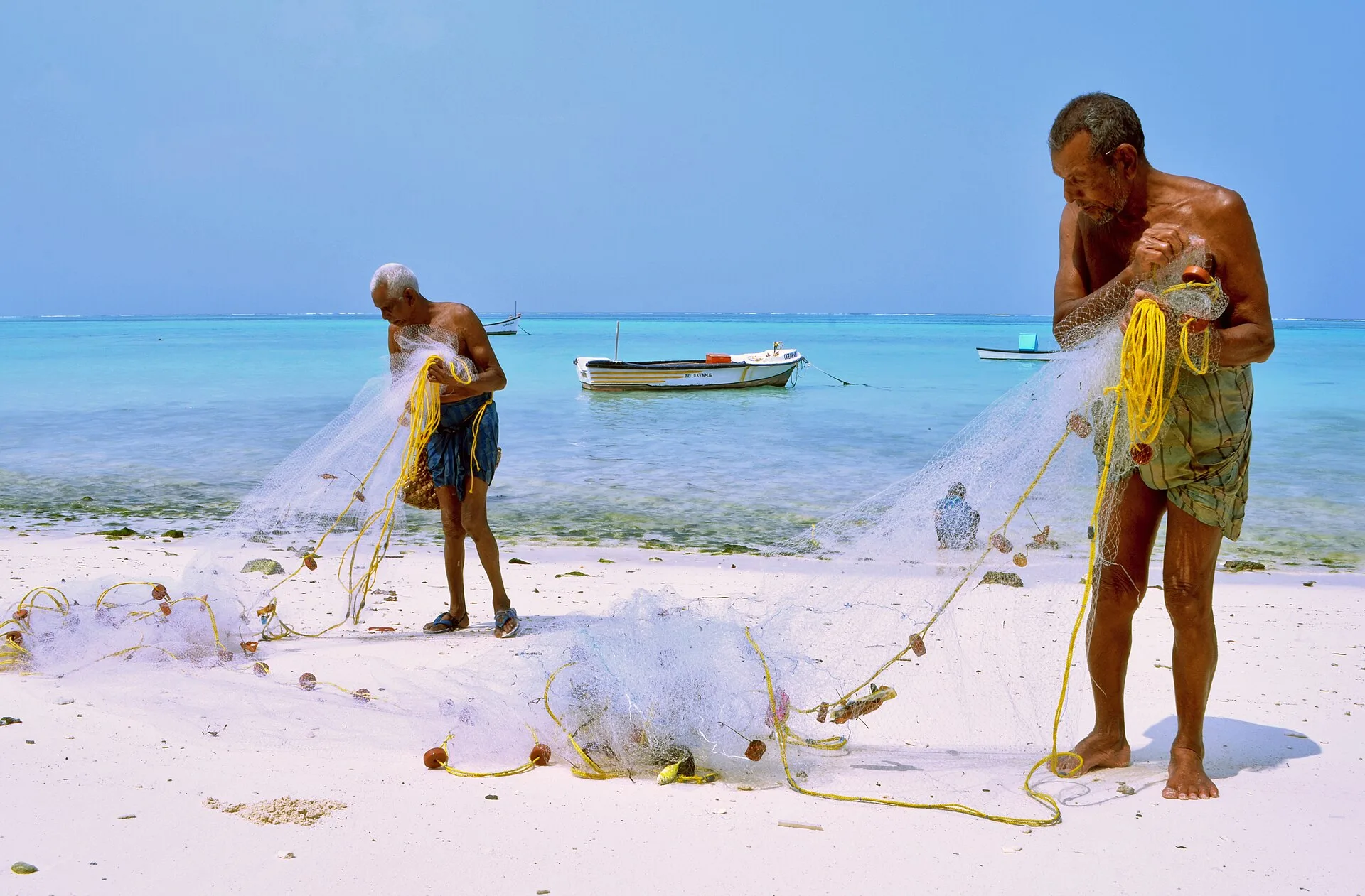
Tourism
Tourism was long kept small. Visitors need an entry permit, most stay on a few islands, and much of the accommodation was run by the administration's own tourism society. Then, on 2–3 January 2024, Prime Minister Narendra Modi visited Kavaratti and posted pictures of himself snorkelling. Remarks by three Maldivian deputy ministers mocking the visit led to their suspension, a diplomatic row and calls in India to boycott the Maldives, and online searches for Lakshadweep hit an all-time high. Official figures show domestic tourist visits rising from 6,985 in 2019 to 45,796 in 2023 and 67,430 in 2024, with 898 foreign visitors. New resorts and a tent city on Bangaram and Thinnakara have been built or planned. Islanders and scientists have asked how many visitors islands with so little land and fresh water can take, and some residents have challenged construction on land they claim.
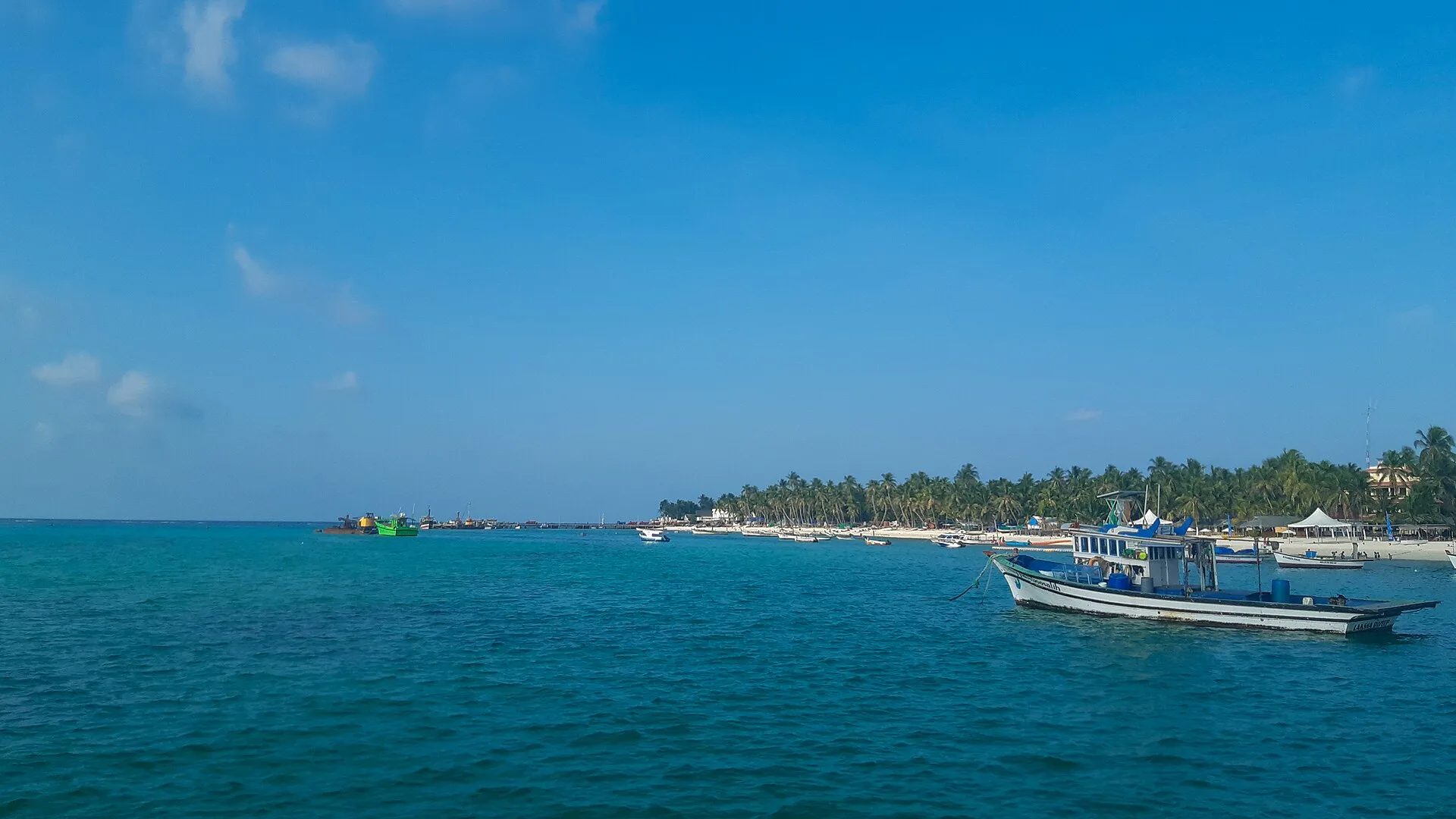
Reefs under heat
Part 1 described how live coral cover on three studied atolls fell by about half between 1998 and 2022. Since then it has got worse. A marine heatwave that began in late October 2023 caused mass bleaching in 2024: researchers recorded sea temperatures of 32.2°C and heat stress of 9.2 degree heating weeks, the highest ever measured in Lakshadweep, and even giant clams and anemones bleached completely. Because the reefs protect the islands' freshwater lenses and break the waves (Part 1), their health is not just a matter for divers. Scientists stress that reefs can recover if given enough years between heatwaves, which depends on global warming as much as on local management.
What is certain and what is not
- Well documented: the 1956, 1964 and 1973 milestones; election results; the 2021 drafts and protests; the 2023 Supreme Court ruling; the 2026 planning regulation and High Court judgment; tourism and fish landing figures; the 2024 bleaching.
- Disputed: whether the reforms since 2020 are overdue development or a threat to islanders' land and autonomy – the core of the current political argument.
- Unresolved as of November 2026: panchayat elections; the Bitra acquisition; the language case; rules under the 2026 planning law; how far tuna production can grow sustainably.
- Takeaway: the old constants still hold. Land is scarce, fresh water fragile and the mainland far away, and whoever controls land, ships and the sea controls island life – as the coir monopoly did two centuries ago.
Timeline
- 1 Nov 1956The Laccadive, Minicoy and Amindivi Islands become a Union Territory.
- 1959The fisheries department is set up.
- 1964The administrator's headquarters moves from Kozhikode to Kavaratti.
- 1 Nov 1973The territory is renamed Lakshadweep.
- 1979Prohibition regulation bans liquor.
- Dec 2020Praful Khoda Patel takes charge as administrator.
- 2021Draft regulations and the Save Lakshadweep protests.
- Dec 2022Panchayat terms end; special officers take over.
- Sept 2023Supreme Court upholds the school meal and dairy decisions.
- Jan 2024Prime Minister's visit; Maldives row; undersea cable opens.
- Mar 2024INS Jatayu commissioned on Minicoy.
- 2024Record marine heatwave and mass coral bleaching.
- July 2025Notification to acquire Bitra.
- 29 July 2026Town and Country Planning and Development Regulation in force.
- 5 Aug 2026Kerala High Court rules on pandaram land.
Questions people ask
Who governs Lakshadweep?
An administrator appointed by the President of India. Islanders elect one MP and, normally, village and district panchayats.
Why is Lakshadweep not a state?
It is too small – about 32 sq km and 65,000 people – and since 1956 it has been governed directly by the Union government.
Do you need a permit to visit Lakshadweep?
Yes. Visitors who are not islanders need an entry permit from the administration.
What was the Save Lakshadweep campaign?
Protests from 2021 by island parties and residents against draft regulations and other measures introduced by the administrator, which the administration defended as development reforms.
(This is the final part of the series. Previous parts: 1 – geography, 2 – early history, 3 – society, 4 – trade and colonial rule, 5 – languages, 6 – music, dance and food.)
See it for yourself, with a local driver who knows these roads.
Book a Munnar Jeep SafariSources & further reading
- Wikipedia: Lakshadweep
- Wikipedia: List of administrators of Lakshadweep
- Wikipedia: Lakshadweep Lok Sabha constituency
- Kerala Kaumudi: Hamdullah Sayeed wins back Lakshadweep (2024)
- Lakshadweep Administration: Directorate of Panchayats
- Down To Earth: Lakshadweep, a plan for the worse (2021)
- ThePrint: 'Want to develop Lakshadweep like Maldives' – Administrator defends draft land law (2021)
- Scroll: Lakshadweep collector says new laws are for development, security (2021)
- Deccan Herald: Lakshadweep, the islands caught in a political storm (2021)
- Bar & Bench: Supreme Court upholds Lakshadweep decision on mid-day meals and dairy farms (2023)
- TeamLease RegTech: Lakshadweep Town and Country Planning and Development Regulation, 2026
- Countercurrents: Home Ministry should seek the views of NCST on Lakshadweep regulations (2026)
- Business Standard: Who owns Lakshadweep? HC ruling settles a key pandaram land dispute (2026)
- Onmanorama: Bitra island eviction concerns (2025)
- ThePrint: Naval base INS Jatayu commissioned (2024)
- Scroll: Lakshadweep transportation crisis (2022)
- Deshabhimani: Lakshadweep travel becomes costlier (2025)
- PIB: PM inaugurates projects in Kavaratti, including the KLI-SOFC cable (2024)
- Indian Infrastructure: Kochi–Lakshadweep submarine optical fibre connection (2024)
- Lakshadweep Administration: Fisheries
- Dakshin Foundation: Lakshadweep fisheries timeline
- Mongabay India: Pole-and-line fishing faces new challenges as push for tuna exports rises (2025)
- New Kerala: Lakshadweep aims to double tuna production to 50,000 tonnes (2026)
- Free Press Journal: Lakshadweep investors' meet attracts over Rs 500 crore proposals (2025)
- Ministry of Tourism: Rajya Sabha unstarred question 2196 (2025), state-wise tourist visits 2019–2024
- Business Standard: Maldives tourism dips after comments on PM Modi (2024)
- South First: Locals protest tent city amid environmental concerns
- PIB: Marine heatwaves, intense coral bleaching recorded in Lakshadweep (2024)
- Galaxea: Impact of thermal bleaching events on non-scleractinian reef inhabitants of the Lakshadweep atolls
- Down To Earth: Lakshadweep's coral reefs have halved in 24 years
Figures are from the sources listed and were checked in November 2026. Park timings and road conditions change, so please confirm before you travel.