
Lakshadweep, Part 6: Kolkali, Lava and Mas – Music, Dance and Food
Stick dances and shield dances brought from Malabar, wedding songs led by women, and in Minicoy drummers in red trousers, women beating time on water pots and painted race boats. At the table: coconut, rice from the mainland and tuna in every form, from fresh curry to the hard dried mas that once fed sailors across the Indian Ocean.
Island culture follows the same fault line as island speech. The northern and central islands share their music and dance with the Mappila Muslims of the Malabar coast, adapted over centuries. Minicoy shares its with the Maldives. Food is more uniform: coconut, imported rice and fish everywhere, with tuna above all. This part of the series looks at all three. Written records are thin, and much of what is published comes from tourism and food writing, so the sources are flagged as we go. (Part 5 covers languages.)
At a glance
- Main dances (nine islands): Kolkali (stick dance) and Parichakali (shield dance), performed by men.
- Weddings: Oppana, songs led by a lead singer with a chorus of women.
- Minicoy: Lava, Thaara, Dandi, Fuli and Bandiya, and the jahadhoni race boats.
- Staples: coconut, rice (always imported), tuna, fresh and dried.
- Alcohol: banned in the territory under a 1979 regulation, with limited permits for tourist resorts.
Kolkali and Parichakali
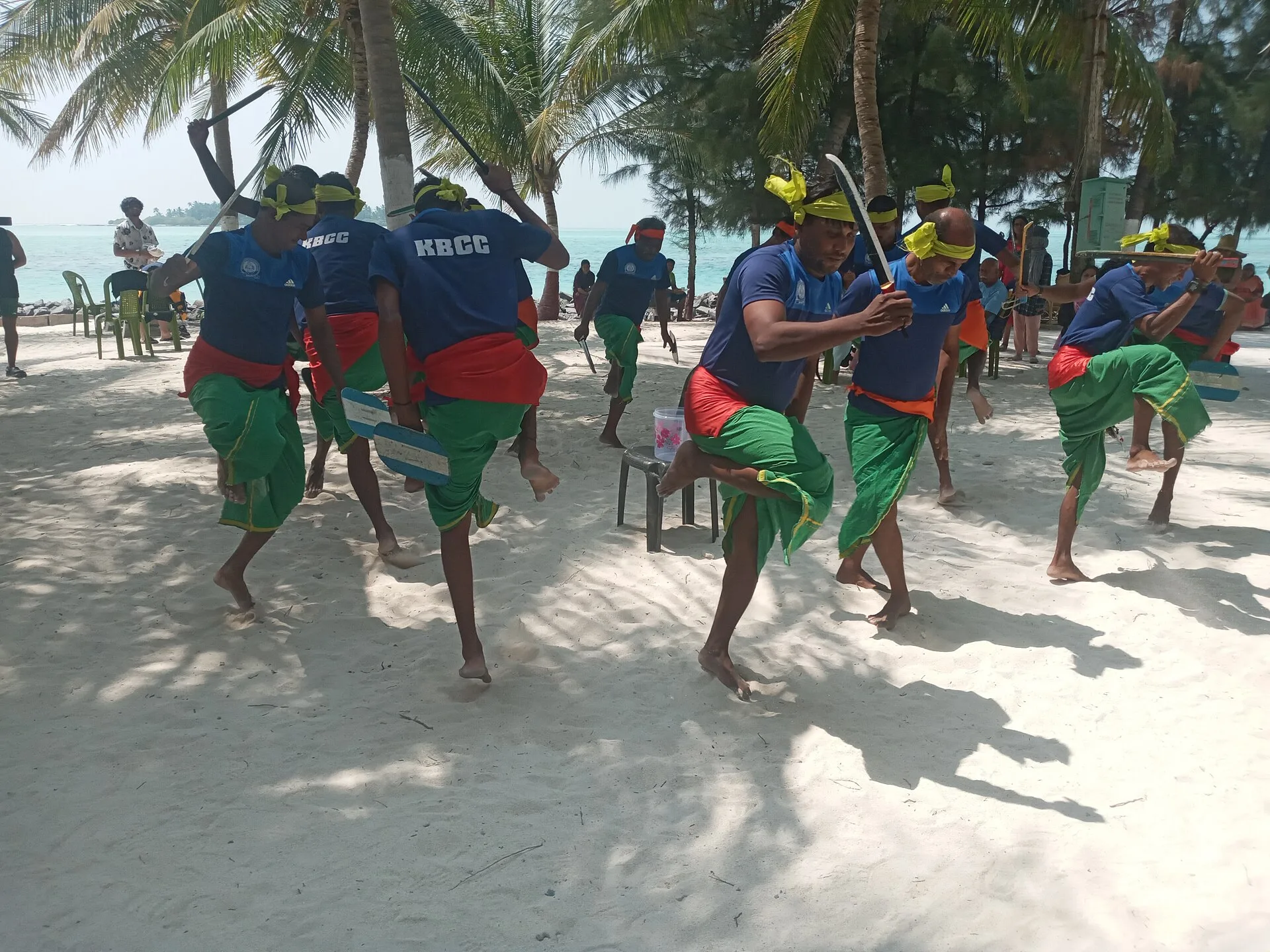
The administration names Kolkali and Parichakali as the two most popular folk art forms in the territory, everywhere except Minicoy. Both came from the mainland.
Kolkali, "stick play", is danced by a group of men moving in a circle, each with a short wooden stick, striking their own sticks and their neighbours' in time with a song. The circle widens and tightens, the tempo rises, and the dance ends at speed. In Kerala the Mappila form of Kolkali is described as a Muslim adaptation of an older stick dance, Kolattam, in which devotional songs were replaced with Islamic ones; it usually begins with prayers to God, the Prophet and Sufi saints. Its footwork and postures are often traced to kalarippayattu, Kerala's martial art. Each island has several Kolkali groups, and the dance is a fixture of festivals and weddings.
Parichakali takes its name from paricha, a shield. Dancers carry a shield in one hand and a stick or sword in the other and strike stick against stick or stick against shield, again following the movements of martial training. On the mainland a version called Parichamuttukali is best known among Kerala's Christians, but shield dances were shared by several communities; on the islands it is danced by men alongside Kolkali.
Songs: Oppana, ballads and devotions
Oppana is the music of weddings. The administration describes it as a song sung by a lead singer and taken up by a group of women. In Kerala, where it is one of the best-known Mappila art forms, the women sing and clap around the seated bride.
The wider family of Mappila songs – devotional praise songs, love songs, wedding songs and the long narrative padappattu (battle songs) – were traditionally written in Arabi-Malayalam, the script described in Part 5. Island ballads sung at family occasions are said to tell local stories as well, from the coming of Ubaidullah to the raids of the Portuguese described in Part 4; such accounts come mostly from tourism sources and the songs themselves are poorly recorded.
Religious gatherings punctuate the year. Accounts of island custom describe Moulood (recitations in praise of the Prophet) and Ratheeb (a Sufi litany, sung and chanted by a group) being held before new undertakings such as building a house or launching an odam. The administration lists the main public festivals as Independence Day and Republic Day, the Prophet's birthday (Milad-un-Nabi), Id-ul-Fitr, Bakrid and Muharram.
A younger generation is collecting what is left. Fulliparava, a band of three musicians from Kiltan formed in 2022 and named after a spotted lagoon fish, sets island folk songs and proverbs to new arrangements while keeping the old words. Many of the songs are about the sea: fishermen in heavy waves and the women at home watching the wind. One, Omanappoovu, is about a beautiful island girl taken away to Kannur as a bride by the king who then ruled the islands – an echo of the Arakkal rule described in Part 4. The band says these songs and proverbs are disappearing and that it collects them from elders and old books.
Minicoy: Lava, Thaara and Bandiya
Minicoy's culture is Maldivian, and its dances are Maldivian too. The administration lists five: Lava, Thaara, Dandi, Fuli and Bandiya.
- Lava is the island's signature dance, performed by men to drums and songs. Dancers start in lines, singly or in pairs, and close into a circle as the rhythm builds. A description reproduced from a Maldivian heritage site gives the costume as red trousers, a white waist cloth with a smaller scarf of a contrasting colour, and black-and-white headgear (bolufeyli) or a fez, and compares the dance to a Maldivian drum dance.
- Thaara takes its name from the tambourine-like frame drum. In the Maldives, Thaara is performed by men seated in two facing rows, is semi-religious, and was traditionally sung in Arabic; Maldivian sources say it was introduced by Arabs from the Gulf in the 17th century.
- Bandiya is danced by women, who sing while tapping metal water pots with their fingertips. The Maldives' own tourism board traces the Maldivian Bandiyaa jehun back to Maliku (Minicoy). Its origins are otherwise obscure, and popular claims that it began as an Indian pot dance are speculation.
- Dandi and Fuli are listed among Minicoy's dances but are hardly described in print.
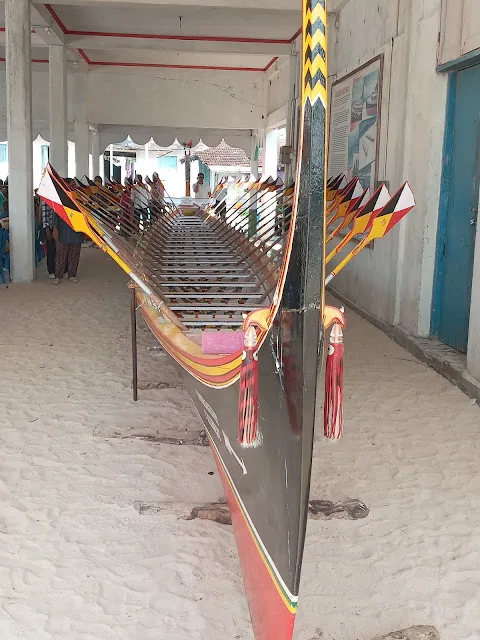
Minicoy's villages, described in Part 3, are the units that perform. Each owns long, brightly painted race boats called jahadhoni, rowed by village crews in races, to welcome important visitors and for the island's annual picnic to the islet of Viringili at the southern end of the lagoon. Houses are painted in bright colours and many have a decorated wooden swing cot, and model boats are a local craft. By 2013 the administration's tourism department was staging a National Minicoy Festival, with boat races and dances as its main events.
What the islands eat
The island diet was shaped by the limits described in Part 1: coral sand, no rice fields and a long monsoon. Coconut is in almost everything – grated, as milk, as oil and as jaggery made from palm sap – and rice has always been brought from the mainland. Fish supplies the protein, and in Lakshadweep fish mostly means tuna. Cooking on the nine islands is close to Malabar's, with coconut oil and curry leaves; Minicoy's is closer to Maldivian cooking, which rests on the same three things: fish, coconut and starch.
Mas: the islands' preserved tuna
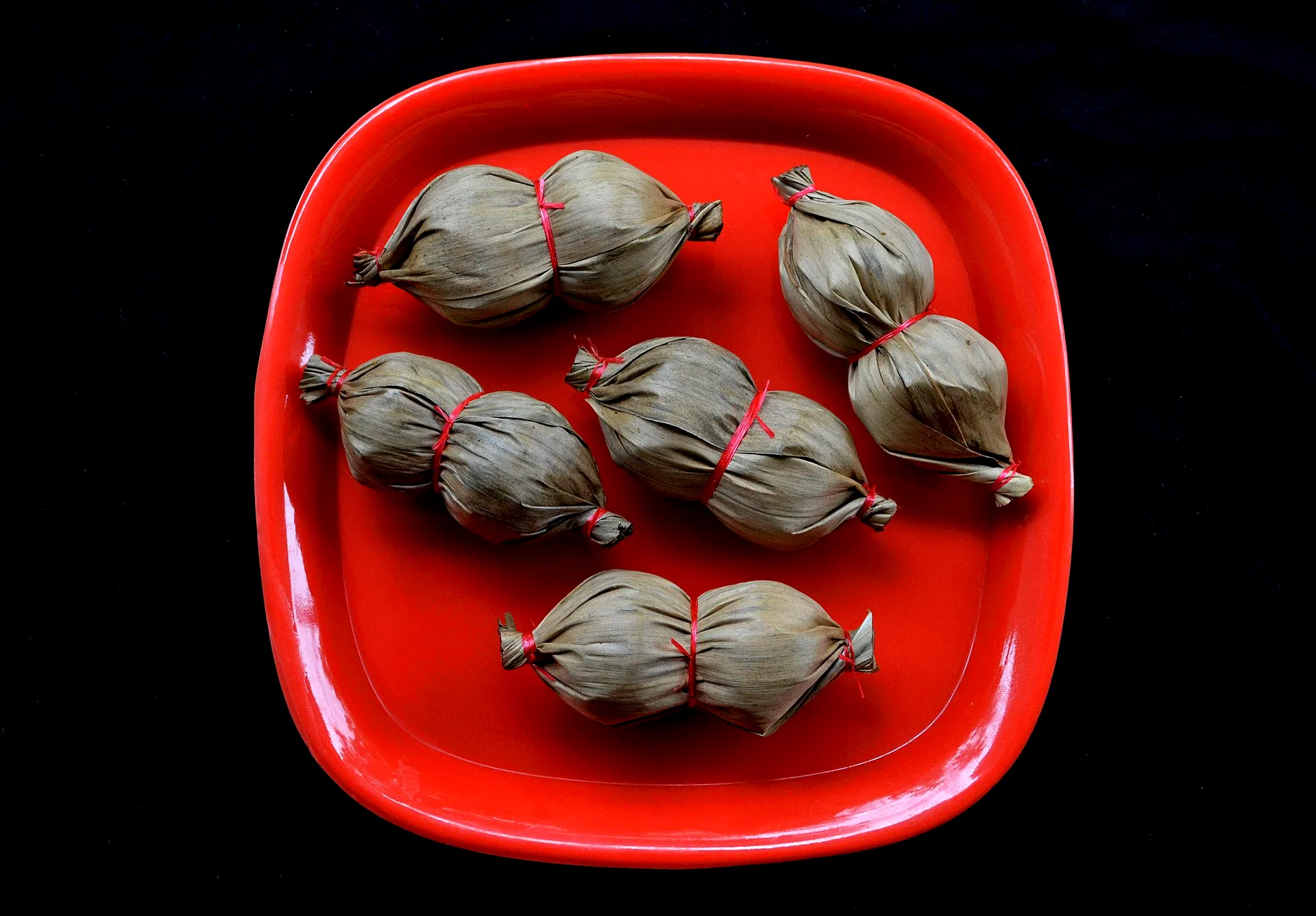
The most important island food is mas (also maas, or masmin on Minicoy): skipjack tuna boiled, smoked and dried until it is as hard as wood. Part 4 described how Minicoy produced it; when pole-and-line fishing spread to the other islands from the 1960s, mas making followed. It keeps for months, which made it ideal for long voyages and the monsoon, and it is still the islands' best-known product, sold to the mainland, Sri Lanka and beyond. At home it is shaved or pounded into dishes such as:
- Mas podichathu – dried tuna pounded with grated coconut, ginger, onion, turmeric and spices, eaten with rice; closely related to the Maldivian breakfast mas huni.
- Mas appams – fried snacks of dough with grated tuna and coconut, taken with black tea (kattan chai).
Other dishes
Food writers list a recurring set of island specialities. Names and recipes vary from island to island and from writer to writer, so treat these as a guide:
- Fresh tuna curries, including mus kavaab, a spiced tuna curry with onion and tomato associated with Minicoy.
- Kilanji – a thin, lacy crepe of rice flour and egg, served sweet with banana, coconut milk and jaggery. Some writers call it a Minicoy dish; others describe a savoury version.
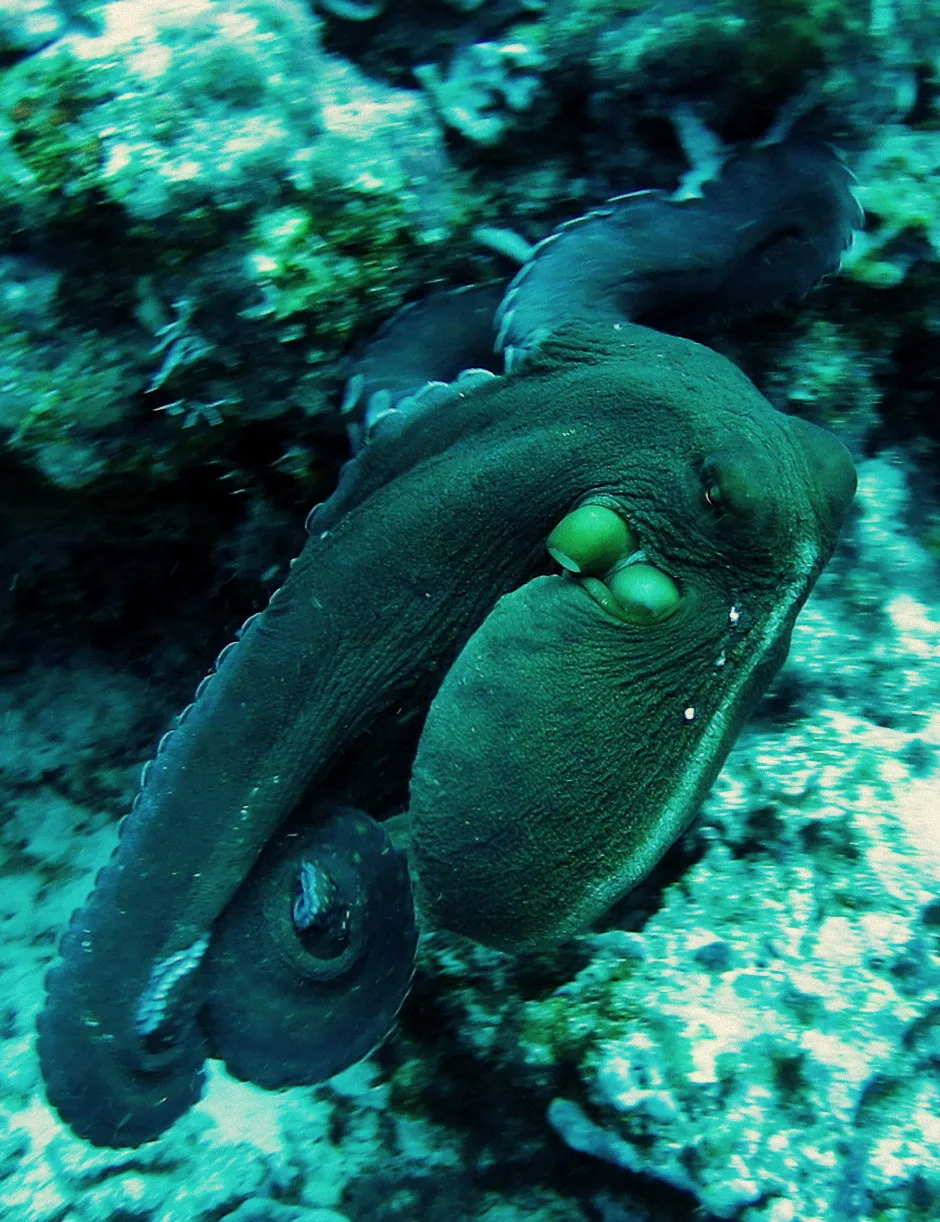
- Octopus, which islanders call appal, caught on the reef flats and fried or cooked in coconut curry. Octopus hunting is common enough that a conservation group published a handbook on doing it sustainably in 2023.
- Batla appam, an idli-like sweet of egg, flour, sugar and cardamom associated with Andrott.
- Boat biryani, cooked by pole-and-line crews on multi-day trips: tuna marinated in coconut vinegar, rice rinsed in seawater and cooked with coconut milk in a pot set over burning coconut shells, garnished with roe grilled over the same flame. The marine ecologist Rucha Karkarey, who ate it at sea, describes it as far more than survival food.
Drink
The Lakshadweep Prohibition Regulation of 1979 bans the import, manufacture and possession of liquor in the territory. Limited permits for some tourist resorts became a political issue in 2021. Tapping palms for toddy and sweet sap (neera) was traditionally the work of the Melacheri group (Part 3); on Minicoy the sap goes into jaggery and no toddy is made. Everyday drinks are tender coconut water and strong black tea.
What is certain and what is not
- Well documented: the names of the main dances; the Malabar roots of Kolkali, Parichakali and Oppana; the Maldivian character of Minicoy's dances; the central place of coconut, imported rice and tuna; mas and its preparation.
- Thinly documented: Dandi and Fuli; island ballads; the role of Moulood and Ratheeb before voyages and building.
- Varies by source: dish names and recipes, which come mostly from food and travel writing rather than studies of island cooking.
- Takeaway: music and dance reproduce the islands' two origins – Malabar and the Maldives – while food reflects their shared limits: a coconut, a lagoon and the open sea.
Timeline
- 17th centuryThaara reaches the Maldives from the Gulf, according to Maldivian sources.
- 1960sPole-and-line tuna fishing, and with it mas making, spreads from Minicoy to the other islands.
- 1979Lakshadweep Prohibition Regulation bans liquor.
- By 2013The tourism department stages the National Minicoy Festival.
- 2022The band Fulliparava is formed on Kiltan.
- 2023A handbook on sustainable octopus hunting is published for island fishers.
Questions people ask
What is the famous dance of Lakshadweep?
Kolkali, the stick dance, on most islands; Lava on Minicoy.
What is Oppana?
A wedding song tradition in which a lead singer is answered by a chorus of women, shared with the Mappila Muslims of Kerala.
What is the most typical Lakshadweep food?
Tuna with coconut and rice – fresh in curries, or dried as mas and pounded with coconut.
Is alcohol allowed in Lakshadweep?
Not generally. A 1979 regulation bans liquor, with limited permits for some tourist resorts.
(Next: Part 7 – the islands since 1956 and today. Previous: Part 5 – languages and scripts. Read also Kannur and the Arakkal kingdom.)
See it for yourself, with a local driver who knows these roads.
Book a Munnar Jeep SafariSources & further reading
- Lakshadweep Administration: Culture & heritage
- Lakshadweep Administration: Minicoy
- Kerala Tourism: Kolkali (Islam in Kerala)
- Kerala Tourism: Mappila art forms and assimilation
- Kerala Tourism: Mappilappattu
- Wikipedia: Kolkali
- Onmanorama: Lakshadweep band Fulliparava at the Malabar Literature Festival (2023)
- Visit Maldives: Maldives dance and musical traditions
- Malikaddu blog: Bandiya (quoting maldivesroyalfamily.com on Maliku dances)
- Utsav (Government of India): National Minicoy Fest
- Rucha Karkarey, A fish, a boat, a feast: Boat biryani in the Lakshadweep (Goya)
- Onmanorama: Mas podichathu, kilanji and other Lakshadweep food (2024)
- Slurrp: Lakshadweep, the cuisine (2024)
- Wikipedia: Maldivian cuisine
- Dakshin Foundation: Lakshadweep fisheries timeline
- Wikipedia: Lakshadweep Prohibition Regulation, 1979
Figures are from the sources listed and were checked in November 2026. Park timings and road conditions change, so please confirm before you travel.