
Lakshadweep, Part 5: Jeseri, Mahl and Arabi-Malayalam – the Islands' Languages and Scripts
Nine islands speak a Malayalam of their own, with no script of its own. Minicoy speaks a form of Dhivehi and writes it right to left, as the Maldives do. Between them sits a third tradition: Malayalam written in Arabic letters. How the three came about, and why schoolrooms have become the place where they are fought over.
Listen to two islanders from Kavaratti and a visitor from Kozhikode will understand most of what they say, but not all of it. Listen to two people from Minicoy and the same visitor will understand almost nothing. Lakshadweep is small, but it holds two quite different languages, three scripts and a long-running argument about which of them children should learn. This part of the series looks at each in turn. (Part 4 covers trade and colonial rule.)
At a glance
- Northern and central islands: Jeseri (also written Jasari or Jazari; locally Dweep Bhasha, "island language"), a dialect of Malayalam, spoken on nine inhabited islands.
- Minicoy: Mahl or Mahal (Maliku bas), a dialect of Dhivehi, the language of the Maldives.
- Scripts: Malayalam script; Arabi-Malayalam (Malayalam in Arabic letters) for religious and devotional writing; Thaana for Mahl.
- Schools and offices: Malayalam and English, with Arabic and, in Minicoy, Mahal offered as third languages.
Jeseri: Malayalam, island-style
The name Jeseri is usually traced to the Arabic jazari, "of the island" or "islander". It is spoken on Chetlat, Bitra, Kiltan, Kadmat, Amini, Kavaratti, Andrott, Agatti and Kalpeni, and each island has its own variety: an Agatti speaker sounds different from a Kavaratti one. Linguists class it as a dialect of Malayalam, close to the Mappila Malayalam of the Malabar coast, which fits everything Parts 2 and 3 said about where the settlers came from. Some reference works also list varieties associated with the old status groups (Koya, Malmi, Melacheri) and with the Amindivi islands, though these have not been well studied.
A handful of regular sound changes give Jeseri its character. Compared with mainland Malayalam:
- an initial p often becomes f: fenn for pennu, girl;
- an initial v becomes b: bili for vili, call;
- an initial ch becomes sh: sholli for older cholli, said;
- the Malayalam zh sound usually becomes an l or a y: mala for mazha, rain; bayi for vazhi, way;
- a short vowel at the start of a word, especially u, may drop: rangi for urangi, slept.
The grammar is close to the mainland, but some pronouns differ – for example ben and bel for "he" and "she" – and the case endings have their own forms. Arabic loanwords are common, as they are in Mappila speech.
A language without a script
Jeseri has never had a standard written form. Islanders went to school in Malayalam, read Malayalam newspapers and wrote in Malayalam script, so the island dialect stayed a spoken language, and educated islanders have long worried that it is being flattened into standard Malayalam. That has begun to change. Island writers have started to write in Jeseri using Malayalam letters; a novel by Thakiyudheen of Kiltan, Fadappurappad, is described as the first in the dialect. In 2018 Sinjar, directed by Sandeep Pampally and shot entirely in Kavaratti, became the first feature film in Jeseri. It won two National Film Awards: the award for best film in the language and the Indira Gandhi Award for the best debut film of a director.
Arabi-Malayalam: Malayalam in Arabic letters
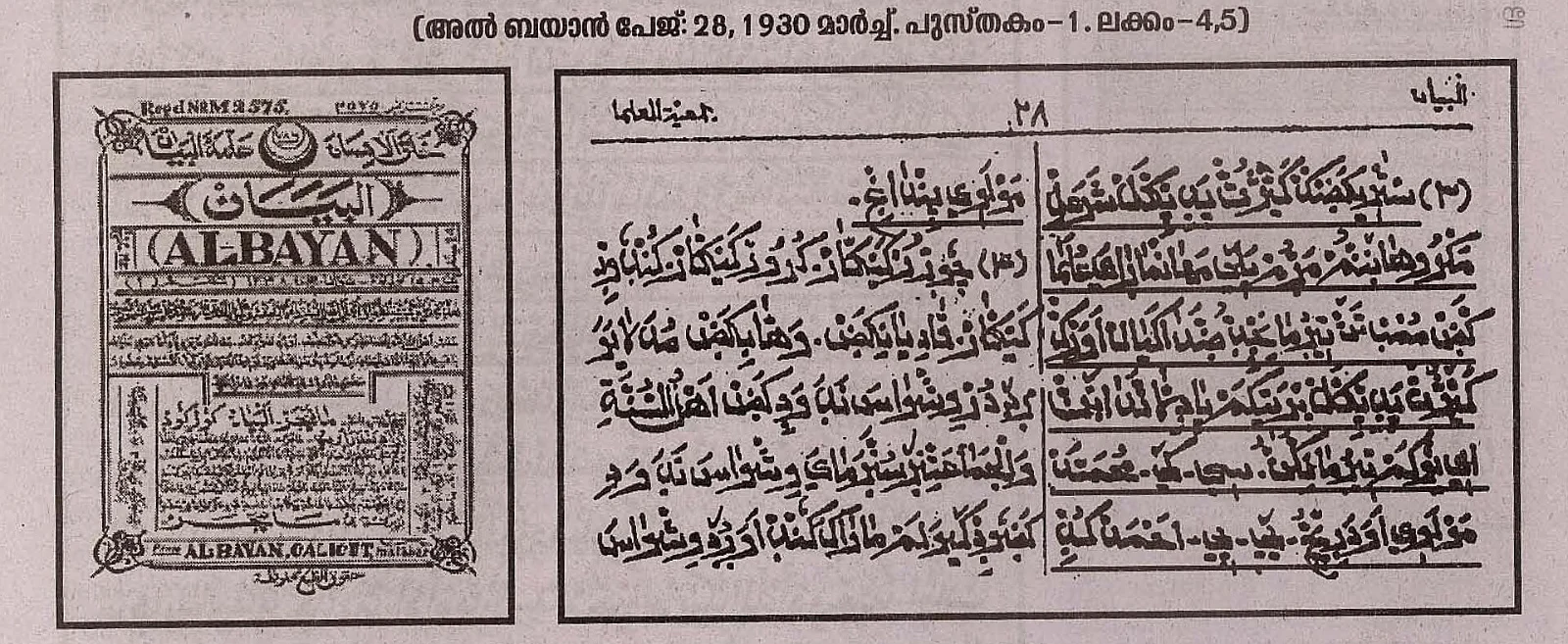
For religious learning, the islands shared a third tradition with the Mappilas of Malabar: Arabi-Malayalam, the Malayalam language written in an adapted Arabic script, with extra letters for Malayalam sounds that Arabic lacks, such as p, ch, g and zh. It grew up because Muslims learned the Arabic script anyway in order to read the Quran. The earliest dated work in it, the devotional Muhyiddin Mala, was written in Kozhikode in 1607, and a large literature of Mappila songs, religious texts and later newspapers followed. Until the 20th century the script was taught in Muslim primary schools (madrasas) across Kerala, and it is still used in some madrasas in Kerala and Lakshadweep. Much of the islands' older religious and song literature circulated in this form.
Mahl: the language of Minicoy
Minicoy speaks Mahl, which islanders call Maliku bas, "the language of Maliku". It is a dialect of Dhivehi, an Indo-Aryan language related to Sinhala and not to Malayalam. Linguists regard the Minicoy dialect as one of the closest to the standard Dhivehi of Malé, closer than the dialects of the far southern Maldivian atolls. Mahl also carries borrowings from Malayalam, Hindi and English, and since the 1950s it has developed largely on its own.
Like Dhivehi, Mahl is written in Thaana, a script that runs from right to left. Its consonant letters were derived from numerals, and its vowels are marked with signs borrowed from Arabic. Thaana replaced an older Brahmi-derived script, Dhives Akuru, in the Maldives; no documents in the older script are known to survive on Minicoy.
The story of the script since 1947 is one of separation. In the 1950s India stopped direct travel between Minicoy and the Maldives. Minicoy missed the spelling reforms made in the Maldives under Mohamed Amin Didi and later, and its writing developed into a distinct variant, sometimes called Malikuthaana. For a time a modified Devanagari alphabet was also devised for Mahl. A Maldives National University study of a mid-20th-century Malikuthaana school primer found that just over half of its phrases (56%) match present-day standard Dhivehi.
Who speaks what
- Nine islands: Jeseri at home, standard Malayalam at school and in print.
- Minicoy: Mahl at home; Malayalam and English at school. The administration lists Hindi, English, Malayalam and Mahal as the island's languages and notes that Minicoy is the only place in India where Mahal is spoken.
- Everywhere: Arabic for prayer and religious learning; English and Malayalam in administration; Hindi and other languages among officials, defence personnel and workers from the mainland.
Schools: Kerala's syllabus and the fight over languages
Formal schooling came late. The first government school opened on Amini in 1904, the first islander graduated in 1942, and the first high schools opened on Amini and Kalpeni in the 1960s. For more than seventy years the islands followed Kerala's school system: Kerala textbooks, Malayalam (or English) as the medium, and Arabic, or Mahal in Minicoy, as a third language.
Two recent orders tried to change that. In December 2023 the education department ordered all its schools to move from the Kerala (SCERT) syllabus to CBSE English medium, starting with first-grade admissions in 2024–25, saying it wanted to raise standards. Kerala's education minister protested to the Union government, pointing out that most of the 12,140 pupils in the islands' 34 schools were studying the Kerala syllabus. The order was challenged in two writ petitions and stayed by the Kerala High Court.
On 14 May 2025 a second order introduced a three-language formula under the National Education Policy 2020: Malayalam and English as first and second languages, with Hindi replacing Arabic and Mahal as the third. Minicoy held protests, and teachers and the island's MP asked for Mahal to be kept. In June 2025 a Kerala High Court bench of Chief Justice Nitin Jamdar and Justice Basant Balaji stayed the order. The court accepted, for the time being, the petitioner's argument that the change had been made without any study or consultation, noted that Arabic is a prescribed subject under the Kerala Education Rules, and said a language carries deep cultural significance. The administration had relied on the education policy and on CBSE guidance. The court left it free to carry out a proper study and consult islanders before returning to the court.
Supporters of the changes argue that a national curriculum and Hindi will widen islanders' options for study and jobs beyond Kerala. Opponents argue that Mahal exists nowhere else in India, that Arabic is part of religious life on every island, and that the islands' children already study successfully in Malayalam. Under the June 2025 ruling the existing arrangements continue while the case is heard; when this was checked in November 2026 we had not found a later decision.
What is certain and what is not
- Well documented: Jeseri is a Malayalam dialect with regular sound changes; Mahl is a dialect of Dhivehi written in Thaana; Arabi-Malayalam was used for religious learning; the 2023 and 2025 school orders and the court stays.
- Less well studied: the differences between island varieties of Jeseri, and how far Mahl has drifted from Maldivian Dhivehi since the 1950s.
- Uncertain: speaker numbers. The 2011 census groups Jeseri under Malayalam, and published figures for Mahl speakers (often 10,000 to 11,000, roughly Minicoy's population) are estimates.
- Takeaway: the islands' languages mirror their history: Malabar settlers in the north and centre, Maldivian ties in Minicoy, and Islam across both.
Timeline
- 1607The Muhyiddin Mala, earliest dated work in Arabi-Malayalam, is written in Kozhikode.
- 1904The first government school opens on Amini.
- 1942The first graduate from the islands.
- 1950sDirect travel between Minicoy and the Maldives stops; Mahl writing goes its own way.
- 1960sFirst high schools on Amini and Kalpeni.
- 2018Sinjar, the first Jeseri feature film, wins two National Film Awards.
- Dec 2023Order to move all schools to CBSE English medium; later stayed.
- 14 May 2025Order replacing Arabic and Mahal with Hindi as the third language.
- June 2025Kerala High Court stays the order.
Questions people ask
What language is spoken in Lakshadweep?
Jeseri, a dialect of Malayalam, on nine islands, and Mahl, a dialect of Dhivehi (Maldivian), on Minicoy. Malayalam and English are used in schools and offices.
Does Jeseri have its own script?
No. When it is written, it is written in Malayalam script.
Can Minicoy people understand Maldivians?
Largely, yes. Mahl is a Dhivehi dialect and is written in the same Thaana script, though vocabulary and spelling have drifted since the 1950s.
Is Mahal still taught in schools?
It was at the last ruling we found: the 2025 order to replace it with Hindi was stayed by the Kerala High Court in June 2025.
(Next: Part 6 – music, dance and food. Previous parts: 1 – geography, 2 – early history, 3 – society, 4 – trade and colonial rule.)
See it for yourself, with a local driver who knows these roads.
Book a Munnar Jeep SafariSources & further reading
- Wikipedia: Jeseri
- GKToday: Jazari language
- Onmanorama: How cinema has put a spotlight on Lakshadweep's Malayalam dialect (2020)
- Scroll: Meet the man who put Lakshadweep on the map with Sinjar (2018)
- The Wire: Lakshadweep students face bureaucratic battle over curriculum
- Wikipedia: Arabi Malayalam script
- Wikipedia: Mahl writing systems
- Riyaz, Hashim & Mohamed, Comparative historical dialectology of standard Dhivehi and the Maliku dialect (Maldives National University, 2024)
- Omniglot: Maldivian (Thaana)
- Lakshadweep Administration: Minicoy
- Maldives Independent: Minicoy islanders battle to preserve ancestral Maldivian language (2025)
- Onmanorama: Lakshadweep to change all schools to CBSE English medium (2023)
- Onmanorama: Kerala condemns Lakshadweep's move to switch schools to English medium (2023)
- SCC Online: Kerala HC stays order to remove Arabic, Mahal from Lakshadweep school curriculum (2025)
- The Wire: Kerala HC defers order mandating Hindi as third language in Lakshadweep schools (2025)
Figures are from the sources listed and were checked in November 2026. Park timings and road conditions change, so please confirm before you travel.