
The Kundale Hounds: Munnar's Forgotten Planters' Hunt of 1899
In 1899, British tea planters in the High Range founded a hunt named after the Kundale valley. What the records show about it, and how much they leave out.
About 20 km out of Munnar on the road to Top Station, Kundala is a place where people stop for a while. Pedal boats and shikaras drift on the reservoir behind the dam, cherry trees line the bank, and tour jeeps queue at the ticket counter. A little away from the road, the nine undulating holes of the Kundale Club lie between patches of forest. It is a members-only club, and most days it is very quiet.
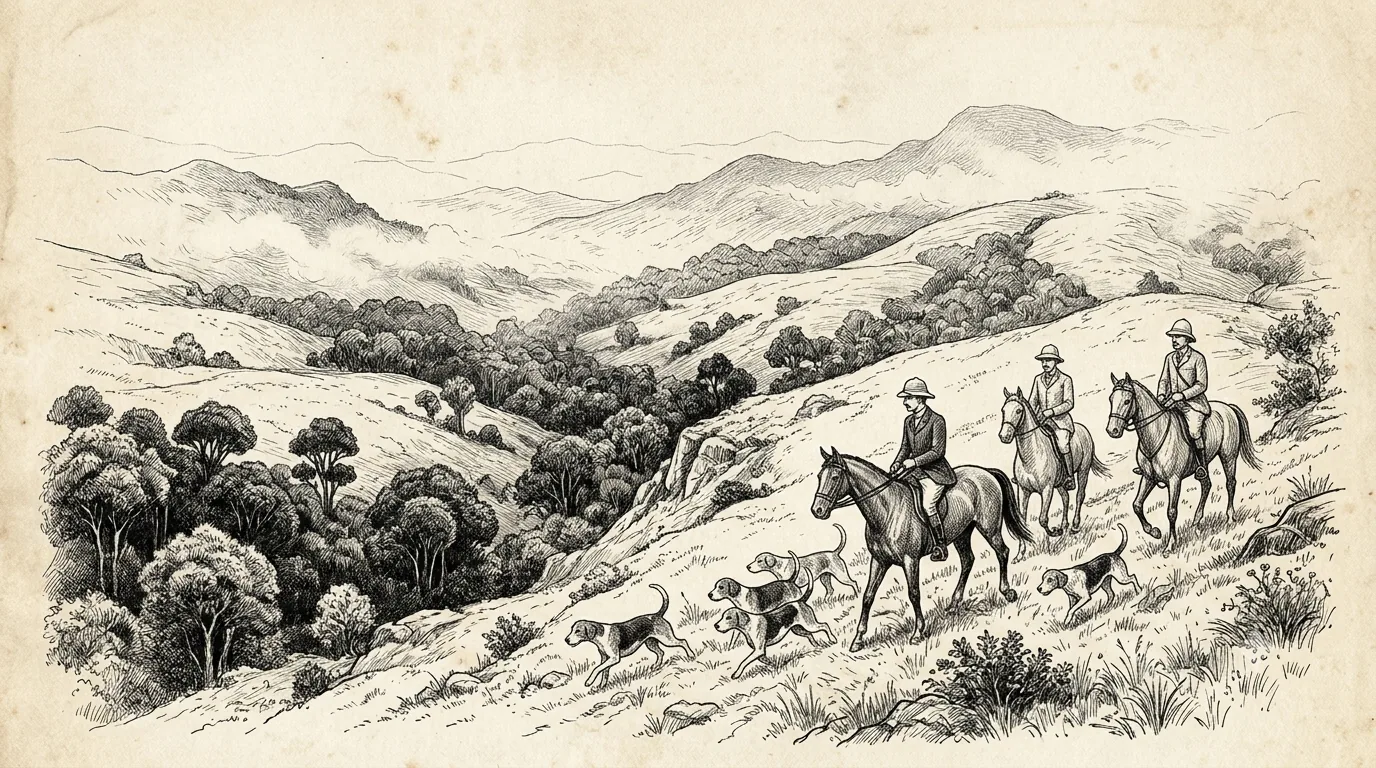
The valley looked different in 1899. There was no dam and no lake. The Kundale river ran through open grassland, and dark shola forest filled the folds of the hills. That year a group of planters, who spent their working weeks clearing jungle and laying out tea, formed a hunt and named it after this valley: the Kundale Hounds.
This story needs a caution from the start. We know the hunt existed, we know when it was founded, and we know the name of one founder. Most other details have not turned up in any source we could find. We do not know what the hounds looked like or what they chased, or whether the riders followed on horseback as they did at Ooty. Where this article fills a gap with context from elsewhere, it says so.
The Kundale Hounds at a glance
- Name: Kundale Hounds. Kundale is the older spelling of Kundala.
- Founded: 1899, by planters of the High Range (the Kanan Devan Hills), then in the princely state of Travancore
- Documented co-founder: Aylmer Ffulke “Toby” Martin (1864–1926)
- Wider context: the Ootacamund Hunt in the Nilgiris, which hunted hill jackal over grassland from 1869
- Not yet documented: the other founders, the size and breed of the pack, where it was kennelled, what it hunted, how often it met, and when it ended
Founded in 1899
The founding date and Martin's part in it come from his life story, which has been revisited for his centenary this year. The South First reports that Martin was among the founders of the Kundale Hounds in 1899, at a time when hunting was a popular pursuit among sections of the European planting community. Our own centenary profile, Toby Martin of the High Range (1864–1926), records the same.
Martin is a believable founder. He was born at Cherrapunji in 1864, went to school in Ireland, reached the High Range in 1883 and opened Chittavurrai estate. He sold the estate to James Finlay & Co. in 1895 but stayed on in the company's service. In 1902 he became the first Master of Lodge Heather, Munnar's Masonic lodge, and he was also linked to a lodge at Ootacamund. After his death in December 1926, The Planters' Chronicle described him as a mason, shikari, iconographer and ethnologist. Shikari, meaning hunter, is the word that links him to the hounds.
We do not know who rode with him in 1899. No membership list, minute book or set of rules for the hunt has been published.
The Ooty model
The Kundale Hounds are often seen as the High Range's answer to the Ooty Hunt. The context supports that reading, though no founding document says so.
The Nilgiris hunt, by contrast, is well documented. The historian M.S.S. Pandian traces it back to a pack of foxhounds that Lieutenant Thomas Peyton kept in the hills in 1845. In 1869, J.W. Breaks, the first Commissioner of Ootacamund, organised a regular pack. Its quarry was the hill jackal rather than the fox, and an eyewitness in the 1880s judged the jackal faster and hardier than the English fox. The pack started with imported foxhounds and later bred its own, and the country-bred hounds were thought just as good. The hunt met twice a week from May to September and was paid for by voluntary subscriptions. In 1896, three years before the Kundale Hounds were founded, the Madras government set aside about 30 square miles of grassland and shola west of Ooty as the hunt's exclusive preserve, called Wenlock Downs.
The Nilgiris and the High Range share the same upland pattern of rolling grassland with shola woods in the hollows. For planters who knew Ooty, Martin among them, its hunt was a ready model.
A society built at altitude
The hunt was one of several institutions the planters built to cope with their isolation.
- 1888The Kanan Devan Planters' Association is formed to bring together planters living far apart in rugged country.
- 1899The Kundale Hounds.
- 1902Lodge Heather is founded, and a monorail begins running along the Kundale valley towards Top Station. In 1908 it is replaced by a narrow-gauge light railway (see The Kundala Valley Railway).
- 1905–1910Planters begin meeting at a Gymkhana Club in 1905. The High Range Club is formally established in 1909, and its clubhouse is completed in 1910.
- 1918The Kundale Club is said to have opened, according to a golf directory. We have not confirmed the date from a primary source.
A planter's family remembers that members rode to the Kundale Club on horseback to play golf, cricket and tennis, and that its sporting meets included clay-pigeon shooting and tent-pegging. The rituals were imported from Britain: dress codes, club bars, Masonic installations and, for a while, a pack of hounds. Together they let a small, scattered community recreate something of home in the Western Ghats.
We found nothing linking the Kundale Club to the Hounds apart from the name of the valley they share.
Hunting the High Range
The country was well suited to hounds but very hard on riders. The upper High Range is mostly a mosaic of grassland and shola, with steep slopes, swampy valley floors and sudden mist. In the Nilgiris, Pandian's 1880s eyewitness noted that hounds could cross swamps where horses could not follow.
Jackals lived in these hills: a later wildlife survey of Eravikulam lists the jackal among the area's predators, alongside the tiger, leopard and dhole. With Ooty's hunt chasing jackal, it is the likeliest quarry for the Kundale pack too.
We should not confuse the hounds with the planters' other hunting. Shikar, which meant stalking game on foot with a rifle, lasted much longer and left more evidence behind. As late as the 1950s, writes George N. Netto, Munnar's British planters sometimes spent their Christmas holidays in Eravikulam, hunting trophies or fishing for trout. Mounted heads of the kind those trips produced still hang on Munnar's walls.
The weather would have been a constant problem. The High Range takes the full force of the south-west monsoon. In July 1924, storms and floods destroyed the Kundale valley railway and much of old Munnar (see The Great Flood of 99). Any pack would have needed dry kennels, steady feeding and a hunting calendar built around the rains.
From hunting ground to national park
The grasslands where hounds may once have run became one of India's best-known conservation stories. From 1928, the High Range Game Preservation Association managed the hills north of Munnar as a game preserve for the Kanan Devan Hills Produce Company. It employed Muthuvan trackers as game watchers. Hunting continued, but under strict limits. One account in the journal Oryx credits the Association with protecting the largest population of Nilgiri tahr from poaching, in the interests of its members' own carefully restricted shooting.
The Government of Kerala took over the area in 1971 and declared it a sanctuary in 1975. On 19 May 1978, Eravikulam became Kerala's first national park, created mainly to protect the tahr. About 60 per cent of the park is grassland. Today the same slopes that colonial sportsmen saw as game country are protected as a habitat in their own right.
What remains today
There is no known trace of the kennels, and no marker for the hunt. What a visitor can see is the setting it belonged to:
- Kundala lake and dam. The dam was built for the Pallivasal hydroelectric project, and KSEB records its completion in 1947. The reservoir flooded part of the old valley floor. Imagine the valley as it was before the water came.
- The Kundale Club. It is a private club. You can see the course from outside, but you should not expect to be let in.
- The High Range Club, Munnar. Begun as a Gymkhana Club in 1905 and formally established as the High Range Club in 1909, it still keeps its colonial traditions. Membership is restricted, but it offers rooms to travellers.
- KDHP Tea Museum, Nallathanni. The museum displays planters' hunting trophies and relics of the Kundale valley railway.
- CSI Christ Church cemetery, Old Munnar. Toby Martin is buried here.
- Eravikulam National Park (Rajamala). Here you can walk through the kind of grassland-and-shola country the hunt knew.
What is certain and what is not
| Claim | Status |
|---|---|
| The Kundale Hounds were founded in 1899 | Reported in recent secondary sources, drawing on planter records |
| Toby Martin was a co-founder | Reported in recent secondary sources |
| Martin was called a “shikari” | Planters' Chronicle, 1926, as cited |
| The hunt was modelled on the Ooty Hunt | Plausible inference; not documented |
| The quarry was jackal | Plausible; not documented |
| The hunt was mounted | Not documented |
| Hound breeds and pack size | Not documented |
| Kennel location | Not documented |
| Date the hunt ended | Not documented |
Where further records may be
The best chance of finding more lies in back issues of The Planters' Chronicle held by UPASI, in the Kanan Devan Hills company archives, in the History of the High Range (1930), in Amita Baig and William Henderson's A Centenary of Planting in the Kanan Devan Hills (1978), and in framed photographs at the High Range Club, the Kundale Club and the Tea Museum. George N. Netto's column “Of Brits and the Hounds of Munnar” (The New Indian Express, 25 April 2017) may also hold details; we have not yet been able to read it. If you hold family letters or photographs from a High Range planter, please get in touch or write to info@geekayglobal.com.
Read also: Toby Martin of the High Range · Lodge Heather · The High Range Club · Kundala Lake and Dam · Eravikulam National Park
See it for yourself, with a local driver who knows these roads.
Book a Munnar Jeep SafariSources & further reading
- Dileep V Kumar, 'A century after his death, Munnar remembers a British planter who made the hills his home', The South First (25 November 2026)
- M.S.S. Pandian, 'Gendered negotiations: Hunting and colonialism in the late nineteenth century Nilgiris', Working Paper No. 112, Madras Institute of Development Studies (January 1993)
- Shonali Muthalaly, 'Memories of Munnar: A childhood in a tea garden', The Hindu (via inkl)
- George N. Netto, 'Dawn of compassion', Deccan Herald
- High Range Club, Munnar: History
- Kerala Tourism: History of Eravikulam National Park
- 'A tale of twists and turns: How Eravikulam became Kerala's first national park', The South First (April 2025)
- 'The Nilgiri Tahr', Oryx (Cambridge University Press)
- Journal of the Bombay Natural History Society: large predators and their prey, Eravikulam National Park (via BioStor, Internet Archive)
- BirdLife International: Eravikulam National Park, Important Bird Area factsheet
- KSEB Dam Safety Organisation: Kundala Dam
- FIBIS wiki: Kundale Valley Light Railway
- Golf Today: Kundale Golf Club, Munnar
Figures are from the sources listed and were checked in November 2026. Park timings and road conditions change, so please confirm before you travel.