
A Church Built Around a Grave: CSI Christ Church, Old Munnar
In 1894 a young bride asked to be buried on a hill above Munnar. Within weeks her wish came true. Sixteen years later the planters built a granite church beside her grave. The story of Eleanor Knight, the cemetery on the hill and the church that rose from it.
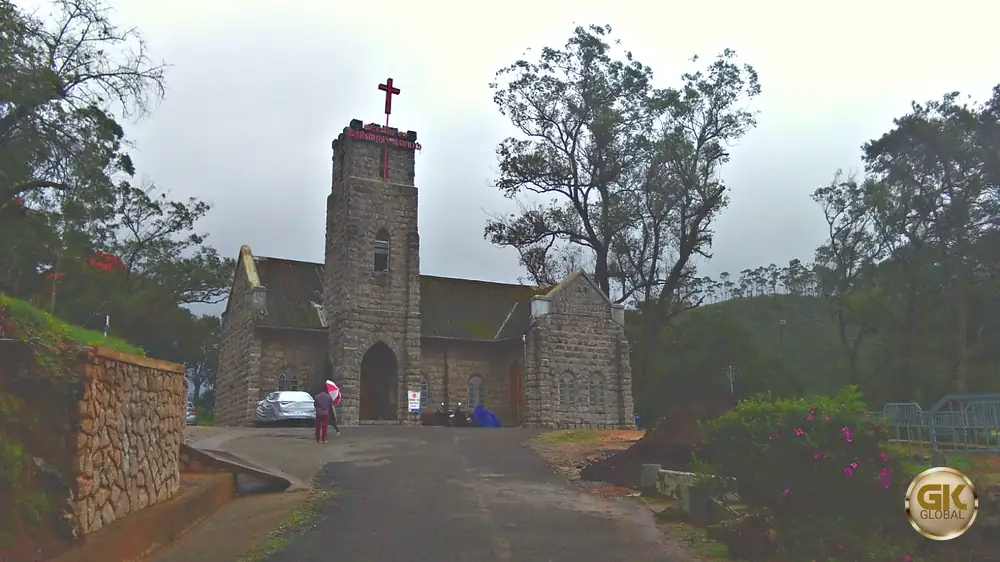
On a low hill at Old Munnar, a little apart from the bustle of the town, a church of rough grey granite stands among old trees. Its walls are unplastered, its windows pointed, its bell tower plain and solid. Behind it, the ground rises in a grassy slope dotted with headstones and crosses. At the very top, set apart from the rest, is a single marble tomb. It is the oldest grave on the hill, and the reason the church is there at all.
Most churches are built first and gather a graveyard around them. At Munnar it happened the other way round. The cemetery came first, sixteen years before the church, and it began with one grave: that of Eleanor Isabel May Knight, who died a few weeks after arriving in the hills as a bride in 1894.
At a glance
- Where: Old Munnar, about 1 km from Munnar town, beside the Kochi–Madurai road (NH 85).
- First grave: Eleanor Isabel May Knight, died 23 December 1894, aged 24.
- Cemetery consecrated: Easter Day, 15 April 1900, by Bishop E. Noel Hodges of Travancore and Cochin.
- Church built: 1910–11, in granite, in the Gothic style; foundation stone laid in 1910; opened for worship on 16 April 1911.
- Today: CSI Christ Church, a parish of the Church of South India's North Kerala diocese since 1981. Services are held in English, Tamil and Malayalam.
Eleanor's hill
In the early 1890s, the Kanan Devan Hills were still a frontier. A handful of European planters had cleared estates in a vast concession of forest and grassland, linked to the plains only by rough bridle paths. Among them was Henry Mansfield Knight, one of the pioneers of the High Range, who rose to manage the planting enterprise that became the Kanan Devan Hills Produce Company.
In November 1894, Knight married Eleanor Isabel May, and brought her up to Munnar. According to the story handed down in Munnar, she was enchanted by the view from a hill above the river and told her husband, half in jest, that when she died she wished to be buried there.
Within weeks she fell ill with cholera, a disease that swept through South India in those years and could kill within a day. She died on 23 December 1894, two days before Christmas, at the age of 24. In an age when the bodies of Europeans who died in India were sometimes sent home, Knight chose to keep his promise. He buried her on the hill she had chosen.
Her grave, marked by a marble headstone brought from England, still stands at the top of the cemetery, separated from the later graves. The inscription records her as the dearly beloved wife of Henry Mansfield Knight. In local retellings, the grave has been called the "Taj Mahal of Munnar", a monument to a husband's grief, though on a far humbler scale than Shah Jahan's.
A cemetery for the hills
Eleanor's grave became the burial ground of Munnar's European community. Life in the hills in those years was hard and often short. Malaria, cholera, typhoid, accidents on the estates and in the rivers took planters, their wives and their children. As the graves multiplied, the planters sought to give the burial ground proper standing.
The bishop of the Anglican diocese of Travancore and Cochin, Edward Noel Hodges, was the first bishop to visit the High Range, in 1898. On Easter Day, 15 April 1900, he returned to consecrate the cemetery. A register of burials was opened, and Eleanor Knight's name was entered as the first.
Today the cemetery holds around 50 graves of the British era. Many record lives that ended young. Its burials are indexed by BACSA, the British Association for Cemeteries in South Asia, which keeps records of European graves across the subcontinent. Descendants of planting families still come to Munnar to find the graves of their forebears.
The church rises
For years, Munnar's Anglicans had no church of their own and met for services where they could. In 1910 work began on a permanent church beside the cemetery, funded by the planters, with Knight among its leading supporters. The foundation stone was laid by Sir Alexander Kay Muir, head of the planting firm of Finlay, Muir & Co., at a ceremony that the brethren of the local Masonic lodge, Lodge Heather No. 928, conducted with Masonic honours.
The church opened for worship on 16 April 1911. It was built in the Gothic Revival style that the British carried across their empire, but in local stone: walls of rough-hewn granite, left unplastered, with pointed windows, a steep roof carried on timber, and a sturdy bell tower. Inside, the church keeps its historic furnishings, including a bell brought from Britain, a piano and an old Bible, and its stained-glass windows depict biblical figures.
The walls are lined with brass memorial plaques to the planters and their families who lived, worked and died in the High Range. Read together, they are a roll-call of the European community of the Kanan Devan Hills: estate managers and assistants, engineers and their wives, some of them remembered here although they died far away.
The flood of 1924
In July 1924, days of torrential rain brought the greatest flood in Kerala's recorded history, remembered in Malayalam as the Great Flood of '99 (after the year 1099 of the Malayalam calendar). In Munnar, landslides and floodwater swept away much of the old town, the light railway of the Kundala Valley and the roads and bridges that linked the hills to the coast.
Standing on its hill above the river, Christ Church escaped the water. Local accounts remember it as a place of shelter during the disaster, where people whose homes had been lost found refuge. (We tell the story of the flood in our history of Munnar and in our article on Karinthiri.)
From the planters' church to the people's church
After Indian independence, the Anglican dioceses of South India united with other Protestant churches to form the Church of South India (CSI) in 1947. In Munnar, the European planting community dwindled through the following decades as Indian managers took over the estates. In 1981, the church was formally handed over to the CSI's North Kerala diocese.
Christ Church today serves a congregation drawn largely from Munnar's own people, including families who have worked on the estates for generations. Services that were once held only in English are now held in English, Tamil and Malayalam. The building that began as a monument to a lost bride and a gathering place for a small colonial elite has become a parish church of the hills.
A place to pause
For visitors, Christ Church is one of the quietest and most moving places in Munnar. The granite walls, the old pews, the brass plaques and the coloured light through the windows speak of a particular moment in the history of the hills. The cemetery behind, climbing to Eleanor's grave, tells of the human cost of that moment. And the living congregation shows how the place has been made new by the people of Munnar.
The church is best seen in the soft light of early morning or late afternoon, perhaps as part of a day exploring Munnar's colonial heritage: the old town, the tea estates and factories, the High Range Club, and the routes of the vanished railway.
Visiting
- Christ Church is a working church and burial ground. Dress modestly, keep your voice low, and ask before photographing inside or during services.
- Please do not step on or lean against graves, and never remove anything from the cemetery.
- Descendants searching for a family grave can consult the BACSA cemetery records and contact the parish in advance.
- To explore Munnar's colonial heritage with a local driver who knows the history, book a sightseeing trip with GK Global, or contact us to plan a bespoke heritage tour.
See it for yourself, with a local driver who knows these roads.
Book a Munnar Jeep SafariSources & further reading
- Domain-B: Eleanor's hill (cemetery consecration 1900, Bishop Hodges, A. K. Muir foundation stone)
- Wikipedia: Noel Hodges, Bishop of Travancore and Cochin 1890–1904
- Wikipedia: Hope Gill, Bishop of Travancore and Cochin 1905–1924
- The News Minute: The 125-year-old tomb built for a wife's last wish
- Onmanorama: Eleanor's tomb, Munnar's historic hidden gem (2019)
- Onmanorama: A century-old love story in Munnar (2026)
- Kerala Tourism: Old Munnar church
- Munnar Info: About CSI Church Munnar (stained glass, plaques, 1924 flood, CSI 1981)
- Story House: Munnar Church
- BACSA Cemetery Records: Munnar record book (index entry)
- District Grand Lodge of India (S.C.): Lodge Heather No. 928 and the 1910 corner stone
- Wikipedia: Great flood of 99
Figures are from the sources listed and were checked in October 2026. Park timings and road conditions change, so please confirm before you travel.