
The Purple Frog of Idukki: Kerala's Living Fossil and Its One Night Above Ground
Described by science only in 2003 from a cardamom plantation near Kattappana, the purple frog spends almost its whole life underground and surfaces briefly with the first monsoon rains. Its nearest relatives live in the Seychelles, a link that goes back to the break-up of Gondwana.
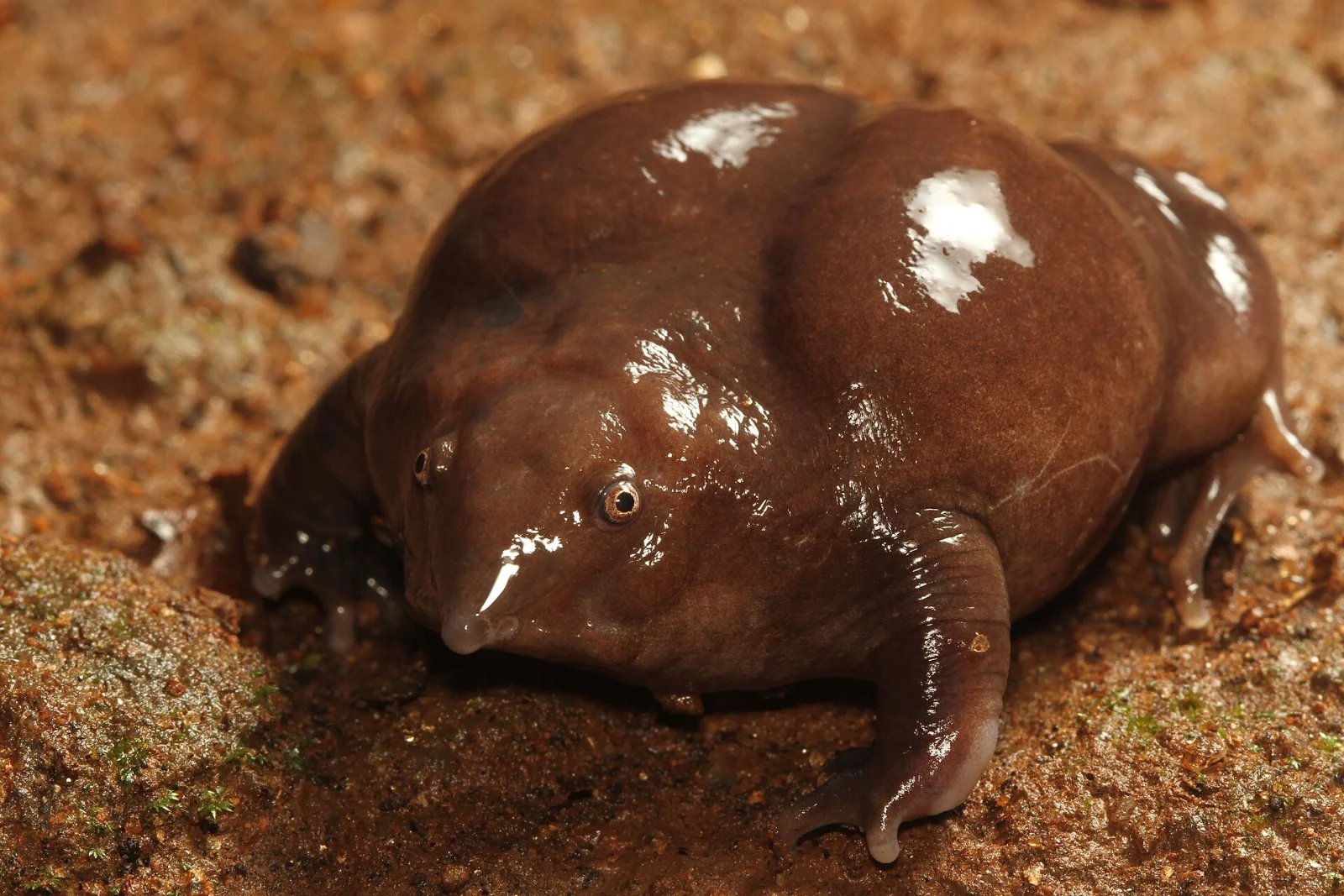
For most of the year it lives a metre or more under the soil of the Western Ghats, in the dark, eating termites. Then, when the first heavy rains of the monsoon soak the hills of Idukki, it digs its way up, calls from the edge of a swollen stream, mates, and is gone again, sometimes within a single night. Few people in Kerala have ever seen it. Scientists did not give it a name until 2003.
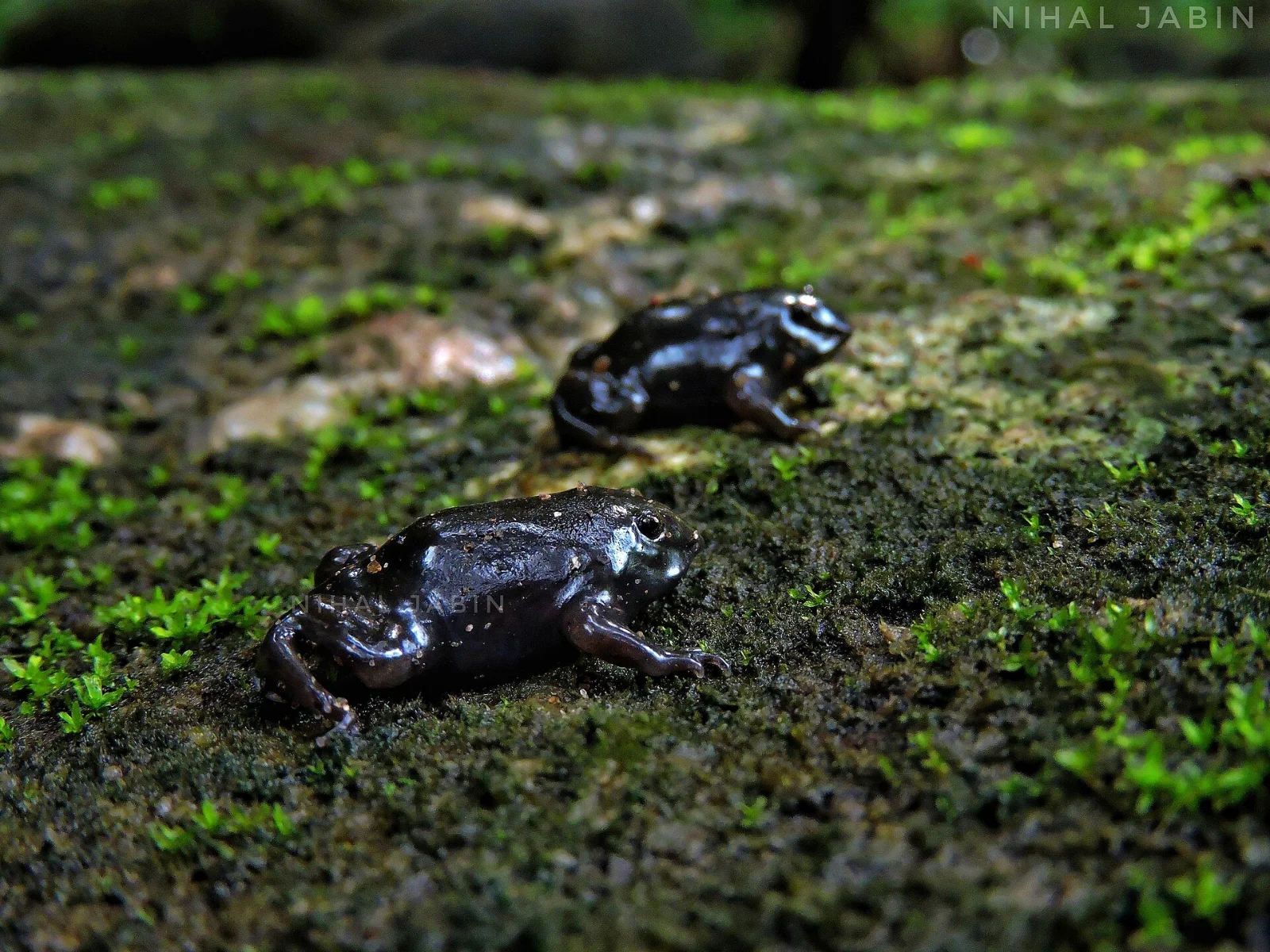
It is the purple frog, Nasikabatrachus sahyadrensis, and it is one of the strangest animals in India: a soft, swollen, purple-grey frog with a tiny head and a pig's snout, whose closest living relatives live on a handful of islands in the Seychelles, some 2,500 km away across the Indian Ocean. This article tells the story of how it was found near Kattappana, how it lives, why biologists call it a living fossil, and the names local people gave it long before science did. As always, our own assessments are clearly marked.
At a glance
- Name: Nasikabatrachus sahyadrensis Biju & Bossuyt, 2003. Purple frog, pig-nosed frog; in Malayalam pathala thavala, ‘the frog of the underworld’; since about 2019 also the ‘Mahabali’ or ‘Maveli’ frog.
- Type locality: disturbed secondary forest beside a cardamom plantation at Kattappana, Idukki district, at about 900 m. The type specimen, an adult female, was collected by S. D. Biju in July 2000.
- Family: Nasikabatrachidae, created for it in 2003. Its sister group, the Sooglossidae, lives only in the Seychelles.
- Size: the type specimen measured 7 cm from snout to vent; males are much smaller than females.
- Life: burrows underground for most of the year and feeds on termites; surfaces briefly at the start of the monsoon to breed in fast seasonal streams.
- Range: the Western Ghats of Kerala and adjoining Tamil Nadu, reported from the Ashambu hills in the south to Wayanad in the north.
- Sister species: N. bhupathi, described in 2017 from the eastern slopes of the Ghats in Tamil Nadu.
A frog from the cardamom hills
Kattappana sits in the heart of Idukki's cardamom country, the high, rolling land between Thekkady and Munnar where shade trees shelter rows of spice plants. In July 2000 the Indian herpetologist Sathyabhama Das Biju, then at the Tropical Botanic Garden and Research Institute at Palode, collected an adult female frog there, in disturbed secondary forest beside a cardamom plantation. It looked like no frog he knew.
Biju worked with the Belgian evolutionary biologist Franky Bossuyt at the Vrije Universiteit Brussel. They compared the frog's anatomy with every known family and sequenced its DNA. The answer, published in the journal Nature on 16 October 2003, was startling. The frog did not belong to any living family. It needed a family of its own, which they named Nasikabatrachidae. Its closest relatives were not in India at all, but on the granitic islands of the Seychelles.
The name is a portrait in three languages. Nasika is Sanskrit for nose, batrachos is Greek for frog, and sahyadrensis means ‘of the Sahyadri’, the old name for the Western Ghats. The next day Indian newspapers carried the story of a seven-centimetre purple frog that had been hiding under the cardamom since the age of the dinosaurs.
Found, or only described?
The frog was new to the scientific catalogue, but it was not new to the world. Its tadpoles had already been described, without anyone realising what they were. In 1917 the zoologist Nelson Annandale, director of the Zoological Survey of India, and C. R. Narayan Rao published a note on Indian tadpoles that included a strange larva with a sucker for a mouth, and in 1918 Annandale described more ‘undescribed tadpoles from the hills of southern India’. In 2007 the herpetologist Indraneil Das pointed out that these forgotten descriptions, and other earlier specimens, had been overlooked in 2003.
And the people of the hills had always known it. Farmers turned it up when digging, and tribal and settler families caught its tadpoles in the monsoon streams. It had names: pathala thavala, the frog of pathalam, the underworld; and, in some communities, different names for the two sexes, Kuravan for the male and Kurathi for the female, as the frog researcher Sandeep Das has recorded.
Our assessment: a discovery for science, not for Kerala
It is accurate to say the purple frog was scientifically described in 2003, and that its place in the tree of life was unknown until then. It is not accurate to say it was ‘discovered’ in 2003. Its tadpoles were in print by 1917, and the people who farmed and fished the hills had names for it long before.
The 2003 paper's real achievement was different and still remarkable: it showed that this unknown frog was the last Indian survivor of a lineage older than the Indian Ocean.
A body built for the dark
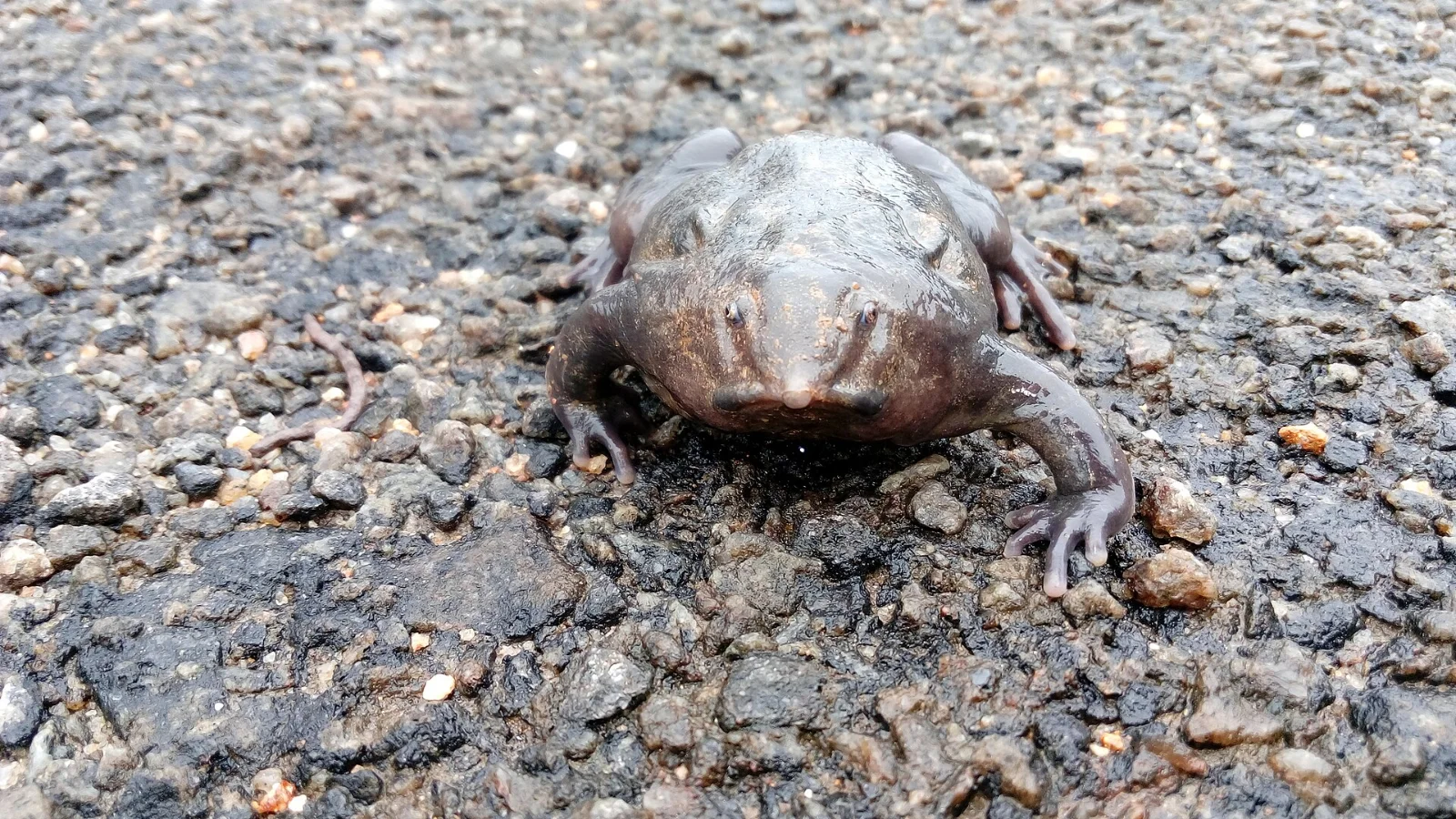
Almost everything about the purple frog makes sense once you know that it lives underground. It is fossorial, a burrower. Its body is round and soft, its limbs short and strong, its head small, its eyes tiny. The skull is wedge-shaped, and researchers who studied its development suggest it digs head first, pushing the pointed snout into the soil.
Underground it hunts termites and ants. The pointed snout fits into narrow termite tunnels, and the frog picks up insects with its tongue, helped by a groove in its mouth. Studies of its feeding published in 2007 found termites to be the main food.
Even its love song is sung from below. Males call while still buried under a thin layer of soil near the breeding streams, a habit described in a 2014 study of the frog's voice. The call is a long, harsh sound, often compared to the clucking of a hen.
One night above ground
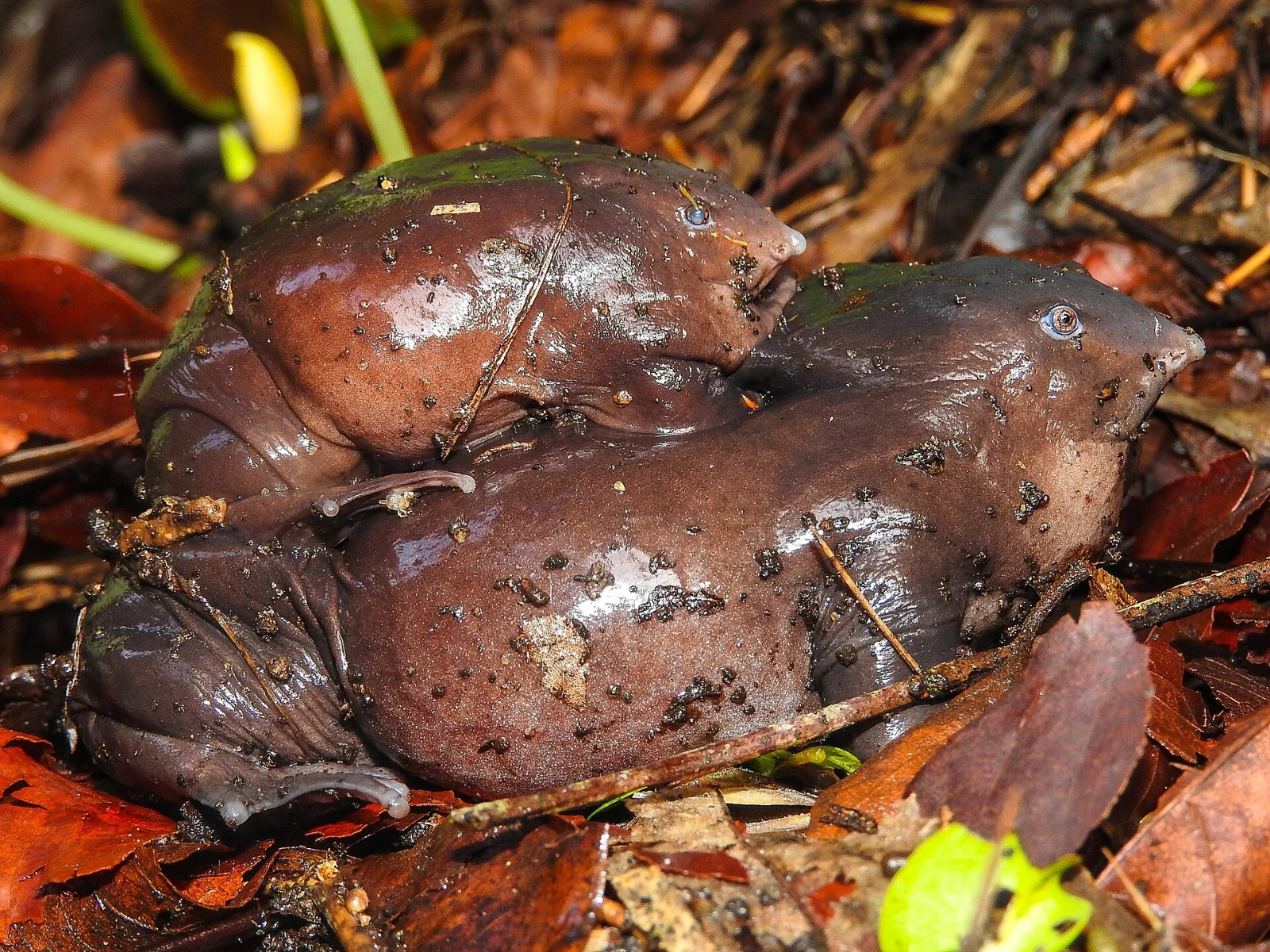
The purple frog's year turns on the rain. When the first heavy showers of the south-west monsoon arrive, usually between late May and June, seasonal streams that were dry gravel a week before begin to run. The frogs come up to meet them.
How long they stay above ground is a matter of some debate. Sandeep Das, who studied the species for years with the Kerala Forest Research Institute, describes adults emerging for about a day; other accounts speak of a breeding season of a few days to about two weeks. The pattern is the same: a brief, intense window at the start of the monsoon.
The tiny male climbs onto the female's back and holds on. She then carries him, sometimes a long way, to a crevice among the rocks of a fast-flowing stream. There she lays her eggs, a few thousand of them, about 3,000 according to a detailed 2012 study of the frog's breeding, and the male fertilises them. Then both return to the earth.
Between 2012 and 2019, Das and his colleagues recorded more than 600 breeding pairs. That sounds like a lot, until you remember that nobody yet knows how many purple frogs there are.
Tadpoles in the torrent
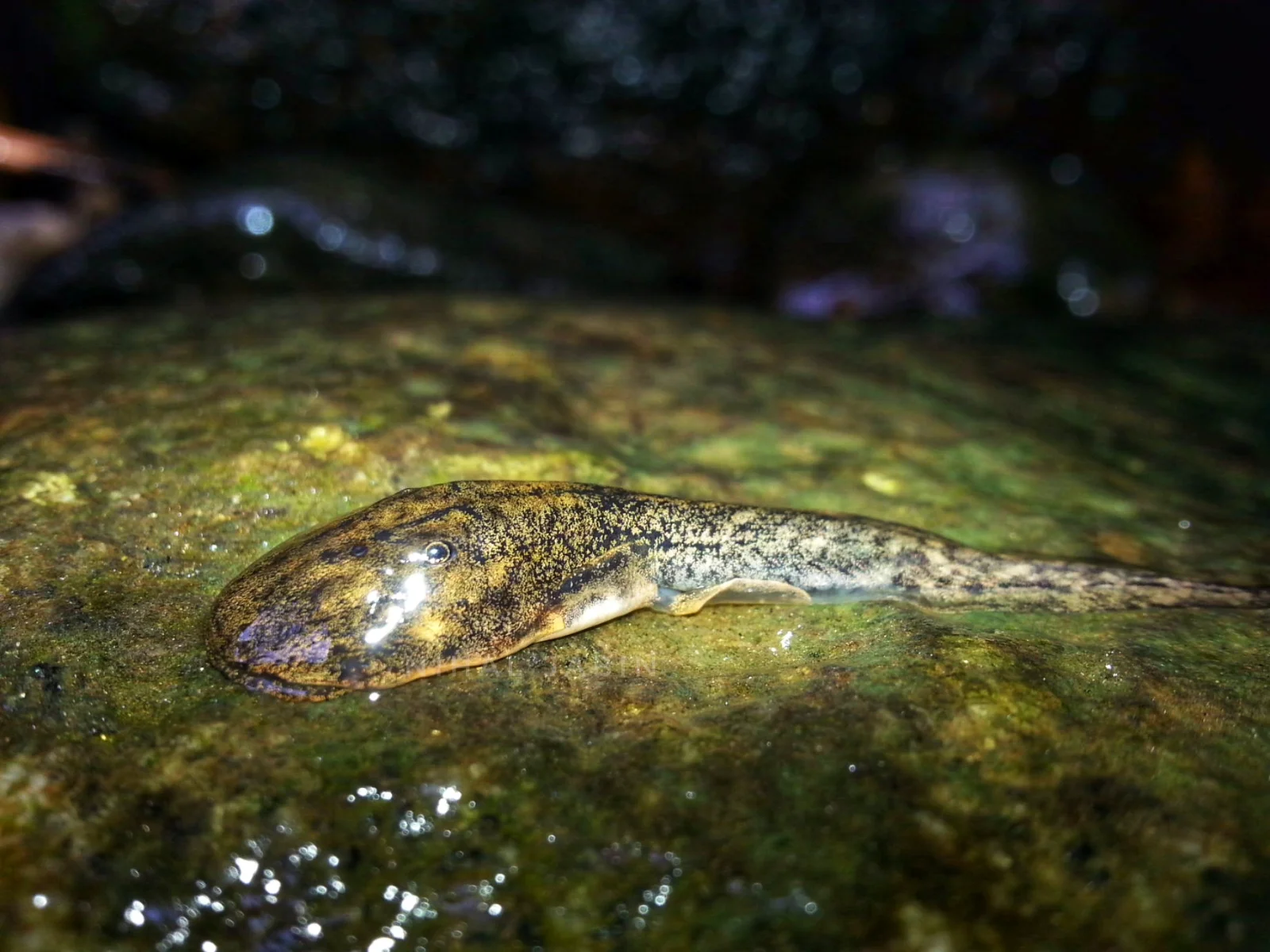
The tadpoles live in exactly the place you would expect a tadpole to be swept away: on the rocks of monsoon torrents and in the spray of small waterfalls. Their mouths form a broad sucker that grips the rock while the water pours over them.
Annandale saw this in 1917, long before he knew whose tadpoles they were. Working with S. L. Hora in 1922, he compared them with hill-stream fishes, which had evolved similar suckers. It is a fine example of convergent evolution: unrelated animals arriving at the same answer to the same problem.
The tadpoles take about 100 to 120 days to change into frogs, which means they must finish growing before the monsoon streams dry up after the rains.
Cousins across the ocean
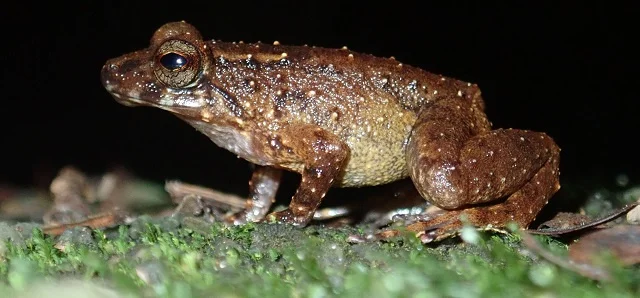
The most famous part of the purple frog's story is its family tree. Biju and Bossuyt's DNA analysis placed it as the sister group of the Sooglossidae, a family of small frogs found only on two of the granitic islands of the Seychelles. The 2003 paper described the Indian frog as “a sole survivor in India” of a lineage that may once have been far more varied.
The explanation lies in geology. More than 100 million years ago, India, Madagascar and the Seychelles were joined in the southern supercontinent of Gondwana. As it broke apart, Madagascar split away first, and later the Seychelles separated from India as India drifted north towards Asia. Frogs cannot cross salt water, so the ancestors of the purple frog and the sooglossids must have been separated by the breaking of the land itself. The 2003 study estimated that the two lineages had parted about 130 million years ago, in the Cretaceous.
That is why the purple frog is called a living fossil. It is not that the animal itself has not changed; it is that it belongs to a very old branch, with few living members, that has survived in one small corner of the world.
Our assessment: what ‘co-existed with dinosaurs’ means
Headlines love to say the purple frog lived alongside the dinosaurs. More precisely, its lineage did: the branch that leads to it split from its Seychelles cousins in the Cretaceous, when dinosaurs were still alive. The individual species we see today is much younger, and molecular dates like 130 million years come with wide margins of error.
The core finding, an ancient Gondwanan link between Kerala and the Seychelles, has held up well.
A second purple frog
For fourteen years the purple frog was thought to be the only member of its family. Then, in August 2017, a team led by S. Jegath Janani described a second species from the eastern slopes of the Ghats in Tamil Nadu, near the Srivilliputhur Grizzled Giant Squirrel Wildlife Sanctuary. They named it Nasikabatrachus bhupathi, Bhupathy's purple frog, after the herpetologist Subramanian Bhupathy, who died in a fall during fieldwork in the Agasthyamalai hills on 28 April 2014.
The new frog breeds with the later north-east monsoon on the eastern side of the mountains, while its western cousin breeds with the south-west monsoon. The authors suggested that this difference in timing, together with the tadpoles' need for monsoon cascades, helped split one ancient frog into two.
From Pathala to Maveli
Kerala's best-known story of someone who lives underground and comes up once a year is the legend of Mahabali, the generous asura king pushed down into the underworld by Vamana, who returns each Onam to visit his people. The comparison was waiting to be made.
It was made deliberately, as a conservation idea. Sandeep Das has explained that he was looking for a way to connect the frog with local culture and thought of linking its once-a-year emergence to the Mahabali story. His team began calling it the ‘Mahabali frog’, or Maveli, in awareness programmes, and the name spread quickly through the press.
So the frog now carries two kinds of name. Pathala thavala and the paired names Kuravan and Kurathi are old, local and earned by long acquaintance. ‘Maveli’ is new, chosen to make people care. Both are worth knowing; they should not be confused.
Kerala's state amphibian that wasn't
In November 2018 Kerala named the Buddha Mayoori, the Malabar banded peacock butterfly, as its state butterfly. That prompted Sandeep Das to propose a state amphibian, and in May 2019 he recommended the purple frog. The idea was that an official title would focus attention and protection on the species and its streams.
In November 2020 the Chief Wildlife Warden told reporters that the proposal was under active consideration. But when the State Wildlife Board met online on 19 January 2023, the Chief Minister objected, and the board set the matter aside. Reports of the meeting said he questioned naming as the state frog an animal that hardly anyone ever sees. As far as published reports show, the purple frog has not been given the title since.
- 1917Annandale and Rao describe Indian tadpoles, including the sucker-mouthed larva later recognised as the purple frog's.
- 1922Annandale and Hora compare these tadpoles with hill-stream fishes, a classic case of convergent evolution.
- July 2000S. D. Biju collects the type specimen near a cardamom plantation at Kattappana, Idukki.
- 16 Oct 2003Biju and Bossuyt describe Nasikabatrachus sahyadrensis and the new family Nasikabatrachidae in Nature.
- 2007Indraneil Das points out the overlooked earlier descriptions; feeding studies confirm a diet of termites.
- 2012A detailed account of breeding and development is published; field monitoring of breeding pairs begins.
- Aug 2017A second species, N. bhupathi, is described from the eastern Ghats slopes in Tamil Nadu.
- May 2019Sandeep Das proposes the purple frog as Kerala's state amphibian.
- 19 Jan 2023The State Wildlife Board sets the proposal aside.
Threats, and a mixed report card
The purple frog's world is the same world as Idukki's farms. More than half its known habitat lies outside protected areas, among plantations of cardamom, coffee and ginger. Its main threats are:
- Loss of forest along streams, as land is cleared or converted to crops.
- Changes to the streams themselves: check dams and diversions built in the monsoon can destroy the cascades the tadpoles need.
- Tadpole harvesting. A 2015 study documented that tadpoles are caught and eaten, mainly between July and September; adults and tadpoles are also used in folk medicine, and in some communities an amulet made from the frog is worn by children to calm their fear of storms.
- Roads. In the breeding season the frogs cross roads at night, and in Nelliyampathy field workers found more dead frogs on the roads than living ones.
Its official status has moved over the years. For a long time the IUCN Red List placed it as Endangered, and the EDGE of Existence programme of the Zoological Society of London ranks it among the world's highest priorities for amphibian conservation because it is so evolutionarily distinct. The most recent Red List assessment, made in 2022, lists it as Near Threatened. Researchers still describe it as threatened, and nobody yet has a reliable count.
Our assessment: what a better status really means
The move from Endangered to Near Threatened is good news, but probably more about knowledge than recovery: since 2003 the frog has been found over a much wider area than was first known. Its numbers have not been counted, its streams are still being changed, and more than half its range is unprotected. A burrowing animal that comes up for a day or two a year is exactly the kind that can decline unnoticed.
What is proven, and what is not
Fact, tradition and simplification
- Documented: the species was described by Biju and Bossuyt in Nature in October 2003, from a specimen collected near Kattappana, Idukki, in July 2000.
- Simplified: that it was ‘discovered’ in 2003. Its tadpoles were described in 1917, and local people already knew and named it.
- Documented: its closest living relatives are the Sooglossidae of the Seychelles.
- An estimate: the 130-million-year split. Molecular dates are approximate and have wide ranges.
- Partly true: that it surfaces for only one day a year. Adults are seen above ground very briefly at the start of the monsoon; accounts range from a single night to about two weeks of breeding activity.
- Modern: the name ‘Mahabali’ or ‘Maveli’ frog, coined by researchers for conservation outreach. Pathala thavala is the older local name.
- Documented: the proposal to make it Kerala's state amphibian was set aside by the State Wildlife Board in January 2023.
Seeing it, and leaving it alone
- You are very unlikely to see one. The purple frog is not a safari sight. Adults appear above ground for a few nights at the start of the monsoon, and breeding sites are not publicised, to protect them.
- If you do: watch from a distance, do not pick it up, and never move tadpoles or disturb stream rocks. A photograph without flash, if any, is enough.
- On monsoon night drives in Idukki, especially around cardamom country and Vagamon, drive slowly where streams cross the road. A frog on the tarmac may be this one.
- Report sightings to the Kerala Forest Department or a research group rather than sharing exact locations online.
- Where it lives: the cardamom hills around Kattappana and Kumily, Vagamon, and other mid-elevation forests of the Western Ghats.
The purple frog spent a hundred million years outliving the continent it was born on. Whether it outlives the next hundred depends on something much smaller: whether the streams of Idukki still run over open rock when the first rains come.
Read also: The Ecological Hotspots of Idukki · Wild Animals of Munnar and the Western Ghats · Cardamom, the Queen of Spices · Vagamon Travel Guide · The Cicadas of the Western Ghats
See it for yourself, with a local driver who knows these roads.
Book a Munnar Jeep SafariSources & further reading
- S. D. Biju and F. Bossuyt, 'New frog family from India reveals an ancient biogeographical link with the Seychelles', Nature 425: 711–714 (16 October 2003)
- Wikispecies: Nasikabatrachus sahyadrensis (holotype BNHS 4202, type locality Kattappana)
- AmphibiaWeb: Nasikabatrachus sahyadrensis
- D. R. Frost, Amphibian Species of the World: Nasikabatrachus sahyadrensis (American Museum of Natural History)
- N. Annandale and C. R. N. Rao, 'Indian tadpoles', Proceedings of the Asiatic Society of Bengal 13: 185–186 (1917); N. Annandale, 'Some undescribed tadpoles from the hills of southern India', Records of the Indian Museum 15: 17–23 (1918); N. Annandale and S. L. Hora, 'Parallel evolution in the fish and tadpoles of mountain torrents', Records of the Indian Museum 24: 505–510 (1922), Records of the Indian Museum on the Biodiversity Heritage Library
- I. Das, 'Some forgotten descriptions of Nasikabatrachus', Herpetological Review 38: 291–292 (2007); C. Radhakrishnan et al. and G. J. Measey et al. on range and feeding, Current Science 92(2) and 93(10) (2007)
- A. Zachariah et al., 'A detailed account of the reproductive strategy and developmental stages of Nasikabatrachus sahyadrensis', Zootaxa 3510: 53–64 (2012)
- A. Thomas, R. Suyesh, S. D. Biju and M. A. Bee, 'Vocal behavior of the elusive purple frog of India', PLOS ONE 9(2): e84809 (2014)
- G. Senevirathne et al., 'From clinging to digging: the postembryonic skeletal ontogeny of the Indian purple frog', PLOS ONE 11(3): e0151114 (2016)
- A. Thomas and S. D. Biju, 'Tadpole consumption is a direct threat to the endangered purple frog', Salamandra 51: 252–258 (2015)
- S. J. Janani et al., 'A new species of the genus Nasikabatrachus from the eastern slopes of the Western Ghats, India', Alytes 34: 1–19 (2017)
- S. Das et al., A Survival Blueprint for the Purple Frog, EDGE of Existence / Zoological Society of London (2019)
- EDGE of Existence: Purple frog
- Sandeep Das, 'The Mahabali frog', Sanctuary Nature Foundation (2019)
- Sandeep Das, 'Protecting the mysterious purple frog', Nature inFocus
- Onmanorama (16 Aug 2025): Mahabali frog or purple frog, conservation efforts
- The South First (27 Jan 2023): How an underground lifestyle cost the Mahabali frog the tag of official amphibian of Kerala
- The Tribune (8 Nov 2020): 'Mahabali frog' may be Kerala's official amphibian
- Scientific American (2003): Scientists discover new frog family
- National Geographic (2017): New purple pig-nose frog found
- Wikipedia: Purple frog
Figures are from the sources listed and were checked in November 2026. Park timings and road conditions change, so please confirm before you travel.