
Cheeveedu: The Cicadas of the Western Ghats
They spend most of their lives hidden underground, emerge for a few weeks of sunlight, and fill the forests with one of the loudest sounds in the insect world. Cicadas are everywhere in the Western Ghats, yet science is only now beginning to name and understand them.
On a hot afternoon in the forests of the Western Ghats, before the monsoon breaks, a sound rises from the trees: a shrill, pulsing, metallic whine that seems to come from everywhere at once. It swells and fades, is taken up by another singer and then another, until the whole hillside rings. Most people in Kerala know the sound, and most call its maker cheeveedu. Few have ever seen one clearly.
The singers are cicadas, some of the most remarkable insects on earth. They are also among the least studied in India. In the last decade, researchers working in the Western Ghats have begun to discover just how many kinds there are, and how many of them are found nowhere else.
At a glance
- Classification: order Hemiptera (true bugs), superfamily Cicadoidea; more than 3,000 species worldwide.
- In India: between about 200 and 250 described species, with many more likely still undescribed.
- Malayalam: cheeveedu, a name often used loosely for both cicadas and crickets.
- Life cycle: egg, several years as an underground nymph feeding on root sap, then a few weeks as a winged adult.
- Sound: produced by males using drum-like organs called tymbals; some species exceed 100 decibels at close range.
What is a cicada?
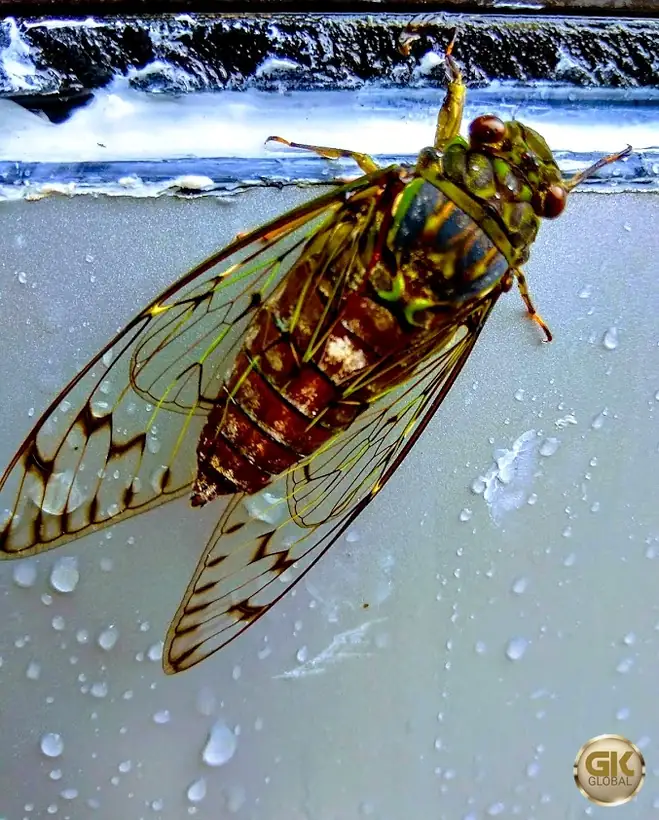
Cicadas are true bugs, relatives of leafhoppers, plant-hoppers and aphids. Like them, they feed by piercing plants with a beak-like mouthpart and sucking sap. Adult cicadas are stout insects, from about 1 cm to 7 cm long in India, with a broad head, two large compound eyes set wide apart, three tiny simple eyes (ocelli) between them, and two pairs of membranous wings, usually clear and finely veined, held like a roof over the body. Some species have patterned or coloured wings.
Cicadas are often confused with crickets and grasshoppers, which also sing. But crickets and grasshoppers belong to a different order (Orthoptera), have chewing mouthparts and produce sound by rubbing body parts together. Cicadas produce their sound in a completely different way, and they mainly sing by day, while most crickets sing at night.
A life spent underground
The life of a cicada is mostly hidden from view.
- Eggs. After mating, the female uses a blade-like egg-laying organ (ovipositor) to cut slits in twigs or bark, and lays her eggs inside.
- Nymphs. When the eggs hatch, tiny nymphs drop to the ground and burrow into the soil. There they attach themselves to roots and feed on the watery sap of the plant's xylem, which is very poor in nutrients. Partly for this reason, they grow very slowly, moulting several times underground over a period of several years.
- Emergence. When the nymph is fully grown, usually triggered by soil temperature or the coming of the rains, it digs its way to the surface, often at night, climbs a tree trunk or plant stem, and grips tightly. Its skin splits down the back, and the soft, pale adult slowly pulls itself free, pumping fluid into its crumpled wings to expand them. Within hours, its body hardens and darkens. The empty, brown nymphal skins (exuviae), still clinging to bark and leaves, are often the easiest sign that cicadas are present.
- Adulthood. Adult cicadas live only a few weeks. They feed on sap from branches, sing, mate and lay eggs, and then die.
Most cicadas have annual life cycles: although each individual spends several years underground, the generations overlap, so adults appear every year. In North America, the famous periodical cicadas (Magicicada) spend 13 or 17 years underground and then emerge all at once in their millions. In India, almost all known cicadas are thought to be annual. A remarkable exception is Chremistica ribhoi of Meghalaya, which emerges in large numbers every four years and is known locally as the "World Cup cicada".
The loudest insects
Only male cicadas sing. On each side of the first segment of the abdomen they have a tymbal, a ribbed, drum-like membrane. Powerful muscles pull the tymbal inwards, buckling its ribs one after another with a click, and it springs back when the muscle relaxes. This happens hundreds of times a second, producing a continuous buzz. Much of the male's abdomen is hollow and acts as a resonating chamber, amplifying the sound. Some cicadas are among the loudest insects in the world, exceeding 100 decibels at close range.
Each species has its own song, differing in pitch, rhythm and pattern, and females are attracted to the songs of their own species. Cicadas hear with membranes called tympana on the abdomen. Many species also produce distress calls when caught. In the Western Ghats, the song is so distinctive that it has become one of the most important tools for telling species apart: researchers now record and analyse cicada songs alongside the shape of their bodies and genitalia.
Cicadas generally sing most in the heat of the day and in warm, dry weather. In Kerala, many species are loudest in the hot months before the monsoon, when the forest seems to ring with their song.
The cicadas of the Western Ghats
Much of what is known about Indian cicadas still comes from the work of the British entomologist W. L. Distant, who described many species from museum specimens in the late nineteenth and early twentieth centuries, often without knowing where exactly they had been collected or what their songs sounded like. For most of the twentieth century, cicadas were largely ignored by Indian scientists.
That has changed. Researchers at institutions such as the National Centre for Biological Sciences in Bengaluru and the Travancore Nature History Society in Thiruvananthapuram, along with field entomologists across India, have begun to survey cicadas systematically, recording their songs and comparing specimens with historic collections in Europe. Their work has revealed that the Western Ghats hold many cicadas found nowhere else, and that several species long believed to be widespread were wrongly identified. Among recent discoveries:
- Pomponia pseudolinearis (2021): described by Kalesh Sadasivan from specimens collected on a cardamom estate at Swargam Medu in Idukki, and later from Rajakumari (Idukki), Ponmudi and Bonacaud. It had long been mistaken for P. linearis, a species that may not occur in the Western Ghats at all. It is distinguished by the structure of the male genitalia and by its song.
- Purana cheeveeda: a cicada of the southern Western Ghats long thought to be Purana tigrina, a species described from Malaysia in 1850. A study led by Sadasivan showed that the Indian insect is a distinct species, and named it after its Malayalam name, cheeveedu.
- Sahyaterpnosia laevospina (2023): a new genus and species from the hill forests of the Agasthyamalai hills of Kerala and Tamil Nadu, described by Kalesh Sadasivan and Vivek Sarkar. The genus name combines Sahyadri, the Indian name for the Western Ghats, with the related genus Terpnosia.
- Rustia minuta and Rustia kodagura (2018): two tiny cicadas, less than a centimetre long, from Goa and Kodagu, discovered by Kiran Marathe of the National Centre for Biological Sciences.
These discoveries show that the true diversity of cicadas in the Western Ghats is still unknown, and that a cardamom estate in the hills of Idukki can still yield a species new to science.
Peculiarities and wonders
- Cicada "rain". Because they feed on watery xylem sap, cicadas take in large volumes of fluid and excrete the excess as fine jets. People walking under trees full of cicadas sometimes feel a light shower on a dry day.
- Masters of camouflage. Despite their loud songs, cicadas are very hard to see: their bark-coloured or green bodies and clear wings blend perfectly with branches, and they fall silent and move to the other side of a branch when approached.
- Food for many. Cicadas are eaten by birds, lizards, bats, spiders, wasps and other predators. Their emergence provides a feast for forest animals.
- Soil engineers. The burrows of millions of nymphs help aerate the soil, and their bodies return nutrients to it.
- Symbols of rebirth. In ancient China, jade cicadas were placed in the mouths of the dead as symbols of resurrection, inspired by the insect's emergence from the earth. In ancient Greece, cicadas were symbols of music and of immortality.
- Silent Valley? The name of Kerala's Silent Valley is often said to come from the absence of cicadas there. Entomologists point out that the forest has plenty of cicadas, and suggest that whoever named it simply visited at a time when they were not singing.
Why cicadas matter
Cicadas are not protected under India's Wildlife (Protection) Act, and very few species have been assessed for the IUCN Red List. Yet they are an important part of forest ecosystems, and because each species has its own song and many depend on particular trees and forests, scientists believe that the cicada chorus could become a useful indicator of forest health. The loss and fragmentation of forests, the use of pesticides in plantations, and changes in climate that alter the timing of rain and heat could all affect them, but without basic information on which species live where, it is impossible to know.
The cicadas of the Western Ghats are a reminder of how much remains to be discovered, even in the most familiar sounds of the forest. The next time you hear a cheeveedu singing on a hot afternoon, listen carefully: it may be a species that science has only just named, or one that has not been named at all. (Read also our article on the butterflies and moths of Munnar, and see more insects in our photo gallery.)
A note for observers
- Recordings of cicada songs, with the date, time, place and if possible a photograph of the singer, are valuable to researchers. Citizen-science platforms such as iNaturalist and India Biodiversity Portal accept such records.
- Please do not collect cicadas. Photograph them where they are, and leave the empty nymphal skins on the trees.
See it for yourself, with a local driver who knows these roads.
Book a Munnar Jeep SafariSources & further reading
- Scroll.in (2018): Sounds of cicadas: a loud but under-studied insect is finally getting due attention
- Mongabay India (2018): Following the sound trail: pulling India's cicadas out of oblivion
- Mongabay India (2026): The insect that makes forests sing
- Sadasivan, K. (2021). A new species of Pomponia from the Western Ghats. Zootaxa 5040(3): 388–403
- inkl: Research corrects mistaken identity of cicada (Pomponia pseudolinearis, Idukki)
- IAS Gyan: Cicada species (Purana cheeveeda)
- Sadasivan & Sarkar (2023). A new genus and species of cicada from the Agasthyamalai hills. Journal of Asia-Pacific Biodiversity 16(2): 163–173
- NovaTaxa (2024): Sahyaterpnosia laevospina, a new cicada genus and species
- Roundglass Sustain: Cicadas
Figures are from the sources listed and were checked in October 2026. Park timings and road conditions change, so please confirm before you travel.