
Tahr, Tigers and a Ghost Civet: The Wild Animals of Munnar and the Western Ghats
The Western Ghats are older than the Himalaya and hold animals found nowhere else on earth. Many of them are now endangered. A field naturalist's account of the mammals, reptiles and amphibians of Munnar and the southern Ghats, the threats they face, and the reasons for hope.
Stand on the grassy shoulder of Rajamala at dawn and the land falls away on every side: rolling grassland, dark pockets of forest in the folds of the hills, cliffs dropping into mist, and far below, the tea estates of Munnar. A herd of Nilgiri tahr grazes a few metres from the road. Somewhere in the forest a Malabar giant squirrel chatters, and a sambar barks in alarm. It is easy to forget, in a moment like this, that you are standing in one of the most threatened landscapes on earth.
The Western Ghats run for about 1,600 km along the western edge of peninsular India, from Gujarat to the southern tip at Kanyakumari. The range is older than the Himalaya. Together with Sri Lanka, it is one of the world's 36 biodiversity hotspots: places that are extraordinarily rich in species found nowhere else, and that have already lost most of their natural vegetation. In 2012 UNESCO inscribed the Western Ghats as a World Heritage Site, citing their exceptional levels of endemism.
Munnar sits at the heart of the richest part of the range. This article looks at the wild animals of Munnar and the southern Western Ghats, with particular attention to the species that are now endangered: what they are, where they live, why they are in trouble and what is being done for them.
At a glance
- Highest point: Anamudi, 2,695 m, inside Eravikulam National Park: the highest peak in India south of the Himalaya.
- Protected areas around Munnar: Eravikulam National Park, Anamudi Shola, Pampadum Shola and Mathikettan Shola National Parks, Kurinjimala Sanctuary and Chinnar Wildlife Sanctuary, with Tamil Nadu's Anamalai Tiger Reserve on the eastern side.
- Flagship species: Nilgiri tahr, Asian elephant, tiger, gaur, lion-tailed macaque, Nilgiri marten, grizzled giant squirrel.
- Most threatened: the Malabar large-spotted civet (Critically Endangered, possibly extinct) and the resplendent shrub frog (Critically Endangered, found only on the summit of Anamudi).
Islands in the sky
Why do the Western Ghats hold so many animals found nowhere else? The answer lies in their geography and their long history.
For millions of years, the Ghats have been a long, wet mountain wall facing the southwest monsoon. The rain that falls on their western slopes feeds tall evergreen forests. Over time, the climate of India has swung between wetter and drier periods. In the dry periods, the forests of the Ghats were cut off from the forests of northeast India and Southeast Asia, and their animals evolved in isolation.
Within the Ghats, there are further barriers. The most important is the Palghat Gap, a 30 to 40 km break in the mountains near Palakkad. The hills to the south of it, including the Anamalai, the High Range of Munnar, the Palani Hills, the Cardamom Hills and the Agasthyamalai, form a separate block. Many animals and birds on either side of the gap have become distinct species.
At the highest altitudes, above about 1,800 m, the hills carry a unique vegetation: rolling montane grasslands broken by small, dense patches of stunted evergreen forest called sholas. Each high plateau is like an island in the sky, separated from the next by warmer valleys. Animals adapted to the cold, wet summits cannot easily move between them. This is why some species, like the resplendent shrub frog, live on a single mountain and nowhere else.
Munnar has the full range of these habitats within a day's drive: the grasslands and sholas of Eravikulam and the Anamudi massif; the wet evergreen and semi-evergreen forests on the slopes towards the west; and, only 60 km to the northeast, the dry thorn scrub and deciduous forest of Chinnar, in the rain shadow of the Ghats, where some places receive as little rain as the plains of Tamil Nadu.
How we measure danger
Throughout this article, we use the categories of the IUCN Red List of Threatened Species, the global standard for judging the risk of extinction. In order of increasing risk, the main categories are Least Concern, Near Threatened, Vulnerable, Endangered and Critically Endangered. The last three together are called "threatened". The categories are based on measurable criteria such as population size, rate of decline and the size of a species' range.
In India, wild animals are also protected under the Wildlife (Protection) Act, 1972. Most of the threatened species in this article are listed in its Schedule I, the highest level of legal protection, under which hunting, capture and trade are serious offences.
The endangered
Nilgiri tahr (Endangered)
No animal is more closely linked with Munnar than the Nilgiri tahr (Nilgiritragus hylocrius), a stocky wild mountain goat of the cliffs and grasslands. It is found only in the Western Ghats of Kerala and Tamil Nadu, and only in the high hills south of the Nilgiris. It is the state animal of Tamil Nadu.
The tahr was hunted heavily in the colonial period, and by the 1960s its numbers had fallen to a few hundred animals scattered across isolated hilltops. The planters of the High Range, through the High Range Game Preservation Association, began protecting the Eravikulam herd in the early twentieth century, and the plateau became a sanctuary in 1975 and a national park in 1978.
In 2025, Kerala and Tamil Nadu carried out their first joint, synchronised census of the species. Survey teams counted 2,668 tahr: 1,365 in Kerala and 1,303 in Tamil Nadu. Eravikulam National Park, with 841 animals, holds the largest single population. Officials credited careful grassland management, including controlled burning, for the healthy numbers. Tamil Nadu has also launched a dedicated conservation programme, Project Nilgiri Tahr.
The tahr remains Endangered because its total population is small and broken into many separate groups. Its grasslands are threatened by invasive trees such as wattle, eucalyptus and pine, by fire, and in the long run by a warming climate that pushes the cool grasslands further up the mountains, where there is nowhere left to go. (Read more in our article on the Nilgiri tahr.)
Asian elephant (Endangered)
The Asian elephant (Elephas maximus) is the largest land animal in Asia and the great gardener of its forests, opening paths, dispersing seeds and shaping the vegetation as it moves. The Western Ghats hold the largest population of Asian elephants in the world.
In October 2025, the Wildlife Institute of India released the results of the first nationwide elephant count based on DNA from dung samples. It estimated 22,446 wild elephants in India, of which 11,934, more than half, live in the Western Ghats. Karnataka had 6,013, Tamil Nadu 3,136 and Kerala 2,785. The previous count, in 2017, had given 27,312 for India as a whole. Because the methods were different, the two figures cannot be compared directly, but the new survey has added to concern about the species' future.
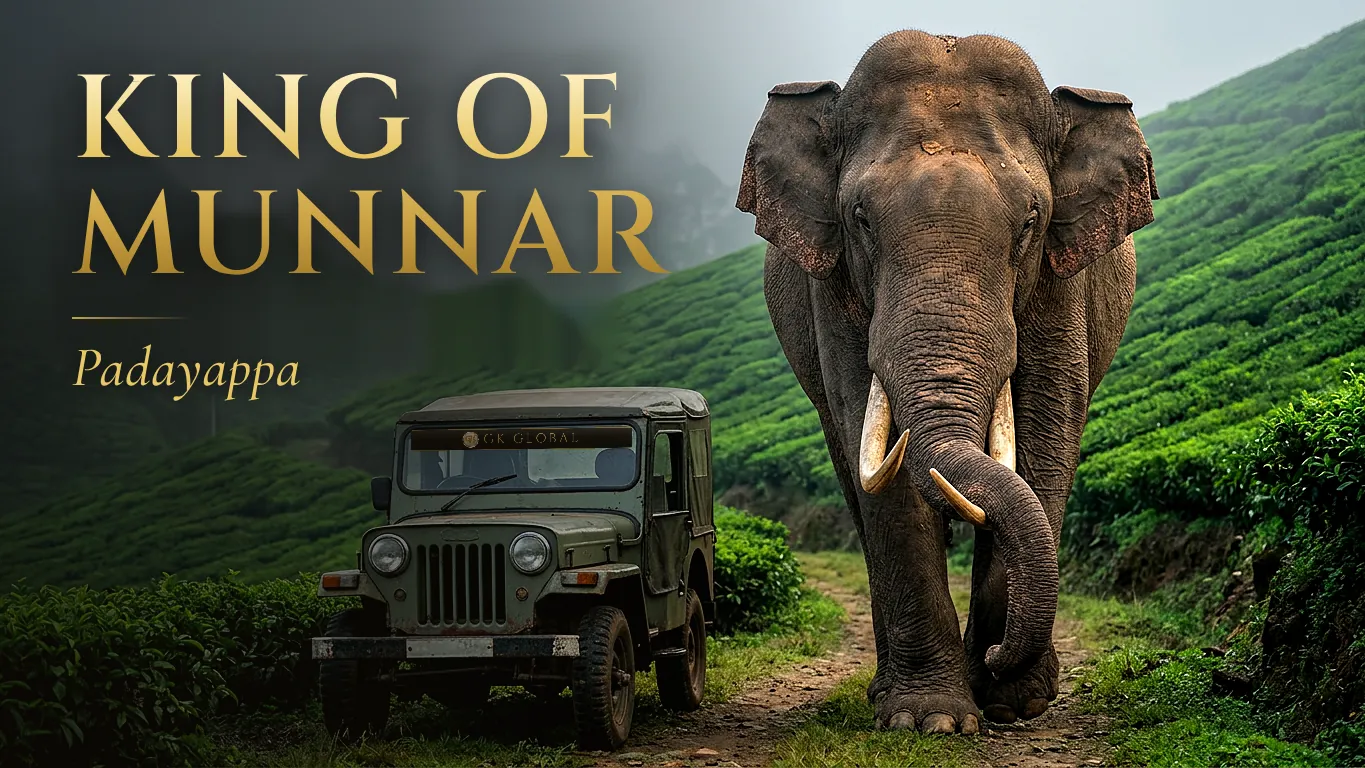
Munnar is elephant country. The name of the Anayirangal dam near Chinnakanal means "where the elephants come down", and the herds still move along old paths between the forests and the river valleys. As the forests have been broken up by plantations, roads, settlements and reservoirs, elephants increasingly pass through tea estates and towns. Conflict between people and elephants is one of the most serious conservation problems in the High Range today. The tusker known as Padayappa has become the most famous face of this story.
Tiger (Endangered)
The tiger (Panthera tigris) is rarely seen around Munnar, but it is here. Camera traps in the protected areas of the High Range, and occasional cattle kills on estates, show that tigers move through the hills, connected to the larger populations of the Anamalai and Parambikulam tiger reserves to the north and the Periyar Tiger Reserve to the south.
India's most recent national tiger estimate, published in 2023 for the year 2022, found that tiger numbers in the country as a whole had grown. The Western Ghats were an exception: the estimate for the landscape fell from 981 in 2018 to 824 in 2022. The report linked the decline to the growing human footprint and to the loss of tigers outside protected areas, while populations within well-protected reserves were stable. Kerala's estimate rose from 190 to 213.
Lion-tailed macaque (Endangered)
With its glossy black coat, silver-white mane and tufted tail, the lion-tailed macaque (Macaca silenus) is one of the most striking primates in the world. It lives only in the tall, wet evergreen forests of the Western Ghats and spends almost its whole life in the canopy, feeding on fruit, seeds, insects and small animals.
The species is listed as Endangered. There are thought to be about 4,000 in the wild, with fewer than 2,500 mature individuals, divided into some 47 isolated groups in Karnataka, Kerala and Tamil Nadu. Because the macaque needs unbroken rainforest, it has suffered more than almost any other mammal from the clearing of the Ghats for plantations, dams and roads. In the plateau of Valparai, just across the border from Munnar in the Anamalai Hills, troops survive in small forest fragments surrounded by tea, and conservationists have built canopy bridges to help them cross roads safely.
The lion-tailed macaque became the symbol of the 1970s campaign that saved Silent Valley in Palakkad from a hydroelectric dam, one of the founding moments of India's environmental movement.
Dhole (Endangered)
The dhole or Asiatic wild dog (Cuon alpinus) is a rust-red pack hunter that whistles to keep in touch with its pack. Packs of a dozen or more animals hunt deer and wild pigs by running them down together. Dholes once ranged across much of Asia but have disappeared from most of it. The forests of the Western Ghats, including the Anamalai, Parambikulam and Periyar landscapes, are among their most important remaining strongholds, and packs are occasionally seen in Chinnar and the forests around Munnar.
Indian pangolin (Endangered)
The shy, nocturnal Indian pangolin (Manis crassicaudata) is covered in overlapping scales and feeds on ants and termites, which it digs out with its powerful claws. When threatened, it rolls into a ball. Pangolins are the most trafficked wild mammals in the world: their scales are smuggled for use in traditional medicine and their meat is eaten. Seizures of pangolins and pangolin scales are regularly reported from Kerala and Tamil Nadu, and the species is listed as Endangered.
Salim Ali's fruit bat (Endangered)
One of the rarest mammals in India is a small fruit bat named after the great ornithologist Salim Ali. Latidens salimalii was first collected in the High Wavy Mountains of Tamil Nadu, across the hills from Munnar, and is known from only a handful of places in the southern Western Ghats. It belongs to a genus found nowhere else on earth. Very little is known about how it lives, and it has been named as a priority for conservation funding in Tamil Nadu.
The critically endangered
Malabar large-spotted civet: a ghost of the lowlands
In the nineteenth century, the Malabar large-spotted civet (Viverra civettina) was considered common in Travancore. It lived in the lowland forests along the Malabar coast, from Karnataka to Kanyakumari. Civets were kept in captivity by merchants, who collected a musky secretion from their scent glands for use in perfume and medicine.
As the lowland forests were cleared for rubber, cashew and other crops, the civet vanished. By the late 1960s it was thought to be nearly extinct. A few skins were obtained near Nilambur in 1987 and 1990, and a single animal was reported in Kerala in 1987. Since then, camera-trap surveys have failed to find it. The IUCN lists it as Critically Endangered, possibly extinct, with fewer than 250 mature individuals if any survive at all. Some scientists have even questioned whether it was a distinct species. In 2020, a video of a civet walking down a road in Kozhikode during the COVID-19 lockdown was widely shared as a rediscovery, but experts identified the animal as the common small Indian civet.
The Malabar civet is a warning of what can happen to a Western Ghats species when its habitat disappears.
Resplendent shrub frog: a whole species on one mountain
Near the summit of Anamudi, among moss-covered rocks and dwarf bamboo, lives a small, brightly coloured frog that was described by science only in 2010. The resplendent shrub frog (Raorchestes resplendens) is known from nowhere else in the world. Its entire known area of occupancy is less than 3 square kilometres, and there are thought to be fewer than 300 mature adults. It is listed as Critically Endangered.
The frog shows both the treasure and the fragility of the sky islands. Because it lives on the very top of the highest mountain in South India, a warming climate leaves it no cooler place to retreat to. It is one reason why the summit of Anamudi is closed to casual visitors.
The vulnerable
Nilgiri marten
The Nilgiri marten (Martes gwatkinsii) is the only marten native to southern India: a sleek, deep brown, tree-climbing hunter with a bright yellow-orange throat, about the size of a large cat. It is active by day and hunts birds, small mammals including the Malabar giant squirrel, and insects, and also eats fruit. It lives mainly in the montane rainforests and sholas of the southern Western Ghats, and has been recorded in Eravikulam and Pampadum Shola. It is rarely seen, little studied and listed as Vulnerable. A sighting of a Nilgiri marten is one of the great prizes for any naturalist in the High Range.
Nilgiri langur
The Nilgiri langur (Semnopithecus johnii) is a glossy black monkey with a golden-brown head, found only in the southern Western Ghats. It is common in the sholas and forests around Munnar, where its deep, booming call carries across the valleys. It was once hunted for its fur and for its flesh, which was falsely believed to have medicinal value, and is listed as Vulnerable.
Gaur
The gaur or Indian bison (Bos gaurus) is the largest wild cattle in the world: a massive, dark animal with white "stockings" and a muscular ridge along its back. Herds graze on the grasslands and estate edges around Munnar and are now often seen near the town. The gaur is listed as Vulnerable across its range.
Sambar, leopard and sloth bear
The sambar (Rusa unicolor), the largest deer in India, is common in the sholas of Munnar, but across Asia it has declined so much from hunting that it is listed as Vulnerable. The leopard (Panthera pardus) is the most adaptable of the large predators and lives even on the edges of tea estates and towns. The sloth bear (Melursus ursinus), shaggy and long-clawed, feeds on termites, fruit and honey, and is found in the drier forests of Chinnar and Marayoor. Both are listed as Vulnerable.
Otters
Two otters live in the rivers and streams of the region. The smooth-coated otter (Lutrogale perspicillata) lives in larger rivers and reservoirs, and the Asian small-clawed otter (Aonyx cinereus), the smallest otter in the world, in hill streams. Both are listed as Vulnerable, threatened by polluted water, sand mining, dams and the illegal trade in their fur.
Reptiles of the rain shadow
Chinnar Wildlife Sanctuary is a refuge for two Vulnerable reptiles. The Indian star tortoise (Geochelone elegans), with its beautiful star-patterned shell, lives in the dry scrub and is one of the most smuggled tortoises in the world for the pet trade. The mugger crocodile (Crocodylus palustris) lives in the Chinnar and Pambar rivers. In the wet forests, the king cobra (Ophiophagus hannah), the longest venomous snake in the world, which builds a nest for its eggs, and the Travancore tortoise (Indotestudo travancorica) are also listed as Vulnerable.
Near threatened: the grizzled giant squirrel
In the riverside forests of Chinnar lives Kerala's only population of the grizzled giant squirrel (Ratufa macroura), a large, silver-grey tree squirrel with a long bushy tail. Outside India it is found only in Sri Lanka. In India it survives in a few patches of riverine forest along the eastern side of the Ghats in Kerala and Tamil Nadu, and its habitat is small and fragmented. It is listed as Near Threatened, and it is the flagship species of Chinnar, a sanctuary of about 90 square kilometres established in 1984.
Common neighbours, uncommon animals
Not every animal of Munnar is threatened. The Malabar giant squirrel (Ratufa indica), with its deep maroon and cream coat, leaps between trees in every forest patch. The Indian muntjac or barking deer gives its sharp alarm call from the undergrowth. The tiny Indian spotted chevrotain or mouse deer, which is not a true deer, slips through the forest floor at dusk. The stripe-necked mongoose, the largest mongoose in Asia, hunts along streams, and the brown palm civet, found only in the Western Ghats, feeds on fruit in the canopy at night. Bonnet macaques live around the towns and roads. Many of these species are endemic to the Western Ghats or to peninsular India and Sri Lanka, even if they are not yet in danger.
The amphibians of the region are an extraordinary story of their own. The Western Ghats hold more than 200 species of frogs, most of them endemic, and new species are still described almost every year. The bizarre purple frog (Nasikabatrachus sahyadrensis), described only in 2003, spends almost its entire life underground and comes to the surface for just a few days during the monsoon to breed. Its closest living relatives are found in the Seychelles, a relic of the time, more than 60 million years ago, when India was part of a larger southern landmass. It is listed as Endangered.
| Species | IUCN status | Where to look near Munnar |
|---|---|---|
| Malabar large-spotted civet Viverra civettina | Critically Endangered (possibly extinct) | Formerly the lowland forests of Kerala; no confirmed recent records |
| Resplendent shrub frog Raorchestes resplendens | Critically Endangered | Summit of Anamudi only (restricted area) |
| Nilgiri tahr Nilgiritragus hylocrius | Endangered | Eravikulam National Park (Rajamala) |
| Asian elephant Elephas maximus | Endangered | Chinnar, Anayirangal, Mattupetty, Marayoor, estate edges |
| Tiger Panthera tigris | Endangered | Rarely seen; moves through the protected areas of the High Range |
| Lion-tailed macaque Macaca silenus | Endangered | Rainforests of the Anamalai (Valparai) and the western slopes |
| Dhole Cuon alpinus | Endangered | Chinnar and the forests of the High Range |
| Indian pangolin Manis crassicaudata | Endangered | Nocturnal and very rarely seen |
| Purple frog Nasikabatrachus sahyadrensis | Endangered | Underground; surfaces briefly in the monsoon |
| Nilgiri marten Martes gwatkinsii | Vulnerable | Sholas of Eravikulam and Pampadum Shola |
| Nilgiri langur Semnopithecus johnii | Vulnerable | Sholas and forests around Munnar |
| Gaur Bos gaurus | Vulnerable | Grasslands and estate edges |
| Sambar Rusa unicolor | Vulnerable | Sholas and grasslands |
| Leopard Panthera pardus | Vulnerable | Widespread but secretive |
| Sloth bear Melursus ursinus | Vulnerable | Chinnar and Marayoor |
| Smooth-coated and small-clawed otters | Vulnerable | Rivers, reservoirs and hill streams |
| Indian star tortoise Geochelone elegans | Vulnerable | Dry scrub of Chinnar |
| Mugger crocodile Crocodylus palustris | Vulnerable | Chinnar and Pambar rivers |
| King cobra Ophiophagus hannah | Vulnerable | Wet forests of the western slopes |
| Grizzled giant squirrel Ratufa macroura | Near Threatened | Riverine forest of Chinnar |
What threatens them
The threats to the animals of the Western Ghats are well understood. Most of them come down to the loss and division of habitat.
- Fragmentation. Over the last 150 years, large areas of forest have been replaced by tea, coffee, cardamom, rubber and timber plantations, reservoirs, roads and towns. Around Munnar, the montane forests were cleared for tea from the 1880s onwards. What remains is often a patchwork of islands that wide-ranging animals like elephants and tigers must cross, and that forest specialists like the lion-tailed macaque cannot cross at all.
- Invasive plants. Wattle, eucalyptus and pine, planted in the twentieth century for fuel and timber, have spread into the high grasslands, crowding out the habitat of the tahr and the grassland birds.
- Conflict. As animals and people share an ever smaller space, elephants raid crops and ration shops, gaur and wild pigs enter farms, and leopards and tigers take cattle. Conflict creates hardship for estate workers and farmers, and anger that can turn against wildlife.
- Roads and traffic. Roads cut through forests and kill animals, from frogs and snakes to deer and leopards.
- Hunting and trade. Pangolins, star tortoises, otters and others are still trapped for the illegal wildlife trade.
- Waste. Open garbage dumps draw elephants, wild pigs and other animals towards towns, as the story of Padayappa at the Kallar waste plant has shown.
- Climate change. For animals of the sky islands, warming is a slow-moving emergency. As the climate warms, cool grasslands and sholas shift uphill. On a mountain, that means less and less space, and eventually none.
Reasons for hope
The story is not only one of loss. The recovery of the Nilgiri tahr from a few hundred animals to more than 2,600 shows what protection can do. Eravikulam, once a private hunting reserve of the planters, is now one of the best-managed national parks in India. The network of protected areas around Munnar, created between the 1970s and the 2000s, now protects most of the remaining high-altitude grassland and shola in Kerala. Restoration projects are removing invasive trees from grasslands and replanting sholas. Scientists continue to describe new species of frogs, reptiles and insects every year, a reminder of how much remains to be discovered.
The future of these animals depends above all on keeping the remaining forests connected, reducing conflict with the people who live alongside them, and treating the hills as a living landscape rather than a backdrop. (For the birds of the region, read our companion article, Songs of the Sky Islands.)
Seeing wildlife responsibly
A guide for visitors
- Keep your distance. Never approach, follow or try to feed wild animals, including tahr and macaques. Elephants and gaur can charge without warning.
- Stay in your vehicle when animals are close to the road, keep your voice low, and never use flash or play recorded calls.
- Follow the rules of Eravikulam, Chinnar and the other protected areas, and use only authorised trails and guides.
- Take all your waste with you. Food waste draws animals onto roads and into towns.
- Drive slowly on forest roads, especially at dawn, dusk and night, when animals cross.
- To explore the wild side of Munnar with experienced local drivers who know the animals and the rules, book a GK Global jeep safari.
A note on the figures
- IUCN Red List categories are given as published at the time of writing (November 2026). They are reviewed regularly and may change.
- The 2025 elephant estimate used DNA from dung samples and is not directly comparable with the 2017 count, which used different methods.
- Animal numbers in the wild are estimates with margins of error. We give the figures published by the forest departments and national institutes.
See it for yourself, with a local driver who knows these roads.
Book a Munnar Jeep SafariSources & further reading
- UNESCO World Heritage Centre: Western Ghats
- The South First (Aug 2025): Nilgiri tahr population rises to 2,668; Eravikulam leads
- DT Next: Tamil Nadu Nilgiri tahr population pegged at 1,303 in latest survey
- The Tribune (14 Oct 2025): India's wild elephant numbers drop by 18%, first DNA-based count shows
- ThePrint (2023): Tiger numbers go up in Shivalik hills and Gangetic plains, dip in Western Ghats
- inkl: Kerala's tiger population on the rise (NTCA 2022)
- inkl: Habitat loss puts lion-tailed macaque on IUCN's endangered list
- Roundglass Sustain: Lion-tailed macaques and canopy bridges in Valparai
- Wikipedia: Nilgiri marten
- Mongabay India: Getting to know the Nilgiri marten
- Wikipedia: Malabar large-spotted civet
- Usthadian (2026): Tamil Nadu endangered species fund to focus on Malabar civet and Salim Ali's fruit bat
- Amphibians of India: Raorchestes resplendens
- Mongabay India (2019): The grizzled giant squirrel struggles to survive
- The Week (2025): In the lap of Chinnar, a wildlife sojourn
- IUCN Red List of Threatened Species
Figures are from the sources listed and were checked in October 2026. Park timings and road conditions change, so please confirm before you travel.