
Mangala Devi Kannagi Temple: The Forest Shrine That Opens One Day a Year
High on a ridge inside the Periyar Tiger Reserve, on the border of Kerala and Tamil Nadu, stand the granite ruins of a temple to Kannagi, heroine of the Tamil epic Silappatikaram. For 364 days a year the forest keeps it. On the full moon of Chitra, thousands climb to it.
For most of the year, no one comes here. The wind moves through the grass on the ridge, the mist rolls in from the valleys of Kerala and spills down towards the plains of Tamil Nadu, and somewhere in the forest below an elephant breaks a branch. On the summit, at about 1,337 m, a cluster of grey granite walls and doorways stands half-hidden among the trees, its stones worn by centuries of monsoon. This is the Mangala Devi Kannagi Temple, deep inside the Periyar Tiger Reserve, on the very line between two states.
For 364 days a year, the gates of the forest stay closed. Then, on a single day, the full moon of the Tamil month of Chithirai, the forest roads fill with jeeps and pilgrims, lamps are lit in the ancient sanctums, and the hilltop rings with prayers in Malayalam and Tamil.
At a glance
- Where: inside the Periyar Tiger Reserve, on the Kerala–Tamil Nadu border, about 14–16 km from Kumily (Thekkady) by forest road.
- Altitude: about 1,337 m (4,380 ft).
- Deity: Mangala Devi, identified with Kannagi, heroine of the Tamil epic Silappatikaram, with shrines also to Ganapathi and Shiva–Parvathi.
- Open: only on Chitra Pournami, the full-moon day of Chithirai (April–May).
- Administered: the festival is organised jointly by Kerala and Tamil Nadu, through the Idukki and Theni district administrations and the forest departments.
The tale of Kannagi
The story is told in the Silappatikaram, "the Tale of the Anklet", one of the five great epics of Tamil literature, traditionally attributed to Ilango Adigal, a prince of the Chera royal house who became an ascetic.
Kannagi was the faithful wife of Kovalan, a merchant's son of the port city of Puhar. Kovalan squandered his fortune on the dancer Madhavi, and when he returned to his wife, penniless, they had only one treasure left: Kannagi's pair of jewelled anklets. Together they walked to Madurai, the Pandya capital, to make a new start, and Kovalan went to the market to sell one of the anklets.
But a goldsmith who had stolen the queen's anklet accused Kovalan of the theft. Without inquiry, the Pandya king ordered his execution. When Kannagi heard, she came to the court holding the other anklet. She broke it open before the king: it was filled with rubies, while the queen's held pearls. Realising his terrible injustice, the king fell dead from his throne, and the queen died with him.
Kannagi's grief turned to fury. Tearing off her breast, she flung it at the city and cursed it, and Madurai burned, sparing only the good, the old, the children and the innocent. Then, alone, she walked west into the mountains of the Chera country. After fourteen days, the epic says, on a hill in the Chera land, Kovalan appeared in a celestial chariot, and the two ascended to heaven together.
The hill people who saw her ascend told the Chera king of the woman who had gone up to the sky, and he resolved to make her a goddess.
Senguttuvan and the stone from the Himalaya
When the Chera king Senguttuvan heard the story from the hill tribes, the epic tells, he set out on a great expedition north to the Himalaya to bring back a sacred stone. From it he carved an image of Kannagi as Pattini, the goddess of chastity and faithfulness, and consecrated her in a temple. Kings from across the south, and even Gajabahu of Sri Lanka, are said to have attended, which is why Kannagi is still worshipped as the goddess Pattini by Buddhists in Sri Lanka.
Many people in Kerala and Tamil Nadu believe that Mangala Devi is the very place where Kannagi ascended, and that its temple is the one Senguttuvan built, perhaps 1,800 years ago. Other traditions place Senguttuvan's temple elsewhere, notably at Kodungallur, and historians treat both the date of the epic and the identification of the site as uncertain. What is not in doubt is the antiquity of the place itself.
The granite shrine
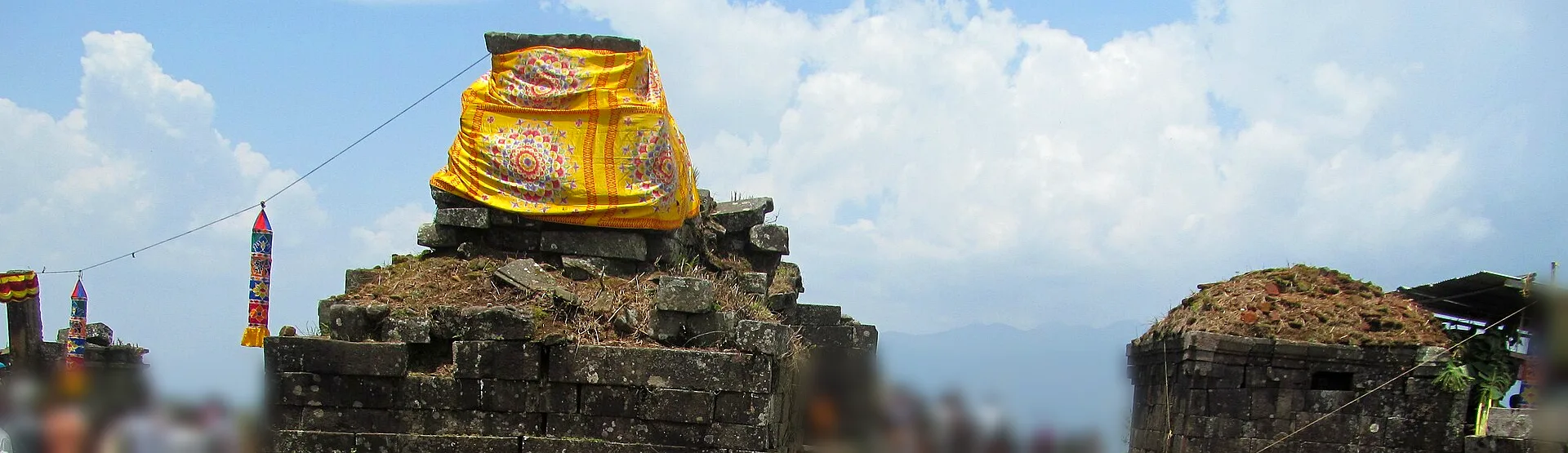
The temple is built of large, dressed granite blocks, in the old stone-temple tradition of the Tamil country, with plain walls, heavy lintels and doorways, and a number of separate shrines within an enclosure on the hilltop. Officials describe a cave entrance in the complex as dating to the Chola period, and the whole is generally believed to be well over 1,000 years old. Today it is largely ruined: walls have slipped, sections have fallen, and the forest presses close. Devotees from both states have long asked for it to be restored in its original form.
The temple lies on the border itself, and Kerala and Tamil Nadu have long disputed which state it belongs to. The festival is therefore a careful partnership: Kerala-style rituals are performed in the main sanctum of Mangala Devi and in the shrines of Ganapathi and Shiva–Parvathi, while Tamil-style rituals are performed in a second sanctum nearby.
The road through the forest
There is no ordinary road to Mangala Devi. From Kumily, authorised jeeps take pilgrims along a rough forest track of about 14–16 km that climbs through the tiger reserve. The jeeps lurch over rocks and ruts, ford streams and grind up steep, broken slopes, through tall evergreen forest, bamboo and open grassland. In the early morning, mist hangs in the trees and the air is cold and damp; elephant dung on the track reminds you whose home this is. As the jeep climbs, the views open over the forested hills of Periyar, and finally, from the ridge, over the hazy plains and towns of the Cumbum valley far below in Tamil Nadu.
From the Tamil Nadu side, many devotees still come the old way, on foot: a steep forest path of about 6.5 km climbs from Paliyankudi near Lower Camp to the summit.
Chitra Pournami: one day in the year
On the festival morning, the forest check post at Kumily opens at dawn, and for a few hours the track becomes a moving river of jeeps. At the summit, the temple doors open at around half past five; priests from both states perform their rituals, lamps and camphor burn before the goddess, and pilgrims offer pongal, flowers and coconuts. Women in Kerala settu mundu and Tamil silk saris stand side by side; prayers, songs and greetings pass in two languages; families share food wrapped in banana leaves. Tens of thousands come in a single day (some 15,000 or more pilgrims in recent years).
And then, by late afternoon, it is over. The last jeeps grind back down the hill, the forest guards close the gates, and the shrine is left once more to the mist, the wind and the animals of the forest for another year.
(Read about the Chera prince who wrote the epic in the Jains of Kerala, about Pattini in the Buddha in Kerala, and about the forests around the temple in Periyar Tiger Reserve.)
Visitor's guide
- When: only on Chitra Pournami (April–May); the date changes each year with the lunar calendar and is announced by the Idukki district administration. At other times the temple is closed and lies in the core of the tiger reserve.
- Permissions: entry is controlled by the Kerala Forest Department and the district authorities. Visitors enter through the forest check post at Kumily, typically from 6 am until early afternoon (about 2.30 pm), and must leave the forest by about 5 pm. Night stays are not allowed.
- Transport: only authorised jeeps may use the forest road, running from the Kumily bus stand area, with passes and vehicle checks issued in the days before the festival. Private two-wheelers are not allowed. Fares are fixed each year (in 2026, ₹200 per person one way).
- Rules: no plastic bottles or bags, no alcohol, no cooking or fires, no loudspeakers, no pets, and only vegetarian food; in recent years photography and videography inside the forest and temple have also been prohibited, and drones are banned.
- What to pack: sturdy walking shoes, a light rain jacket or warm layer for the cold, windy ridge, a steel water bottle, food wrapped in banana leaves, a cap, and any medicines you need.
- Be prepared: expect large crowds, long queues and a bumpy ride; the elderly and those with health problems should consider carefully. Rules change from year to year, so check the latest notice from the Idukki district administration before you travel.
Plan your Idukki journey with GK Global
Mangala Devi is an easy addition to a trip through Idukki's high ranges. From our base in Adimali, the gateway to Munnar, GK Global runs Munnar jeep safaris, elephant-spotting drives and scenic day trips, and helps you find a stay to suit your plans. Stay in Kumily or Thekkady for the festival, and explore the spice gardens and Periyar Lake while you are there. (Read our Thekkady and Kumily guide.)
Explore our jeep safarisFind a staySee it for yourself, with a local driver who knows these roads.
Book a Munnar Jeep SafariSources & further reading
- Onmanorama (Apr 2026): Mangala Devi Chitra Pournami festival: entry timings, route changes, restrictions
- The Week / PTI (May 2026): Thousands offer prayers at Mangala Devi temple inside tiger reserve
- DT Next: Kannagi temple in ruins, no access road via Tamil Nadu
- Onmanorama (May 2025): Mangala Devi temple festival in Periyar forest
- The Hindu via inkl: 15,534 pilgrims visit Mangaladevi temple inside PTR
- Wikipedia: Cilappatikaram
Figures are from the sources listed and were checked in October 2026. Park timings and road conditions change, so please confirm before you travel.