
The Jains of Kerala: A Faith That Came, Flourished and Faded
For more than a thousand years, Jain monks, merchants and kings left their mark on Kerala: in rock-cut shrines, in a great temple near Kodungallur, in the granite basadis of Wayanad and in words still spoken every day. Most of it is now forgotten or worshipped under other names. The story of how Jainism came to Kerala, what it gave, and how it vanished.
Ask most people in Kerala about its religious history and they will speak of Hindu temples, of Christians since the early centuries and of Muslims since the Arab traders. Few will mention the Jains. Yet for well over a thousand years, Jain ascetics, merchants and patrons were part of Kerala's life. They built temples and monasteries, received grants from kings, taught village children and left images of their Tirthankaras carved into the rock. Then, slowly, they faded from the story, and many of their shrines came to be worshipped as temples of the Goddess.
This article brings together what historians, epigraphists and archaeologists have established, and marks clearly where the evidence is thin or disputed.
At a glance
- Arrival: tradition links Jainism in the south to the 3rd century BCE; firm evidence in Kerala begins with Tamil Brahmi records, Sangam literature and, above all, inscriptions of the 9th to 11th centuries CE.
- Greatest centre: Tirukkunavay, near Kodungallur (Mathilakam), from about the 8th century; its "rules" were a model for other Jain temples.
- Surviving early sites: Kallil (Perumbavoor), Chitharal (now in Kanyakumari district), Alathur and the Palghat Gap, and Wayanad.
- Sect: mainly Digambara, judged from images and inscriptions.
- Decline: largely gone as an organised faith by about the 14th century, except in Wayanad and Palakkad, where Jains from Karnataka settled later.
- Today: about 4,500 Jains in Kerala (Census 2011), mainly in Wayanad, Kochi and Kozhikode.
What is Jainism?
Jainism is one of India's oldest living religions. Its teachers, the 24 Tirthankaras ("ford-makers"), are believed to have shown the way across the river of rebirth. The last two are historical figures: Parshvanatha, the 23rd, and Mahavira, the 24th, a contemporary of the Buddha in the 6th or 5th century BCE. At the heart of the faith are ahimsa (non-violence to every living being), aparigraha (non-attachment) and anekantavada (the view that truth has many sides). Jains are strict vegetarians, and their monks and nuns live lives of great austerity. The two main traditions are the Digambara ("sky-clad"), whose monks wear no clothes, and the Svetambara ("white-clad").
In Kerala, Jain images are easy to recognise once you know the signs: a Tirthankara sits or stands in calm meditation, often under a triple umbrella; Parshvanatha is shaded by the hoods of a serpent; and with them often appears the goddess Padmavati or Ambika, the guardian yakshi. Early British-era scholars mistook several of these for images of the Buddha.
How Jainism came south
A well-known Jain tradition says that around 300 BCE, during a long famine in the north, the teacher Bhadrabahu led a group of monks south, accompanied by the Maurya emperor Chandragupta, who ended his days as a monk at Shravanabelagola in Karnataka. Whatever the exact truth of the story, Jain monks were certainly active in the Tamil country, which then included Kerala, by the last centuries BCE. Tamil Brahmi inscriptions in caves record gifts by merchants and chiefs to Jain ascetics, and early Chera chieftains donated caves to Jains in the Karur–Pugalur region of present-day Tamil Nadu.
Kerala was then part of Tamilakam, the Tamil-speaking south, and its rulers were the Cheras. A separate Kerala identity, and the Malayalam language, grew only later, from about the 9th century. Sangam poems record that the Chera chieftain Utiyan Cheral Atal died by fasting, a death that some historians, including M. G. S. Narayanan, link to the Jain practice of sallekhana, the vow of a peaceful death by gradually giving up food.
Jainism probably entered Kerala by two main routes: through the Palghat Gap from the Kongu country (around Coimbatore and Erode, itself a strong Jain region), and through the Aralvaimozhi pass in the far south from Tirunelveli. Much later, a third route brought Jains up from Karnataka into Wayanad.
The Chera prince who became a monk
The great Tamil epic Silappatikaram, "the Tale of the Anklet", is traditionally said to have been written by Ilango Adigal, a younger brother of the Chera king Chenguttuvan, who renounced the throne and became an ascetic. The epic is full of Jain ideas, and tradition holds that its author lived at a Jain monastery called Kunavayir Kottam. Its companion epic, Manimekalai, describes Jain centres at Vanchi, the Chera capital. Many scholars identify Kunavayir Kottam with Tirukkunavay near Kodungallur, though this, like the dates of the epics themselves, remains debated.
Tirukkunavay: Kerala's great Jain temple
The most important Jain temple of medieval Kerala was Tirukkunavay, also called Kunaka or Gunaka, identified with Trikkanamathilakam, today's Mathilakam, a few kilometres from Kodungallur, the old Chera port of Muziris. Inscriptions suggest it was founded in the late 7th or early 8th century. It became so important that it had its own calendar, the Tirukkunavay era, and its code of conduct, the "rules of Tirukkunavay", was laid down as the model for other Jain temples in Kerala. A Jain inscription from Talakkavu in Wayanad (about 850 CE) is dated in the 137th year of this era.
The temple's later history shows the change that came over Kerala. The 14th-century Manipravalam poem Kokasandesam describes Kunaka as a large settlement of traders, and says that Brahmins thought it unlucky to look upon its deity. By the 15th century it had become a Shiva temple. The site was later lost; an excavation at Mathilakam in 1970 found the foundations of an 8th–9th century structure unlike an ordinary Hindu temple, along with Chola-period coins. Nothing of the temple stands today.
Inscriptions: the Jain temples in Kerala's records
Much of what we know comes from inscriptions in Vattezhuthu script. They show Jain temples (palli) as wealthy, well-organised institutions with land, protected by merchant guilds, local chiefs and kings.
| Inscription | Date | What it tells us |
|---|---|---|
| Talakkavu, Wayanad | c. 850 CE | Dated in the Tirukkunavay era; shows Jains in Wayanad long before the later Karnataka settlers |
| Chitharal (Tiruchanattumalai) | 9th century | Gift of gold ornaments in the 28th year of the Ay king Vikramaditya Varaguna |
| Kinalur, near Kozhikode | Medieval (dating debated) | Links the Chera king Kota Ravi Vijayaraga with a Jain institution called Kunavay-Nallur |
| Alathur / Godapuram, Palakkad | c. 10th–11th century | Mentions Jain traders; images of Mahavira and Parshvanatha found nearby |
| Tiruvannur, Kozhikode | 11th century | A Chola-period record from a temple now dedicated to Shiva |
Several inscriptions name merchant bodies, such as the Nalpattennayiravar and Ezhunuruvar, as protectors of temple property: a reminder that Jainism in Kerala grew with trade.
Shrines that became temples of the Goddess
A remarkable feature of Kerala's Jain heritage is how many Jain shrines live on as Hindu temples, usually of Bhagavathi. The Jain goddess Padmavati or Ambika, standing beside the Tirthankaras, was easily worshipped as the Devi, and the Tirthankaras themselves came to be seen as Shiva, Vishnu or local gods.
- Kallil, near Perumbavoor (Ernakulam): a temple set beneath a huge overhanging rock on a forested hill, reached by a long flight of steps. Carved in the rock are images of Mahavira, Parshvanatha and Padmavati. Padmavati is worshipped as Bhagavathi, and the temple is held by the Kallil Pisharody family. The main festival falls on Karthika in the month of Vrishchikam (November–December). Jain pilgrims still visit it.
- Chitharal (Tiruchanattumalai): in the old Travancore country, now in Kanyakumari district of Tamil Nadu. The hill's name means "the holy hill of the Charanas" (Jain ascetics). It has rock beds of early Jain monks and a 9th-century rock-cut shrine with fine reliefs of Tirthankaras, Padmavati and Ambika. A Bhagavathi temple grew beside it through the 13th century. Scholar T. A. Gopinatha Rao, who first identified the site as Jain in 1915, at first called this a "conversion", but later judged that the two faiths had shared the site.
- Alathur (Palakkad): granite images of Mahavira and Parshvanatha were recovered at Godapuram and Kavassery, along the Palghat Gap trade route.
- Paruvassery (Palakkad): a Tirthankara image at the Palliyil Bhagavathi shrine was once taken for the Buddha; the triple umbrella identifies it as Jain.
- Kudalmanikyam, Irinjalakuda: some writers suggest that this famous temple, dedicated to Bharata, was once linked to the Jain Bharateshvara. Most historians regard this as unproven, and we mention it only as a theory.
Carvings on the rock at Kallil
Above the Kallil temple, on the top of the natural granite rock, are several carvings that are rarely noticed and today lie neglected, half-hidden by moss and fallen leaves. We recorded them on a visit to the temple at Methala. None of them has been studied or dated, as far as we know, and we describe them here as we found them.
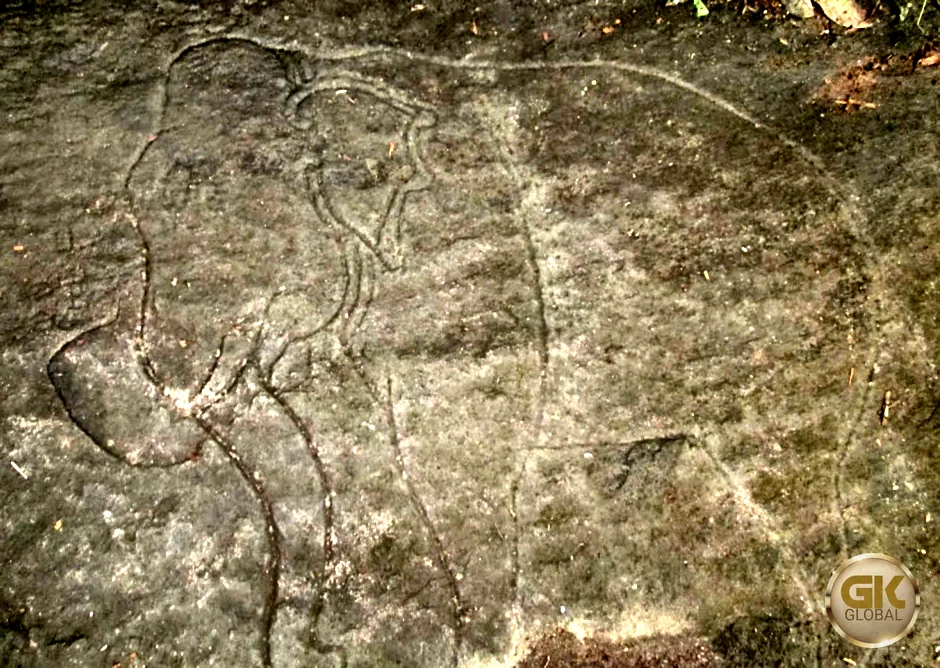
The finest is an elephant, drawn in outline with deep, sure grooves: the domed head, a large ear, the trunk falling in a curve, a tusk and the long line of the back. It is the work of a skilled hand, and its weathering suggests it is old, perhaps much older than the other marks around it. Elephants appear often in Jain art as emblems and as the mount of the gods who attend the Tirthankaras, but there is no way to tell, without expert study, whether this figure belongs to the Jain period of the site or to a later time.
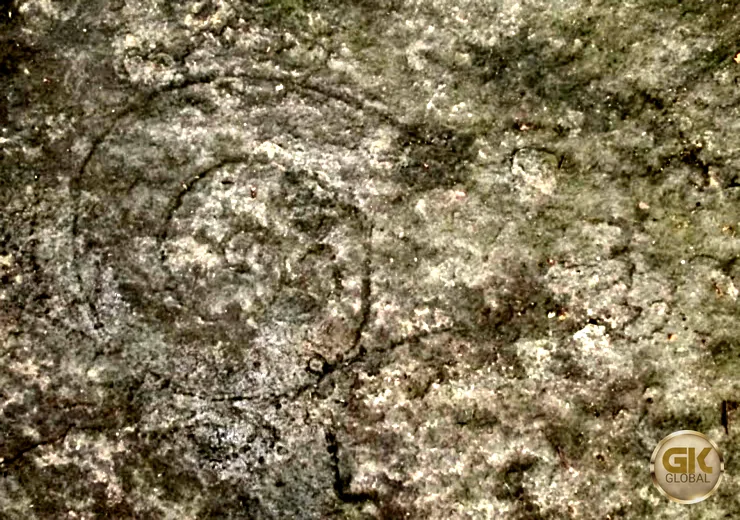
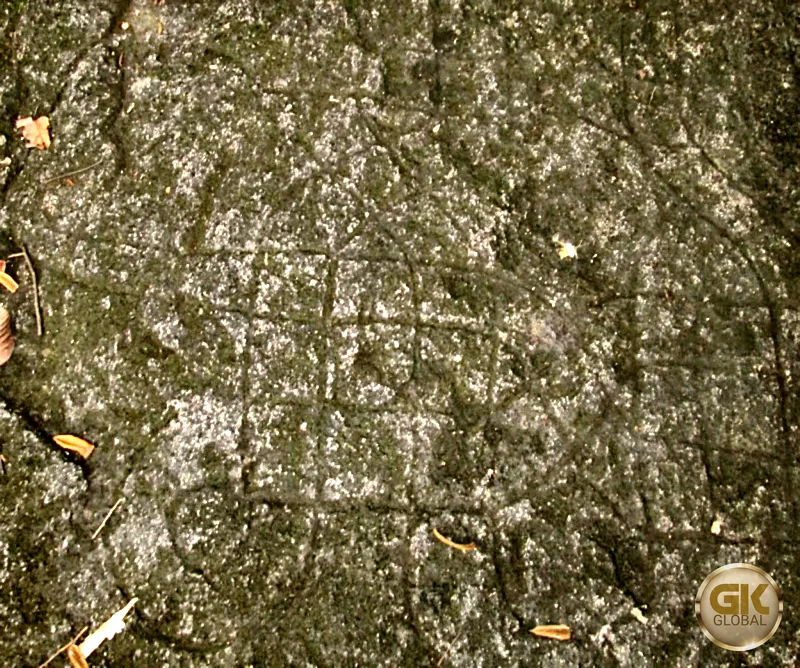
Nearby are two concentric circles with a line running from them, whose meaning we cannot tell, and a grid of squares, part of it apparently enclosed by a curving line. Its purpose is uncertain. Grids like this are scratched into rock at temples, forts and resting places all over South India, and many are boards for traditional games played with shells or stones, such as the eight-by-eight ashtapada. But a grid can also be a yantra, a sacred diagram used in worship, including the numbered "magic square" yantras and the square grids of Vastu mandalas. It is certainly not a Sri Chakra, which is built of interlocking triangles. The number of squares, and any letters, numbers or seed syllables in them, would help to tell a game board from a yantra, but much of the grid is still hidden under soil.
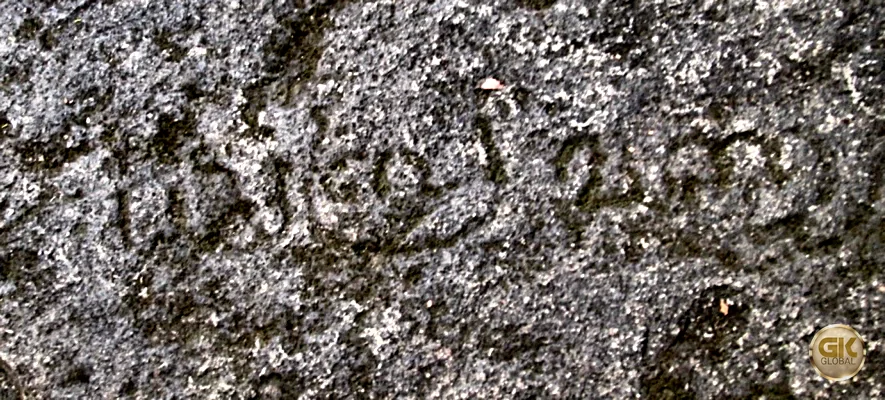
There is also a short inscription in Malayalam. The letters are worn but partly readable, and we read the word as Subrahmanya, a name of Murugan, the Palani Andavar. It is not ancient: it is written not in the Vattezhuthu or Grantha scripts of the medieval inscriptions, but in Malayalam letters of recent times. The letter forms are those of the traditional script, with its many joined conjunct letters, in use before the script reform of 1971, which simplified Malayalam writing for typewriters and printing. We therefore believe the inscription was carved before about 1970, as a much later addition to a rock whose carvings were already there. It may record devotion to Murugan, or it may be the name of a person, since Subrahmanyan is a common name in Kerala; only a careful reading of every letter can settle this.
Taken together, these marks show the rock at Kallil as a place that many generations have visited and left their mark on: first, perhaps, Jain monks and their followers, and later Hindu devotees and passers-by.
Unprotected and fading
- The carvings have no protection. They lie on the open top of the rock, largely covered by soil, moss and overgrowth. We cleared only a small part of the surface by hand to see and photograph them; more carvings may lie hidden under the soil.
- The rock belongs to a living temple, and further inspection was not permitted by the present temple authorities. We respect that, and we have not gone back to dig or clean further.
- Carvings like these can be recorded without harm to the temple or its worship. We hope that the Kerala State Department of Archaeology, or scholars working with the temple's permission, will document and protect them before they are lost.
- If you visit, please do not dig, chalk, paint or scrub the carvings. It damages them, and the site is a place of worship: ask the temple first.
Wayanad: the second coming of Jainism
While Jainism was fading in the rest of Kerala, it found new life in Wayanad. The Talakkavu inscription shows Jains there by the 9th century, but the great wave came from Karnataka under the Hoysala kings (12th–14th centuries), whose early rulers were Jain patrons, and later under Vijayanagara. Kannada-speaking Jains came along the Kabani river, cleared forests and brought settled farming to the plateau. A Kannada inscription at Varadur confirms their Karnataka origin, and many Wayanad place names are still Kannada.
Their finest monument is the granite Jain temple at Sulthan Bathery, once called Kidanganad Basti, in an area known in Kannada as Hannaradu Beedi, "the twelve streets". Built in the Vijayanagara style, probably in the 13th century (some historians date it later), it has a sanctum, vestibule and pillared halls carved with Jain emblems. In the 18th century the armies of Tipu Sultan used it to store arms and ammunition, and the British named the town "Sultan's Battery" after it. Today it is protected by the Archaeological Survey of India. Its sanctum is empty: the image of Mahavira is kept at the Anantanatha temple near Kalpetta and brought here once a year at Mahavir Jayanti.
Other Jain sites in Wayanad include:
- Anantanatha Swami temple, Puliyarmala, about 6 km from Kalpetta, dedicated to the 14th Tirthankara and the living centre of Wayanad's Jains.
- Puthenangadi and Panamaram, with ruined basadis on the banks of the Panamaram river, including the old shrines known as Vishnugudi and Janardhanagudi.
- Varadur, Punchavayal and other sites with temple ruins and inscriptions.
Wayanad's Jain population declined from the 18th century amid the wars of Mysore and the British, and many of its basadis fell into ruin or became Hindu shrines. Yet a community survived. About 1,600 Jains live in Wayanad today, many of them Kannada-speaking Digambara farming families known as Jain Gowdas.
Palakkad: the merchants of Jainimedu
In the 15th century, Jain merchants from Karnataka, fleeing hard times there, settled near Palakkad with the welcome of the local ruler. A family of diamond merchants built the Chandraprabha (Chandranatha) temple at Jainimedu, a small granite Digambara temple about 32 feet long, with images of Tirthankaras and yakshis. At one time some 400 Jain families are said to have lived around it. Few remain, but the temple was restored and reconsecrated in 2013. A literary footnote: the poet Kumaran Asan is said to have written his famous poem Veenapoovu ("The Fallen Flower", 1907) while staying at a Jain house near this temple.
The merchants of the coast: Kochi, Kozhikode and Alappuzha
A different Jain community came by sea and by trade: Gujarati merchants from Kutch and Saurashtra, who settled in the port towns of Kochi, Kozhikode and Alappuzha to trade in spices, cloth and other goods. They are mostly Svetambara. In Mattancherry, the Dharmanath Jain temple was built in 1904 by Hirubai Jivraj Dhanji in memory of her husband. Its main image is of Dharmanatha, the 15th Tirthankara, and visitors often come to watch the feeding of the pigeons in its courtyard. The coastal Jains keep the festivals and customs of Gujarat, and they are among the best-known Jains in Kerala today, but their history is separate from that of the ancient Jains of Kerala.
In the far north, at Manjeshwar in Kasaragod, the Chaturmukha Basadi belongs to the Jain world of Tulu Nadu and Karnataka; its history goes back to a local Jain dynasty of the 12th century, though its present form is from the late 18th century.
Festivals
Kerala's Jains celebrate the festivals common to Jains everywhere, each community in its own way:
- Mahavir Jayanti (March–April): the birth of Mahavira. In Wayanad, the image of Mahavira is carried to the old Kidanganad Basti at Sulthan Bathery for worship.
- Paryushana (August–September): the most important period of the Jain year, given to fasting, reflection and forgiveness. Svetambaras keep it for eight days; Digambaras keep a ten-day Das Lakshana festival, each day devoted to a virtue such as forgiveness, humility and truth. It ends with Kshamavani, when people ask each other's pardon with the words Micchami Dukkadam.
- Deepavali (October–November): for Jains, the night of Mahavira's nirvana, his final liberation, celebrated with lamps, prayer and fasting rather than firecrackers.
- Akshaya Tritiya: remembering the breaking of the first Tirthankara Rishabhanatha's long fast with sugarcane juice.
- Temple festivals such as consecrations (Panch Kalyanak, as held at Jainimedu in 2013) and the annual festivals of each basadi.
At the old Jain sites now worshipped as Hindu temples, the festivals are Hindu ones, like the Karthika festival at Kallil, but Jain visitors still come to honour the Tirthankaras.
Marriage and family life
No old records describe the weddings of the medieval Jains of Kerala. Today's Jain communities follow the customs of the regions their families came from: the Kannada Digambara traditions of Karnataka in Wayanad and Palakkad, and the customs of Gujarat in Kochi and Kozhikode.
A Jain wedding is in many ways like a Hindu one, with an engagement, the fixing of an auspicious date and the joining of hands, but its worship is directed to the Tirthankaras rather than to Hindu gods. The ceremony usually begins with a puja to the Pancha Parameshthi, the five supreme beings of Jainism, and the couple's rounds of the sacred fire are linked to Jain vows of truth, non-violence, honesty, restraint and non-possession. Food is strictly vegetarian, often without onion, garlic or root vegetables, and traditionally served before sunset. Weddings are avoided during Paryushana. Because the communities are small, families often look for matches among Jains elsewhere in South and West India.
We have not found a published account of the particular customs of the Wayanad or Palakkad Jain families. If you belong to one of these communities and would like to share your traditions, we would be glad to hear from you.
What the Jains gave Kerala
- Education: Jain and Buddhist monks are credited with spreading basic education in villages. The Malayalam word palli, first used for Jain and Buddhist places of worship, survives in pallikkoodam (school), as well as in the names of mosques and churches (palli) and in many place names ending in -palli.
- Literature: some of the greatest early Tamil works, which belong to Kerala's heritage too, were written by Jains or carry Jain ideas, including Silappatikaram and Jivaka Chintamani.
- Trade and towns: Jain merchants and their guilds linked Kerala's ports with the Kongu country and Karnataka.
- Farming in Wayanad: Jain settlers from Karnataka are credited with opening up much of the plateau to settled agriculture.
- Values: historians suggest that the vegetarianism and ideals of non-violence found in some Kerala communities owe something to Jain and Buddhist influence, though this is hard to measure.
Why the Jains vanished
There was no single cause. Historians point to several, working together over centuries:
- The Bhakti movement and Brahmanical revival (7th–12th centuries): the Shaiva and Vaishnava saints of the Tamil country preached against Jains and Buddhists, and some stories describe fierce hostility. Temple-centred Hinduism, with its festivals, music and land-owning Brahmin institutions, won the support of kings.
- Loss of royal patronage: as Kerala's rulers turned to Hindu temples, Jain institutions lost the grants and protection they depended on.
- The collapse of trade routes: after the end of the Chera (Perumal) kingdom of Mahodayapuram in the 12th century, the trade links with the Kongu country that had sustained Jain merchant communities broke down.
- Absorption: Jain shrines with their goddess images were easily taken into Bhagavathi worship, and Jain families may have merged into Hindu communities over generations.
- War: in Wayanad, the 18th-century wars of Mysore and the British broke up the surviving communities.
By about the 14th century, Jain monks had largely disappeared from Kerala. What remained were names, images worshipped under other names, and the Karnataka-rooted communities of Wayanad and Palakkad.
Visiting Kerala's Jain heritage
- Kallil temple, near Perumbavoor, Ernakulam district.
- Jain temple, Sulthan Bathery, Wayanad (ASI monument).
- Anantanatha Swami temple, Puliyarmala, near Kalpetta.
- Chandraprabha temple, Jainimedu, Palakkad.
- Dharmanath Jain temple, Mattancherry, Kochi.
- Chitharal, Kanyakumari district, Tamil Nadu (ASI monument).
These are places of worship: dress modestly, remove footwear, and do not take leather goods into Jain temples.
(Read more about the region's places of worship in Munnar's churches, temples and mosques, the cave temples of Andavar Kovil, Vattavada and Kuthirayala, and the ancient dolmens of Marayoor.)
A note on the evidence
- Kerala's Jain history rests on a limited number of inscriptions, images and literary references, and historians disagree on many details, including the identification of Kunavayir Kottam with Tirukkunavay, the dates of some Wayanad temples and how far Jain shrines were "converted" rather than shared. We have noted these disagreements where they matter.
- If you can share knowledge, photographs or family traditions of Kerala's Jain communities, please contact us.
See it for yourself, with a local driver who knows these roads.
Book a Munnar Jeep SafariSources & further reading
- Sahapedia: Jainism in Kerala, a historical perspective
- Wikipedia: Jainism in Kerala (Keralite Jain)
- Wikipedia: Chitharal Jain Monuments and Bhagavati Temple
- Wikipedia: Kallil Temple
- P. S. Rizvan (2021): Thrikkanamathilakam as a Jain centre, TRIVALENT Journal of Archaeology, Tourism & Anthropology
- Indica Today (2024): Jain traditions in ancient and medieval Kerala
- Onmanorama (2021): Kerala's Jain heritage in Palakkad and Wayanad
- Deccan Chronicle (2015): Jain temple gives peek into historical past (Sulthan Bathery)
- Onmanorama (2018): The Jain temple of Sulthan Bathery
- Kerala Tourism: Jain temple, Sulthan Bathery
- Wikipedia: Anantnath Swami Temple, Puliyarmala
- Wikipedia: Jainimedu Jain temple
- Wikipedia: Kochi Jain temple (Dharmanath, Mattancherry)
- Wikipedia: Vikramaditya Varaguna
- Wikipedia: Jain festivals
- Vaidik Vivah: Jain wedding rituals and traditions
Figures are from the sources listed and were checked in October 2026. Park timings and road conditions change, so please confirm before you travel.