
Kalpathy: The Agraharams of Palakkad, Half of Kashi and the Chariot Festival
Six centuries ago, Tamil Brahmin families from the Kaveri delta crossed the Palakkad Gap and built a village of joined houses on the banks of the Nila. Every morning its doorsteps carry fresh kolams; every November its narrow streets fill with giant wooden chariots, as Kalpathy's gods ride out in the Ratholsavam.
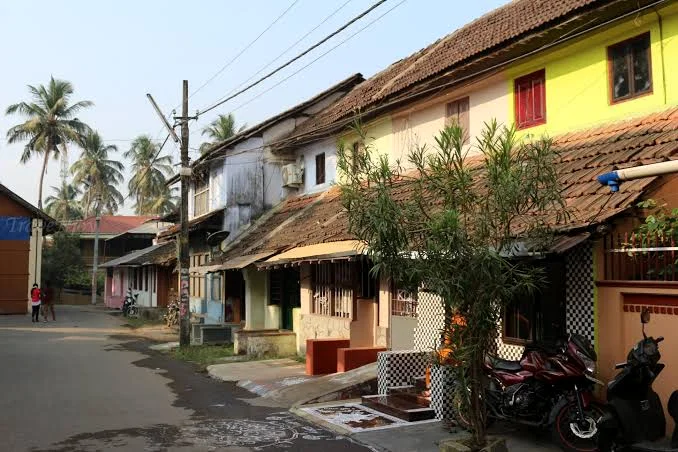
Walk into Old Kalpathy early in the morning and you could be in a village of the Kaveri delta. Two unbroken rows of houses face each other across a straight street, joined wall to wall. Every house has a raised front platform, the thinnai, under a sloping tiled roof. On every doorstep a woman is drawing a kolam in rice flour. From an open window comes Carnatic music; from another, the smell of filter coffee.
This is an agraharam, a Brahmin street, and Kalpathy is the best known of the many in Palakkad. At one end of the street stands a temple. Above it all, on the bank of the river, is the Viswanatha Swamy temple, whose fame earned the village the saying Kasiyil pathi Kalpathy: Kalpathy is half of Kashi.
Every November its narrow streets fill with giant wooden chariots, as Kalpathy's gods ride out in the Ratholsavam. This article tells the story of the village, its houses, its morning kolams and its festival. As always, our own assessments are clearly marked.
At a glance
- Where: Kalpathy, about 3 km from the centre of Palakkad town, on the Kalpathy river, a tributary of the Bharathapuzha (Nila).
- The agraharams: New Kalpathy, Old Kalpathy, Chathapuram and Govindarajapuram around the Viswanatha Swamy temple, with Manthakkara often counted too.
- When: Tamil Brahmin migration to Palakkad from about the fourteenth and fifteenth centuries; the earliest firm date at Kalpathy is a temple endowment inscription of Kollam Era 600 (1424–25).
- The festival: the Ratholsavam, ten days in the Malayalam month of Thulam (Tamil Aippasi), usually in mid-November, with chariots on the last three days. In 2026 it closed on 17 November.
- Status: declared Kerala's first heritage village in 2008, covering 22.36 hectares.
Across the Palakkad Gap
Palakkad sits in the one wide break in the Western Ghats, the Palakkad Gap. For centuries it has been the easiest way between Tamil country and Kerala, and people, goods and ideas have moved through it. The Tamil Brahmins of Palakkad, the ‘Palghat Iyers’, came this way from the Kaveri delta: from Thanjavur, Kumbakonam and Mayavaram (Mayiladuthurai).
Why they came is told in two ways. One tradition says a Palakkad ruler, after a quarrel with the local Namboothiri priests, invited Tamil Brahmin families to serve in his temples. The other says they fled war and famine in the Kaveri delta, as the region suffered invasions and drought from the fourteenth century on. The two stories are not exclusive, and migration probably came in several waves over centuries. One early village, Sekharipuram, is thought to be named after a Palakkad raja.
Palakkad today has dozens of agraharams, about eighteen of them in and around the town. Their people speak a Tamil full of Malayalam words, cook Tamil food, and keep Tamil temple rites, while being thoroughly at home in Kerala.
Our assessment: a migration, not a moment
Popular accounts give a single date for the Tamil Brahmin arrival: ‘700 years ago’, ‘1425’, ‘the 1790s’. We think it is better understood as a slow movement over several centuries, through the Palakkad Gap, encouraged by local rulers who wanted priests and scholars and pushed by trouble in the Kaveri delta.
Kalpathy's 1425 inscription is one fixed point in that long story, not its beginning.
Half of Kashi: the Viswanatha Swamy temple
The village story of the temple begins with a woman. Lakshmi Ammal, wife of a Brahmin of Kollengode, is said to have travelled to Kashi and brought back a Siva linga. She asked the Raja of Palakkad to build a temple for it, gave him 1,320 gold coins, and left its management in his hands. The Raja, Itti Kombi Achan, built the temple and endowed it with land.
A stone inscription in front of the temple records endowments by Itti Kombi Achan in Kollam Era 600, that is 1424–25. That is the oldest firm date in Kalpathy's history, and the temple itself may be a little older. Lakshmi Ammal is also credited with three more temples, at Kollengode, Koduvayur and Pokkunni, each with a linga from Varanasi.
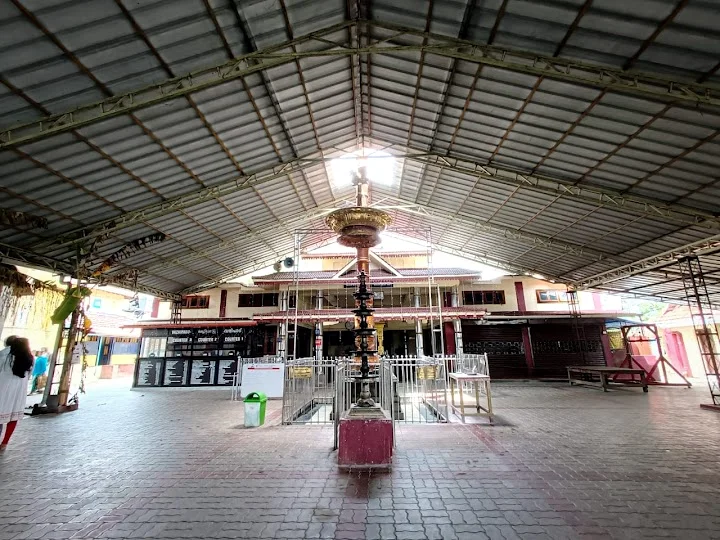
The temple stands at the top of eighteen steps above the river, like a ghat on the Ganges. Siva is worshipped as Viswanatha, Lord of the Universe, with his consort Visalakshi, the wide-eyed goddess, just as at Kashi. Its rites follow the Tamil temple tradition, on the model of the Mayuranathar temple at Mayiladuthurai, not the Kerala Tantric one. Locals simply call it Kundukovil.
How an agraharam is built
An agraharam is a planned street, not a cluster of houses. In the classic form, two rows of houses run along either side of a straight road, with a temple to Siva at one end and, often, a temple to Vishnu at the other. At Kalpathy each of the four agraharams has its own temple, and all four look to the Viswanatha Swamy temple at their centre.
The houses are long and narrow, built deep into the plot. Behind the thinnai, where men once sat to talk and travellers could rest, comes a front room, then an open central courtyard that brings light and rain into the house, then the kitchen and the back yard with its well. Neighbours share side walls, so the street reads as a single continuous facade. The plan is the same as in the agraharams of Thanjavur; only the steep tiled roofs and wooden details are Kerala's.
The kolam at the door
Before sunrise, in house after house along the street, a woman steps out with a broom, a pot of water and a small tin of rice flour. She sweeps the ground in front of the door and sprinkles it with water; in the old days the water was mixed with cow dung to seal the earth. Then she bends down and, letting the flour fall in a thin stream from between her thumb and forefinger, draws a kolam. In a few minutes the doorstep carries a pattern of white dots and lines. By evening it will have been walked over, eaten by ants and blown about by the wind. Tomorrow she will draw another.
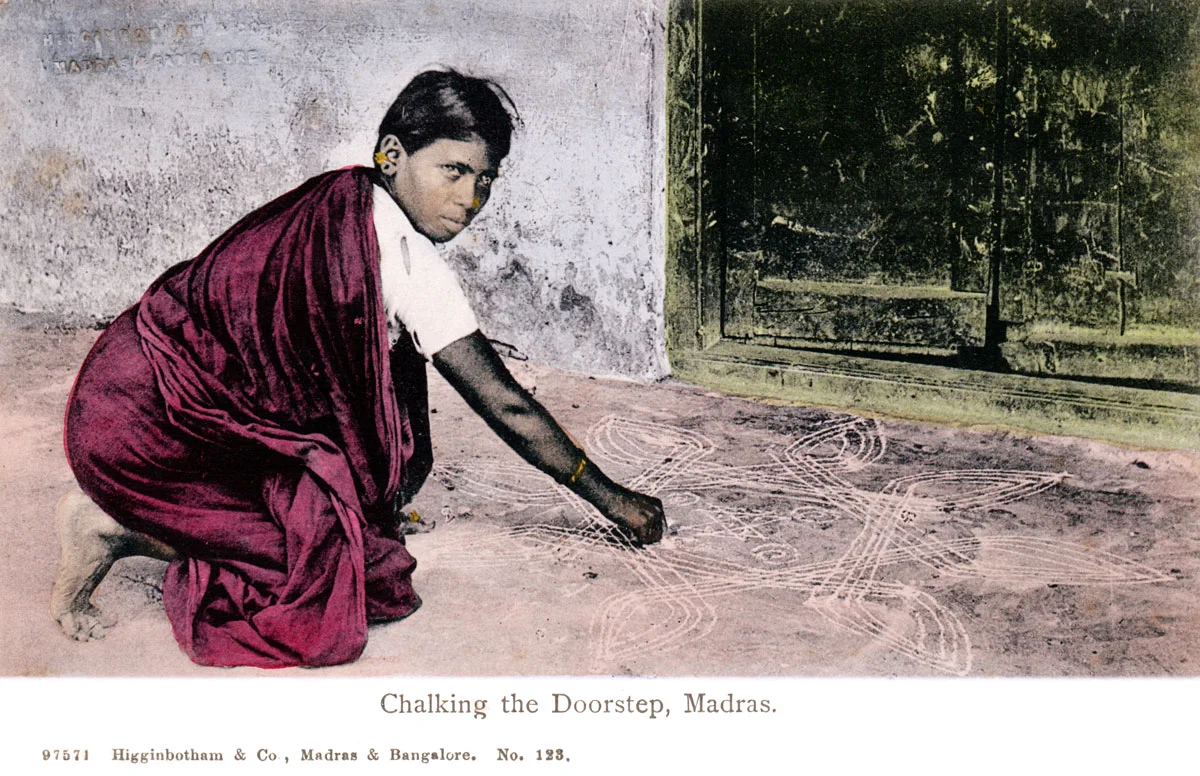
What it means. Kolam means ‘form’ or ‘beauty’ in Tamil. Drawn at the threshold, the line between the house and the world, it welcomes good fortune and the goddess Lakshmi, and marks the home as awake, clean and well. Because it is made of rice, it is also food: ants, birds and insects eat it through the day. Women describe this as the householder's duty to ‘feed a thousand souls’, the phrase the scholar Vijaya Nagarajan took as the title of her study of the kolam. Its absence speaks too: in many families, a doorstep is left bare during a period of mourning, and the whole street understands.
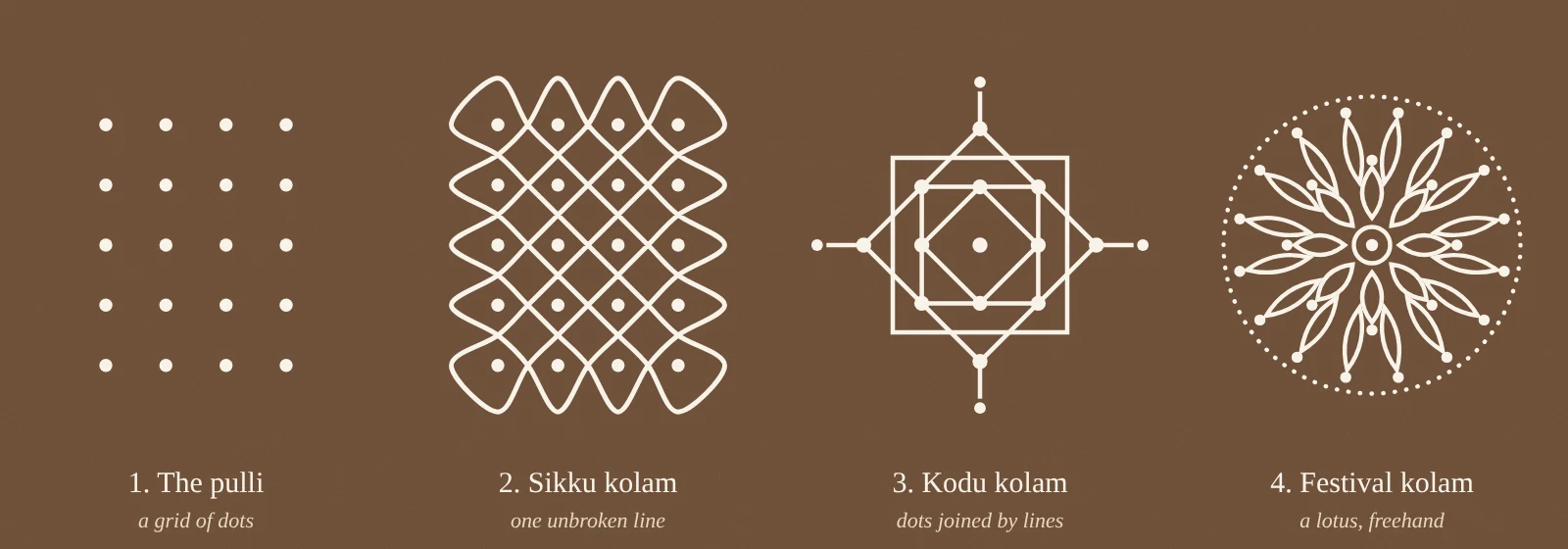
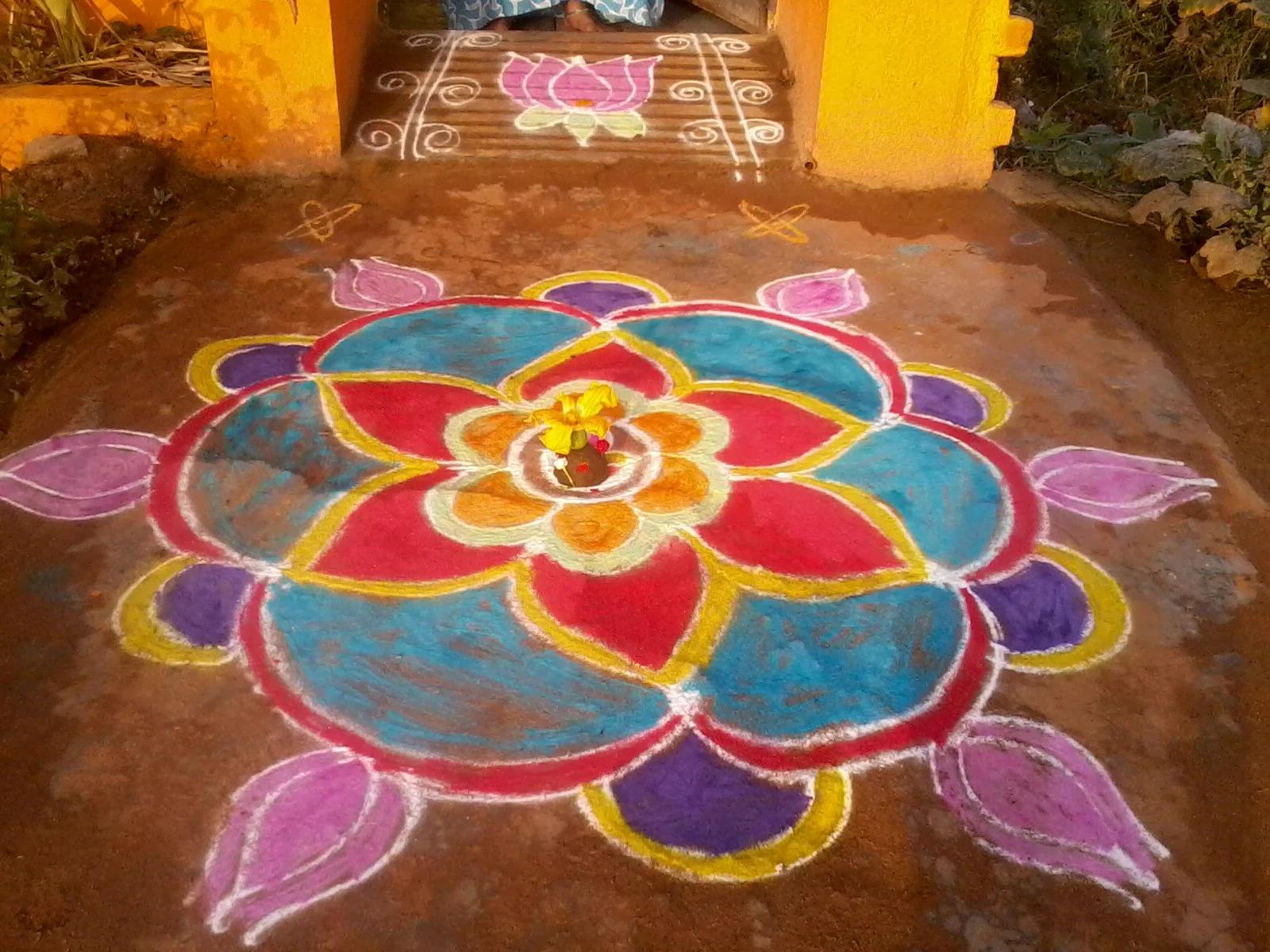
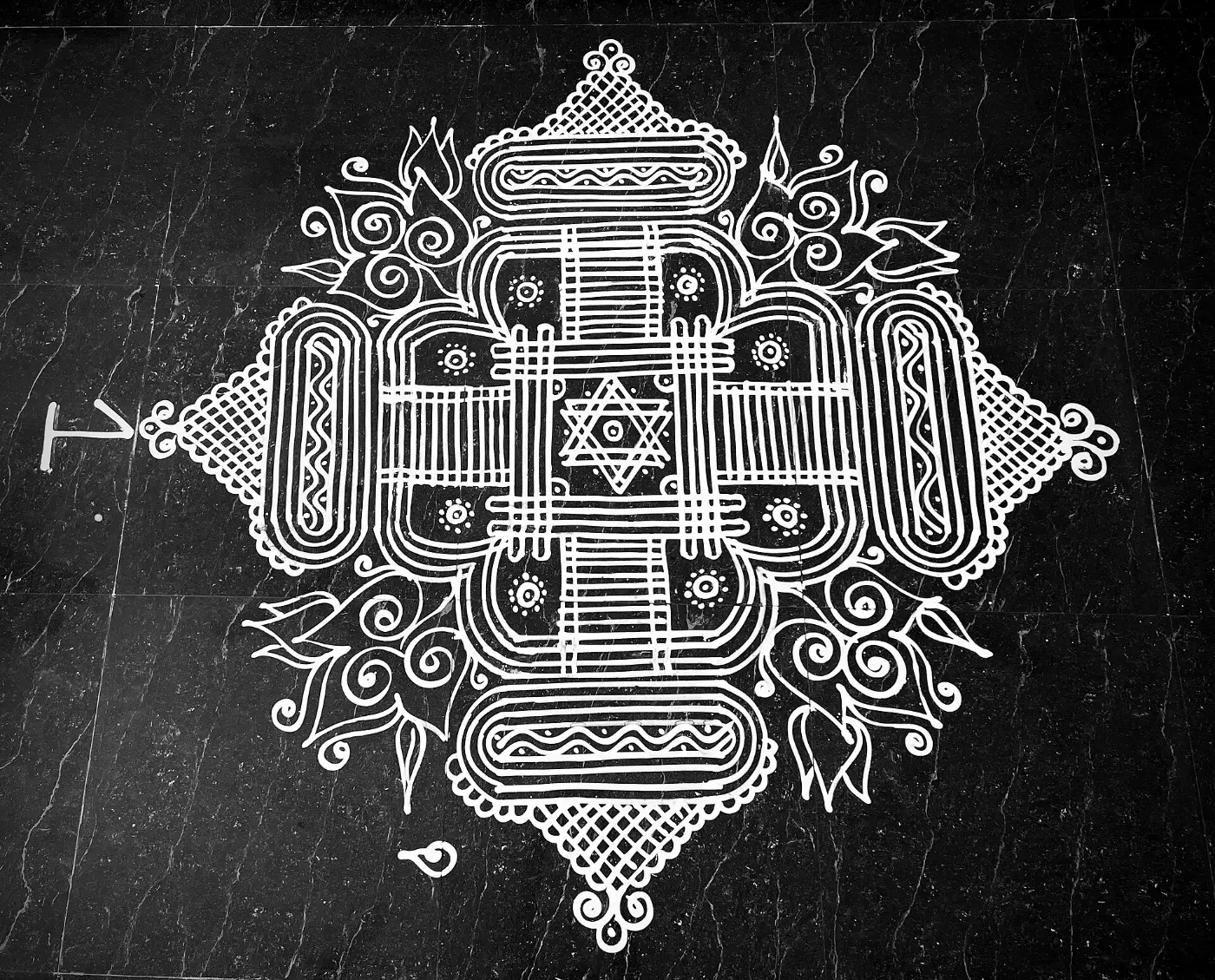
The kinds of kolam. Most begin with a grid of dots, the pulli. In a sikku or kambi kolam, a single unbroken line weaves around every dot and returns to where it began, with no loose ends. In a kodu kolam the dots are joined by straight lines into stars and squares. For festivals, women draw larger freehand designs of lotuses, lamps and peacocks, sometimes with coloured powders, and use maa kolam, a wet rice-flour paste, so that the design lasts.
Margazhi. The kolam reaches its height in the Tamil month of Margazhi, from mid-December to mid-January. Kolams grow until they cover the street; in the agraharams, women rise earlier still, and neighbours quietly compete. Margazhi is also the month in which the poet-saint Andal's Tiruppavai is sung at dawn, and Nagarajan traces the kolam's devotional meanings through Andal's poetry.
How old is it? The kolam is often called thousands of years old, and it may well be very ancient, but the written record is later than people think. The mathematician and historian Gift Siromoney, who studied kolams for decades, found the earliest clear references in Tamil literature in the Madurai Meenakshiammai Kuram of the sixteenth century and the Thiru Kutraala Kuravanji of the seventeenth. Designs made of unending lines, like sikku kolams, appear on fifteenth-century pillars of the Thousand Pillared Basti at Moodabidri in coastal Karnataka. By the nineteenth century, kolam pattern books were being printed in Tamil Nadu.
Kolam and mathematics. From the 1970s, Siromoney and the computer scientists Rani Siromoney, Kamala Krithivasan and others used kolam patterns to study ‘picture languages’ and ‘array grammars’: ways of describing how complex patterns can be built from a few simple rules. The sikku kolam is a puzzle in its own right: drawn the classic way on a rectangle of dots, the line closes as one single loop only for certain grid sizes (on a 4 × 5 grid it does; on a 4 × 4 it splits into four), a rule generations of women have known by hand.
In Kalpathy the kolam is still part of every morning, and kolam contests are part of local events such as the Kalpathy Sports Fest.
The street that was closed: 1924
The chariot street was also a public road, built and maintained with government money. In the early 1920s it was still closed to castes regarded as ‘polluting’. In 1924, the year of the Vaikom Satyagraha in Travancore, Ezhavas of Palakkad walked along it towards the temple to assert their right to a public road.
The Madras government issued an order allowing them to enter, but conservative residents resisted and several Ezhavas were beaten. One of them later became a Christian, took the name John Kittu, and was elected an independent member of Kerala's first legislative assembly. The episode is now largely forgotten; it is part of the same story as Vaikom and Guruvayur.
Our assessment: a festival with two histories
The Ratholsavam is rightly celebrated as a festival where anyone may pull the ropes. It is worth remembering that a century ago the same street was closed to most of Palakkad's people, and that it took protest, a government order and violence to open it.
Telling both stories does not diminish the festival; it shows how far the village has come.
The Ratholsavam
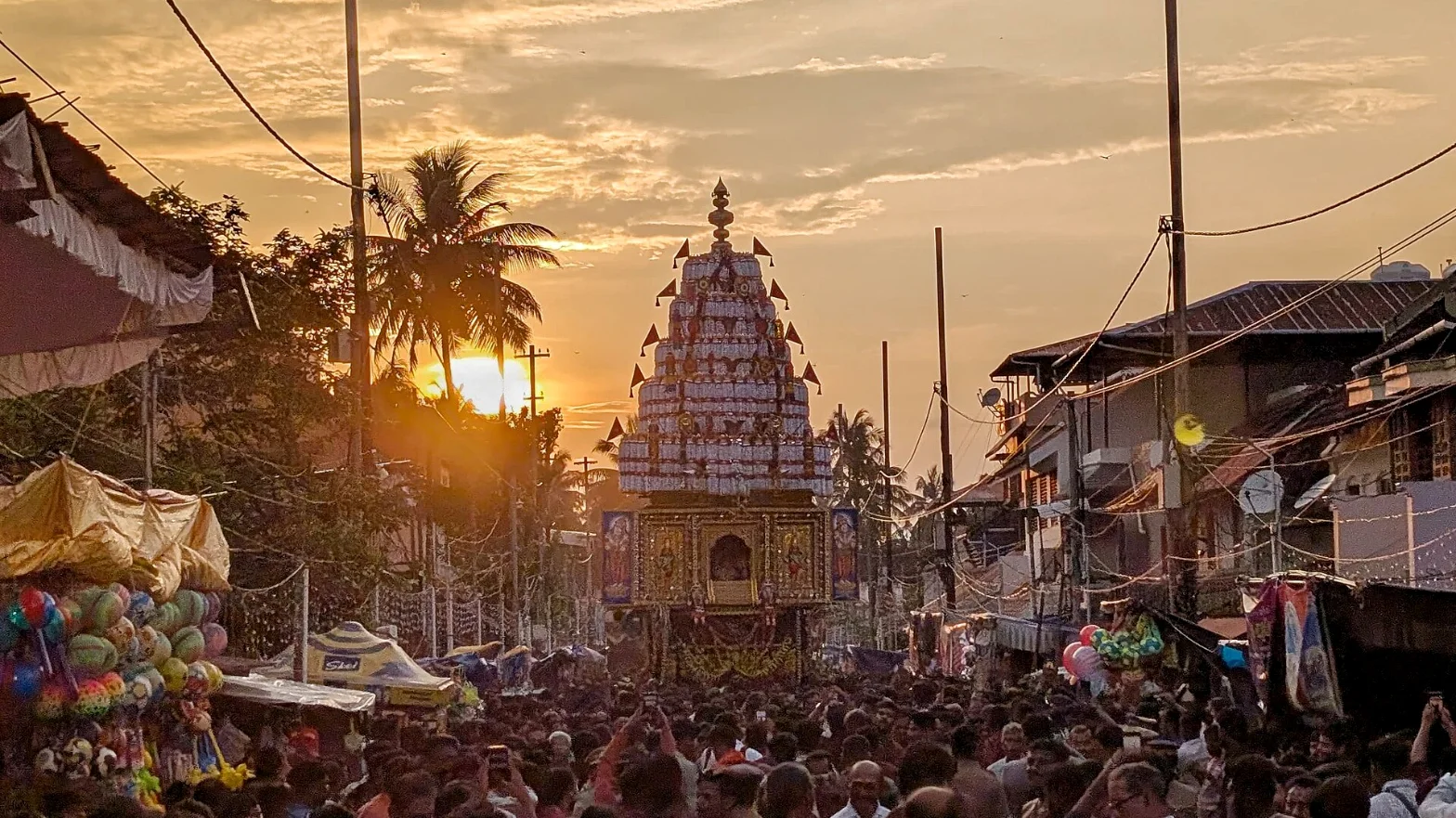
In the Malayalam month of Thulam, the Tamil Aippasi, usually in mid-November, Kalpathy holds its great festival, the Ratholsavam. It lasts ten days and is shared by four temples: the Viswanatha Swamy temple, the Lakshmi Narayana Perumal temple of Old Kalpathy, the Mahaganapathy temple of Manthakkara in New Kalpathy, and the Prasanna Mahaganapathy temple of Chathapuram.
The first days. The festival opens with the hoisting of the flag at the Viswanatha Swamy temple. The early days are given to rituals, Vedic chanting and cultural programmes, and a week of Carnatic concerts runs alongside the festival. The great wooden chariots stay in their sheds.
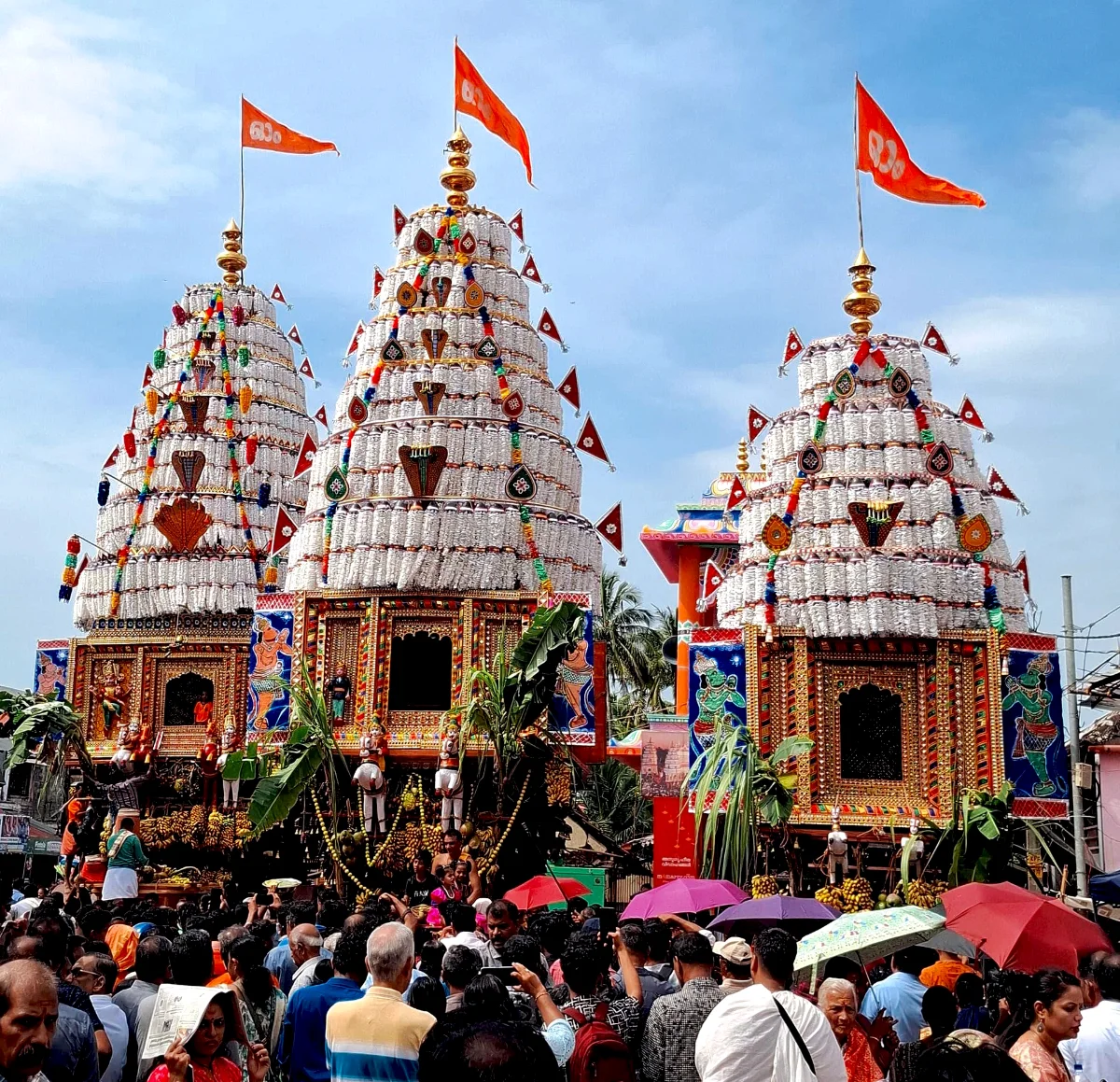
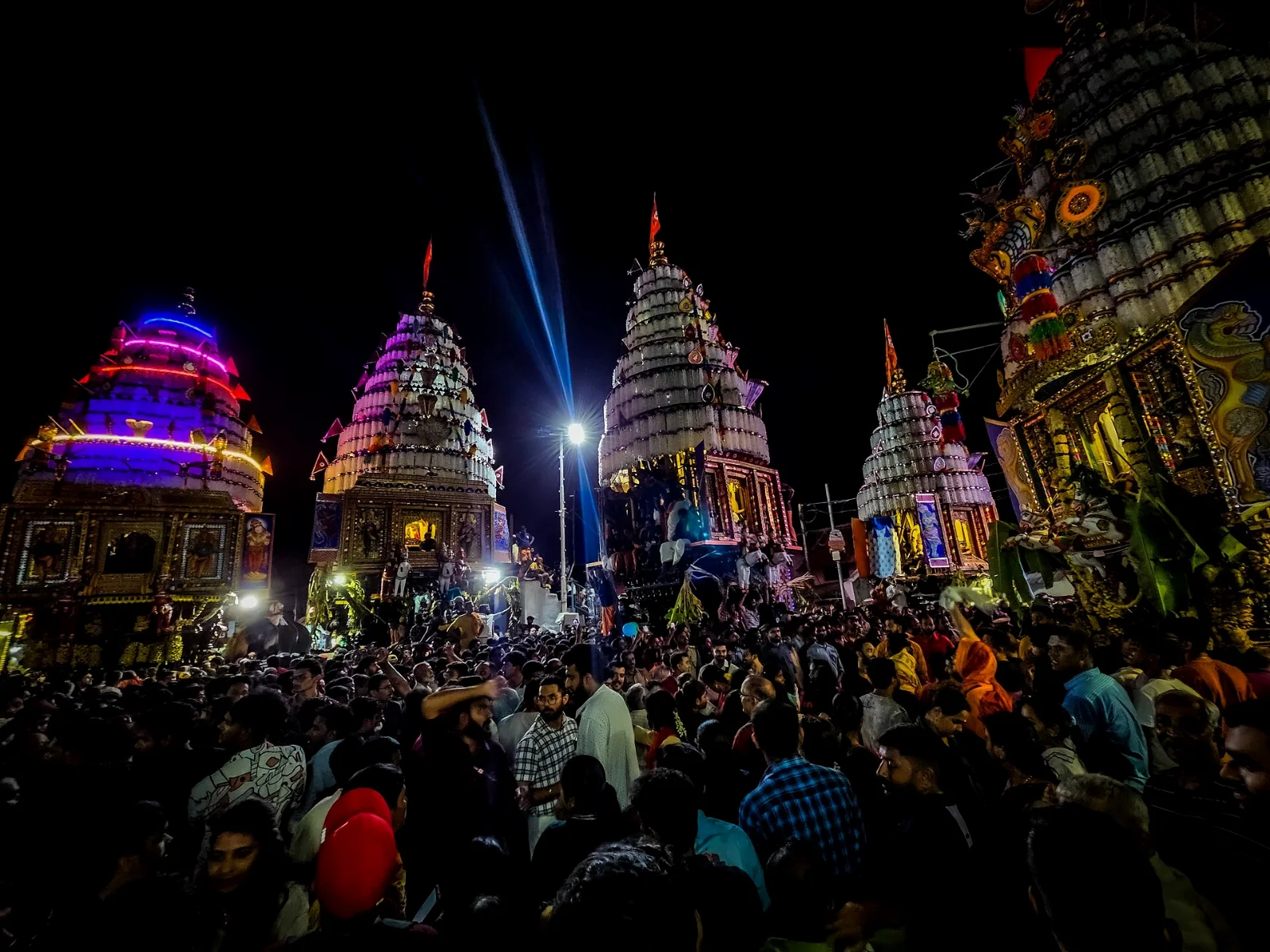
The chariots. On the last three days, six chariots take to the streets. Three belong to the main temple: Siva with Visalakshi, Ganapathy and Subrahmanya. The other three carry the deities of the other agraharams: Ganapathy from New Kalpathy, Lakshmi Narayana Perumal from Old Kalpathy and Ganapathy from Chathapuram. Built of carved wood, several storeys high, hung with cloth, flowers and mirrors, they are pulled through the narrow streets on thick ropes by hundreds of devotees. Only villagers set up the wheels and steer from behind, but residents say more than half of those pulling now come from outside the village. By the custom of the festival, anyone may take a rope, whatever their caste.
A son asks his father. Before Ganapathy mounts his chariot, he must ask his father Siva's permission. The request is acted out in a symbolic conversation between two priests, one speaking for each god.
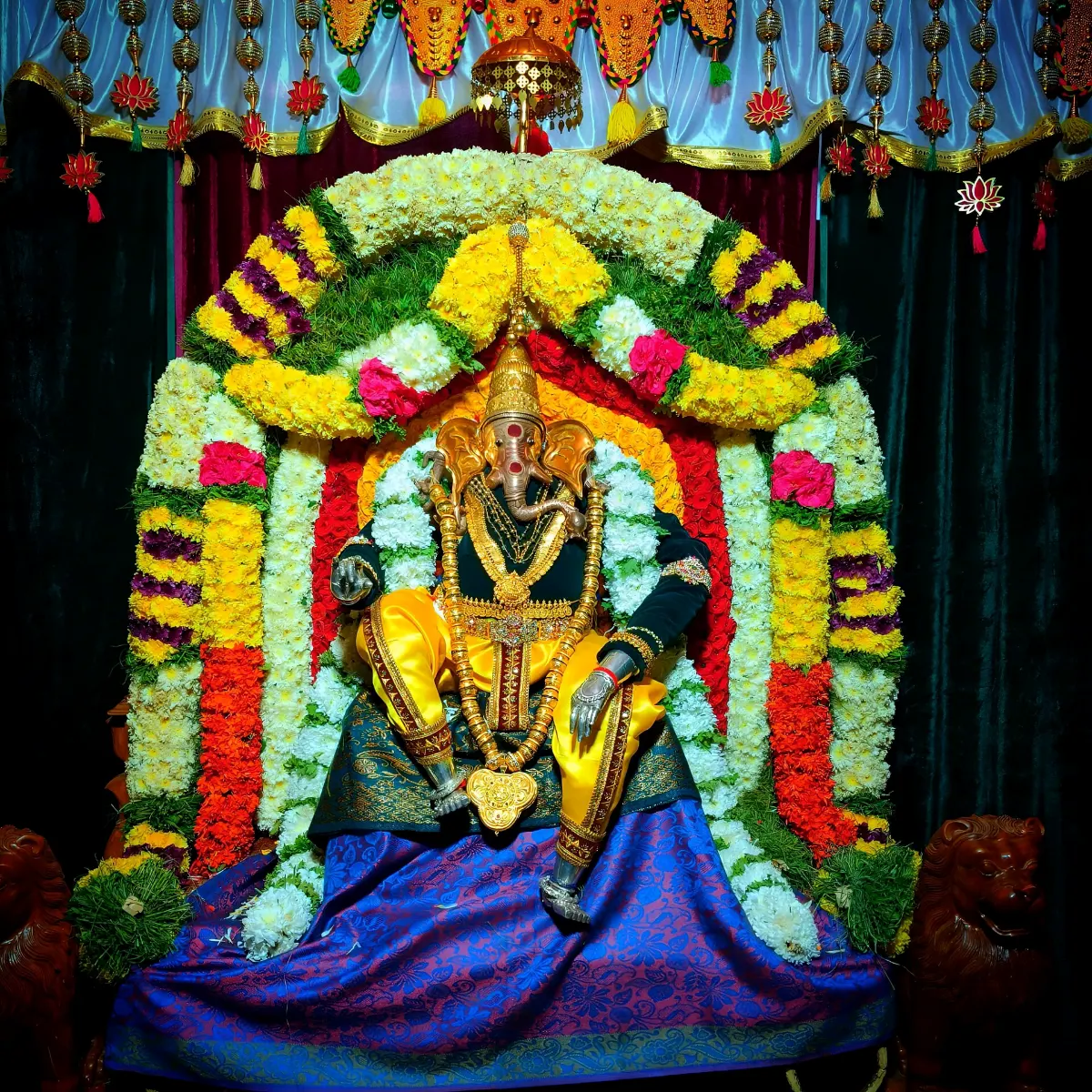
The meeting of the gods. On the final evening comes the Devaratha Sangamam, the ‘meeting of the divine chariots’. The chariots of all the agraharams converge at Therumutty junction, and the crowd, now more than a lakh of people, waits for the moment they stand together. Then each chariot returns to its own street, the deities are purified and anointed, and the festival closes with the lowering of the flag.
One rule shows how closely the festival is bound to the village: if anyone in Kalpathy dies during the ten days, the chariots must go back and make their journey again.
A heritage village
In 2008 the Kerala government declared Kalpathy the state's first heritage village, covering 22.36 hectares of Old and New Kalpathy. Under the rules, any building work, repair or demolition needs the approval of the Art and Heritage Commission.
The status has not been welcomed by everyone. A 2022 study found residents resentful of restrictions that make it hard to repair or extend old houses, and a 2014 report described houses in urgent need of repair. Meanwhile many families have moved to Chennai, Bengaluru or abroad, and the houses they leave are sold, rented or rebuilt with grilles, gates and parking. The street is still beautiful, but it is changing house by house.
Our assessment: preservation needs the residents
Heritage rules that only forbid will not save Kalpathy. The houses survive because families live in them, and families need kitchens, bathrooms and repairs.
The best hope is help, not just restrictions: grants and technical advice for owners who repair in the old way, and a simple, quick approval process. Otherwise the street will be preserved on paper and rebuilt in reality.
What is proven, and what is not
- The Viswanatha Swamy temple existed by 1424–25: documented, by a stone inscription of Kollam Era 600 recording Itti Kombi Achan's endowments.
- ‘The temple was built in 1425’: slightly off. The inscription records endowments, so the temple may be older; 1425 is the earliest firm date, not a founding date.
- Lakshmi Ammal brought the linga from Kashi: tradition. The palm-leaf record of the founding is said to have been lost.
- Tamil Brahmins came from the Kaveri delta: documented broadly, by family histories, language, temple rites and local histories.
- They came because the raja fell out with the Namboothiris: tradition, and not datable.
- ‘The settlers fled Tipu Sultan in the 1790s’: doubtful as the origin. Kalpathy is centuries older, and Tipu himself held Palakkad; at most a later wave.
- Ezhavas were blocked from the agraharam road in 1924: documented.
- Kalpathy is Kerala's first heritage village (2008): documented.
- ‘The kolam is thousands of years old’: possible, but undocumented. The earliest clear literary references are sixteenth and seventeenth century.
- Kolams feed ants and birds, and are left undrawn in mourning: living tradition, documented in fieldwork.
Visiting
- Getting there: Kalpathy is about 3 km from the centre of Palakkad town; an auto-rickshaw from the bus stand or Palakkad Junction station is easiest.
- When: early morning, for the kolams and the temple's first puja, or the evening.
- The Ratholsavam: ten days in mid-November, with chariots on the last three days and the Devaratha Sangamam on the final evening. Dates move with the calendar, so check before you travel. Expect huge crowds; keep valuables safe and wear comfortable footwear.
- Etiquette: these are homes. Don't step onto a thinnai uninvited, don't walk across a fresh kolam, ask before photographing people, and dress conservatively in the temple.
- Eat: Tamil Brahmin vegetarian food: idli, dosa, sambar and filter coffee.
- From Munnar: Palakkad is roughly five to six hours by road.
Read also: Palakkad Fort · Kerala Architecture · Thrissur Pooram · Sabarimala
See it for yourself, with a local driver who knows these roads.
Book a Munnar Jeep SafariSources & further reading
- K. N. Lakshminarayanan, From Cauvery to Neela: A History of the Tamil Agraharams of Palakkad (Notion Press, 2020)
- Vijaya Nagarajan, Feeding a Thousand Souls: Women, Ritual, and Ecology in India: An Exploration of the Kolam (Oxford University Press)
- Gift Siromoney, 'South Indian kolam patterns', Kalakshetra Quarterly 1:1 (1978)
- Gift Siromoney archive: kolam studies
- Sahapedia: Significance of kolam in Tamil culture
- Kalpathy heritage village: community perception after the 2008 designation (Springer, 2022)
- Kerala Tourism: Kalpathy to be the first heritage village in Kerala (2008)
- Kerala Tourism: Kalpathy Ratholsavam
- Onmanorama: Kalpathy Ratholsavam, traditions and stories (16 November 2026)
- Deccan Chronicle: Kalpathy heritage village on bad days (2014)
- Wikipedia: Kalpathy
- Wikipedia: Viswanatha Swamy Temple, Palakkad
Figures are from the sources listed and were checked in November 2026. Park timings and road conditions change, so please confirm before you travel.