
Andavar Kovil: The Cave Temple of Vattavada
On a hillside half a kilometre from Vattavada town, on Kerala's border with Tamil Nadu, a small Murugan temple stands at the mouth of two natural rock caves. Local legend says a cave once led all the way to Madurai. What the shrine is, what its offerings board tells us, and what the cave really is.
Beyond Top Station, where the road from Munnar runs on towards the Tamil Nadu border, lies Vattavada, a cluster of farming villages on terraced hillsides at around 1,700 m. Its fields of carrots, garlic, cabbage and strawberries have made it famous as Kerala's vegetable garden. Less well known, even to most visitors who pass through, is a small temple built into the rock of a hillside just outside the town, which local people call Andavar Kovil.
This article is based on our own visits and observation. We have not found any published study or official record of the temple, so what follows is a first-hand account. Older photographs from our visits since 2002 will be added as we find them.
At a glance
- Where: on a hillside about half a kilometre from Vattavada town, reached by a narrow lane; Devikulam taluk, Idukki district, about 45 km east of Munnar, on the border with Tamil Nadu.
- Deity: Murugan, here called Andavar, "the Lord".
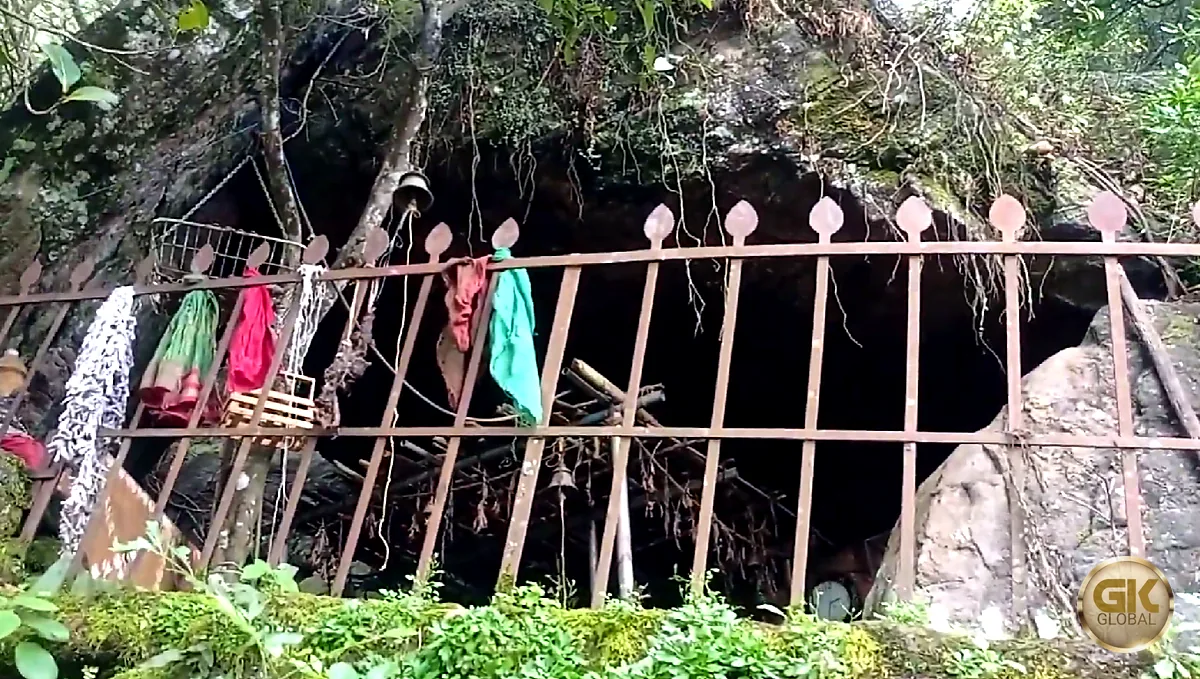
- The caves: two distinct natural rock caves, with the shrine built at their mouths.
- Pooja: on Saturdays.
- Legend: a cave is said to lead underground all the way to Madurai. It does not: these are natural caves, and two iron grills inside block any passage beyond the shrine.
Vattavada and its people
Vattavada lies on the western edge of the Palani Hills, the range that stretches east to Kodaikanal. Its villages, including Vattavada, Koviloor, Kottakamboor, Kadavari, Chilanthiyar and several tribal hamlets, are home to about 3,300 people. Most speak Tamil. According to local tradition, many of their ancestors came up from the Tamil plains generations ago, some say fleeing war at the time of Tipu Sultan's campaigns, and settled in these high, cold valleys, much as the farmers of the nearby Anchunadu villages of Marayoor and Kanthalloor did. The village of Koviloor takes its name from the Tamil for "village of temples".
The people of Vattavada kept many of the customs of the Tamil country, including their own village councils and temple festivals. Their gods are the gods of the Tamil villages and hills, and above all Murugan, the god of the hills.
Andavar: the Lord of the hills
In Tamil devotion, Andavar, "the Lord", is a name most often given to Murugan, as at the great hill shrine of Palani (Palani Andavar) and at the Kurinji Andavar temple at Kodaikanal, on the far side of the same Palani Hills. At Vattavada too, the deity of the cave temple is Murugan, linking this small shrine with a much wider tradition of Murugan worship in the hills between Kerala and Tamil Nadu. Murugan is the god of hilltops and high places, and shrines to him in caves and on rock outcrops are common across the Tamil country.
The temple today
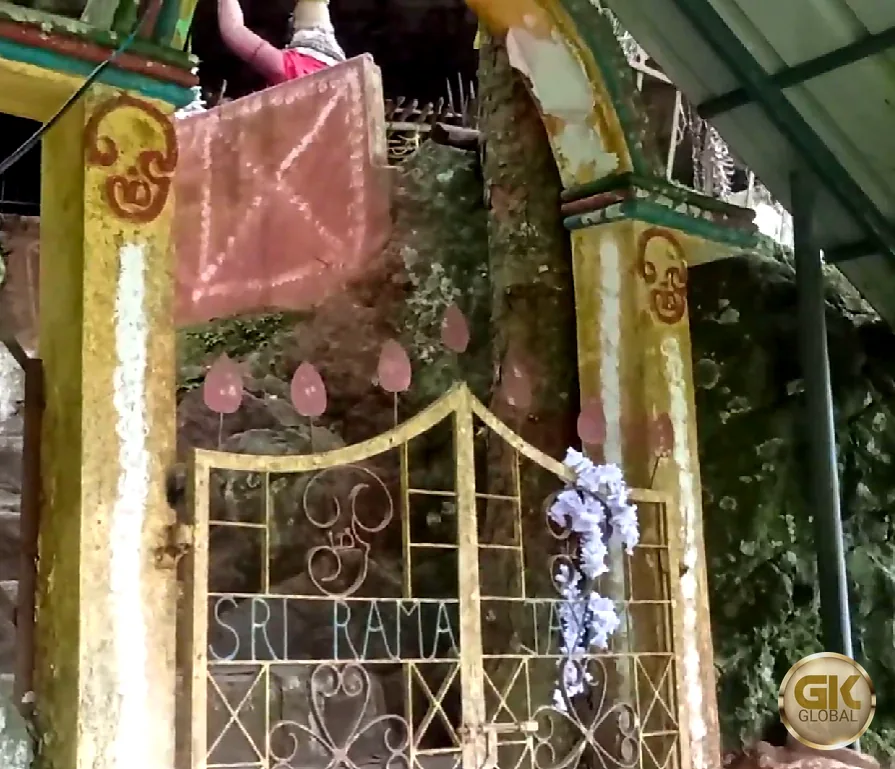
The shrine is entered through a small painted gateway of yellow pillars and a decorated iron gate. Worked into the gate's ironwork are the words SRI RAMA JAYAM, "victory to Sri Rama". This is a blessing that Tamil devotees of every deity write at the head of letters, account books and notice boards, and its presence here does not mean the temple is dedicated to Rama. The same words head the offerings board beside the gate.
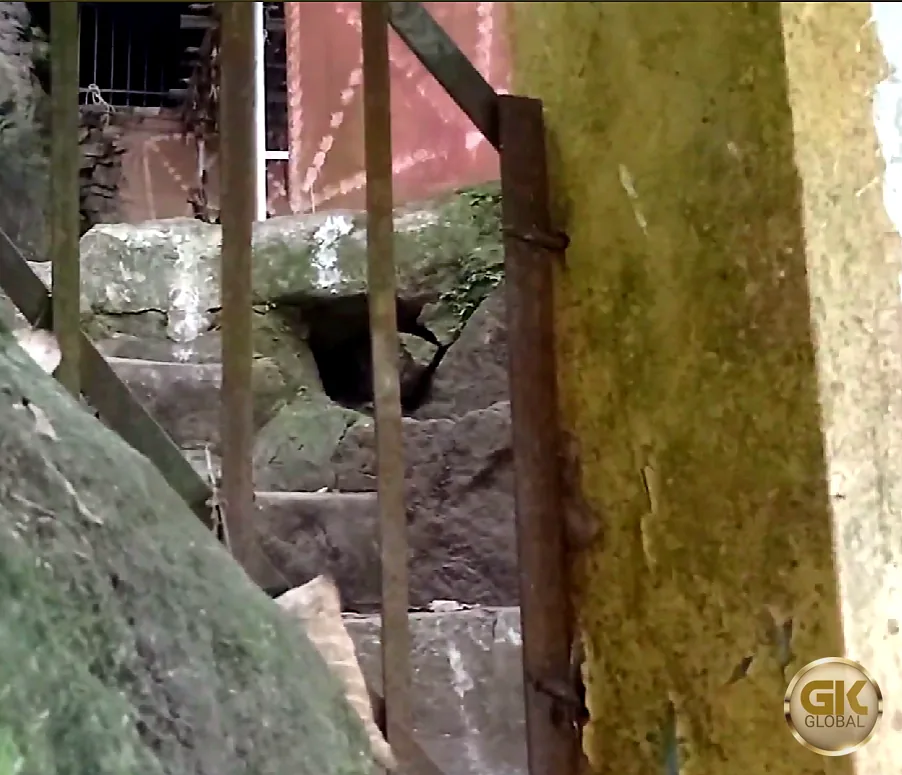
Beyond the gate, rough stone steps and an iron-railed stairway climb between moss-covered boulders to the caves. There are two distinct caves. Their mouths are fenced with old iron railings, to which devotees tie strips of cloth as vows and prayers, and bells hang from the roots of a tree that grows over the rock. It is a quiet, simple place, far from the busy tourist spots of Munnar. Pooja is performed on Saturdays.
The offerings board
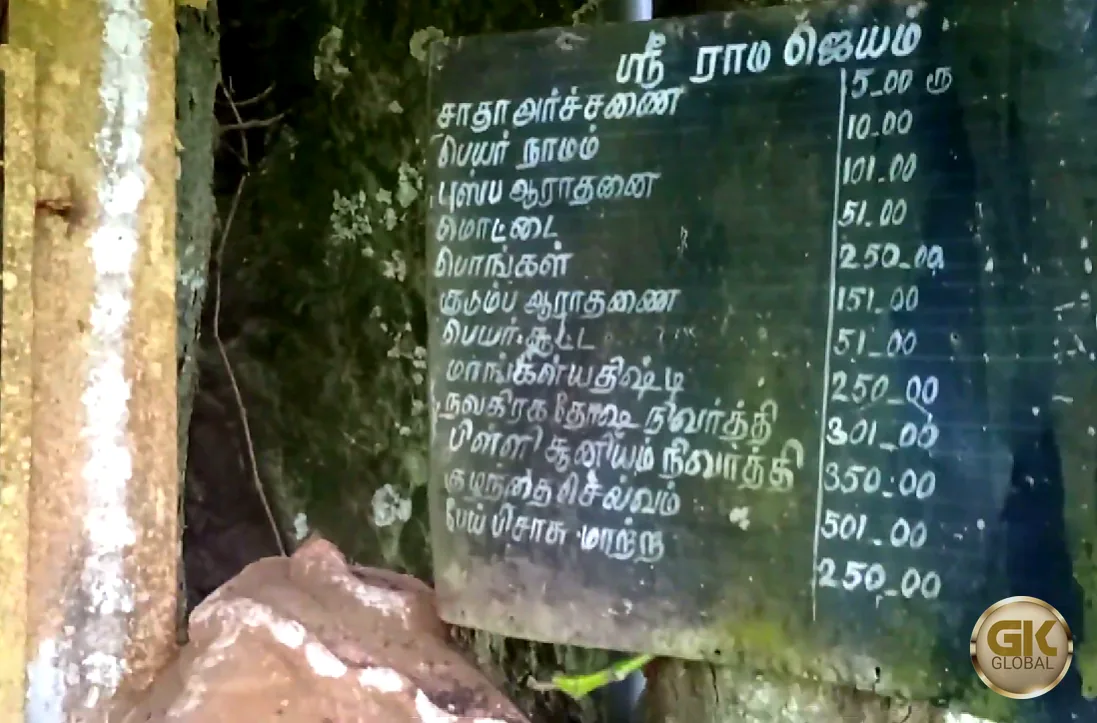
A board in Tamil beside the gate lists the poojas and offerings that devotees may make, and their fees. It tells us a great deal about what people come here to pray for: not only ordinary worship, but naming ceremonies, family blessings, the gift of children and protection from evil. These are the concerns of a village shrine, close to the everyday lives and hopes of the people around it.
| Tamil (as on the board) | Meaning | Fee (₹) |
|---|---|---|
| சாதா அர்ச்சனை (sadha archanai) | Ordinary archana: the priest offers worship with the chanting of the god's names | 5 |
| பெயர் நாமம் (peyar namam) | Archana in the devotee's own name (and birth star) | 10 |
| புஷ்ப ஆராதனை (pushpa aradhanai) | Worship with flowers | 101 |
| மொட்டை (mottai) | Tonsure: shaving the head as a vow | 51 |
| பொங்கல் (pongal) | Cooking and offering sweet pongal (rice boiled with jaggery) to the god | 250 |
| குடும்ப ஆராதனை (kudumba aradhanai) | Worship for the whole family | 151 |
| பெயர் சூட்டல் (peyar soottal) | Naming ceremony for a child | 51 |
| மாங்கல்ய திஷ்டி (mangalya dishti) | A prayer concerning mangalyam (marriage), most likely to remove the evil eye or obstacles to a marriage | 250 |
| நவகிரக தோஷ நிவர்த்தி (navagraha dosha nivarthi) | Remedy for the ill effects of the nine planets in one's horoscope | 301 |
| பில்லி சூனியம் நிவர்த்தி (billi sooniyam nivarthi) | Removal of black magic and sorcery | 350 |
| குழந்தை செல்வம் (kuzhandhai selvam) | Prayer for the blessing of children | 501 |
| பேய் பிசாசு மாற்று (pey pisasu maatru) | Driving away ghosts and evil spirits | 250 |
Some words on the board are hand-painted with small spelling variations (for example நலகிரக for நவகிரக, "navagraha"); we have given them in standard form. Our translation of mangalya dishti is our best reading and may be corrected by those who know the temple's practice.
The cave and the tunnel to Madurai
Local people say that in the past, one of the caves was a tunnel that led all the way to Madurai, the great temple city of the Tamil country, more than 100 km away across the mountains.
From what we have seen of the caves and the rock around them, and from the lie of the land, this is not true. The caves are natural formations in the rock of the hillside, of a kind found in many places in these hills, where great boulders and rock faces leave hollows and passages between and beneath them. They extend some way into the hillside, but there is no sign of any man-made tunnel, and a passage of more than 100 km under the Western Ghats is not possible. Two iron grills inside the caves now block the way beyond the shrine, most likely to protect it and to keep people out of unsafe passages.
Stories of secret tunnels linking hill caves, temples and forts with distant cities are found all over South India. Similar legends tell of tunnels from caves to Madurai, Palani, Srirangam and other holy places, used by kings, saints or rishis. Such stories are better read as a memory than as fact: they speak of the close bond between the hill people and the temples and kingdoms of the plains, and of the journeys, pilgrimages and migrations along the routes that link them. For the people of Vattavada, many of whose ancestors came from the Tamil country, a cave that "leads to Madurai" is a way of saying that their hills and the old heartland are one.
Questions for the future
Many questions about Andavar Kovil remain open. How old is the shrine? Who first worshipped here: the Tamil settlers of Vattavada, or the tribal communities of the hills before them? Are there carvings or inscriptions in or near the caves? When were the grills installed, and what festivals does the temple keep? We hope that local people, historians and archaeologists will help answer them. (Read about other cave shrines in the region: the Kuthirayala cave temple, and the ancient monuments of Marayoor; and about the region's places of worship in Munnar's churches, temples and mosques.)
Visiting
- Andavar Kovil is a living place of worship, on a hillside about half a kilometre from Vattavada town. Pooja is held on Saturdays. Ask permission before entering or photographing, remove your footwear, and respect local customs.
- Do not attempt to go beyond the grills or explore the caves: natural caves can be dangerous, and the rock steps are slippery when wet.
- Vattavada is about 45 km from Munnar by road via Top Station. The road passes near Pampadum Shola National Park and the Kurinjimala Sanctuary. (Read our introduction to Munnar.)
Help us tell this story
- If you know the history, festivals or legends of Andavar Kovil, or have old photographs, please contact us. We will add your information, with credit and your permission.
See it for yourself, with a local driver who knows these roads.
Book a Munnar Jeep SafariSources & further reading
- GK Global: our own visits and photographs (2002 to 2026)
- Wikipedia: Vattavada
- Vattavada Grama Panchayat
- Wikipedia: Koviloor, Kerala
- Onmanorama (Dec 2020): Land of vegetation: a walk through Vattavada
- Kerala Tourism: Vattavada
- Trawell: Kurinji Andavar Temple, Kodaikanal
Figures are from the sources listed and were checked in October 2026. Park timings and road conditions change, so please confirm before you travel.