
One Hill, Many Layers: Thiruparankundram from Tamil-Brahmi Caves to the Supreme Court
Ascetic beds with Tamil-Brahmi letters, an 8th-century Pandya cave temple, a Nayaka processional temple, a dargah, a British survey pillar and a case before the Supreme Court: one granite hill near Madurai, read layer by layer, keeping fact, tradition and what is still sub judice apart.
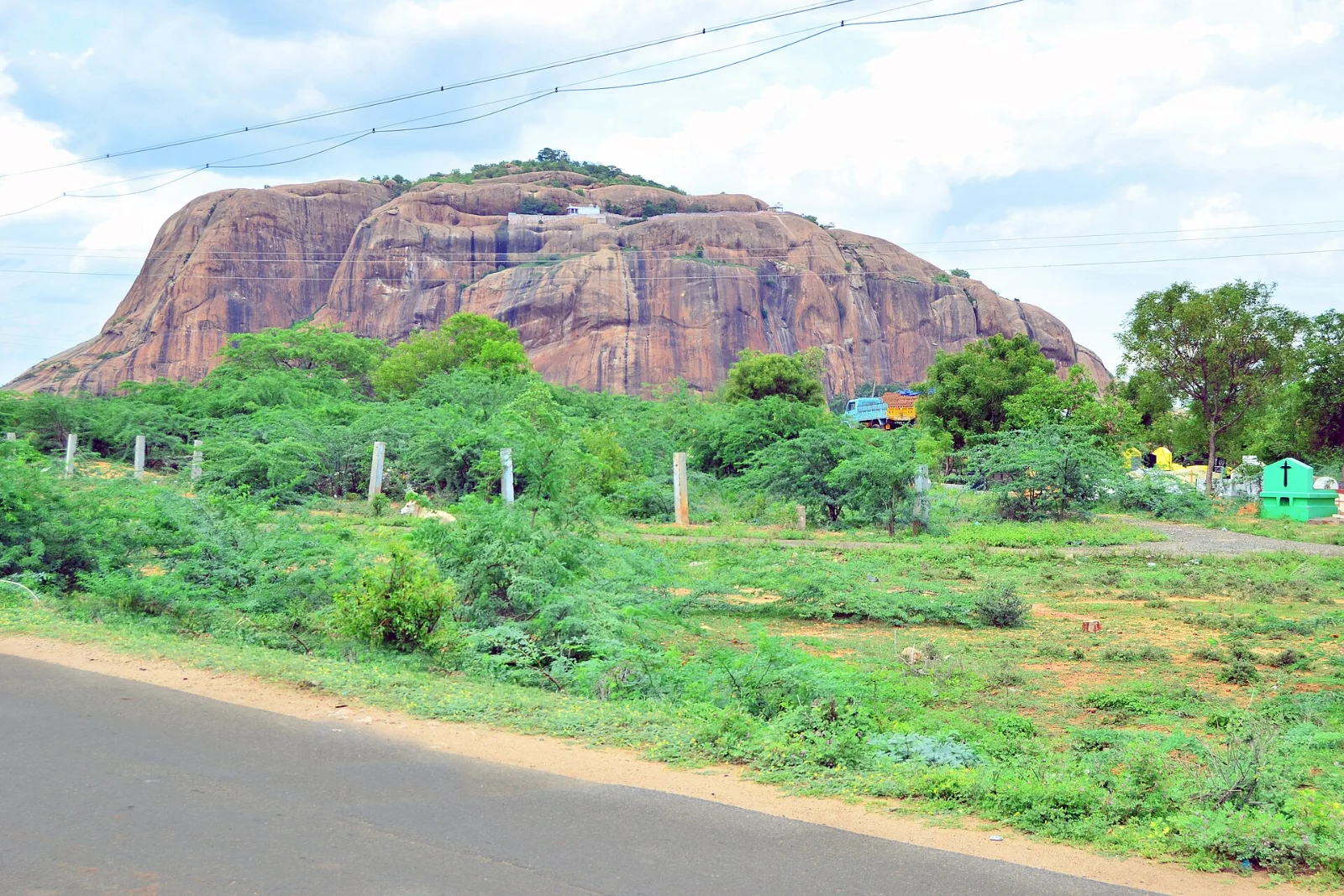
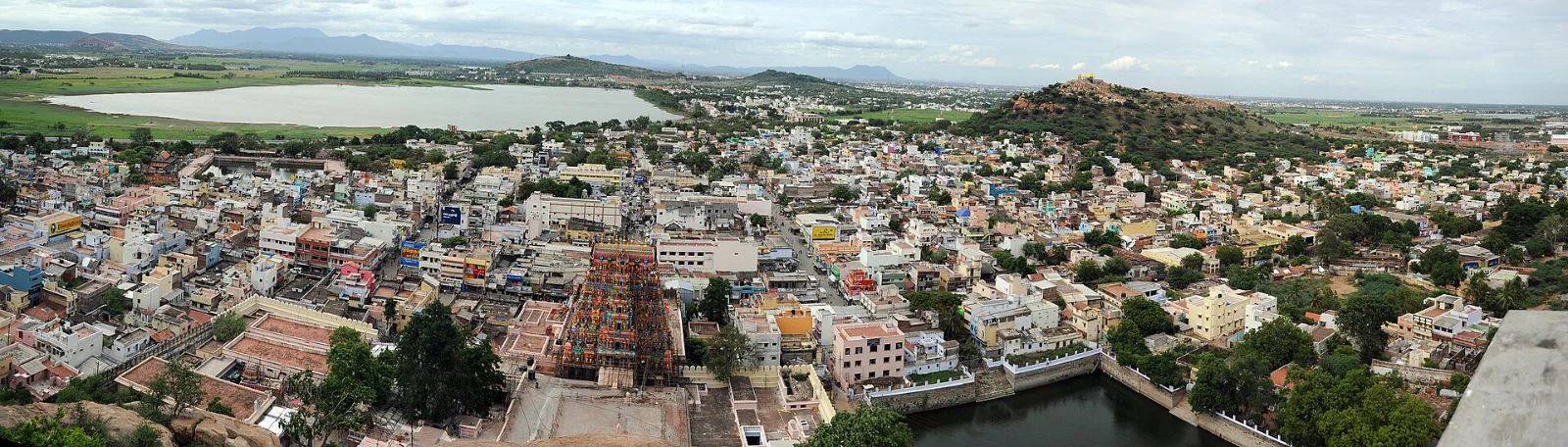
Seen from the Madurai–Tirumangalam road, Thiruparankundram is a single grey dome of granite. Walk around it and it divides into many places. At its northern foot is one of the busiest Murugan temples in Tamil Nadu, cut back into the rock. On the south face there is a smaller cave temple and a spring. On the western slope, natural caverns hold stone beds carved for ascetics more than two thousand years ago. On the summit there is a dargah, a pillar and a flagstaff. Since 2025 the summit has also been the subject of a run of court orders that reached the Supreme Court of India.
This article treats the hill the way our Vizhinjam long read treated a port: it keeps the layers apart. A line of poetry is not a building date. An inscription dates the thing it was cut into, not the whole complex around it. A court finding about ownership is not an archaeological finding about age. Each layer has its own kind of evidence, and confusing them is how most of the noise around Thiruparankundram has arisen. As always, our own assessments are clearly marked.
At a glance
- Where: a granite hill about 8 km southwest of Madurai, rising to roughly 1,048 ft (319 m), with a circumference of over 3 km.
- Names: Thiruparankundram (Tirupparankunram); Skandamalai to Murugan’s devotees; Sikkandar Malai in local Muslim usage; Paramasikharin in an 8th-century Sanskrit record.
- Oldest layer: natural caverns with stone beds and Tamil-Brahmi inscriptions, generally dated between the 2nd century BCE and the early centuries CE.
- Dated architecture: rock-cut shrines of the early Pandya period, including a Sanskrit inscription of Kali year 3874 (773 CE).
- On the summit: the dargah of Sultan Sikandar Badusha and a stone pillar now at the centre of litigation; on a lower peak, the Uchi Pillaiyar shrine and Deepa Mandapam.
- Today: the Arulmigu Subramaniya Swamy Temple at the foot of the hill, counted first of Murugan’s Arupadai Veedu (six abodes), and a dispute before the Supreme Court of India.
Deep time: caverns, stone beds and Tamil-Brahmi
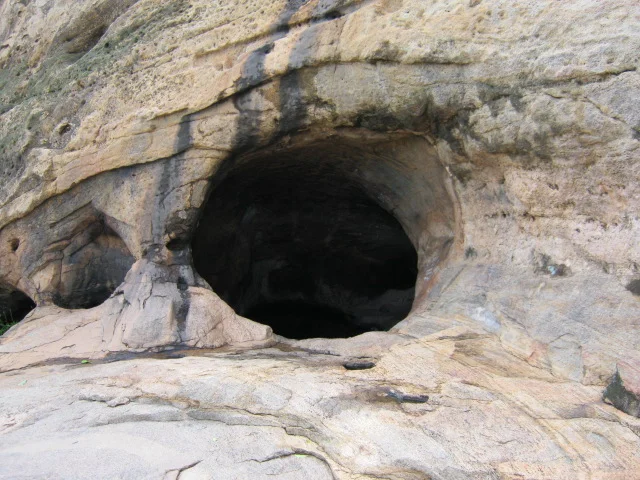
The oldest human traces on the hill are on its western side, in natural caverns opposite Thiruparankundram railway station. Inside are smoothed stone beds, of the kind found in caverns across the Madurai region, and short inscriptions in Tamil-Brahmi, the earliest script used to write Tamil.
- What the inscriptions are. Three Brahmi inscriptions were copied in the caverns after repairs and published in the Annual Report on Indian Epigraphy for 1951–52 (nos. 140–142). They are fragmentary. Like similar records around Madurai, they appear to name the people who caused the beds to be cut. Iravatham Mahadevan’s corpus (Early Tamil Epigraphy, 2003) includes them among the Tirupparankunram records; he dated the cave inscriptions of this class to between about the 2nd century BCE and the early centuries CE.
- Who used them. Beds of this kind are widely attributed to Jain (and possibly other) ascetics, and later Jain bas-reliefs line the path that climbs the south side of the hill towards the rock-cut Kasi Viswanathar shrine. Local tradition calls the western beds the “Pancha Pandava beds”, after the Mahabharata brothers; historians treat that name as a later folk label.
- A recent addition. More recently, the Madurai archaeologist V. Balamurali reported another Tamil-Brahmi inscription in a smaller cavern with five stone beds, near the protected cave. Its second line is badly damaged.
- Protection. The Archaeological Survey of India protects the Tamil-Brahmi beds on the western edge and the Jain reliefs along the southern trail as a monument of national importance (ASI N-TN-C87). It separately protects the rock-cut cave and inscription on the south face (N-TN-C88).
For the script itself, see our guide to Tamil-Brahmi, Vattezhuthu and Kolezhuthu. For the same early urban world on the Vaigai, see Keeladi.
Literature: the first of the six abodes
Thiruparankundram, as Parankunram, appears in early Tamil literature as a sacred hill of Murugan. Two texts matter most: the Tirumurukarruppadai, attributed to Nakkirar, which guides a devotee to Murugan’s places and opens with Parankunram; and the Paripadal, a Sangam-era anthology of hymns, several of which celebrate Murugan at Parankunram near Madurai. From these, devotional tradition counts Thiruparankundram as the first of the Arupadai Veedu, the six abodes of Murugan. It is also remembered as the place of Murugan’s marriage to Deivanai.
Our assessment: poems are not building dates
The poems prove that Parankunram was a sacred Murugan hill in the early Tamil literary imagination. Their dates are themselves debated, and they say nothing about which structures stood on the hill then. The present temple is not a Sangam building: its datable fabric begins in the 8th century, and most of what a visitor walks through is much later. The idea of exactly six abodes as a fixed pilgrimage set is also a later development of the tradition.
Epigraphy: the 8th-century rock-cut shrines
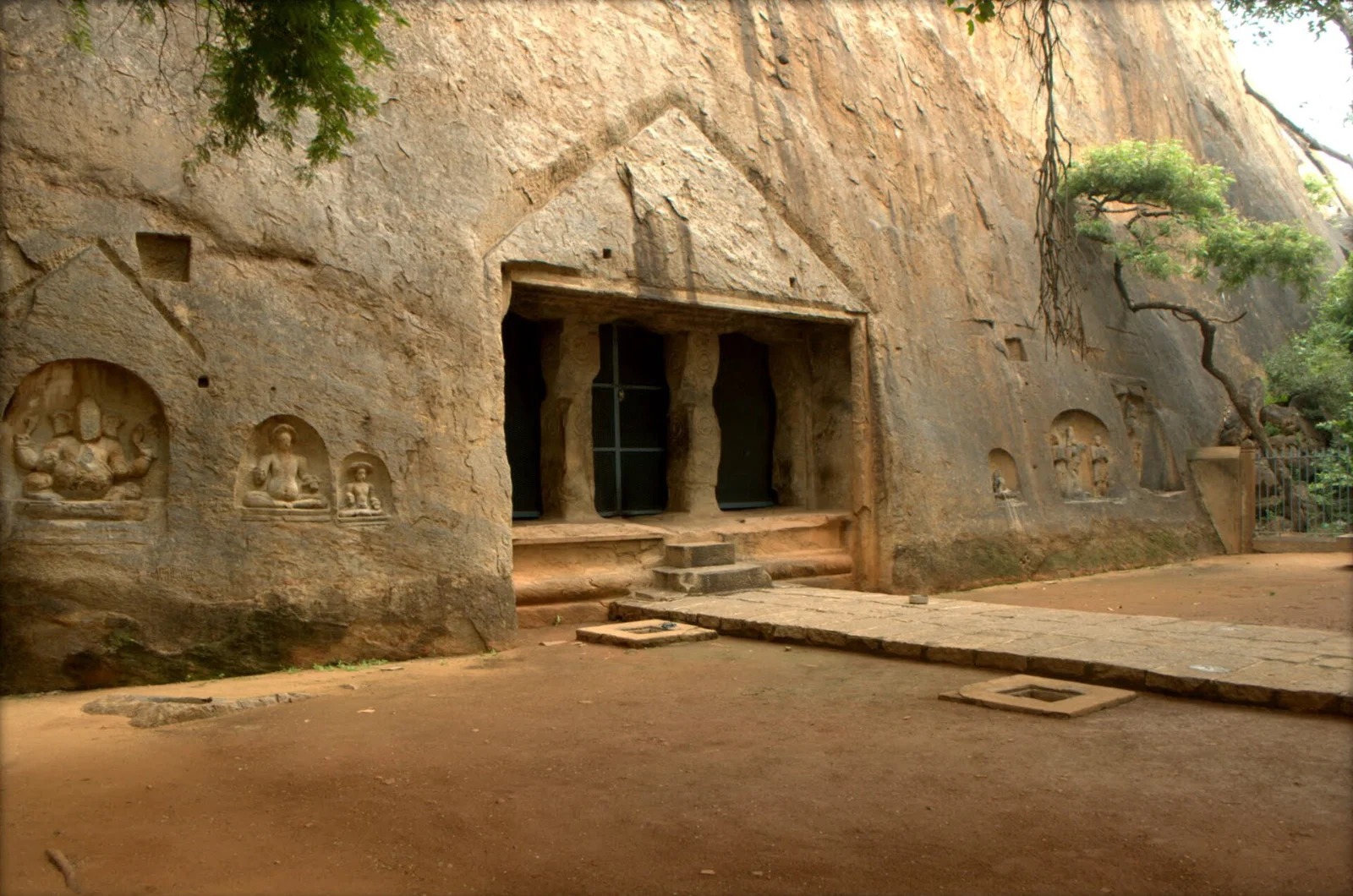
The first securely dated architecture on the hill belongs to the early Pandya kings of Madurai, who cut cave shrines into granite hills across their country in the 8th century. The Subramaniya Swamy temple on the north face grew outward from such a cave, and two early inscriptions date that core:
- A Vattezhuthu inscription on a pillar of the cave, dated in the 6th regnal year of the Pandya king Maranjadaiyan. It records the making of the shrine (tirukkoyil) and a tank by Sattan Ganapati of Karavandapuram, a high officer of the Vaidya community. Associated records name his wife Nakkan Korri as the builder of shrines to Durga and Jyeshtha. (South Indian Inscriptions XIV, no. 3; ARE 37 of 1908.)
- A Sanskrit verse in Grantha on the lintel of the Durga shrine’s doorway. It records that a man of the same Vaidya family excavated the Siva temple on the hill, which it calls Paramasikharin, and installed an image of Ganapati in Kali year 3874, that is 773 CE. (ARE 1951–52, no. 143.) A relative, Marangari, is known from an inscription at Anaimalai, about 25 km away, to have cut a Vishnu cave there in Kali 3871 (770 CE).
Together these show that the cave at the heart of today’s Murugan temple was first excavated in the 770s, as a Saiva shrine with Durga, Ganapati and other deities, not as a Murugan temple from the start. How and when Murugan became the principal deity is a question of later ritual history, not of the 773 CE inscription.
The south face. The smaller Umaiyandar (Umai Andar) cave temple at the foot of the south face is a separate early Pandya rock-cut shrine, with inscriptions and carvings in several layers. It is usually dated between the 8th and 13th centuries.
Architecture: how the temple grew
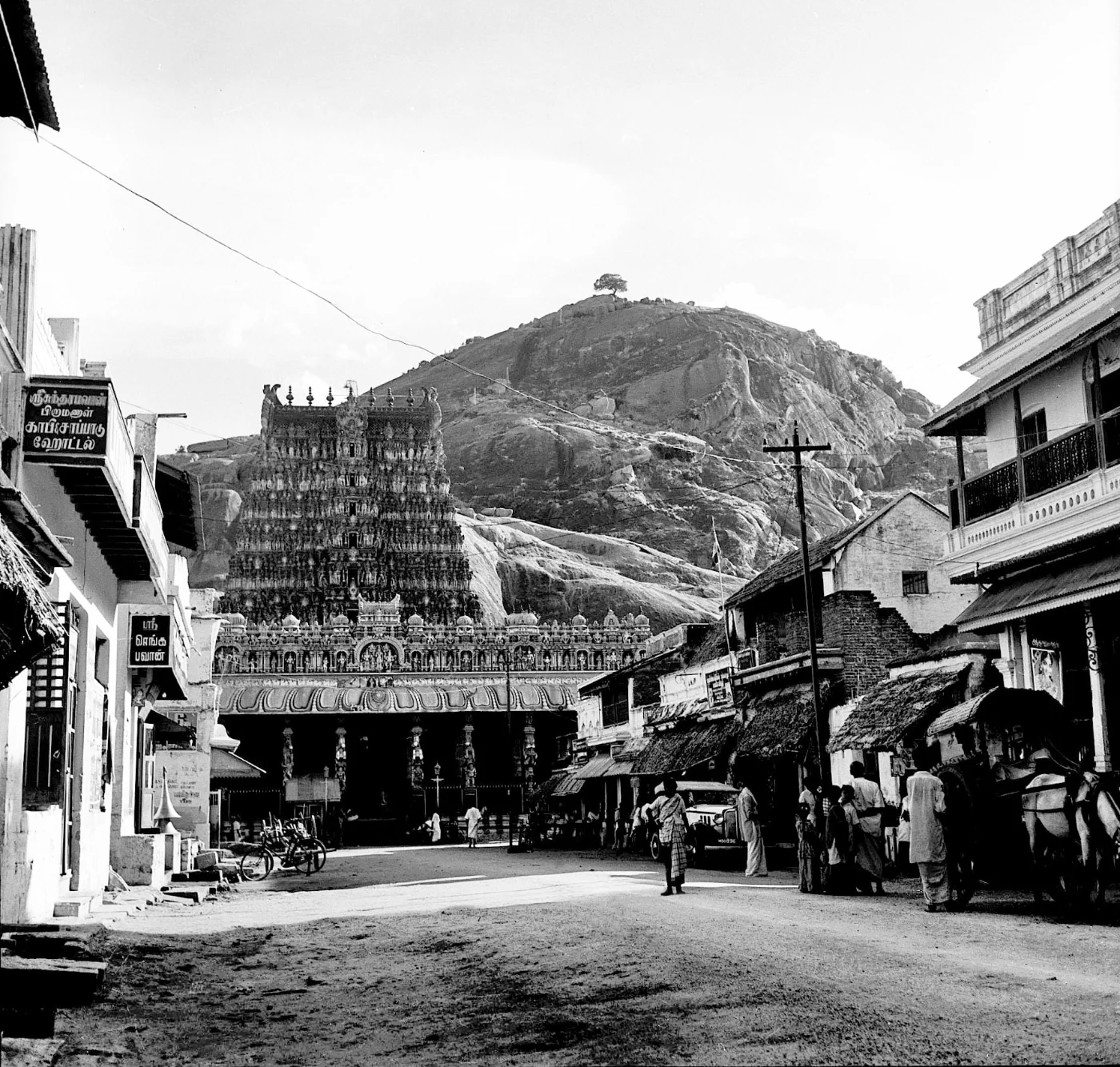
Most of what a visitor sees at the Subramaniya Swamy temple today, the long approach, pillared halls and gateway tower, is not 8th-century work. In “The Madurai Nayakas and the Skanda temple at Tirupparankundram” (Ars Orientalis 33, 2003), the SOAS art historian Crispin Branfoot traces how the temple was extended outward and downward from the cave in the Madurai Nayaka period (16th–17th centuries). The new halls were stepped up the slope in front of the rock, turning an old cave shrine into a processional temple fit for the great festivals of Nayaka Madurai.
| Layer | Evidence | Date |
|---|---|---|
| Sacred hill of Murugan in literature | Tirumurukarruppadai, Paripadal | Early Tamil literary period; exact dates debated |
| Ascetic beds and Tamil-Brahmi inscriptions | The inscriptions themselves; palaeography | c. 2nd century BCE to early centuries CE |
| Rock-cut Siva shrine (core of today’s temple) | Vattezhuthu and Sanskrit inscriptions | 770s; Sanskrit record dated 773 CE |
| Umaiyandar cave, south face | Inscriptions and style | 8th to 13th centuries |
| Halls, approach and tower of the main temple | Architecture; Branfoot’s study | Mainly Madurai Nayaka period, 16th–17th centuries, with later additions |
| Dargah on the summit | Tradition, documents, court records | Disputed: see below |
| GTS survey station on the summit | Colonial survey records; 2026 State report | 19th century |
For the Nayaka city that shaped this temple, see our history of the Meenakshi temple.
The dargah: tradition, buildings and the 1931 ruling
On the higher summit stands the dargah of Sultan Sikandar Badusha, venerated as a martyr. Its annual urs, the Santhanakoodu festival, draws large crowds. It is a living place of prayer, and its history has layers like the rest of the hill.
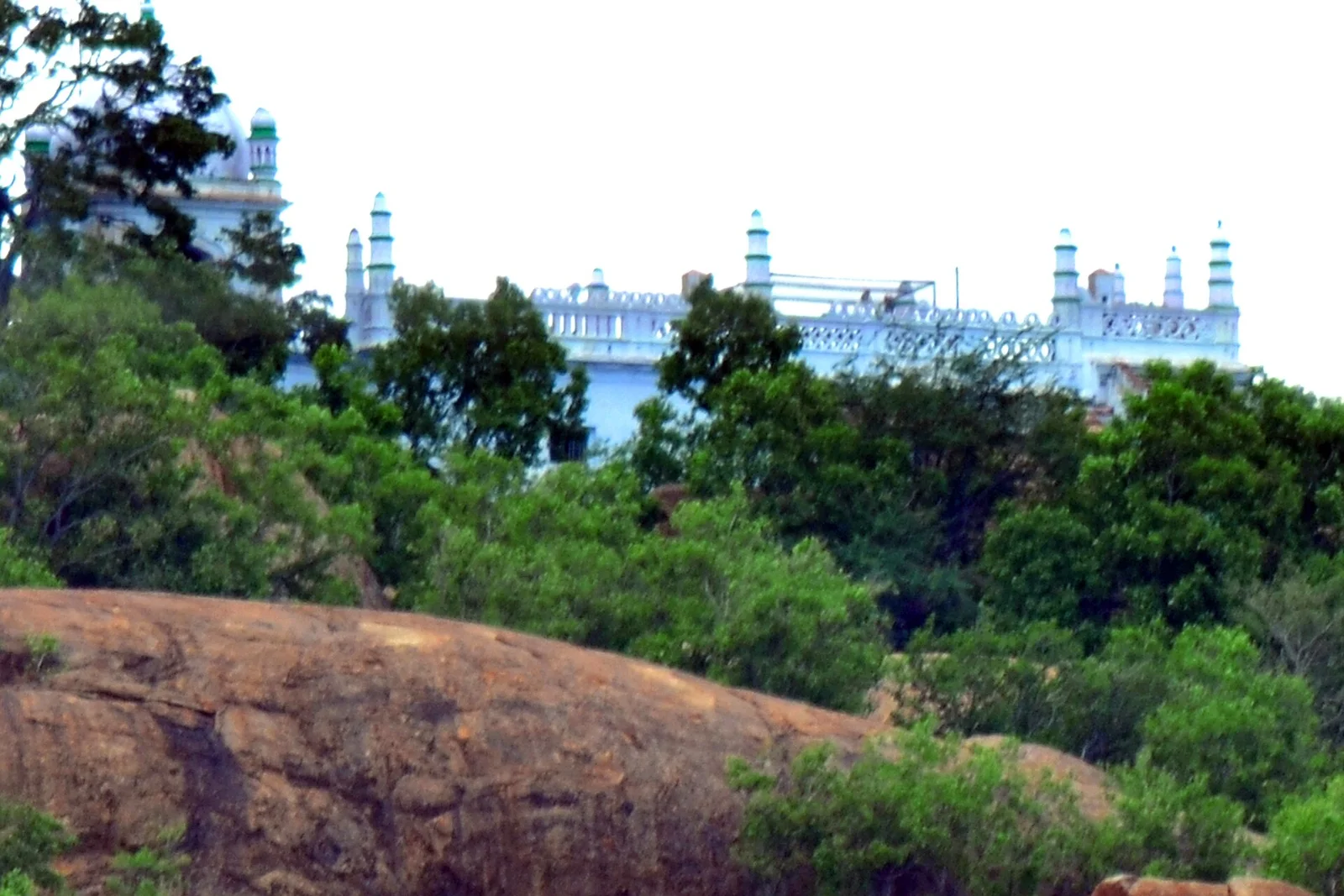
- The tradition. The dargah is associated with Sikandar Shah, generally identified as the last ruler of the short-lived Madurai Sultanate (c. 1335–1378), who was killed during the Vijayanagara campaign led by Kumara Kampana that ended the Sultanate. Tradition places his death and grave on the hill.
- The buildings. Published dates for the present structures vary widely. Some writers call the dargah 14th-century, following the tradition; others date the building to the late 17th century; a rebuilding in 1805 by the Ilayangudi landholder Miran Mugaidheen Rowther is also recorded. We have not found a published architectural survey that settles this, so we treat the building’s date as unresolved.
- The 1920s case and the Privy Council. A civil suit (O.S. No. 4 of 1920, at the Madurai Sub-Court) between the temple and the dargah’s trustees decided rights over the hill. The Madras High Court reversed it on appeal, holding the hill to be Government land. In 1931 the Privy Council set aside the High Court’s judgment and restored the trial court’s decree: the dargah, its flagstaff and the flight of steps leading to it belong to the Muslim side, and the rest of the hill belongs to the temple. Both sides cite this ruling today.
- Shared practice. Accounts from the area describe long periods of coexistence, with people of both communities attending each other’s festivals. The disputes described below are recent in their intensity, not in their roots.
The survey layer: a British pillar on the summit?
The Great Trigonometrical Survey, begun by William Lambton near Madras in 1802, measured India from hilltop to hilltop. Its surveyors marked their stations with stone pillars and engraved marks. In 2026 the Tamil Nadu Departments of Survey and Settlement and of Archaeology jointly published Documentation of the Great Trigonometrical Survey Stations in Tamil Nadu, a five-volume report that physically documents 484 surviving stations, 210 primary and 274 secondary. According to press reports of the report:
- It identifies the pillar near the dargah as a GTS station, recorded in colonial documents as “Sikandarmalai”.
- It cites survey marks on the rock, including an engraved circle with a dot, and two control points forming a triangle with the station.
- It says present-day bearings to other stations, Nagamalai, Sadragiri, Gopalswami, Kutiparai, Ponurikimalai and Perumalmalai, with a sightline to the Meenakshi temple in Madurai, closely match the colonial values.
- It separately marks a Deepam pillar bearing an inscription at a lower point on the hill.
If correct, this matters for the dispute below: it would make the summit pillar a 19th-century survey marker rather than an old lamp pillar. Petitioners and their supporters contest this reading. The Supreme Court has not ruled on it, and an ASI team sent to examine the pillar in November 2026 did not complete its inspection. For the survey’s work in the Kerala hills, see our story on the Ward and Conner survey.
The modern disputes: what the courts have done
This section reports what courts have ordered. It does not take a side, and it does not treat any contested claim as settled. All the litigation below is in the Madurai Bench of the Madras High Court and the Supreme Court of India.
Animal sacrifice, food and the hill’s name (2025)
- January–February 2025. An attempted animal sacrifice at the dargah led to protests, prohibitory orders and petitions.
- 24 June 2025: split verdict. A Division Bench (Justices J. Nisha Banu and S. Srimathy) disagreed. Justice Nisha Banu would have dismissed the petitions, finding animal sacrifice at the dargah to be long-standing; Justice Srimathy issued directions, including that the dargah prove any such practice in a civil court. Both rejected renaming the hill “Sikkandar Malai”.
- 10 October 2025: tie-breaker. Justice R. Vijayakumar held that animal sacrifice, and cooking or serving non-vegetarian food, are barred on the hill until a civil court decides whether the practice existed “from time immemorial”. He also held that Muslims may pray at the Nellithoppu area during Ramzan and Bakrid, and that the hill cannot be renamed.
The Karthigai Deepam and the “Deepathoon” (2025–2026)
For many decades the temple has lit the Karthigai Deepam at the Deepa Mandapam near the Uchi Pillaiyar shrine on the lower peak. Petitioners sought to have it lit also at a stone pillar on the higher summit, about 50 m from the dargah, which they call the Deepathoon, an old lamp pillar. Earlier petitions on the same demand had been dealt with in 1996 and dismissed in 2014.
| Date | Court | What happened |
|---|---|---|
| 1 Dec 2025 | High Court, single judge (Justice G. R. Swaminathan) | Directed the temple to light the Deepam at the Deepathoon in addition to the usual places, from that year on. |
| 3–4 Dec 2025 | High Court; State | The State lit the lamp at the Uchi Pillaiyar mandapam only, citing law and order. The judge allowed the petitioner and ten others to light it under CISF protection, and an appeal against that was dismissed. The State moved the Supreme Court. There were clashes on the hill, and political controversy followed. |
| 6 Jan 2026 | High Court, Division Bench (Justices G. Jayachandran and K. K. Ramakrishnan) | Upheld the single judge. Held that the Deepathoon area belongs to the temple, that lighting the lamp does not affect the dargah’s rights, and that the number of people may be fixed in consultation with the ASI. |
| June 2026 | Supreme Court | The new State government (TVK) filed a special leave petition against the 6 January judgment. |
| 3 Aug 2026 | Supreme Court | Issued notice but declined to stay the High Court’s order. |
| 20 Nov 2026 | Supreme Court (Justices Aravind Kumar and Vipul M. Pancholi) | Stayed the High Court’s findings (paras 1–140 of the 6 January judgment), including those on the pillar’s character and land, insofar as challenged. Allowed a restricted temple team to light the lamp at the pillar on 24 November as a one-time measure creating no custom or right. Barred processions and new construction, and protected access to the dargah. Main matter listed for January 2027. |
| 24 Nov 2026 | – | The lamp was lit at the customary Uchi Pillaiyar site only. The temple’s newly appointed trustees had resolved to follow established practice, describing the pillar as a British survey stone. The Collector said no team had been authorised. |
| 27 Nov 2026 | Supreme Court | Called the non-compliance “flagrant”. Suspended the temple’s board of trustees and appointed two former High Court judges, Justices S. Vaidyanathan and V. Parthipan, as receivers. Handed security of the hill to the CRPF and ordered the lamp lit at the pillar on 28 November, at least 50 m from the dargah. Issued contempt notices to senior officials and summoned the Chief Secretary. |
| 28 Nov 2026 | – | According to news reports, the lamp was lit at the pillar under CRPF security, in the presence of the court-appointed former judges. |
A separate petition asking for the temple to be handed to the ASI, and for a lamp to burn on the pillar permanently, has also been filed in the Supreme Court; notice was issued in January 2026.
What remains open
The Supreme Court has expressly said its interim orders create no custom, religious right or property right. The questions of what the summit pillar is, who owns the ground it stands on, and whether a custom of lighting a lamp there existed will be decided in the main appeal, expected in January 2027. Until then, statements that the pillar “is” an ancient lamp pillar, or “is” only a survey marker, are claims made by parties, not findings that stand. This section was checked on 29 November 2026 and will be updated as the case proceeds.
What is proven, and what is not
Fact, tradition and what is before the courts
- Established by inscriptions and archaeology: Tamil-Brahmi inscriptions and stone beds in the western caverns, of the class dated to about the 2nd century BCE to the early centuries CE; early Pandya rock-cut shrines, with a Vattezhuthu record of Maranjadaiyan’s 6th year and a Sanskrit record of 773 CE naming the hill Paramasikharin; extensive Madurai Nayaka-period building at the main temple; a Great Trigonometrical Survey station on the hill named “Sikandarmalai” in colonial records.
- Established by courts: the 1931 Privy Council allocation of the dargah, flagstaff and steps to the Muslim side and the rest of the hill to the temple; the current bar on animal sacrifice and non-vegetarian food on the hill, pending a civil suit (October 2025).
- Tradition, or debated among historians: the dates of the poems and when the six-abode pilgrimage took shape; the identity of the ascetics who used the beds (Jain use is widely accepted; the “Pancha Pandava” name is a later label); the date of the present dargah building.
- Before the Supreme Court: whether the summit pillar is an old lamp pillar or a 19th-century survey pillar; who owns the land around it; whether a custom of lighting the Deepam there existed.
Visiting notes
- The temple: the Arulmigu Subramaniya Swamy Temple is at the north foot of the hill, about 8 km from central Madurai and close to Thiruparankundram railway station. It is busiest on Fridays, Tamil festival days and during the Karthigai Deepam and Panguni Uthiram festivals.
- The caves: the Umaiyandar cave on the south face and the Tamil-Brahmi caverns on the western slope are ASI-protected. Access depends on the season and on current security arrangements; check locally.
- The summit: in late 2026 security on the hill is under court orders and the CRPF. Expect restrictions, especially near the dargah and the pillar, and do not try to reach disputed areas.
- Respect: this is a living place of worship for two communities. Dress modestly, follow the rules of each shrine, and do not photograph people at prayer without permission.
- Nearby: combine the visit with the Meenakshi temple in Madurai. From Munnar, Madurai is about four to five hours by road.
Planning a heritage route to Madurai and the hills around it? Write to us at info@geekayglobal.com or through our contact page.
Read also: The Meenakshi temple · Keeladi · Tamil-Brahmi and Vattezhuthu · The Jains of Kerala · Vizhinjam before the cranes
See it for yourself, with a local driver who knows these roads.
Book a Munnar Jeep SafariSources & further reading
- Annual Report on Indian Epigraphy, 1951-52, nos. 140-143: Tirupparankunram Brahmi and Sanskrit inscriptions
- South Indian Inscriptions XIV, no. 3 (ARE 37 of 1908): Vattezhuthu inscription of Maranjadaiyan, Tirupparankunram
- Iravatham Mahadevan, Early Tamil Epigraphy: From the Earliest Times to the Sixth Century A.D. (Cre-A / Harvard Oriental Series, 2003)
- Crispin Branfoot, 'The Madurai Nayakas and the Skanda temple at Tirupparankundram', Ars Orientalis 33 (2003), pp. 146-179
- DT Next: Ancient Tamil-Brahmi inscription discovered in Thiruparankundram hillock cave
- The News Minute (November 2026): Atop Thiruparankundram is a survey pillar from British era, finds TN archaeology report
- LiveLaw (June 2025): split verdict on animal sacrifice at Thiruparankundram
- Bar & Bench (October 2025): third judge rules on animal sacrifice and name of the hill
- Madras High Court (Madurai Bench), Division Bench judgment of 6 January 2026 (via Supreme Court Observer)
- LawChakra (November 2026): Supreme Court stays HC findings, allows one-time lamp
- The News Minute (November 2026): SC orders lamp to be lit at Deepathoon on Nov 28, suspends temple trustees
- Deccan Herald (August 2026): Supreme Court issues notice on Tamil Nadu's plea, refuses to stay HC order
- ThePrint: Karthigai Deepam row, what's the controversy over lighting a lamp on a Madurai hilltop
- The News Minute: In Madurai, a dargah and shrine existed side by side for two centuries (on the 1931 Privy Council ruling)
- Wikipedia: Thiruparankundram
- Wikipedia: Thirupparankundram Rock-cut Cave and Inscription
Figures are from the sources listed and were checked in November 2026. Park timings and road conditions change, so please confirm before you travel.