
The Lion-tailed Macaque and Silent Valley: The Primate That Saved a Rainforest
A shy, silver-maned monkey of the Western Ghats canopy became the emblem of India's first great environmental campaign. Its ecology, its dependence on a single rainforest tree, the battle for Silent Valley, and the pressures it faces today.
In the mid-elevation rainforest of Silent Valley, the first sign of lion-tailed macaques is usually sound: a sharp, barking call carried across the canopy, the rustle of branches high overhead, the patter of discarded fruit husks falling through the leaves. Then a black shape crosses an opening in the canopy, a pale ruff of fur catching the light. Lion-tailed macaques spend most of their lives 20 to 40 metres above the ground, and they rarely come down. Seeing one clearly is a privilege, even for researchers who have followed them for years.
Few animals of the Western Ghats are as specialised, and none has played a larger part in India's conservation history. In the 1970s, this primate became the symbol of the campaign to save Silent Valley, a fight that changed the way India thought about its forests.
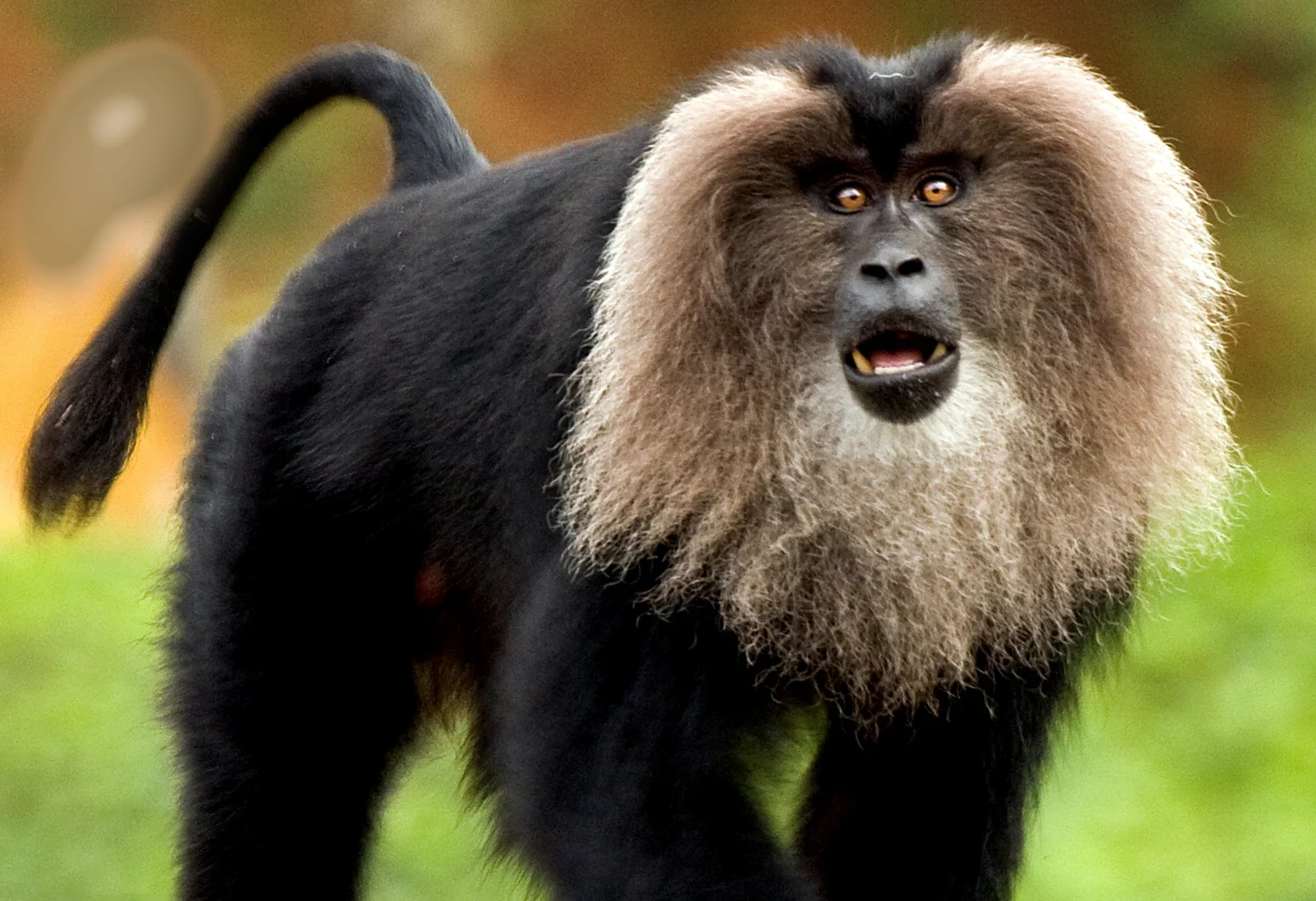
At a glance
- Scientific name: Macaca silenus (Linnaeus, 1758); Malayalam simhavalan kurangu, "lion-tailed monkey".
- Range: endemic to the Western Ghats of Kerala, Tamil Nadu and Karnataka.
- Habitat: tropical wet evergreen forest, mostly at about 600–1,400 m.
- Status: Endangered on the IUCN Red List; Schedule I of India's Wildlife (Protection) Act.
- Wild population: long estimated at 3,000–4,000; some recent assessments suggest fewer than 2,500, in many isolated subpopulations.
- Stronghold: Silent Valley and the surrounding forests of the Nilgiri Biosphere Reserve hold the largest known cluster.
A macaque apart
The lion-tailed macaque is unmistakable. Its coat is glossy black. Around a hairless black face grows a thick mane of silver-grey to pale brown hair, framing the head from the crown to the chin. The tail, moderately long, ends in a dark tuft like a lion's, and is often held in a loose arc. Adult males weigh around 6 to 10 kg; females are smaller.
Among macaques, a genus better known for adaptable, opportunistic species such as the bonnet and rhesus macaques, the lion-tail is the exception. It is a true arboreal rainforest specialist. It needs tall, continuous canopy to travel, feed and escape predators, and it avoids open ground, plantations and degraded forest wherever it can.
Life in the canopy
Lion-tailed macaques live in troops of roughly 10 to 25 animals, usually with a single adult male, several adult females and their young. The adult male advertises the troop's presence with a loud, far-carrying call, and troops tend to avoid each other. Home ranges are large for a primate of this size, often a few square kilometres, because the fruiting trees on which the troop depends are scattered through the forest.
Reproduction is slow. Females typically give birth to a single infant every two to three years, and young animals take years to mature. A troop can lose ground for a long time after a bad year, and a population that falls is slow to recover. This low reproductive rate is one of the reasons the species is so vulnerable to change.
A diet tied to the rainforest
Lion-tailed macaques are mainly frugivores. Fruit, particularly of native evergreen trees and figs, forms the largest part of their diet, supplemented by seeds, flowers, leaves, buds and a considerable amount of animal food: insects and their larvae, which they search for under bark and in dead leaves caught in the canopy, and occasionally small lizards, frogs and birds' eggs.
One tree stands out: Cullenia exarillata, known locally as vediplavu, a tall evergreen of the Malvaceae endemic to the rainforests of the southern Western Ghats. It is often a dominant tree in the mid-elevation forests where lion-tailed macaques are most common. Crucially, it flowers profusely in the dry season, when fruit is scarce elsewhere in the forest. Field studies have found that its flowers and seeds make up around a fifth or more of the macaques' annual diet in such forests: about 21% in Silent Valley and about 25% in the Puthuthottam forest fragment in the Anamalai hills.
The relationship runs both ways. While feeding on the flowers, the macaques transfer pollen between trees, and Cullenia is pollinated mainly by fruit bats and arboreal mammals, including the lion-tailed macaque itself. The macaques also disperse the seeds of many rainforest trees. In lower-elevation forests where Cullenia is scarce, it makes up only a tiny fraction of their diet, and macaque numbers tend to be lower. The species' fortunes are tied to the health of a particular kind of forest.
Silent Valley: the forest that was nearly drowned
Silent Valley, in the Palakkad district of Kerala, is a basin of largely undisturbed tropical evergreen forest drained by the Kunthipuzha, which flows south from the Nilgiri plateau. Its remoteness and steep terrain had protected it from logging and plantations, leaving one of the most intact rainforests in the Western Ghats.
The Kunthipuzha's fall made it attractive for hydroelectric power. Proposals to dam the river had been surveyed for decades, and in February 1973 the Planning Commission approved a Kerala State Electricity Board scheme at a cost of about ₹25 crore. The dam and reservoir would have flooded part of the valley floor, around 830 hectares of the richest forest, and opened the rest to access roads and settlement.
Opposition grew slowly, then rapidly. Naturalists and scientists, including the herpetologist Romulus Whitaker, drew attention to the valley's ecological value. Field surveys of the lion-tailed macaque in the late 1970s showed that Silent Valley held one of the species' last large, continuous populations, and that the project area included forest the macaques used. In 1978, the IUCN passed a resolution calling for the protection of the lion-tailed macaque and its habitat, focusing international attention on the valley.
In Kerala, the campaign became a people's movement. The Kerala Sasthra Sahithya Parishad, a science-popularisation organisation, toured villages and towns explaining the case against the dam. Writers and poets joined; the poet Sugathakumari became one of its leading voices. The ornithologist Salim Ali was among the scientists who argued for the valley's protection. The macaque, a rare, appealing animal found nowhere else, gave the campaign its face.
The battle for Silent Valley
- 1973: the Planning Commission approves the Silent Valley hydroelectric project.
- 1977–78: ecological studies and growing opposition; the IUCN calls for protection of the lion-tailed macaque.
- 1979–80: the High Court of Kerala hears challenges to the project; Prime Minister Indira Gandhi asks Kerala to halt work while the issue is examined.
- 1980–83: a committee under M. G. K. Menon, including the ecologist Madhav Gadgil, studies the project; after its report, the Union Government decides to drop the dam.
- 15 November 1984: the forests are declared Silent Valley National Park.
- 7 September 1985: Prime Minister Rajiv Gandhi formally inaugurates the park.
- 1986: the park becomes the core of the new Nilgiri Biosphere Reserve, India's first.
- 2007: a buffer zone of 147 km² is added around the park.
The outcome was a landmark. It was one of the first times in India that a major development project was abandoned on ecological grounds, and the debate helped shape the country's environmental laws and institutions in the years that followed. Proposals for a hydroelectric project on the Kunthipuzha below the park, at Pathrakkadavu, resurfaced in the 2000s, and were again opposed. (Read more in Silent Valley National Park.)
Endangered, and in pieces
The lion-tailed macaque is listed as Endangered by the IUCN, and it has been listed as threatened since the earliest Red List assessments. The wild population has long been estimated at 3,000 to 4,000 animals; more recent assessments suggest the number of individuals may be lower, perhaps under 2,500, though there is no recent comprehensive census of breeding adults. Researchers stress the uncertainty: dense evergreen forest and steep terrain make these animals hard to count.
The deeper problem is fragmentation. The species survives in dozens of isolated subpopulations scattered along the southern Western Ghats, in Silent Valley and the adjoining forests of Kerala and Tamil Nadu, the Anamalai and Nelliampathy hills, Periyar, the Agasthyamalai and Kalakkad–Mundanthurai hills, and smaller pockets in Karnataka around Sharavathi and Kudremukh. Many of these groups are small, separated by tea, coffee and cardamom plantations, reservoirs, roads and settlements. Small, isolated populations are more vulnerable to chance events, disease and inbreeding.
The forest fragments of the Valparai plateau in the Anamalai hills show both the danger and the species' persistence. In the Puthuthottam fragment, surrounded by tea estates, numbers rose from about 25 animals in 1978 to more than 120 in three troops by 2011, and around 150 in five troops more recently. But these troops increasingly cross roads, raid homes and eat human food and garbage; road kills and electrocution on power lines have become regular hazards. Conservationists, notably the Nature Conservation Foundation, have built canopy bridges over roads so that the macaques can cross through the trees, and work with residents and estates on garbage management and speed limits.
Other pressures loom. Climate change may alter the flowering and fruiting cycles of rainforest trees, including Cullenia, on which the macaques rely in the lean season, and could shift the narrow belt of evergreen forest they occupy. Feeding by tourists, though often well meant, changes behaviour and exposes the animals to traffic and disease.
What protection looks like now
- Keeping large forests intact: Silent Valley, the Nilgiri Biosphere Reserve and the tiger reserves of the southern Ghats protect the largest populations.
- Reconnecting fragments: restoring rainforest corridors, and canopy bridges where roads cut through habitat.
- Managing contact with people: no feeding, secure garbage, slower traffic on forest roads.
- Better knowledge: population surveys, genetic studies of isolated groups, and long-term monitoring by forest departments and researchers.
Seeing them responsibly
Lion-tailed macaques can be seen, with luck, in Silent Valley National Park (visits are by Forest Department vehicle from Mukkali, with permits), and they are often encountered by visitors along the forest roads around Valparai and the Anamalai hills. If you see them, stay in or near your vehicle, keep your distance, keep noise down and never offer food.
(Read also the wild animals of the Western Ghats, Parambikulam, Periyar and human–wildlife conflict in the hills.)
See it for yourself, with a local driver who knows these roads.
Book a Munnar Jeep SafariSources & further reading
- Wikipedia: Save Silent Valley
- Wikipedia: Cullenia exarillata
- Down To Earth (Jan 2026): Symbol of Silent Valley
- Roundglass Sustain: Lion-tailed macaques and the case of disappearing forests (Valparai)
- Roundglass Sustain: Canopy bridges for lion-tailed macaques
- Nature Conservation Foundation: Lion-tailed macaques in the neighbourhood
Figures are from the sources listed and were checked in October 2026. Park timings and road conditions change, so please confirm before you travel.