
The Punalur Suspension Bridge: Travancore's Swaying Bridge over the Kallada, 1877
Built by a Scottish engineer for the Maharaja of Travancore, the Punalur hanging bridge has carried traffic over the Kallada for almost 150 years. The engineering, the legends of elephants and tigers, and how to see it.
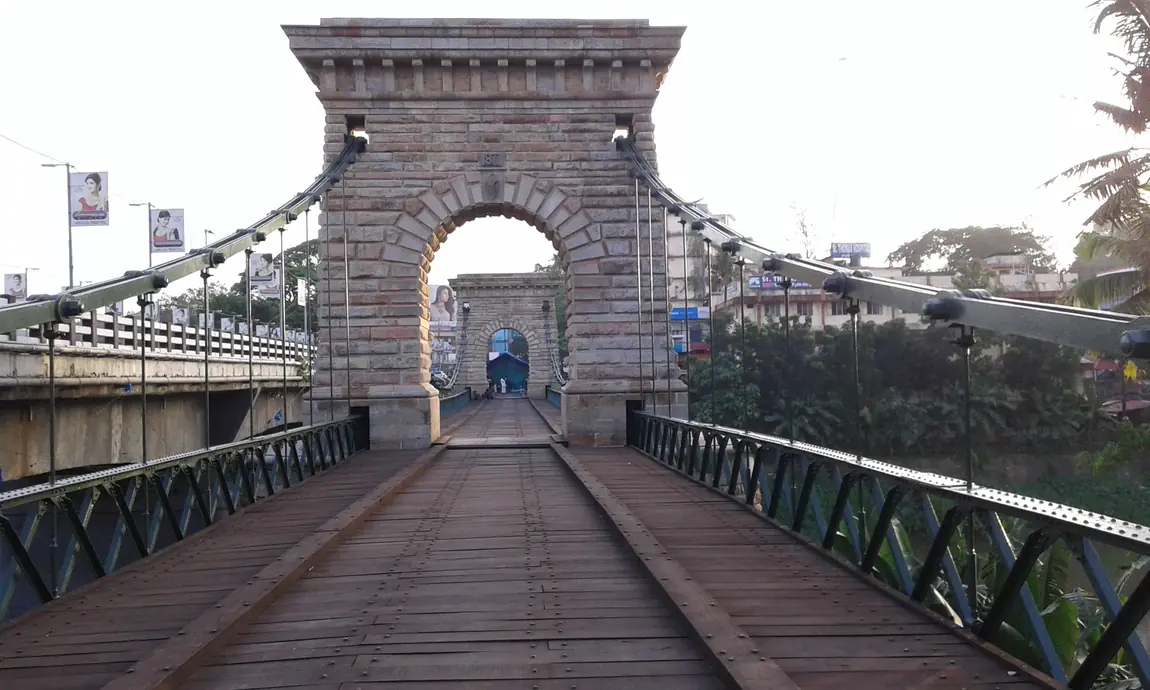
In the middle of busy Punalur, where the road from Kollam climbs towards the Aryankavu pass and Tamil Nadu, two stone towers rise on either bank of the Kallada river, with iron chains swooping between them. Hung from the chains, a wooden deck crosses the water. People walk across it slowly, feeling it move under their feet. This is the Punalur Suspension Bridge, the thookkupalam, completed in 1877 for the Maharaja of Travancore and one of the oldest surviving suspension bridges in India.
At a glance
- Where: Punalur, Kollam district, across the Kallada river on the old Kollam–Shencottah road.
- Built: about 1871 to 1877, in the reign of Maharaja Ayilyam Thirunal Rama Varma.
- Engineer: Albert Henry, a British engineer in Travancore's service; the work is said to have been begun under an earlier chief engineer, W. C. Barton.
- Length: about 400 feet (some 120 metres).
- Today: a protected monument, open to pedestrians only.
A road to the Ghats
In the nineteenth century Punalur was a small market town on the edge of the forest, at the point where the road from the port of Kollam began its climb into the Western Ghats and across to Shencottah and the Tamil country. Pepper, timber and other goods moved along it, and in the 1870s the Travancore government set about improving it (see Kollam and Thangasseri). The Kallada, wide and fast in the monsoon, was a serious obstacle. A ferry could not cope with the traffic, and the river was too deep and too strong for a simple masonry bridge with many piers.
The answer was a suspension bridge. Chains of iron, carried over masonry towers on each bank and anchored firmly into the ground behind them, would hold up a deck across the whole width of the river, with no piers in the current. Most of the ironwork was brought from Britain.
Building the bridge
The work was carried out by the Travancore Public Works Department in the reign of Maharaja Ayilyam Thirunal Rama Varma (1860 to 1880). It is credited to Albert Henry, a British engineer, usually described as Scottish; some accounts say the work was begun under his predecessor as chief engineer, Walthew Clarence Barton, and completed by Henry. Construction took about six years and the bridge was opened in 1877.
The finished bridge is about 400 feet long. Its deck, originally of timber, is hung from the chains by vertical iron rods. Like all suspension bridges it gives a little under load, and walkers on it can feel the deck move.
A note on figures: some websites and travel guides give the bridge's length as 400 metres. The correct figure is about 400 feet, roughly 120 metres.
Tigers, elephants and a boat
Two stories are told about the bridge in Punalur, and both belong to local tradition rather than the written record.
The first explains why it was built as a suspension bridge at all. The far bank of the Kallada was then dense forest, the story goes, and the people of the town feared that wild animals would use a solid bridge to cross into it. A hanging bridge, which sways and shakes underfoot, would frighten animals away while still carrying people and carts. The engineering reasons above are enough to explain the choice, but the legend is part of the bridge's charm.
The second story is about the day it opened. People were afraid to use such a strange bridge, and to prove it was safe, Albert Henry is said to have sent six elephants across it, or lined them up on it, while he and his family sat in a boat on the river directly beneath. Versions differ in the details, and we have not found a contemporary account of it.
From traffic to heritage
For about a century the bridge carried carts, buses and lorries on the busy road to Tamil Nadu. As traffic grew heavier it was replaced by a modern concrete bridge nearby, and the old bridge was closed to vehicles. It was later declared a protected monument by the Kerala State Department of Archaeology and was restored, with major work in August and September 2013. Today it is open to pedestrians only, and it is lit up in the evenings (see the Neriamangalam bridge for another of Travancore's historic crossings).
Visiting
The bridge is in the heart of Punalur, beside the road towards Thenmala and Aryankavu, about 45 km from Kollam. It is free to walk across. Early morning and evening are the best times, when the light is soft and the town is quieter. Remember that it is a protected monument: walk gently, and do not jump on the deck to make it swing. It combines well with the Thenmala ecotourism area and the Palaruvi waterfall on the road to the Tamil Nadu border. For another hanging bridge closer to Munnar, see Ayyappancoil.
Timeline
- c. 1871 to 1872Work begins on the Kollam–Shencottah road crossing at Punalur.
- 1877The suspension bridge is completed by Albert Henry and opened.
- 20th centuryHeavy traffic; a new concrete bridge takes over and the old bridge is closed to vehicles.
- Aug to Sep 2013Major restoration works.
- TodayA protected monument open to pedestrians.
Questions people ask
Who built the Punalur hanging bridge?
The British engineer Albert Henry, for the Travancore government, in the reign of Maharaja Ayilyam Thirunal; it was completed in 1877.
How long is the Punalur suspension bridge?
About 400 feet, roughly 120 metres. Figures of 400 metres are a mistake.
Can vehicles use the bridge?
No. It is now a protected monument open only to pedestrians.
Is the elephant story true?
It is a popular local tradition; we have not found a contemporary record confirming it.
(Read also the Neriamangalam bridge, Ayyappancoil and its hanging bridge and Kollam and Thangasseri.)
See it for yourself, with a local driver who knows these roads.
Book a Munnar Jeep SafariSources & further reading
- Wikipedia: Punalur Suspension Bridge
- Bridgemeister: 1877, Punalur, Kerala
- Kerala Tourism: Punalur Suspension Bridge
- Kerala Tourism: Punalur Suspension Bridge (Enchanting Kerala, 2020)
- Hearitage: Punalur Hanging Bridge, an engineering marvel
Figures are from the sources listed and were checked in November 2026. Park timings and road conditions change, so please confirm before you travel.