
Freedom in the Clouds: Munnar's First Independence Day, 15 August 1947
An old photograph shows thousands gathered on a hillside ground in Munnar on 15 August 1947. It was a remarkable scene in a company town run by British managers, in a princely state whose rulers had wanted to stay out of India. The story behind the picture.
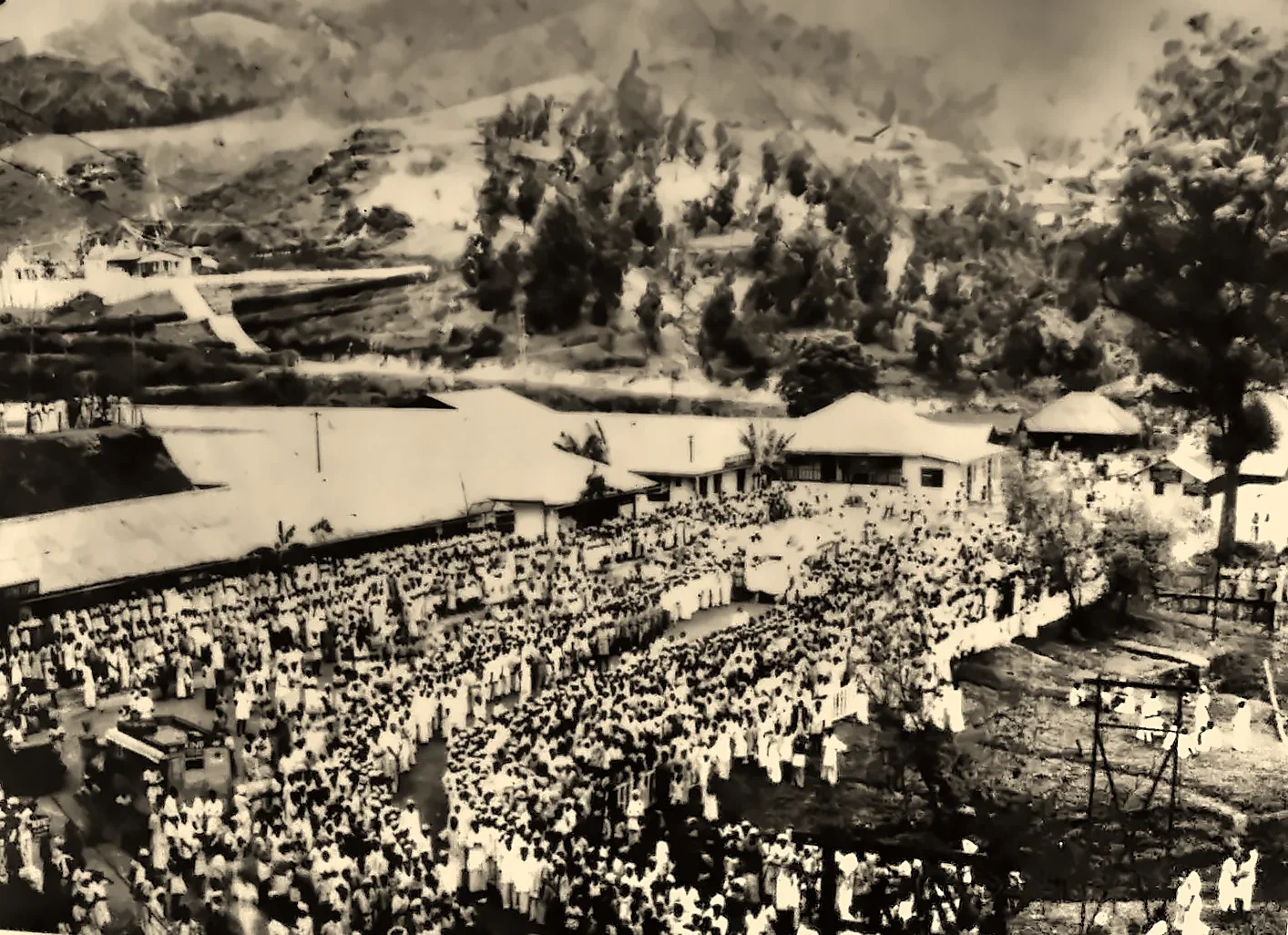
The photograph is faded and grainy, but the scene is unmistakable. Below a hillside of tea and tall trees, in front of a row of long, tile-roofed buildings, an enormous crowd fills an open ground: thousands of people, most of them dressed in white, standing in long rows and dense blocks, more of them lining the edges and climbing the slopes to see. A label above the print reads simply: "Celebrations on 15th August 1947".
It is a picture of Munnar on India's first Independence Day. To understand why it is so remarkable, you have to know what kind of place Munnar was in 1947, and what an uncertain summer it had been in Travancore.
A company town in a princely state
In 1947, Munnar was not part of British India. It lay in the Kingdom of Travancore, a princely state ruled by Maharaja Sri Chithira Thirunal, with the formidable Sir C. P. Ramaswami Iyer as his Dewan. But the hills themselves were run by a British company. The Kanan Devan Hills Produce Company, managed by the Glasgow firm of James Finlay & Co., held the concession over most of the High Range, and its European managers lived in bungalows on the estates and met at the High Range Club. (Read the history of Munnar and the High Range Club.)
The people who did the work were tens of thousands of Tamil labourers and their families, recruited over generations from the districts of the Madras Presidency through the kangani system, living in rows of estate "lines" and earning low wages. For them, the hills were home, but the land, the houses and the rules belonged to the company. (Read the history of Munnar's tea workers.)
Travancore's uncertain summer
As British rule drew to an end, it was not at all certain that Travancore would join India. The months before Independence were among the most dramatic in its history:
- June 1947Sir C. P. announced that Travancore would become an independent country when British paramountcy ended, and on 18 June the Maharaja's declaration was broadcast over Trivandrum Radio. The Travancore State Congress and many others protested.
- 25 July 1947At a concert in Thiruvananthapuram, Sir C. P. was attacked and wounded by K. C. S. Mani, a young revolutionary.
- Late July 1947Days later, the Maharaja informed the Viceroy, Lord Mountbatten, that he would accede to India; most accounts date his telegram to 30 July. Historians differ on the exact terms and sequence of the agreements that followed.
- 15 August 1947India became independent.
- 19 August 1947Sir C. P. resigned as Dewan and soon left Travancore.
Even after the decision to join India, Independence Day was a strange affair in the state. According to a later account in The New Indian Express, the Dewan's government barred the hoisting of the Indian tricolour, allowing only Travancore's own flag, with its conch-shell emblem, and there were no official celebrations; some people defied the order and flew the tricolour at their homes anyway. We have not been able to confirm the details of that order from the official records.
The day in the hills
Against that background, the scene in the Munnar photograph is extraordinary. Whatever the orders in Thiruvananthapuram, a very large crowd came together in Munnar on 15 August 1947. Most wear white, the colour of festivals and of the nationalist movement; they stand in ordered ranks, as if for a flag-hoisting, a procession or a public meeting. People line the paths and the slopes above, and the buildings at the back of the ground are crowded with onlookers.
The photograph leaves many questions open. We do not know exactly where it was taken, though the long tile-roofed buildings and the open ground suggest one of the central grounds of the town or the company. We do not know who organised the gathering, which flags flew, or what was said. Nor do we know how the company's British managers responded on the day their own country gave up India. If you or your family remember that day, or recognise the place in the picture, we would love to hear from you: please contact us.
What freedom changed
Independence did not change life on the estates overnight, but the years that followed transformed Munnar:
- Democracy reached Travancore. Elections for a representative assembly were held in 1948, and on 1 July 1949 Travancore and Cochin were merged into the state of Travancore-Cochin, which became part of the new state of Kerala in 1956.
- Language and borders. In the early 1950s, Tamil political groups campaigned for the Tamil-majority taluks of the High Range, including Devikulam, to join the Madras state; when the states were reorganised in 1956, the High Range remained in Kerala.
- Workers' rights. Trade unions grew strong on the estates, and the Plantations Labour Act of 1951 required employers to provide housing, medical care, drinking water and schools. The kangani system was gradually abolished.
- From Finlay to the workers. The British company remained in charge for decades. Tata joined Finlay in 1964 and took over in 1983, and in 2005 most of the estates passed to the Kannan Devan Hills Plantations Company, largely owned by its own workers. (Read Pembilai Orumai and the 2015 strike.)
Seen in that light, the thousands in white on the hillside ground in 1947 were standing at the start of a long road: from a company town ruled from Glasgow to an estate partly owned by the grandchildren of the people in the photograph.
A note on the evidence
- The photograph's date and subject come from the label on the display print. The other dates in this article come from published histories and news accounts listed below; accounts of Travancore's accession differ in some details.
- We have found no detailed written account of the Munnar celebration itself. If you know of one, please contact us.
See it for yourself, with a local driver who knows these roads.
Book a Munnar Jeep SafariSources & further reading
- Onmanorama (Aug 2022): How CP Ramaswamy Iyer's assassination bid dramatically altered Kerala history
- The New Indian Express: Flashback to August 15, 1947
- Wikipedia: C. P. Ramaswami Iyer
- Wikipedia: Chithira Thirunal Balarama Varma
- Varnam: How Travancore joined the Union
Figures are from the sources listed and were checked in October 2026. Park timings and road conditions change, so please confirm before you travel.