
The Lion-tailed Macaque: The Silver-maned Monkey of the Western Ghats
Black coat, silver mane, a tail tipped like a lion's: one of the world's rarest monkeys lives only in the rainforests of the Western Ghats. Its life in the canopy, the campaign it inspired at Silent Valley, and why its future now depends on tea estates and roads as much as on forests.
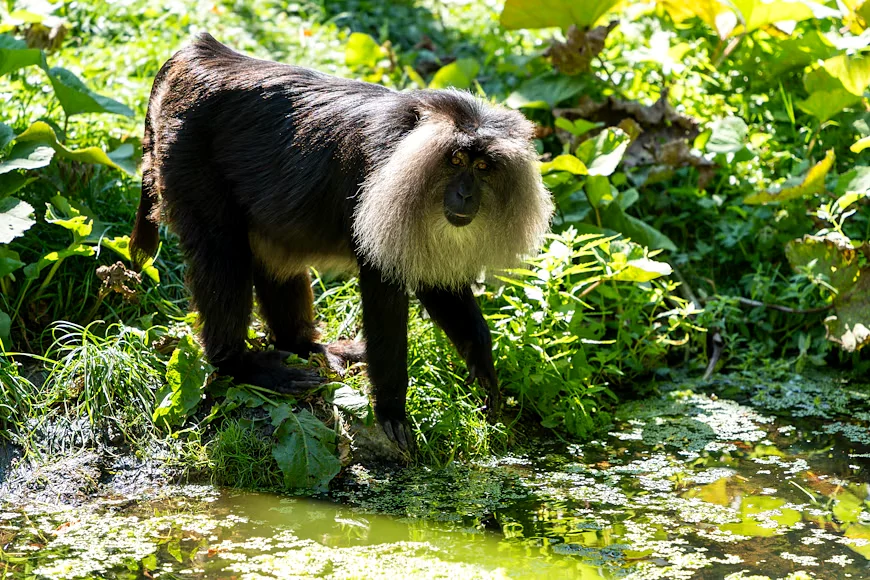
High in the canopy of a Western Ghats rainforest, a branch shakes and a face looks down: black, framed by a great ruff of silver-grey hair, with amber-brown eyes. A moment later the animal moves on along the branch, and you see the tail, long and thin, ending in a dark tuft like a lion's. Few people ever see a lion-tailed macaque. It lives nowhere else on Earth but these hills, and there are perhaps only a few thousand left.
At a glance
- Scientific name: Macaca silenus; in Malayalam often called simhavalan kurangu ("lion-tailed monkey").
- Found: only in the Western Ghats of Kerala, Tamil Nadu and Karnataka.
- Habitat: the upper canopy of tropical wet evergreen forest, mostly between about 600 and 1,500 m.
- Status: Endangered (IUCN); Schedule I of India's Wildlife (Protection) Act; CITES Appendix I.
- Numbers: older estimates put the wild population at 3,000–3,500; some recent assessments suggest fewer than 2,500, in roughly 40 scattered populations.
A monkey made for the canopy
The lion-tailed macaque is one of the smaller macaques: adults weigh roughly 2 to 10 kg, males being much larger than females. Its glossy black fur and silver-white mane make it one of the most striking primates in the world, and the tufted tail gives it its name. It is a true creature of the treetops, living almost its whole life in the upper canopy of tall evergreen forest, and it rarely comes to the ground in undisturbed forest.
It lives in troops of about 10 to 20, usually led by a single adult male, with several adult females and their young. Troops keep to home ranges in the forest, and dominant males give loud calls that carry through the trees, warning other troops away. Compared with the bold bonnet macaques of the roadsides, lion-tailed macaques are shy and quiet.
What it eats
The macaque is mainly a fruit-eater, and the fruits of rainforest trees, especially figs and the tall Cullenia trees of the evergreen forest, form the core of its diet. It also eats seeds, leaves, flowers, buds and fungi, and searches bark and leaves for insects, as well as taking the occasional lizard, frog or bird's egg. By swallowing fruits and dropping the seeds far from the parent tree, it helps the forest to regenerate.
A slow life
Like many large forest animals, the lion-tailed macaque breeds slowly. Females usually give birth to a single infant, born after a pregnancy of about six months, and typically wait two to three years or more between births. Infants are born with dark fur and cling to their mothers, gradually developing the silver mane as they grow. This slow pace means that populations recover only very slowly from losses.
The monkey that saved a forest
In the 1970s, the Kerala State Electricity Board planned to dam the Kunthipuzha river in Silent Valley, in Palakkad district, flooding part of one of the last large tracts of undisturbed rainforest in the Western Ghats, and the home of the largest population of lion-tailed macaques. Scientists, writers, students and local people across Kerala and India campaigned against the project, and the macaque became its emblem. In 1983, the project was abandoned, and Silent Valley was declared a national park in 1984. The campaign is remembered as one of the founding moments of India's environmental movement. (Read Silent Valley National Park.)
Where it lives today
The macaque's forests once ran almost unbroken along the Ghats. Over the past two centuries, most of them were cleared for plantations of tea, coffee, cardamom and teak, for dams and roads, and for farms. What survives today is a scatter of populations, some in large protected forests and others in small fragments surrounded by plantations. The main strongholds include:
- Silent Valley and the surrounding forests of the Nilgiri Biosphere Reserve, Kerala, the largest known cluster;
- the Anamalai hills and the Valparai plateau, Tamil Nadu, with the neighbouring Parambikulam and Nelliyampathy forests in Kerala;
- Periyar Tiger Reserve and the forests of southern Kerala;
- the Agasthyamalai hills and Kalakkad-Mundanthurai, at the southern tip of the Ghats;
- small populations in Karnataka, around Kudremukh and the Sharavathi valley, the northern limit of its range.
The lion-tailed macaque is not a monkey of the high, cold grasslands and tea estates of the Munnar plateau itself. Its world is the warmer evergreen forest of the middle slopes.
The monkeys of Puthuthottam
At Puthuthottam, near Valparai in the Anamalai hills, a troop of lion-tailed macaques lives in a small rainforest fragment surrounded by tea estates and a busy road. Over the years, the monkeys learned to cross the road, raid homes for food and take snacks from tourists, and many were killed by speeding vehicles. Since the late 2000s, the Nature Conservation Foundation, working with the forest department, estates and local people, has built canopy bridges across the road, posted "macaque guards" to stop traffic when the troop crosses, asked drivers to slow down, and discouraged feeding. Road deaths fell sharply, and Puthuthottam has become one of the few places where people can watch the species easily, from the roadside, without disturbing it.
A long-term study of macaques in the Anamalai hills, reported in 2026 by scientists of CCMB Hyderabad and the University of Mysore after four decades of monitoring, found that troops in private tea and coffee estates had grown, often larger than those in protected forests, but warned that this was not a sign of health: the estate troops depend on human food and garbage, face traffic and electrocution, and are cut off from other populations. The researchers concluded that conservation must reach beyond the borders of protected forests.
Threats
- Loss and fragmentation of rainforest: the macaque cannot live in plantations alone, and isolated troops cannot exchange members, slowly losing genetic diversity.
- Roads and power lines: vehicles and electrocution kill monkeys in fragmented landscapes.
- Feeding and garbage: human food draws macaques into conflict with people, and into danger.
- Hunting and the pet trade, now much reduced but not gone.
Seeing lion-tailed macaques responsibly
- Never feed them, and never leave food or waste where they can reach it.
- Keep your distance, keep quiet, and don't use flash.
- Drive slowly on forest roads, especially around Valparai, and stop for crossing animals.
- In protected areas, go with forest department guides and follow the rules.
(Read also the endangered wild animals of the Western Ghats, Munnar's wildlife and human–wildlife conflict around Munnar.)
Plan your Idukki journey with GK Global
The Western Ghats' wildlife is an easy addition to a trip through Idukki's high ranges. From our base in Adimali, the gateway to Munnar, GK Global runs Munnar jeep safaris, elephant-spotting drives and scenic day trips, and helps you find a stay to suit your plans. Our safaris explore the hills, forests and plantations around Munnar and Adimali; the lion-tailed macaque itself is best looked for in the rainforests of Silent Valley, the Anamalai hills and Periyar.
Explore our jeep safarisFind a staySee it for yourself, with a local driver who knows these roads.
Book a Munnar Jeep SafariSources & further reading
- Down To Earth (Jan 2026): Symbol of Silent Valley
- Telangana Today (Mar 2026): Study warns of extinction risk for lion-tailed macaques
- Drishti IAS (May 2024): Lion-tailed macaques
- Oryx: Decline of the endangered lion-tailed macaque in the Western Ghats
Figures are from the sources listed and were checked in October 2026. Park timings and road conditions change, so please confirm before you travel.