
Wings of the High Ranges: Butterflies and Moths of Munnar and the Western Ghats
From the Southern Birdwing to a small orange fritillary found only on a few cold summits, the hills around Munnar hold one of India's richest gatherings of butterflies, and a world of moths that science is only beginning to map.
Walk any path above Munnar on a sunny morning after the monsoon and the air is full of wings. A Southern Birdwing sails past, larger than a man's hand, its black and gold wings beating slowly. Smaller butterflies dance over the wet edges of the road, drinking from the mud. Out on the grassland, a little orange butterfly flits low between the tussocks. It is the Palni Fritillary, and almost nowhere else on Earth will you see it.
The Western Ghats are one of the world's great biodiversity hotspots, and butterflies and moths, the insect order Lepidoptera, are among their most visible treasures. This article looks at the butterflies of the Ghats and of the Munnar High Ranges in particular: the species found only here, the great seasonal migrations that pass through these hills, the far larger and less-known world of moths, and the pressures that now bear on all of them.
At a glance
- Western Ghats: about 336 butterfly species, of which roughly 12% (around 40) are found nowhere else.
- Munnar High Ranges: at least 254 butterfly species recorded across the landscape, including 27 Western Ghats endemics.
- Eravikulam National Park: 198 species, about 60% of all the butterflies of the Western Ghats, in a park of grassland and shola between about 1,200 m and 2,695 m.
- Signature species: Palni Fritillary, Nilgiri Tiger, Palni Four-ring, Red-disc Bushbrown, Palni Sailer, Nilgiri Clouded Yellow.
- India: about 13,700 species of butterflies and moths are now catalogued; the great majority of them are moths.
Butterflies and moths: one order, two lives
Butterflies and moths together make up the Lepidoptera, the "scale-winged" insects. Their wings are covered in tiny overlapping scales, which give them their colours and patterns. All of them pass through the same four stages: egg, caterpillar, pupa and adult.
The division between butterflies and moths is more a matter of habit than of biology. Butterflies are, broadly, one lineage of day-flying Lepidoptera, usually with clubbed antennae, that rest with their wings folded upright. Moths are everything else: most fly at night, their antennae are often feathery or thread-like, and many rest with their wings spread flat or folded like a roof. There are exceptions on both sides, and some of the most brightly coloured Lepidoptera of the Ghats are day-flying moths.
In numbers, the moths win easily. The Zoological Survey of India's catalogue of Indian Lepidoptera, completed in 2026, lists about 13,700 species for the country. Butterflies account for only around a tenth of these; the rest are moths, many still poorly known.
A hotspot of butterflies
A 2018 study of the butterflies of the Western Ghats and their larval food plants put the fauna at 336 species in six families, of which about 12% are endemic to the Ghats and 59 are legally protected in India. Kerala alone holds the great majority of them: a 2022 study of Eravikulam counted about 326 species for the state.
The six families each have their own character:
- Swallowtails (Papilionidae): the large, often tailed butterflies, including the birdwings, roses, Mormons and peacocks.
- Whites and yellows (Pieridae): the emigrants, grass yellows, albatrosses and the clouded yellow.
- Brush-footed butterflies (Nymphalidae): the largest family, with tigers and crows, browns and rings, fritillaries, sailers, leafwings and more.
- Blues (Lycaenidae): small, quick butterflies, many with delicate tails and eyespots; India's smallest butterfly, the Grass Jewel, is one of them.
- Metalmarks (Riodinidae): a tiny family, with only two species in the Ghats.
- Skippers (Hesperiidae): stout, fast-flying butterflies, mostly brown, many of them hard to tell apart and many endemic.
The High Ranges: a sky island for butterflies
Munnar lies at the heart of the High Range, where the Western Ghats rise to their greatest height. Anamudi, inside Eravikulam National Park, reaches 2,695 m, the highest point in India south of the Himalaya. Around it, the landscape drops through cold grasslands and shola forests to tea estates, evergreen forests and, on the rain-shadow side at Chinnar and Marayoor, dry thorny scrub.
That range of habitats, packed into a small area, makes the Munnar landscape exceptionally rich. A 2015 literature review by the Sálim Ali Centre for Ornithology and Natural History (SACON) counted at least 254 butterfly species for the Munnar High Range Mountain Landscape, including 27 Western Ghats endemics. Regular surveys by the Kerala Forest Department with the Travancore Nature History Society keep adding to the list. A three-day survey in 2015 across Chinnar, Mathikettan Shola, Pampadum Shola, Anamudi Shola and Kurinjimala recorded 206 species, and took Chinnar's own checklist to 222. A 2020 survey of the same parks and Eravikulam recorded 173 species and added seven new ones to the landscape's list.
The most complete picture comes from Eravikulam National Park. A study published in 2022, drawing on two decades of fieldwork, recorded 198 butterfly species in the park and its surroundings, about 60% of all the butterflies of the Western Ghats. Thirty-five of them show some degree of endemism, and 22 are found only in the Ghats.
| Family | Eravikulam | Kerala | Western Ghats |
|---|---|---|---|
| Swallowtails (Papilionidae) | 14 | 19 | 19 |
| Whites and yellows (Pieridae) | 25 | 32 | 34 |
| Brush-footed (Nymphalidae) | 70 | 97 | 100 |
| Metalmarks (Riodinidae) | 1 | 2 | 2 |
| Blues (Lycaenidae) | 42 | 94 | 98 |
| Skippers (Hesperiidae) | 46 | 82 | 82 |
| Total | 198 | 326 | 335 |
Species counts by family, from Sadasivan et al. (2022). The Western Ghats total differs slightly between checklists, depending on how subspecies and doubtful records are treated.
The richest group in Eravikulam is the Satyrinae, the browns, rings and bushbrowns, with 20 species. Their caterpillars feed mainly on grasses, and the park is, above all, a grassland.
Found only here: the endemics of the grasslands and sholas
The high grasslands and sholas of the southern Ghats are often called "sky islands": cool, isolated summits separated from one another by warmer valleys. Over thousands of years, species stranded on them have become unique. Several butterflies of the Munnar hills belong to genera that are otherwise mostly found far to the north, in the temperate Himalaya and beyond, and survive here only because the mountaintops are cold enough.
- Palni Fritillary (Argynnis castetsi): a small orange butterfly with black spots and a silvery-patterned underside, flying low over the grasslands and shola edges. Fritillaries are a northern, temperate group; in the Western Ghats this one is confined to the high hills. In Eravikulam it is still common.
- Nilgiri Clouded Yellow (Colias nilagiriensis): another member of a northern genus, a fast yellow butterfly of the open grasslands.
- Nilgiri Tiger (Parantica nilgiriensis): a dark, white-streaked milkweed butterfly of the shola forests, mostly above 1,500 m. It is listed as Near Threatened by the IUCN, the only butterfly of Eravikulam above "Least Concern", and its decline has been linked mainly to the conversion of shola forest to tea.
- Palni Four-ring (Ypthima ypthimoides) and Red-disc Bushbrown (Telinga oculus): small brown butterflies with eyespots, both tied to the grasslands where their caterpillars feed.
- Palni Sailer (Neptis palnica) and Palni Bushbrown (Telinga davisoni): two "super-endemics", restricted to parts of the Munnar landscape and the neighbouring Palani hills. Both are rare, and the Palni Sailer is protected under Schedule II of India's Wild Life (Protection) Act.
Lower down, in the evergreen forests and tea-estate edges of the landscape, live other Ghats endemics: the Malabar Raven, Malabar Rose, Malabar Tree Nymph, Travancore Evening Brown, South Indian Blue Oakleaf (a butterfly that, at rest, looks exactly like a dead leaf), and a long list of small, hard-to-see endemic skippers and aces.
Giants and jewels
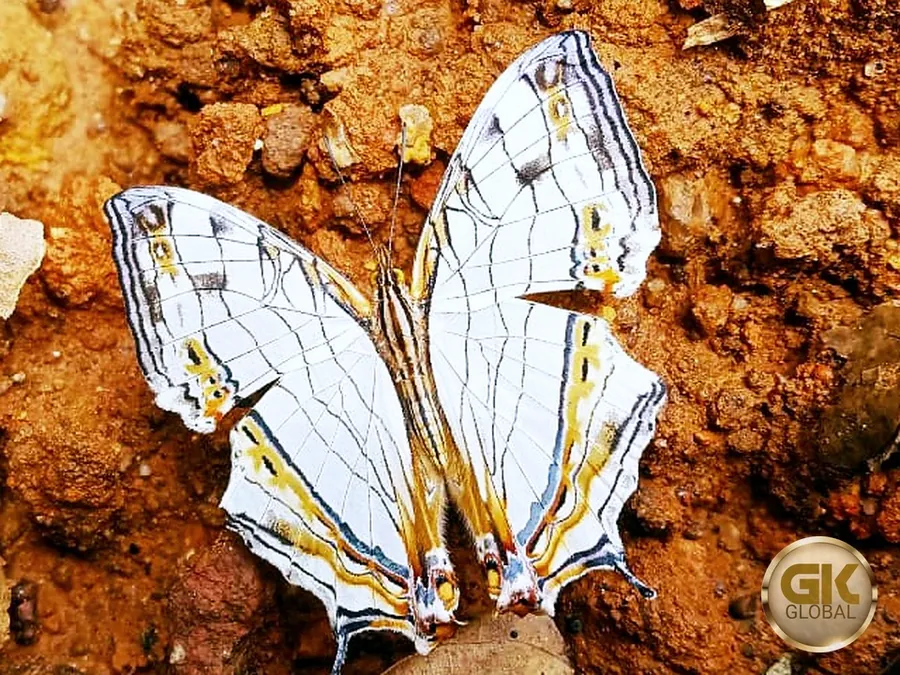
The Southern Birdwing (Troides minos) is India's largest butterfly, with a wingspan of up to about 19 cm. Black above, with brilliant golden-yellow hindwings, it glides through forest clearings and gardens, often high in the canopy. Its caterpillars feed on Aristolochia vines, and it has been recorded at Kurinjimala and Pampadum Shola. Karnataka adopted it as its state butterfly in 2017.
Kerala's own state butterfly is the Malabar Banded Peacock (Papilio buddha), a Western Ghats endemic. On its black wings, a broad band of iridescent green-blue catches the light like a peacock's feather. Its caterpillars feed on the Indian prickly ash, Zanthoxylum rhetsa.
At the other end of the scale, the Grass Jewel, India's smallest butterfly, has been found in the dry scrub of Chinnar. Its wingspan is only about 2 cm.
The great migration through the hills
Each year, millions of butterflies cross southern India. The best-known migrants are the milkweed butterflies (Danainae): the Dark Blue Tiger, Blue Tiger, Common Crow, Double-branded Crow, Plain Tiger and Striped Tiger. Before the southwest monsoon, in April and May, freshly emerged butterflies leave the Western Ghats and fly east towards the Eastern Ghats and the plains. After the monsoon, from about October to early December, they return.
The phenomenon was first described by the naturalist E. H. Aitken in 1897, who wrote that the butterflies passed in such numbers that it was impossible to look out of a window without seeing them. Modern studies show that migrating females delay breeding until they arrive. Butterflies also gather in huge resting congregations, sometimes in their tens of thousands, and stay there for months.
Munnar sits on one of the routes. The 2022 Eravikulam study describes the park as lying in "the main migration path of the Anamalai–High Range–Palni landscape". On the return journey, butterflies enter the hills from the Amaravati valley through the Marayoor gap and from the Palani hills. They climb through valleys such as Olikudi, cross the high plateau, and descend towards Valparai and Edamalayar before spreading into the lower Periyar landscape. The researchers recorded 29 migrant taxa in the park. The migration usually opens with whites and yellows such as the emigrants and the Lesser Albatross, and is then led by the tigers and crows. Blues, skippers and the cosmopolitan Painted Lady also take part.
These movements are not fixed. In one long-term study in Wayanad, a congregation of more than 25,000 butterflies counted in 2019 fell to fewer than 50 in 2022, before recovering to over 5,000 in 2023. Researchers linked the crash to habitat loss and local weather in the breeding grounds.
The hidden majority: moths
If the butterflies of the Ghats are well studied, the moths are not. Most fly at night and many are small and dull, so they are surveyed far less often. Even so, the numbers are striking. A three-year survey of just two sites in southern Kerala, Shendurney and Ponmudi, recorded 282 moth species in 31 nights, including new records for Kerala and India and a species new to science.
The Munnar hills have their own share of discoveries. In 2026, scientists from the Zoological Survey of India and the Natural History Museum, London, described an entirely new genus and species of tiger moth, Antaram idukki, from a single specimen collected in Idukki district in 2024. New species are found regularly. A new genus is rare, and it shows how much remains unknown in these forests.
Among the moths that visitors are most likely to notice:
- Atlas moths (Attacus): giant silk moths with wingspans that can exceed 25 cm. Their wingtips are shaped like a snake's head, and the adults do not feed at all, living only a few days on reserves stored by the caterpillar.
- Moon moths (Actias): pale green silk moths with long, trailing hindwing tails.
- Hawk moths (Sphingidae): fast, streamlined fliers that hover in front of flowers at dusk, including the day-flying hummingbird hawk moths. Many are important pollinators.
- Tiger moths (Arctiinae): often boldly coloured, warning birds that they taste bad; some fly by day.
- Tussock moths (Lymantriinae): stout, furry moths, often white or brown. Their hairy caterpillars can irritate the skin, so they are best admired without touching.
- Geometrids: by far the largest moth family in India, with about 2,100 species. Their caterpillars are the familiar "loopers" or "inchworms".
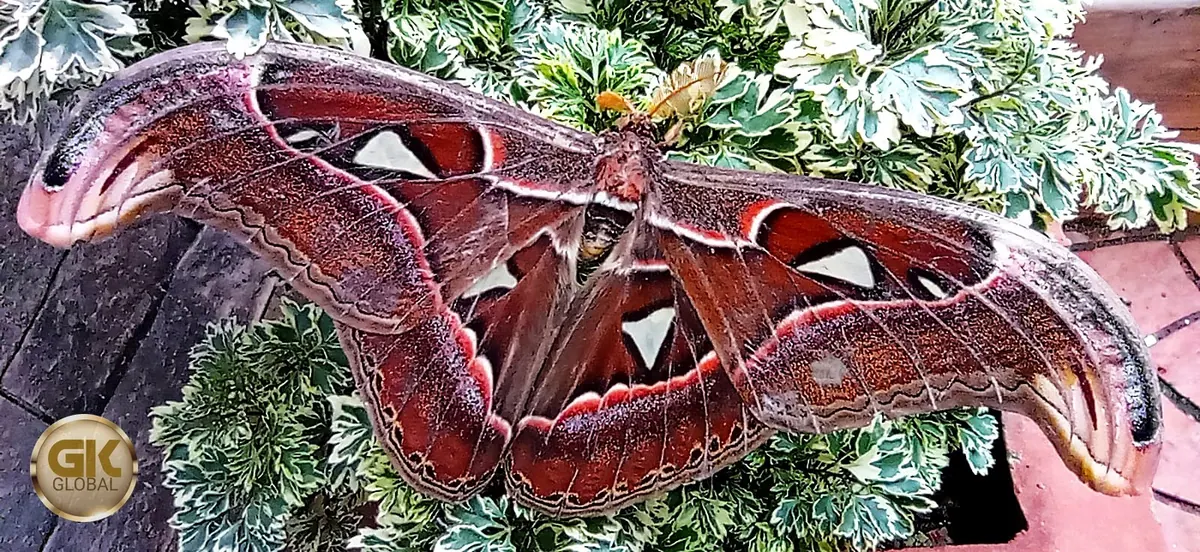
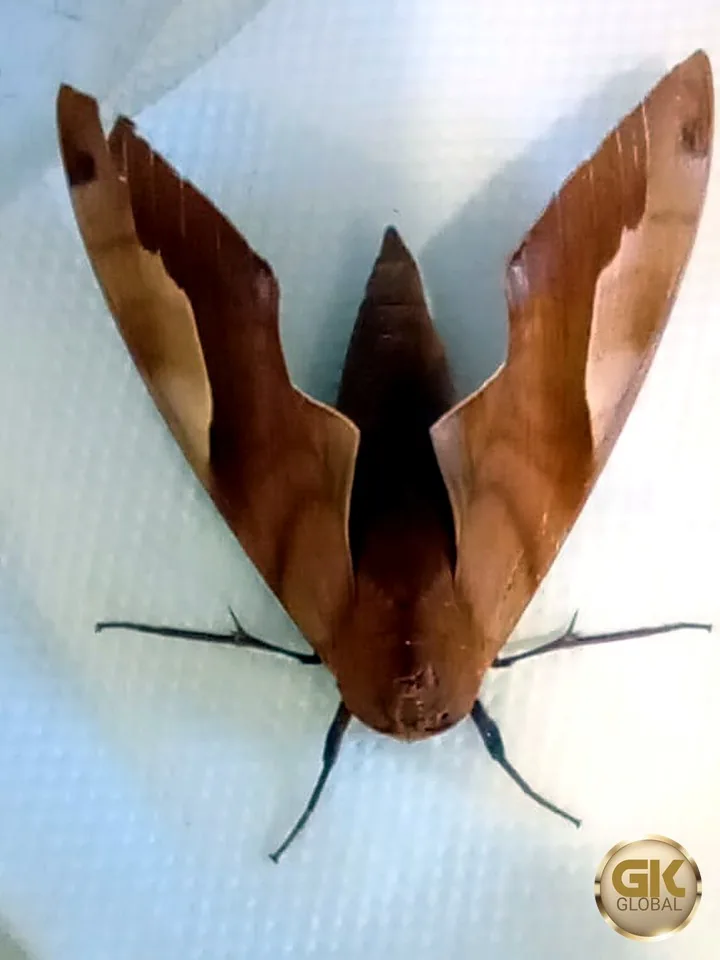
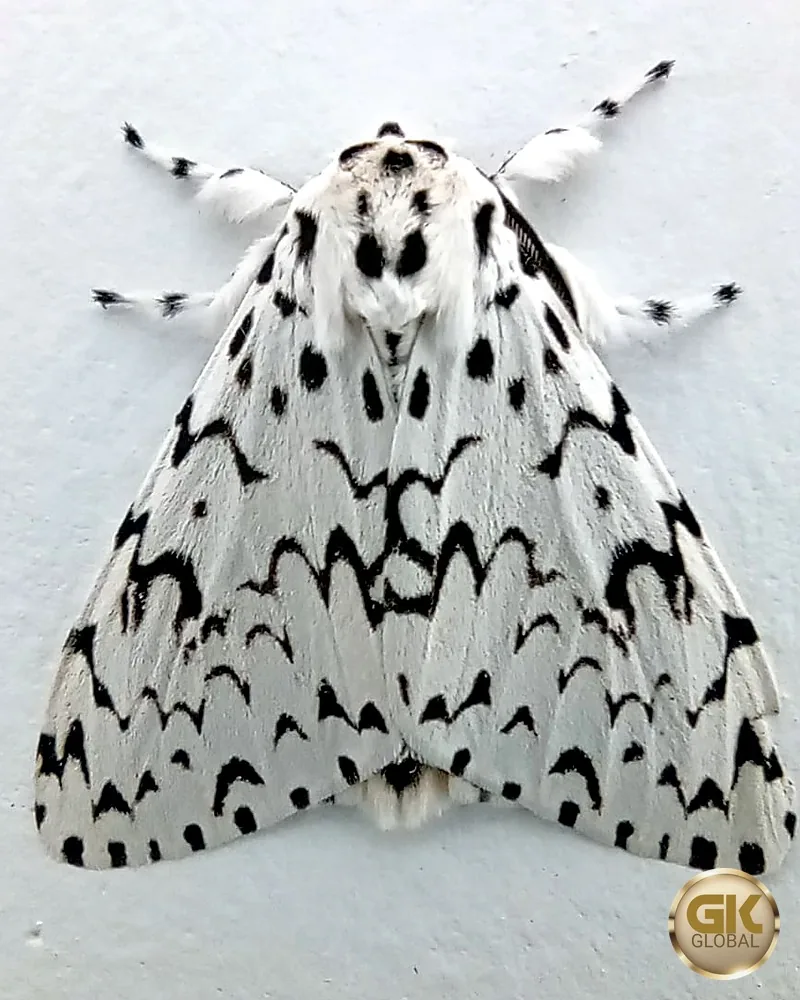
Moths matter far beyond their numbers. They pollinate night-flowering plants. Their caterpillars are a staple food for forest birds and their chicks, and the adults are hunted by bats. Some, of course, are pests. The tea estates of the High Range have long battled leaf-eating caterpillars, and the response, pesticides, has its own costs for wild Lepidoptera.
Pressures on a fragile world
The butterflies of the high grasslands and sholas depend on habitats that are small, fragmented and under pressure.
- Fire: the Eravikulam study calls fire "the most alarming threat to the shola grassland ecosystem". Uncontrolled grassland fires destroy eggs, caterpillars and pupae, and the plants they feed on.
- Invasive trees: wattle, eucalyptus and pine, planted in the past, are invading the grasslands from their edges, shading out grasses, violets and other food plants. (We tell this story in our article on Neelakurinji.)
- Pesticides: chemicals used on neighbouring tea estates drift into wild habitats and kill non-target insects.
- Roads and tourism: heavy traffic in the dry season disturbs habitats, and migrating butterflies are killed on roads, especially where flowering shrubs grow along them.
- A warming climate: species of the cold summits have nowhere higher to go. As temperatures rise, their habitat shrinks towards the peaks, a pattern seen in mountain butterflies around the world. (See our article on Munnar's changing climate.)
- Light at night: bright lights at hotels, homestays and roadsides draw moths away from their feeding and breeding, and many die by morning.
There is good news too. Eravikulam, the Shola national parks and Kurinjimala protect the core of the high-altitude habitat. Efforts to remove invasive trees and restore the grasslands have begun in parts of the Western Ghats. Kerala's long tradition of citizen surveys, run by the Forest Department with naturalists' societies, means the butterflies of the High Range are now among the best documented in India.
Watching butterflies around Munnar
- Best seasons: after the monsoon, from October to December, when the return migration passes and the hills are green; and in March to May, before the rains.
- Best time of day: mid-morning on sunny days, once the mist has lifted. Butterflies need warmth to fly.
- Where: the grasslands and shola edges of Eravikulam National Park for the high-altitude endemics; the dry forests of Chinnar for a completely different set of species; forest roads and stream banks for "mud-puddling" butterflies drinking salts from wet ground.
- Moths: look at walls and lights early in the morning, especially after rain. Please don't keep outdoor lights on all night.
- Be gentle: watch and photograph; don't catch, handle or chase butterflies, and never pick plants. Many species, and all wildlife inside protected areas, are protected by law.
The butterflies of the High Ranges are more than pretty insects. They react quickly to changes in temperature, rainfall and vegetation, which makes them some of the best indicators of the health of the hills. As long as the Palni Fritillary still flies over the grasslands of Eravikulam and the tigers and crows still pour through the Marayoor gap each autumn, the mountains are still working as they should.
See it for yourself, with a local driver who knows these roads.
Book a Munnar Jeep SafariSources & further reading
- Sadasivan, K., Augustine, T., Kunhikrishnan, E. and Kochunarayanan, B. (2022). Butterflies of Eravikulam National Park and its environs in the Western Ghats of Kerala, India. Journal of Threatened Taxa 14(6): 21199–21212
- Nitin, R., Balakrishnan, V. C., Churi, P. V., Kalesh, S., Prakash, S. and Kunte, K. (2018). Larval host plants of the butterflies of the Western Ghats, India. Journal of Threatened Taxa 10(4): 11495–11550
- SACON (2015). Butterflies of Munnar High Range Mountain Landscape: A Literature Review (UNDP project report)
- India Environment Portal: Butterfly survey spots 206 species in Munnar (2015)
- Onmanorama: Survey adds new bird species and butterflies to Munnar fauna list (2020)
- Mongabay India: Why are butterflies migrating across the Indian peninsula? (explainer, 2025)
- Sondhi, Y., Sondhi, S., Pathour, S. R. and Kunte, K. Moth diversity of Shendurney and Ponmudi in Agastyamalai Biosphere Reserve, Kerala. Tropical Lepidoptera Research
- Mongabay India: A lone moth leads the discovery of a new genus (2026)
- Drishti IAS: India's first comprehensive catalogue of Lepidoptera (ZSI, 2026)
- Wikipedia: Parantica nilgiriensis (Nilgiri tiger)
- Wikipedia: Papilio buddha (Malabar banded peacock)
- Citizen Matters: Karnataka declares Southern Birdwing as state butterfly (2017)
- Indian Foundation for Butterflies: State butterflies of India
- Moths of India: Attacus taprobanis
Figures are from the sources listed and were checked in October 2026. Park timings and road conditions change, so please confirm before you travel.