
The Vineyards of Cumbum and Surulipatti: South India's Grape Valley
Just across the mountains from Kerala, in the rain-shadow valley of Cumbum in Tamil Nadu, grapes hang in green tunnels almost all year round. The story of the Cumbum Panneer grape, its GI tag, how it is grown, and the vineyards of Surulipatti.
Drive down from Kumily and the Cardamom Hills into Tamil Nadu and the land opens into a broad, flat valley ringed by mountains. Coconut groves and paddy fields line the road, and then, behind low walls of stone posts, come the vineyards: long, shaded tunnels of vines trained over head-high wire frames, heavy with bunches of dark purple grapes. This is the Cumbum valley in Theni district, known as the "grape city of South India", and among its best-known vineyard villages is Surulipatti.
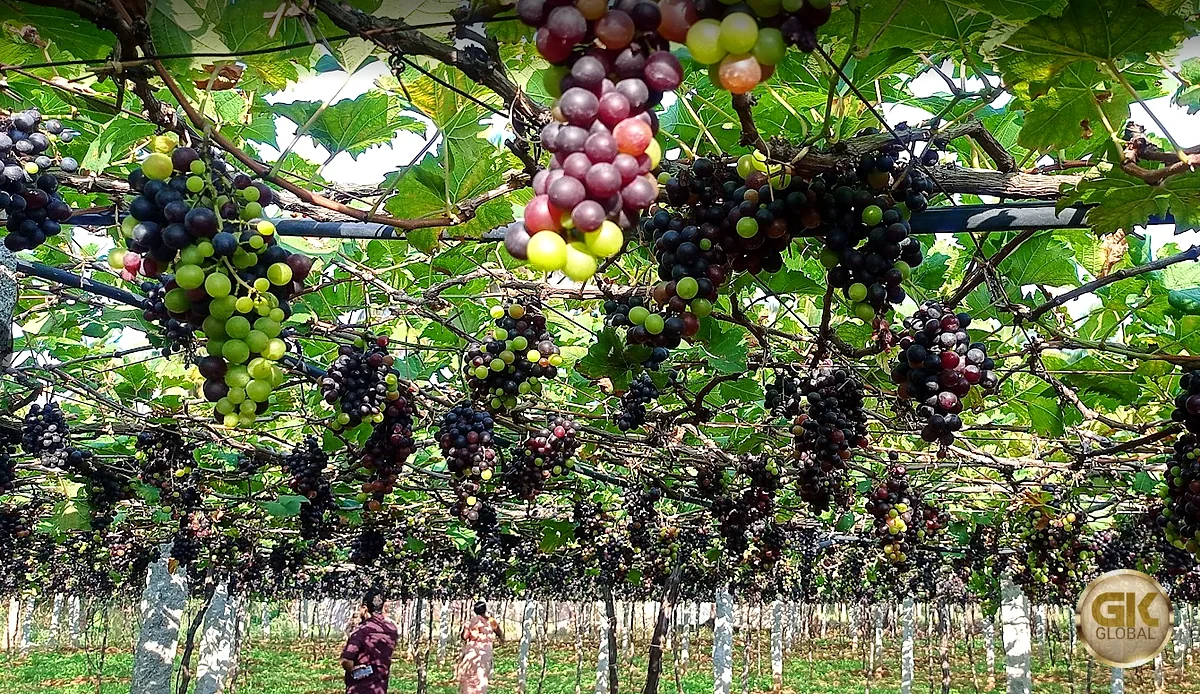
▶ Video: Vineyards of Surulipatti
The Panneer grape vineyards of Surulipatti in the Cumbum valley, Theni, Tamil Nadu. More in our video gallery
At a glance
- Where: the Cumbum (Kambam) valley, Theni district, Tamil Nadu, between the Cardamom Hills of Kerala, the Varusanadu hills and the Palani (Kodaikanal) hills; about 30 km from Kumily.
- Main grape: Muscat Hamburg, known locally as Panneer thratchai ("rosewater grape").
- GI tag: Cumbum Panneer Thratchai received a Geographical Indication in 2023.
- Scale: Theni district has about 2,200 ha of vineyards, roughly three-quarters of Tamil Nadu's grape area and production. Estimates for the Cumbum valley range from about 2,000 to 5,000 acres of Panneer grapes, in around ten villages.
- Season: thanks to the climate, grapes can be harvested almost all year round, with two or more crops a year.
The valley and its water
The Cumbum valley lies in the rain shadow of the Western Ghats. Its mean rainfall is modest, about 825 mm a year, and it is warm and sunny for most of the year, with strong winds blowing through the passes in the monsoon months. What turns this dry valley green is water from Kerala's mountains. Since 1895, the Mullaperiyar dam on the Periyar has diverted water through a tunnel under the ridge into the Vaigai basin of Tamil Nadu, and this water, flowing down the Suruli and other channels past Lower Camp and Gudalur, irrigates the fields of the Cumbum valley. The fertile red and black soils, the warmth and the steady water supply make the valley one of the most productive farming areas in South India.
(Read more: The Mullaperiyar dam.)
Surulipatti
Surulipatti is a farming village near Cumbum, on the way to the Suruli falls, a popular waterfall and pilgrimage spot at the foot of the Meghamalai hills. Its vineyards, set against the mountains of the Western Ghats, are among the most visited in the valley. Other grape-growing villages and towns include Cumbum, Gudalur, Uthamapalayam, Kamayagoundanpatti, Anaimalayanpatti, Odaipatti, Rayappanpatti and Pudupatti.
The Panneer grape
The grape that made Cumbum famous is the Muscat Hamburg, a black-skinned, seeded grape with a strong, sweet, musky perfume, which is why it is called panneer, "rosewater", in Tamil. According to the account in its GI registration, it was introduced to Tamil Nadu in 1832 by a French missionary. The bunches are medium to large and compact, the berries purplish-brown to black, juicy and aromatic. Muscat Hamburg makes up about 85 to 90 percent of Tamil Nadu's grape area.
In 2023, Cumbum Panneer Thratchai was registered as a Geographical Indication, recognising that its qualities come from this particular valley, its soil, water and climate. Along with it, other products of the Palani hills region, such as Kodaikanal hill garlic and Palani panchamirtham, received GI tags.
Other varieties grown in smaller areas include Thompson Seedless, Sonaka, Manik Chaman, Red Globe, Sharad Seedless, Crimson Seedless and the hybrid Manjari Medika, introduced in recent years for juice and wine.
How the grapes are grown
- Planting: rooted cuttings are planted in June or July, in trenches about 0.6 m wide and deep, at about 3 m × 2 m spacing for Muscat. Grapes need deep, well-drained loamy soil.
- The pandal: the vines are trained up a single stem to an overhead trellis, the pandal, about 2 m high, made of wires stretched over rows of granite or concrete posts. The arms of each vine spread along the wires, so the fruit hangs below a roof of leaves. Walking under it, as visitors do at Surulipatti, is like walking through a green tunnel hung with grapes.
- Pruning: pruning controls when the vines fruit. Muscat is usually pruned back to about four buds. In the classic pattern, vines pruned in December–January are harvested in April–May, and vines pruned in May–June are harvested in August–September.
- Year-round grapes: because the valley has no cold winter, farmers can stagger their pruning, so that different vineyards ripen at different times, and some push their vines to give up to five crops in two years. This is why Cumbum grapes are in the market almost every month, while grapes in Maharashtra and Karnataka are harvested mainly from January to April.
- Irrigation: vines are watered weekly in the growing season; water is held back for about two weeks before pruning and before harvest to improve the fruit. Drip and sub-surface irrigation are spreading.
- Yields: Muscat can yield up to about 30 tonnes per hectare a year.
- Pests and diseases: downy mildew, powdery mildew and anthracnose are the main problems, especially in wet weather, and vineyards need careful spraying and canopy management.
Research and advice come from the Grape Research Station at Anaimalayanpatti of Tamil Nadu Agricultural University, and from the ICAR National Research Centre for Grapes, Pune, which has worked with growers in Theni to introduce new varieties, better rootstocks and training methods.
Markets: table grapes, juice and wine
Most Cumbum grapes are sold as fresh table fruit across South India, and a large share goes to Kerala, where Panneer grapes are in demand for home-made grape wine, especially in the weeks before Christmas. Growers say that a large part of the crop ends up in wine-making, and a winery, Cumbum Valley Winery, was set up in the valley in 2009. The grapes are also used for juice, jam and raisins.
Visitors who stop at the vineyards, many of them from Kerala on the way to or from Thekkady, can usually buy grapes fresh from the vines, along with grape juice; in season, prices at the farm gate have been around ₹50 a kilo.
Challenges for the growers
- Prices: farm-gate prices swing widely, and in glut seasons they have fallen to around ₹30 a kilo or less, below the cost of production. Growers have long asked for better market support.
- Quality and shelf life: forcing vines to give many crops can reduce berry size and sweetness, and the soft-skinned Panneer grape keeps poorly in transport. Seedless grapes from Maharashtra compete in the same markets.
- Weather and climate: unseasonal rain and heat waves damage flowers and fruit and encourage disease.
- Costs: fertilisers, pesticides, labour and the pandal itself make vineyards expensive to establish and run, and credit is often hard to get.
The GI tag, value-added products such as juice and wine, and farm tourism are seen as ways to give growers a better return.
Visiting the vineyards
- Getting there: Cumbum is about 30 km from Kumily (Thekkady) by the Kumily–Cumbum road through Lower Camp and Gudalur, and can also be reached from the Munnar side through Bodinayakanur and Theni.
- When: grapes can be seen almost all year, but the main harvests come around April–May and August–September; check locally before you go.
- Etiquette: the vineyards are private farms. Ask permission before entering, do not pick grapes without paying, and do not damage the vines or the pandal.
- Nearby: the Suruli falls, the Meghamalai hills and the Mullaperiyar water channels at Lower Camp.
(Read more: Periyar Tiger Reserve, the ecological hotspots of Idukki and Marayoor jaggery, another GI-tagged product of the hills.)
See it for yourself, with a local driver who knows these roads.
Book a Munnar Jeep SafariSources & further reading
- Krishi Jagran (Apr 2023): Tamil Nadu's Cumbum grapes secure coveted GI tag
- FreshPlaza / New Indian Express (2024): Successful grape cultivation in India's Cumbum valley
- Krishi Jagran (Feb 2023): Grapes cultivation in Theni
- DT Next (2020): Cumbum growers seek value-addition in Panneer grapes
- DT Next (2020): With market down, Cumbum Paneer grape growers eye GI tag
- ETV Bharat (2025): Cumbum vineyards ready for harvest, tourists flock
- Wikipedia: Cumbum Valley
- ICAR-NRC for Grapes: Theni visit report (March 2022)
- TNAU Horticultural Research Station, Theni
Figures are from the sources listed and were checked in October 2026. Park timings and road conditions change, so please confirm before you travel.